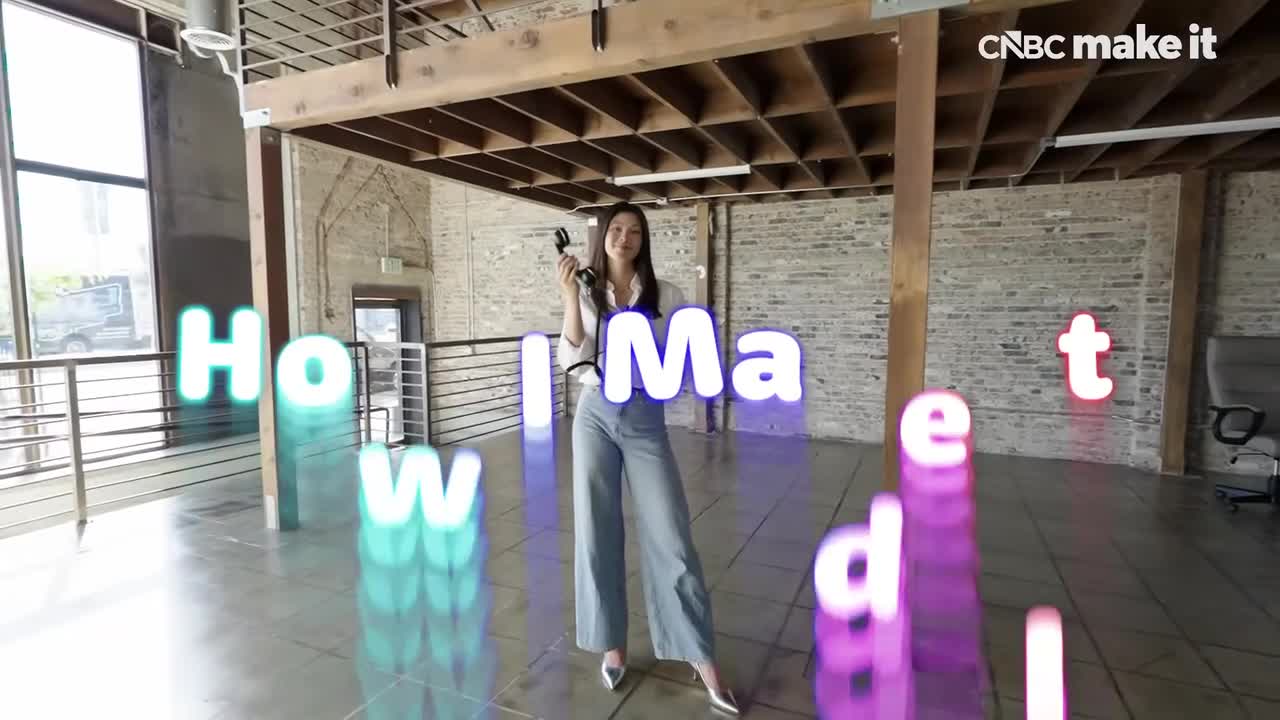
Hello.
I decided to create the landline phone because I realized one day that the colors on my phone were more beautiful than the colors in real life.
And that was a major problem for me.
I think like a lot of people, it made me think about, you know, simpler times.
My name is Kat Getze.
I'm 29 years old.
And in 2025, my landline phone business brought in about $789,000.
I had the idea to create a Bluetooth compatible landline phone back in 2023.
I had spent the last three years since the start of the COVID pandemic trying to spend less time on my phone in general.
So naturally it made me harken back to the time that I was growing up, when I had a landline phone and I had to share the line with my siblings and my family, before we all had smartphones.
Then I looked up how to actually get a landline phone and I realized you need a separate phone number and it costs like 70 or 80 a month minimum and I wasn't willing to do either of those things.
With my technical background, I thought to myself it probably wouldn't be that difficult to just hook up a landline phone to my smartphone.
Then I started tinkering around and prototyping and figuring out a way to build that.
I studied science, technology, and society at Stanford University.
When I had the chance to start working in startups, I was working much more closely with the C-suite.
Once I did that, I kind of realized these people aren't wizards.
This is not rocket science.
I think if they can do it, I can do it too.
The phone on the wall will ring in real life.
Just like that.
Hi, baby.
I made this landline phone that connects your iPhone via Bluetooth so that if somebody calls you, it actually starts ringing.
I think it took off the way that it did at that time because as a creator, your job is really to kind of hold an antenna out into the zeitgeist and pick up on what people want creatively spiritually, emotionally.
Physical phones are Bluetooth landline phones.
It comes out of the box.
It's battery powered, so you just turn it on.
It connects via Bluetooth to your smartphone.
From that point forward, as long as your smartphone is paired to the physical phone, if you receive an inbound call, the physical phone will ring in addition to your smartphone.
You can pick it up.
That initiates the call.
And then if you put it down, it hangs up the call.
If you want to make an outbound call on the physical phone, pick up the handset, dial the number you want to call and it'll start ringing.
A lot of us nowadays don't have people's phone numbers memorized, and so we built in this feature where, if you pick up the handset and you dial star, it activates Siri.
So you can just say call mom and it'll actually place an outbound call directly to the contact that's saved in your phone as mom.
The physical phone will ring for calls from FaceTime, WhatsApp, and regular phone calls.
You can also place outbound calls the same way.
We have our rotary phones, which are some of our most popular sellers.
This is entirely what we sold in our first round of production, plus the well-mounted hanging phone.
And this is one of our phones that's coming out super, super soon in the spring of 2026.
This is my personal favorite, because the original original prototype from 2023 looked exactly like this.
With the profits, we are reinvesting back into more research and development for new models, new designs and hiring to grow the team.
I actually do not take a salary from Physical Phones.
I am able to support myself with the salary that I earn just from the media business because Catch EPT has its own lines of business, primarily surrounding branded content and content partnerships.
My current role in Physical Phones is that I am the founder, but it's not like a typical tech founder where I'm involved in the everyday day-to-day decisions of the company.
The company actually now has a CEO and that CEO runs the business day to day.
My role is as a creator entrepreneur.
So it's my job to actually integrate the story of physical phones directly into my content.
The entire first round of production for the physical phones was funded by our pre-orders.
So we took out no loans, we took no investment.
It also provided for things like warehousing shipping printing, hiring and everything else that we needed to actually get the business off the ground.
We source our phones from a manufacturer in Asia.
When we started the business, the new tariffs from the Trump administration were already in effect.
They levied a huge whopping portion of our profits directly out of us.
It was difficult finding a supplier, simply because I had absolutely never done it before the first sample we ever got from a manufacturer.
It was close enough to the kind of functionality that we were looking for that we were able to proceed with conversations for that factory at that time.
The process of going back and forth with the manufacturer is probably the longest, most labor intensive part of the entire process.
It's pretty draining honestly, because what I underestimated before building physical phones was just how every single detail gets poured over for a hardware product.
I mean, we finished that process for our first model within two to three months.
The only way for us to meet that goal was to actually air freight all of the phones over to our warehouse directly from our manufacturer in Asia.
It was a huge hit to our profit margin.
But I also think it's those kinds of decisions where you really stand up for your customer and you show them how much you care.
I called in every single friend, family member colleague, neighbor that I knew and basically asked anybody with a pair of hands to come to the warehouse and help us break down and ship all of these phones within 24 hours.
We did it all directly on the dock of the warehouse overnight and in the hallway of the loading dock.
For physical phones, I hope that this year we'll see a lot of growth.
I have some interest in maybe exploring things like selling to retail or exploring other avenues that go outside of just pure organic social media marketing.
That's tied directly to me.
One of the main questions that we're toying with right now is do we want to continue to have this sort of drop model, where we ship out large quantities of inventory at a time?
Or do we want to have more of a traditional e-commerce or evergreen model where we have stock consistently?
There's pros and cons to each.
What I'm building next is called Cat Labs.
And it's a place where we will be building the next 5, 10 physical phones over and over and over again.
It might not be hardware.
It might not be phones.
Maybe it's software.
Maybe it's an app.
Maybe it's a website.
Maybe it's a service, something different.
I do see myself continuing to be very involved with physical phones, but in a way that leverages my unique advantages as a creator entrepreneur.
So overseeing the business and working on it as opposed to working in it.
As a creator founder, my advantages and my zone of genius, if you will, comes from my ability to stick that cultural antenna up into the air and understand what my audience wants, and being able to predict and build what they want.
Next,