Hello hello, hello and welcome to english learning for curious minds by leonardo english, the show where you can listen to fascinating stories and learn weird and wonderful things about the world at the same time as improving your english.
I'm alistair budge, and today we are going to be talking about operation valkyrie and the plot to assassinate hitler.
It's a story of bombs plots, secret briefcases, underground bunkers and one of history's greatest what-ifs.
But before we get right into all of that good stuff, I want to remind you that you can become a member of Leonardo English and follow along with the interactive transcript and subtitles over on the website, which is leonardoenglishcom.
Membership of Leonardo English gives you access to more than double the number of episodes, plus all of our learning materials, including instant translations in 12 languages, study packs and much, much more.
So if you are ready to take the next step on your English learning journey, the place to go is LeonardoEnglishcom.
OK, then let's not waste a minute and get right into it.
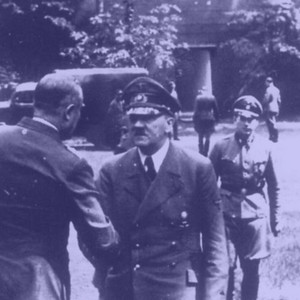
In the early afternoon of July, the 20th 1944, Twenty or so senior Nazi officials were gathered around a long oak table in the Wolf's Lair, Hitler's military headquarters on the Eastern Front in modern-day Poland.
The situation for the Nazi war machine was getting worse by the day.
The Allies had landed in Normandy six weeks earlier.
Russia was advancing on the Eastern Front.
The Allies had captured Rome, and the United States was advancing towards Japan.
If the war was still winnable for Nazi Germany, well, it would take something very special.
A meeting had been called, and senior Nazi leaders had been instructed to fly in for it.
One such officer was Klaus von Stauffenberg, a 36-year-old lieutenant colonel who had been awarded the Iron Cross for his bravery in the Battle of France.
Von Stauffenberg knew all too well the cost of war.
He had been fighting in North Africa, where he had lost an eye, his entire right hand and two fingers on his left.
It had taken him three months to recover, but he was still without one eye and seven fingers, so he was transferred to office duty far from the front line.
He had met Hitler on several occasions, and Hitler had always been polite and courteous to him.
After all, the sacrifices this man had made for the Nazi cause were plain to see.
So when von Stauffenberg arrived a couple of minutes late for the meeting, instead of receiving a dressing down and being shouted at by the Fuhrer, there was a quiet nod of acceptance.
Indeed, von Stauffenberg had only arrived at the Wolf's Lair that morning.
He would have been on time for the meeting, but it was such a hot day and he was drenched in sweat.
He had to go and change his shirt, and he needed his assistant to help him.
After all belts, buckles and buttons they aren't so simple if you're only operating with three fingers.
The meeting was was to be held in a different room from usual.
Normally, these types of meetings were held deep underground, in reinforced concrete bunkers.
But it was so hot that nobody would have lasted very long down there, without any ventilation.
So the meeting was taking place above ground, with the windows open for fresh air.
Von Stauffenberg had been ushered into a room next to the conference to allow him to get changed in private.
Together with his assistant, the pair proceeded to open up the briefcase.
They took out the spare shirt, but they were more interested in what the shirt was wrapped around.
Two sticks of plastic explosives, two bombs.
The men began to prime the device, setting a timer for 10 minutes.
They completed the first, but before the men had the chance to prime the second bomb, there was a knock on the door.
What are you up to in there?
Quick!
The meeting is about to begin.
There were assurances that they'd be out in a minute.
Von Stauffenberg was just having a bit of trouble with his belt.
And sure enough, shortly after, the door opened.
Von Stauffenberg was there in a new shirt, briefcase in hand.
He was ushered into the conference room, where the meeting was already in full flow.
Hitler was standing in the middle, leaning over a map placed on the table.
Von Stauffenberg approached the table and slid the briefcase underneath, next to where Hitler was standing.
A couple of minutes later, an attendant came in and knocked von Stauffenberg on the shoulder.
Sir, there's a telephone call for you. von Stauffenberg made his excuses and left the room.
At 1242, just a few minutes after von Stauffenberg's departure, there was a massive explosion right in the heart of the Wolf's Lair.
It looked like it might even have come from the conference room itself.
By this point, von Stauffenberg was making a beeline for the perimeter, heading for the exit as quickly as possible.
It's not known exactly what he told the guards to be allowed through the numerous checkpoints that surrounded the Wolf's Lair, but by 1pm less than 20 minutes after the blast, von Stauffenberg and his assistant were on an aeroplane back to Berlin.
The hard part was done.
Adolf Hitler was dead, and a bunch of his senior leadership too.
The next part was comparatively easy.
Mobilise the emergency continuity of government plan, appoint an interim successor and, most probably, seek peace with the Allies.
The only problem was, Hitler wasn't dead.
Unbeknownst to von Stauffenberg, his carefully positioned briefcase had been slightly pushed to one side, tucked behind the leg of the heavy oak conference table.
Most probably this was done by an officer called Heinz Brandt, who just pushed the briefcase with his feet, not out of any great patriotic duty, but because it was in the way of where he wanted to put his legs.
It might well have been the act that saved Hitler's life, but it cost Brandt his.
He died the following day, one of the four people in the conference room to die from the blast.
Another nine were seriously injured, and the remaining 11 escaped with minor injuries.
And this included the target of the entire operation, Adolf Hitler.
His trousers were torn to shreds, his arm was damaged, and his eardrum burst.
But he survived.
The immediate aftermath of the event he could be seen wandering around the rubble inspecting the chaos.
Officers tried to understand what had happened.
Had a Soviet bomber flown overhead and dropped a bomb with such precision that it landed in the exact conference room where the Fuhrer had been meeting.
No, no planes had been seen, and there were no other explosions.
The focus quickly switched to a threat from within and suspicion fell on the man who had entered with a briefcase, then quickly left without one Lieutenant, Colonel von Stauffenberg.
By this point, von Stauffenberg was in the air, on the way back to Berlin.
By the time he landed, he expected Operation Valkyrie to be well underway.
Now.
Operation Valkyrie was the code name for the operation that would be triggered if there was a full breakdown of civic order in Nazi Germany or if there was some kind of uprising from the foreign workers in German factories.
It was essentially a plan that would see the territorial reserve army seize control of the streets and key state functions.
Importantly, Operation Valkyrie wasn't a secret plot.
It had been drawn up as a genuine emergency plan to crush unrest or uprisings.
And Hitler himself even signed off on it.
But unbeknownst to Hitler, Operation Valkyrie was being used to take him down.
It was a clever idea in theory.
Kill Hitler.
Declare that he had been assassinated by rogue rebel forces within the Nazi party, namely the SS, arrest these supposedly rogue forces, declare martial law and declare a field marshal called Erwin von Witzleben as commander-in-chief.
It was a clever idea because it would pin all blame on the SS and treacherous forces within the Nazi party, allowing for a relatively smooth transition to a Hitler-free Germany without all of the mess that might come from a more overt coup or assassination attempt.
And, after all, this was far from the only attempt on Hitler's life.
There are 42 documented assassination attempts, with presumably many more than this that were never discovered.
From poisoned letters to bombs to snipers, starting in 1932, all manner of methods and locations were tried.
Miraculously, Hitler survived all of them.
But it was this attempt, the attempt of the 20th of July 1944, which was the widest reaching, the best planned and perhaps came closest to succeeding.
Now it's unclear exactly how many people were involved in the plot and what knowledge different people had of its inner workings.
What is clear is that there have been various groups within the Nazi upper leadership that had been planning to overthrow or kill Hitler since before the start of the war.
And as for their intentions, well, they were varied.
Those directly involved in the July 20th plot included nationalists Democrats, aristocrats and communists.
This wasn't one homogenous group. with a clear, unified aim for post-Hitler Germany.
Nor is it fair to characterize them as some great, upstanding group of moral citizens who were disgusted by the behavior of the Nazis.
For some, this might well have been the case.
In von Stauffenberg's case, several historians have suggested that he had a strong moral objection to the treatment of Jews.
For many other military officers, though, the motivation was more pragmatic.
The disaster at Stalingrad in 1943, the Allied landings in Normandy in June of 1944 and the rapid Soviet advance on the Eastern Front convinced them that war was lost under Hitler's leadership.
It was a motley crew, but what did unite them was a firm belief that Adolf Hitler needed to be removed from power, and killing him and pinning the blame on rebel factions was the best way of doing it.
So when von Stauffenberg touched down in Berlin and made his way to the army headquarters, he was expecting to hear that Operation Valkyrie was in full swing.
Hitler was dead.
The reserve army units had taken control of the key state institutions and the groups most loyal to Hitler, in particular the SS, and had been neutralised.
But he soon realised that things weren't going as smoothly as he had hoped and that in fact there was a potentially devastating problem.
There had been a phone call from the Wolf's Lair to the plotters at Central Command confirming that there had been a massive explosion in the conference room.
But the message that came through was that Hitler had survived.
And if Hitler wasn't dead, then the whole thing came crashing down.
For Operation Valkyrie to work, the reserve army units had to buy the lie that Hitler had been killed by disloyal forces within the Nazi party.
And that was the reason the crackdown was necessary.
At first, von Stauffenberg insisted I saw the explosion.
Nobody could have survived it.
Hitler is dead.
So the plotters had these two contradicting reports.
Von Stauffenberg saying Hitler is dead and the others saying he isn't.
Finally, at 4pm that afternoon, the order was given to put Operation Valkyrie into action.
Radio messages were sent to major military centres and across Berlin and in military districts throughout Germany reserve army units were mobilized.
They began arresting local SS officers, seizing key government buildings and preparing proclamations to the German people.
For a few tense hours that afternoon, it looked as though the coup might actually succeed.
And let's remember, these reserve troops don't know that they are part of a coup.
They are simply following their orders, which are to put into place this contingency plan, which involves rooting out treacherous elements within the Nazi party.
They even manage to detain Joseph Goebbels, the Nazi propaganda chief, in his Berlin office.
Goebbels has realized it's a coup and knows the one thing he can do to stop it.
Make sure the Reservists know that Hitler isn't dead.
So when he is detained by Major Otto Ernst Rehmer, a commanding officer of the reserve troops, Goebbels puts Hitler on the line.
Major Rehmer now realises that he has been duped, and he listens for his orders.
Crush the plot, he is told, and take them alive.
It's around 7 o'clock in the evening at this and the conspirators are in disarray.
General Friedrich Fromm, the commander-in-chief of the reserve army, had been aware of the plot and had done nothing to stop it, essentially making him a conspirator and aid to the coup.
But when it became clear that the bomb hadn't done its job, he quickly started to cover his tracks, switching sides.
He even tries to have von Stauffenberg arrested.
Chaos breaks out.
There was a firefight at the Bändelblock, the Berlin headquarters, where several of the conspirators were based, and von Stauffenberg was shot in the arm.
By 11pm that evening, the tide had well and truly turned.
The Bändelblock was surrounded, and the reserve army managed to overpower the plotters.
General Fromm pushed for an impromptu court to be set up to try the conspirators, and he then court-martialed four of them, including von Stauffenberg, who were taken into the courtyard and shot.
Presumably Fromm rushed this through despite Hitler's express order for the conspirators not to be executed so that they couldn't reveal his involvement in the plot.
Or, as Goebbels neatly put it, You have been in a damn hurry to get your witnesses below ground.
The entire coup, or attempted coup, lasted less than 12 hours.
And the aftermath was brutal.
Over the following weeks, the Gestapo uncovered thousands of people connected or suspected of being connected to the conspiracy.
Show trials were held in the People's Court, presided over by the raging, screaming judge Roland Freisler.
Many were humiliated before being sentenced to death by hanging, strangled slowly with piano wire.
In total, some 7000 people were arrested and almost 5000 were executed, including the side-switching General Fromm, who was kept in prison for a year, only to be executed shortly before Germany's surrender in 1945.
And to this day, the plot has remained one of history's great what-ifs.
After all, it's almost more surprising that the blast didn't kill Hitler.
If von Stauffenberg had been able to prime both bombs instead of one, it would almost certainly have killed him.
If the meeting had been held in a concrete bunker deep underground, like usual, instead of the venue being changed for a breezier wooden room above ground, it would almost certainly have killed him, as the blast force would have been contained.
If Hitler hadn't been leaning over the table, it would almost certainly have killed him.
And if Heinz Brandt hadn't pushed the briefcase to one side, it would almost certainly have killed him.
And if Hitler had been killed in the blast, it seems highly probable that Operation Valkyrie would have proceeded as it was intended.
The Reserve Army would have arrested the supposedly disloyal elements within the Nazi Party.
Field Marshal Erwin von Witzleben would have become Commander-in-Chief.
Germany may well have sought peace.
And World War II might have ended in the summer of 1944.
As you've heard, things didn't work out that way. and the consequences were devastating.
Between that hot July afternoon in 1944 and the end of the war the following May, another six to eight million people would lose their lives.
If Hitler had died in the Wolf's Lair that day, many of them might have been spared.
Instead, the war raged on and the failed coup of July the 20th went down as one of history's most haunting What ifs.
Okay then, that is it for today's episode on Operation Valkyrie and the plot to kill Hitler.
As a final reminder, if you enjoyed this episode and you are wondering how to more than double the number of episodes you can get, plus learn with our interactive transcripts, subtitles and key vocabulary, then the place to do that is leonardoenglishcom.
And if you aren't yet ready to become a member but you'd like to do something to support the show, then I would love for you to think about leaving a review or a star rating on your favourite podcast app.
It takes less than 30 seconds to do, but they are super helpful and each one brings a smile to my face.
You've been listening to English Learning for Curious Minds by Leonardo English.
I'm Alistair Budge, you stay safe, and I'll catch you in the next episode.