Hey there, Alasdair here.
Just a quick note before we get into the episode.
This month we've been running our very first Great Speeches Challenge, where members have been learning English with some of the most powerful speeches in the English language.
The challenge was supposed to be closed by now and I wasn't planning to reopen it until next year.
But I've had a lot of messages about it and honestly I think it's one of the best things that we've ever done.
So I've decided to do something special.
If you sign up for the Pro annual membership before midnight on Sunday the 25th of May I will personally make sure that you are added to the challenge, even though it's technically closed.
You'll get lifetime access to all of the challenge content, including over 3 hours of expert video lessons, plus full access to everything in the Pro membership, including bonus episodes, interactive transcripts, PDF study packs and more.
Just click the link in the description to find out more.
Okay, now it's time to enjoy the show.
Hello, hello, hello and welcome to English Learning for Curious Minds by Leonardo English, the show where you can listen to fascinating stories and learn weird and wonderful things about the world at the same time as improving your English.
I'm Alistair Budge and today we are going to be talking about the Salem witch trials.
It's a story of suspicion, the devil, witchcraft, alleged witchcraft, mass hysteria, hints of psychedelic drugs and justice.
But before we get right into this fascinating story, I want to briefly remind you that you you can become a member of Leonardo English and follow along with the interactive transcript and subtitles over on the website, which is LeonardoEnglish .com.
Membership of Leonardo English gives you access to more than double the number of episodes, plus all of our learning materials including instant translations in 12 languages, study packs and much, much more.
So, if you are ready to take the next step on your English learning journey, the place a go is LeonardoEnglish .com.
Okay then, let's step into the icy, unsettling world of the Salem Witch Trials.
The winter of 1692 was particularly cold in Massachusetts.
The temperature rarely got above freezing point, and many of the ponds and rivers had frozen over since late the previous year.
In the small village of Salem the 500 or so Puritan settlers did everything they could to stay warm.
Church was of course a regular occurrence.
This was a highly religious community and what these God fearing men and women feared the most was naturally the devil.
In story whispered to scare children.
He was real. To the 500 or so Puritans huddled in their icy wooden homes, he was an ever -present enemy, lurking in the shadows, waiting to snatch their souls.
But why were they so afraid?
Why did this small, God -fearing community see the devil behind every misfortune?
Well these settlers weren't just a random collection of English people they were Puritans a group so strict so devoted that they crossed an ocean to build a pure life.
Back in England their parents or grandparents had watched the Protestant Reformation unfold and they believed the Church of England, the Protestant Church, hadn't gone far enough to strip away Catholic influences.
So they sailed across the Atlantic, dreaming of a holy community, a shining city upon a hill.
But that dream came with a catch. If they were God's chosen people – and of course they fervently believed that they were – the devil would surely try to destroy them.
And in early 1692 life gave them plenty of reasons to feel that the devil was edging closer.
The winter was brutal.
Crops had failed, smallpox had swept through, and Indian raids from the north had left families grieving.
Every creak of the floorboards, every howl of the wind through the frozen trees felt like a sign.
The Puritans believed the devil wasn't some distant figure, someone you might meet in hell if you didn't live a God -fearing life.
He was here, or rather his secret servants were.
These servants were witches, people, almost exclusively women who had made a pact with Satan, a deal with the devil.
And they weren't random strangers, they were neighbours, friends, even family, who were working with the devil.
His tricks were clever.
He could send spectres, invisible spirits, to pinch or choke you in the Every Sunday, Reverend Samuel Paris, the village minister, would stand in front of his congregation and preach exactly this.
Beware the devil. He has evil and cunning ways and he is sending witches to test you.
Perhaps it all sounded theoretical, but in January of 1692, he noticed something unusual happening in his own house.
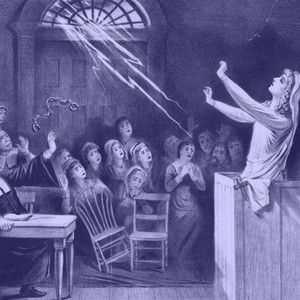
His daughter Betty and her cousin Abigail started behaving strangely.
They were only nine and eleven years old, but suddenly they weren't acting like children anymore.
They twitched and shook, cried out in pain and complained of being pinched or bitten.
But there was nothing there.
It wasn't mice, it wasn't some pest or bedbugs.
they seemed to be being attacked by some invisible force.
At first, it might have seemed like a sickness.
After all, the winter had been harsh and disease wasn't uncommon. But when a local doctor examined them and found no clear cause, he gave an altogether different explanation.
Witchcraft. To the Puritans, this made perfect sense.
If the devil was real, and his witches were among them, then these girls were under attack.
Word spread quickly through the village.
Salem was small, only about five hundred people, so news travelled fast. From house to house, whispered over fences and church pews.
Soon, other girls in the village started showing the same signs.
Ann Putnam Junior, a 12 -year -old girl from a powerful family, and Mercy Lewis, a 17 -year -old servant, joined Betty and Abigail in their fits.
They screamed about invisible tormentors, pointed fingers, and named names.
The first to be accused were the kind of people you might expect in a suspicious little village – outcasts, people on the edges.
There was Sarah Goode, a beggar who smoked a pipe and muttered under her breath when anyone refused her charity.
Then Sarah Osborne, an older woman who'd shocked the village by marrying her servant and committing the most scandalous of all, skipping church. And finally Tituba, a black slave woman who worked in Reverend Paris's own home.
Now, not much is known about Tituba.
It's thought she might have come from the Caribbean, perhaps Haiti.
And if so, she may well have told the girls stories about voodoo, spirits and fortune -telling.
These might have sounded weird and fascinating.
But with the accusation of witchcraft to her puritan master, they sounded like the work of the devil.
Under pressure, Tituba confessed.
She was questioned for days, beaten, and likely told that confessing could save her life, while denying it would mean death.
In a village gripped by fear, she had little choice but to give them what they wanted.
A story. She described visions of black dogs, red cats and witches flying through the air.
Details that matched Puritan fears perfectly.
She said she'd met the devil, that he'd asked her to serve him and that she'd seen other witches in Salem, signing his book - a sort of evil guest list. Her confession wasn't just a story, it was fuel.
Suddenly the village had proof, or so they thought.
If Tituba was a witch, then the girls' fits weren't imagination, they were evidence.
And if there were more witches out there, As The tomb acclaimed, no one was safe.
Soon fingers started to be pointed every which way.
The accusations didn't stop with the outcasts, they spread to people no one expected.
A 71 year old grandmother who went to church every Sunday and a well respected farmer.
When a woman named Martha Corry, who was in her 70s at the time, dared to question if the girls were telling the she found herself accused of being a witch. Her husband, Giles Corry, an 80 year old farmer, was another one of the few who refused to play along.
And of course he found himself accused of witchcraft too.
He wouldn't confess or deny the charges so the court ordered him to be pressed under heavy stones, a terrible torture intended to get him to realize the error of his ways and corroborate.
For two days he lay there saying only more wait until he died a stubborn stand against the madness.
His wife was executed three days later.
In a village of 500 where everyone knew each other this had become personal.
Neighbor turned against neighbour, enemy against enemy, friend against friend.
By spring the panic had grown so big that the local magistrates couldn't handle it anymore.
A special court was set up in Salem town, just a few miles away, to deal with the growing list of the accused.
And here's where things got even stranger.
The court didn't rely on normal evidence, like witnesses or proof you could touch, they used spectral evidence, the idea that the devil could send a witch's spirit to harm someone, even if her body was somewhere else.
if a girl screamed in court and said she saw Sarah Good's specter choking her, that was enough.
it didn't matter if Sarah was standing right there, clearly not doing anything other than trying to defend herself.
to the Puritans, the invisible world was just as real as the frozen ponds outside.
As you might imagine, the courtroom was a mess, girls fainting, judges pushing for guilty verdicts, and even a touch test where if an accused touched a girl, and her fits stopped, it was proof of guilt.
By summer, the jails were full and the gallows were busy.
19 people were hanged that year.
Five more died in prison, including Sarah Osborne who was worn out by illness and chains.
And Giles Corey, of course, met his end under the stones, but it couldn't go on forever.
By late summer, the accusations had become a form of village retribution, a way to settle scores with quarrelling neighbours.
If there was a dispute over land, or some feeling of being wronged in the past, what better way to get your vengeance than accusing your enemy of being in bed with the devil?
In fact, it took the accusations to reach the very top Puritan society, for the madness to end.
People began pointing fingers at the wives of important men like the wife of Governor William Phipps who was in charge of Massachusetts.
This was a step too far.
Phipps had been away dealing with Indian wars up north but when he returned in October 1692 he saw the chaos and shut the special court down.
Or more cynically, he might have thought I don't mind people accusing other people's wives of being a witch, but you're not going to accuse my wife of witchcraft. He banned spectral evidence saying it wasn't reliable.
Of course it reliable.
It was invisible and was one person's word against another's.
Without that, most of the cases fell apart because there was no evidence.
The trials slowed then stopped.
By early 1693 the jails started to empty.
Tituba, who'd confessed, was sold to a new owner and disappeared from the records.
The girls, Betty, Abigail, Anne and Mercy went quiet, their fits fading away as the village tried to move on.
Years later, in 1706, Anne Putnam Jr. stood in church and apologised.
She said she'd been tripped by the devil, she claimed, and hadn't meant to hurt anyone.
By then twenty people were dead and Salem was a village full of scars.
In the immediate aftermath there were movements to try to undo some of the damage or at least acknowledge the sheer insanity of it.
In 1702 the trials were declared unlawful.
Then in 1711 the government passed a law to restore the rights and good names of many who'd been condemned.
They even paid some money to the families, a token compensation payment by way of apology.
It wasn't much, but it was something.
Still, not everyone was included.
Seven people's names stayed on the list of the guilty, forgotten by that first effort.
It wasn't until 1957 that Massachusetts said sorry and tried to fix it again, clearing more names.
But one person, a woman named Elizabeth Johnson Jr. was somehow missed out.
She'd been accused, and convicted, but not hanged.
She died of natural causes in 1747, at the ripe old age of 77.
But with no living descendants to fight to clear her name, legally speaking, she was still a witch. However, more than 300 years after this conviction, she found some unlikely supporters in the form of a particularly creative teacher called Carrie Lapierre, and her middle school class.
Mrs. Lapierre found out about Elizabeth Johnson Jr, and set her eighth her name.
The class worked tirelessly, collating records and writing letters.
And in 2022 a bill was passed that officially exonerated Elizabeth Johnson Jr, thereby clearing the last convicted person in the Salem witch trials.
Of course, she should never have been convicted in the first place, but it was better than nothing and Mrs Lapierre definitely deserves some sort of prize for devising such an interesting class project.
So if we are to conclude that the residents of Salem were not being challenged by the devil and there was not a mass transformation of the female population into witches, what was going on?
Well, people have been trying to figure that out for centuries and there are a few theories.
One idea is that it all came down to a fungus, ergot to be exact.
Ergot grows on rye, a grain the Puritans used to make bread.
If the weather is wet and warm like it might have been in the summer of 1691, ergot can spread fast. Now, here's the strange part.
Ergot contains natural chemicals that are similar to LSD, the powerful hallucinogenic drug that became famous in the 1960s.
LSD causes people to see and feel things that aren't real and ergot can do something similar.
If someone eats bread made with infected rye they might become very sick, have convulsions, feel like they're being pinched or burned, or even see things that aren't really there.
In other words, make people do exactly what the young girls did.
Some historians think this could explain the strange behavior, not witches, just bad bread.
But not everyone agrees.
The symptoms don't match perfectly, nor does the timeline, and a handful of girls.
Another theory is simpler, mass hysteria.
Salem was a pressure cooker.
Harsh winters, failed crops, disease and attacks from nearby tribes had nearly everyone on edge.
Add in the deep fear of the devil and it wouldn't have taken much to spark panic.
When the girls started twitching and shouting, the village was ready to believe the worst. Fear spread like wildfire.
And soon, people saw witches everywhere because they expected to.
The girls might've kept it going, maybe for attention, maybe out of fear for themselves, while adults fueled the flames with old grudges and power struggles.
Then there's the idea of plain old jealousy and spite.
Salem was tiny. 500 people.
And everyone knew everyone else's business.
Sarah Goode was poor and bitter.
Sarah Osborn broke the rules.
Tatuba was an outsider.
Accusing them could settle scores or shift blame.
Once it started. It snowballed.
People piled on, afraid of being accused themselves if they didn't join in.
So which is it? Maybe a bit of all three.
Some sickness, a lot of fear, and plenty of human messiness.
Now, to wrap things up, this was a weird period indeed.
15 months, more than 200 people accused, the vast majority of whom were women.
19 people were hanged, one 80 year old man crushed to death under heavy stones and at least five more died in jail.
It was a miscarriage of justice indeed and, to think, it might all have come down to bad bread.
Ok then, that is it for today's episode on the Salem Witch Trials.
I hope hope it's been an interesting one, and that you've learned something new.
If you enjoyed it, we have another episode on the history of witches.
It's episode number 322.
I'll put a link in the show notes if you'd like to listen to that one.
And we have a bunch of other horror themed episodes or ones about weird history too.
Just click on the horror or weird history tab if you're listening on the website and I'll put some links to those in the show notes as well.
And, as a final reminder, if you enjoyed this episode and you're wondering how to more than double the number of episodes you can get, plus learn with our interactive transcripts, subtitles and kivocabulary, then the place to go for that is LeonardoEnglish .com.
You've been listening to English Learning for Curious Minds by LeonardoEnglish.
I'm Alistair Budge, you stay safe, and I'll catch you in the next episode.
.