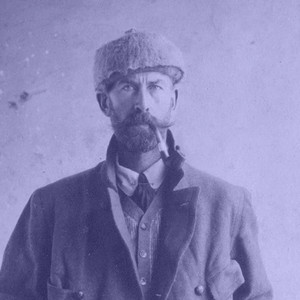
Hello, hello hello and welcome to English learning for curious minds by Leonardo English, the show where you can listen to fascinating stories and learn weird and wonderful things about the world at the same time as improving your English.
I'm Alistair Budge and today Today we are going to be talking about a man called Percy Fawcett.
You may remember this name from an episode at the start of the year on secret lost civilisations.
And if you are listening very carefully, you might recall I said that this story deserved its own episode.
And this is it, a story of adventure, exploration, discovery, fearlessness, success against all the odds, an unsolved mystery and the story of a real life Indiana Jones.
But before we get right into this gripping tale I want to remind you that you can become a member of Leonardo English and follow along with the interactive transcript and subtitles over on the website, which is leonardoeenglish .com.
Membership of Leonardo English gives you access to more than double the number of episodes plus all of our learning materials, including instant translations in 12 languages, study packs, and much, much more.
So if you are ready to take the next step on your English learning journey, the place to go is LeonardoEnglish .com.
Oooookay then, let's get right into it, and learn about the story of Percy Fawcett.
Picture the late 19th century.
Most maps of the world still had large, blank spaces, swathes of uncharted territory, just waiting for someone brave enough, or reckless enough, to fill them in.
Exploration was the ultimate frontier, and it promised fortune, glory, and the chance to write your name into history.
Into this era stepped Percy Harrison Fawcett, a dashing, determined British explorer with an uncanny ability to survive conditions that killed lesser men in days.
In 1925, at the age of 58, he ventured deep into the Amazon rainforest on a quest for what he believed was a lost city, a place he called Zedd.
But shortly after the journey began, he vanished without a trace, leaving behind a mystery that would captivate the world for decades.
You might remember this story from Episode 525, the one on legendary lost cities and civilisations, which came out earlier this year, where we told the story of Fawcett within the context of stories about Atlantis and El Dorado.
Now the stories of Atlantis and El Dorado deserve their own standalone episodes too, but today it is time for Percy Harrison Fawcett.
To understand how Fawcett came to risk everything for this mythical city, and most likely pay the ultimate price, We need to rewind to the earliest chapters of his life.
Let's start there, with a young man born into a world that seemed to breed explorers as readily as it did aristocrats, often with a very fuzzy line between the two, which was the case of Percy Harrison Fawcett.
He was born in 1867 into a well -to -do British family, Yorkshire Gentry, that had made a lot of money in shipping in the early days of the British Empire.
His father was something of a free spirit, an adventurer, a friend to literary figures, and a bit of a gambler.
It was the sort of life one could lead in Victorian England, at least if you were born into a wealthy aristocratic family.
There was little concern for work in our modern understanding of the word And such families would live off large inheritances passed down from generation to generation.
So what did you do as a Victorian aristocrat?
Well, you could, of course, sit around playing cards, drinking port, and gambling your family's fortune away, as it seemed Percy Fawcett's father did.
But you could also develop other interests.
and for some this took the form of a fascination with distant corners of the globe.
Britain was still riding the wave of Empire, funding expeditions to map and claim territories on nearly every continent, and the men who had the nerve for it were in high demand.
Percy Fawcett would find himself to be one of these men.
At the age of 17 he was sent to the Royal Military Academy at Woolwich, where he reportedly learned to regard the risk of death as the most piquant source to life.
After graduating, he was commissioned into the Royal Artillery, but he quickly discovered that his talents lay beyond conventional soldiering.
He had a knack for languages and a taste for the exotic.
He spent time in Ceylon, modern day Sri Lanka, Hong Kong and Malta and also spent time working as a British spy in North Africa, all by his mid -thirties, I should add.
This sense of adventure and a clear talent for existing outside his comfort zone, almost but magnetically drew him to an organization called the Royal Geographical Society.
Now, if you look at the Royal Geographical Society's website today, you'll find that it claims to be the UK's learned society and professional body for geography.
Unless you have a particular passion for geography, this might not sound like the most interesting club in the world.
But, 150 years ago, it was in the business of creating geography, of sponsoring and supporting expeditions to explore, map and understand the natural world.
It raised money for expeditions in previously uncharted territory and supported the missions of many of the explorers we've talked about before on this show.
David Livingston's African missions, Scott and Shackleton's missions to reach the south pole, and of course, the research of Charles Darwin.
For a young man keen on adventure and with a high tolerance for risk, it was a natural home.
The Royal Geographical Society had its sights set on South America and proposed this as an option to force it.
At the time, large parts of Bolivia, Peru, and Brazil were practically unmapped in the eyes of European powers, who were eager to define borders and exploit the land's resources.
Fawcett was told by the president of the society that, and I'm quoting directly, "...the terrain was all but impassible, it would take up to two years, and there no guarantee of survival.
What's more, disease was rampant, and the local Indians who had been brutally and mercilessly attacked by the rubber trappers would kill interlopers on sight.
This was, by the way, at the height of the rubber boom, so what the President of the Society was referring to was the fact that native tribes were now so used to outsiders encroaching on their territory and trying to claim it for themselves, that outsiders would typically be greeted by a storm of poison darts and arrows.
They were not given a warm welcome.
So given all of this was Fawcett interested in the job?
Interested? He thought it was his life's calling.
It was what he had been put on this earth to do.
His first mission was in 1906 and he amazed everyone by returning intact and a year ahead of schedule.
Not only had he managed it, but he had got the bunk, he loved every minute of it and as soon as he returned to London, he wanted to go straight back.
It didn't take long for his fame to grow and he became renowned for his skill in surveying these rugged remote regions.
He'd tramp through mosquito infested jungles with bundles of maps and theodolites, a type of instrument used for surveying territory and measuring angles.
Undeterred by this incredibly hostile territory he would calmly record latitudes and longitudes in areas where few outsiders had ever ventured.
And with every mission he went on, slowly but surely, more areas of the map would get filled in.
And stories of his exploits spread quickly.
He claimed to have shot enormous 20 -meter -long anacondas, to have encountered tribes that no other European had seen, and to have a near superhuman resistance to the fevers and diseases that ravaged his fellow explorers.
Other men would get struck down within days or even hours of setting foot into the Amazon.
They would be consumed by flesh -eating maggots or larvae.
They would be blinded by little worms. They were all manner of diseases and threats that killed or crippled his traveling companions.
But not Fawcett. For some reason, he simply didn't get ill, or at least never seriously ill.
He also seemed never to tire.
When the going got tough and his party hadn't eaten for several days or someone was suffering from a disease, he wouldn't let them lie down to rest. Lying down was giving up.
He knew that every time a sick or tired man lay down to rest, it was harder to get back up again.
If you died, Fawcett said.
You died standing up.
Some believe he exaggerated his exploits for fame, but many saw him as the real deal.
A man born to explore.
As was the norm with Victorian explorers, he recorded everything in a diary and published it on his return.
With every new publication his fame grew and while he was away on a mission Victorian England awaited his return and the tales of mystery and adventure that he would come back with.
Along the way there were rumors that he had never really left the secret service and that he was still working as a British spy.
Mapping Being distant frontiers, after all, was often as politically useful as it was scientifically exciting.
Yet for Fawcett, there seemed to be something more profound than mere map -making.
In his conversations with indigenous communities, he heard tales of a great city hidden far into the rainforest, a place filled with monumental architecture and advanced culture.
Local lore described it in hushed tones.
This was no simple village of huts, but something far older, far grander.
It initially seemed like folklore, a tale passed down through generations.
But then he found it mentioned in a manuscript in the national library in Rio de Janeiro.
The more he looked, the more clues seemed to point to the existence of this city he called Z.
And what's more, Machu Picchu was discovered high in the hills of Peru in 1911.
Faucet took this as yet more evidence that the jungles and mountains of South America held secrets that were yet to be discovered.
and somewhere deep in the Amazon was Z.
He became convinced that if he could find such a city, it would rewrite what the world believed about human civilization in the Amazon.
Now this was in the early 20th century, and just as his obsession was reaching a fever pitch, Europe descended into the chaos of the First World War.
Fawcett, at this time, was nearly 50 years old, hardly the age at which one typically enlists for frontline service.
Nevertheless, he had a deep sense of patriotism, he had extensive military and leadership experience, and he believed his country needed him.
He was probably right.
He returned to Britain, traded his machete and compass for an officer's uniform and headed into the trenches of northern France.
The horrors he witnessed there changed him forever.
Young men, boys really, were being sent over the top into a maelstrom of machine gun fire, poison gas and artillery barrages.
It was a grim lesson in how civilized nations could turn technology and organization into instruments of mass destruction.
Amid the mud, blood, and sheer senselessness of it all, Fawcett began to question the supposed superiority of Western progress.
If this was what civilization had to offer, was it truly more advanced than the tribal societies he had encountered in the Amazon?
During those long, haunted nights on the western front, his mind drifted back to the lush green canopy of South America.
To the gentle currents of unknown rivers and to the stories of that hidden city.
Perhaps, he mused, the true measure of civilization wasn't bombs and factories and industrial output, but wisdom and harmony, qualities that might lie undiscovered beneath the rainforest's thick foliage.
Unlike a large proportion of the young men he commanded, Fawcett survived the Somme.
And when the war ended, he wasted no time returning to his life's mission.
Now in his late 50s, hardly an age most men would choose to slog through dense undergrowth in searing heat, he was more determined than ever.
He returned first in 1920, but the mission was a failure.
Bad weather conspired against him, and the now 53 -year -old wasn't quite as young and nimble as he had been 15 years before.
Plus, his legendary resistance to tropical disease seemed to be weakening.
He fell ill, too ill to continue the mission, and had to return to England.
But if you had thought this would have been enough to put him off for life, well, you would be wrong.
For Fawcett this was a temporary setback, and he soon started planning another mission.
The problem was that he didn't have the money to do it.
Although he was what we would probably call a celebrity explorer by this point, he didn't find it easy to find anyone willing to pay for the trip.
The Royal Geographical Society had mixed feelings about further expeditions, by then Fawcett had a reputation as something of a maverick, difficult to control, and passed his prime as an Amazonian explorer.
Yet he managed it. He managed to secure just enough funding, some from newspaper deals and some from private backers to return to the Amazon.
His plan was straightforward and audacious.
Travel into uncharted territory, gather fresh evidence and come out triumphant, maybe with gold, maybe with tales of a living civilization beyond the scope of imagination.
Some people called him delusional, others saw him as a visionary.
Fawcett himself was unwavering but he decided not to make the journey alone.
He recruited his son Jack along with Jack's friend a young man named Raleigh Rimmel.
They set off in 1925, going up rivers, cutting through dense jungle and negotiating passage with tribes that had rarely, if ever, encountered outsiders.
For a while, all went well.
Fawcett sent intermittent updates via runners who carried letters back to the edges of the jungle, where telegraphs could relay his words to the wider world.
He sounded enthusiastic, confident even.
Soon, though, the messages stopped.
stopped. In his last known letter, written about a month into the journey, Fawcett described how they were about to push into completely uncharted territory.
After that point, nothing more was heard. He, Jack, and Rimmel effectively vanished.
No one knows exactly what happened.
Some guess they succumbed to disease or starvation.
Others suspect they ran afoul of a hostile tribe.
A few spin wilder theories that Fawcett discovered said decided to stay and purposefully vanished from Western civilization.
Their disappearance ignited a feverish obsession.
Adventurers from around the globe tried to retrace Fawcett's steps.
And many didn't make it out of the Amazon.
An estimated 100 explorers died or disappeared themselves in the search for the British trio.
So many that by the 1930s the Brazilian government banned further attempts to find him, fearing the toll on human life.
And over the decades rumors spread.
Bones were found here or there.
Or a tribe told stories of a tall white -haired stranger.
But no definitive proof of Fawcett's fate has ever come to life.
Despite the countless expeditions launched to uncover the truth, Fawcett's remains have never been identified.
Whatever happened to him the Amazon has guarded her secrets well.
And in a sense Fawcett's obsession may not have been in vain, he might have been right.
Recent archaeological studies have revealed that parts of the Amazon once supported large complex societies lending credibility to the idea that advanced civilizations could exist there hidden from outside eyes.
Though Fawcett never returned to the existence of Z, his conviction that the region was more than just a green desert was remarkably prescient.
Today, Percy Fawcett is often called the real -life Indiana Jones, a moniker that suits his larger -than -life persona and daring exploits.
Clearly, he was a fascinating character, but was full of contradictions.
An imperial agent, but an open -minded explorer, a Victorian aristocrat but one who started to question the superiority of European civilization.
An apparently loving husband and father but one who took his oldest son to his death.
A man who knew full well that he might not return from the mission but went anyway.
So let me leave you with a quote widely attributed to Percy Fawcett which seems to sum up his attitude rather well.
It should be remembered that the difficulties are great and the tale of disasters a long one, for the few remaining unknown corners of the world exact a price for their secrets.
OK then. That is it for today's episode on Percy Harrison Fawcett, a man I hope you all agree most certainly deserves the title of a real life Indiana Jones.
I hope it's an interesting one and that you've learned something new.
I think these ones on Adventurers are some of the most fun episodes we make, and if you'd like to listen to more of them then we have that one on Atlantis and El Dorado, that's episode number 525, but we also have a bunch more.
From attempts to find the north and south poles to a three -part mini series on the search for the source of the Nile, we've got loads that you might not have listened to yet.
The easiest way to find them is probably on our website, where you can search for episodes with the tag adventure or exploration.
I'll put a link in the description so you can just click on that and go straight there.
And as a final reminder, if you enjoyed this episode and you are wondering how to more than double the number of episodes you can get, plus learn with our interactive transcripts, subtitles, and key vocabulary, then the place to go for that is LeonardoEnglish .com.
You've been listening to English learning for Curious Minds by Leonardo English.
I'm Alistair Bunch, you stay safe, and I'll catch you in the next episode!