This message comes from Capital One.
Say hello to stress-free subscription management.
Easily track, block, or cancel recurring charges right from the Capital One mobile app.
Simple as that.
Learn more at CapitalOne.com slash subscriptions.
Terms and conditions apply.
You're listening to Life Kit from NPR.
Hey, it's Marielle.
Brett McKay has an impressive mustache.
It looks like the head of a broom.
Black, maybe a little salt and pepper.
And to my eye, an indispensable companion to his eyebrows.
He first grew it out for Movember in 2009.
That's the annual campaign in November where folks sport mustaches to raise awareness and money for men's health.
I didn't think I was going to keep it.
But at the end of Movember, I was like, you know what?
I actually look pretty good in this.
And my wife was like, I'm really surprised by this, but I also think you look good in it, too.
Brett is the writer of a blog and the host of a podcast called The Art of Manliness.
So, of course, I had to ask, what does manliness mean to him?
He said he studied classical literature in college, things like the Iliad and the writings of Cicero.
And that word, manliness, meant something different then than it often does today.
I think today we have this sort of cartoonish idea of what manliness is.
It's this big, burly guy who likes to eat meat and lift weights.
But for...
Ancient Greeks and ancient Romans, and you can see this all the way up through the 19th century and the West, to be manly meant the development of certain virtues like prudence and courage and strength.
And so it's about becoming a virtuous, all-around solid dude.
And I wanted to bring that idea back that manliness could be something that's positive and affirming.
The art of manliness actually reminds me a lot of Life Kit.
Brett interviews experts on different topics, including health, but the show is made specifically for men.
And they give tips on all sorts of topics, including growing facial hair.
One is don't waste your money on beard serums or vitamins that promise increased beard growth.
They're probably not going to do it.
A lot of facial hair just comes down to genetics.
But the thing you can do for facial hair is just like be a healthy person, like sleep well, eat a nutritious diet exercise, because that also contributes to hair growth.
On this episode of Life Kit, Brett and I talk about men's health.
He'll share five takeaways based on the reporting he's done for The Art of Manliness on movement, explosive strength testosterone, depression and the good stress of socializing.
A quick disclaimer here, Brett is not a medical doctor.
He's someone who's passionate about his health and about sharing the research out there.
If you do have any questions about these topics, for sure bring them up with your doctor.
This message comes from NPR sponsor Adobe.
Introducing the all new Adobe Acrobat Studio, now with AI powered PDF spaces.
Need to turn 100 pages of market research into five insights with a click?
Templates for a sales proposal that'll close that deal?
Or an AI specialist to tailor the tone of your market report?
You can do all that with the all-new Adobe Acrobat Studio.
Learn more at adobe.com slash do that with Acrobat.
This message comes from ServiceNow.
People should do the creative work they actually want to do, not boring busy work.
Now, with AI agents built into the ServiceNow platform, you can automate millions of repetitive tasks in every corner of your business IT, HR and more.
So your people can focus on the work that they want to do.
That's putting AI agents to work for people.
It's your turn.
Get started at servicenow.com slash AI dash agents.
You have an episode on how men and everyone really can nurture their physical identity.
So what does that mean, physical identity?
So we are moving creatures, right?
When we're a baby, we learn how to crawl, eventually learn how to walk.
And then when we're kids, we run and play.
The problem is, you develop this idea when you're a kid.
It's like you're either an athlete or you're not an athlete.
I'm sure everyone remembers when they were in elementary school or middle school getting picked last for the dodgeball team playing little league baseball and just realizing oh, I'm not good at this.
And so what happens is, when you're a kid, you're like well, I'm not an athlete, so I'm just not going to move at all.
Which I think is a shame because again, you don't have to be an athlete to move your body.
And so this idea of physical identity is just Seeing yourself as a creature that moves, and it has a vitality.
Being a person with a physical identity doesn't mean I have to play a sport.
You can move your body doing other activities.
You can do yoga.
You can take walks.
You can do all sorts of things.
Totally.
You also suggest that people pick a physical activity they enjoy, because that's what they're going to keep doing.
Yes.
How do you actually find it though?
I always say, if you haven't found the physical activity that you enjoyed, is you haven't tried it yet.
Take classes, watch a YouTube video.
There's a physical activity or a physical practice out there that you're going to love.
Yeah.
I learned that this summer was softball.
I had never really played before.
And work was doing some games like NPR does a media league very casually.
And I just I showed up, I played second base.
I loved it.
Now I've played 12 games this year.
I'm in like, I joined another league.
I'm really into it.
Who would have thought?
Yeah.
So yeah, take the jujitsu class that you've kind of had that hunch.
Maybe I should try it.
Like just, just follow that hunch and give it a go.
And you know, worst case scenario, you're out an hour of your time.
Okay, men and everyone really take away one.
Don't forget that you have a physical identity, whether you were good at sports in high school or not, whether you like them now or not.
There are so many ways to move your body that you might not have considered.
Go for hikes.
Run around after your dog or your friend's dog.
Try live action role play, also known as LARPing.
Go rock climbing or bouldering.
Try geocaching, which is basically an outdoor treasure hunt.
Throw around a Frisbee or play my favorite impromptu game at the office, tossing a highlighter to a friend while standing on one foot.
If your office is chill and it's the end of the day, do a desk chair race.
Go ice skating or snowshoeing.
Play paintball or laser tag.
Climb a tree.
Dig a hole in the sand.
Okay, so another episode of yours that we loved is about muscle power and explosiveness.
What do we mean by that?
So muscle power is strength expressed quickly.
So you use muscle power whenever you sprint, whenever you drive jump, whenever you skip or whenever you're about to fall down.
You have to try to catch yourself before you hit the ground.
And we tend to lose muscle power or explosiveness as we age, right?
That's correct.
Between the ages of 65 and 90, on average, people lose about 3.5% of their muscle power per year.
So it drops off faster than strength.
And the reason why it drops off so fast is that we just don't use it.
And the thing with muscle power is your nervous system is also involved.
And so in order for you to express power, you also have to train your nervous system, right?
And so if your nervous system isn't used to contracting your muscles as quickly as possible, you're going to lose that ability.
Yeah.
And then when you need it, when you need to run really fast because somebody's chasing you or for whatever reason, to catch the bus, then you pull a hammy.
Right.
You pull a hammy or you just don't have that oomph.
A common one like why it's really important for particularly older people, right in their 60s or 70s.
You use muscle power.
It's one of the things you do to catch yourself when you're falling.
Yeah.
Okay.
Well, how can we hold on to our muscle power?
How can we get it back?
There's easy things you can do.
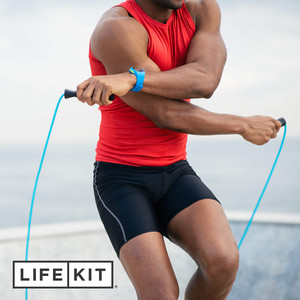
Jumping rope is actually a great way to train your lower body muscle power, because you're just hopping up and down quickly.
You can do squat jumps.
So you go down to a squat position and then, when you get to the bottom, you're going to explode out of there and jump as high as you can.
Just do two sets of five before your usual workout.
You can do more sprinting.
Take up a sport where you have to express power.
I think softball is a great example of that.
You can do medicine ball slams.
So just get a medicine ball that your gym might have and just throw it on the ground as hard as you can.
You do plyometric pushups.
So you just do a regular pushup.
You're just going to explode up until your hands come a little bit off the ground.
I've been doing stuff like that.
It feels good.
It does.
You can start to feel the difference.
That's right.
Takeaway two, muscle power, also called explosiveness, allows us to express our strength quickly.
It helps us run, jump, and catch ourselves so we don't fall over.
And we lose it when we don't use it, especially as we age.
Some ways to hold on to it jump rope, squat jumps, plyometric push-ups, medicine ball snaps and sports that require throwing and hitting.
Okay, so next up, let's talk about testosterone.
You did an episode on this.
For men, what does it mean to have a healthy level of testosterone?
So testosterone is important for men and women.
So it's important for bone density.
It's important for muscle mass, strength.
It's important for sexual health.
So libido and sexual function, mood.
Testosterone plays a big role in mood in men.
Okay.
And should men be getting tested for their testosterone levels regularly?
Or how do you go about finding this out anyway?
So you want to see if you have low symptoms of testosterone.
So those common low symptoms are low or no libido, erectile dysfunction.
You aren't sleeping well, low mood fatigued, like you're after a workout.
It takes you a couple of days to recover from a hard workout brain fog.
If you have those symptoms then you would want to go to talk to your doctor about getting a testosterone test.
Because what happens is, let's say, you're a 35-year-old guy, you're feeling good, libido's great, you recover well from workouts.
And you're scrolling Instagram and you see an ad for like, oh, get your testosterone tested.
Know your number.
You're like, oh, okay.
I want to go do that.
And you do it and you get the test back and it shows that your total testosterone it's on the low end.
But this guy, he feels great.
Like he has no symptoms of low testosterone.
If he saw that test, he's like, oh, it's low.
I must get on TRT then.
Like, well, no.
Like, how are your symptoms?
How are you feeling?
Yeah.
Yeah.
Maybe that's normal for you.
That's normal for you.
Maybe this is what your body needs.
Yeah.
Exactly.
Exactly.
There's a saying in the medical field is you want to treat the patient, not the number.
And I feel like what a lot of consumers do, who are doing these blood tests on their own, like they're treating the number instead of themselves.
Okay.
Yeah.
And what are some of the common treatments for low testosterone?
A good doctor will first start off with lifestyle interventions.
Yeah.
So if you have symptoms of low testosterone...
They're going to look at your lifestyle and ask you, okay, are you exercising regularly?
No.
Well, you need to start doing that.
Are you overweight?
Yes.
Okay.
Well, we need to lose some weight because body fat aromatizes testosterone into estrogen.
It's a fancy way of saying converts into estrogen.
So it can actually reduce your testosterone, but increase your estrogen levels.
They're going to look at how's your sleep?
Are you sleeping well?
No, I'm not.
Okay.
Let's work on your sleep.
So I would say, like doing lifestyle interventions, like pulling those big levers of health, first try that.
And then, if not, then you can talk to your doctor about potentially doing hormone replacement therapy.
Takeaway three if you're having symptoms like low libido, erectile dysfunction, low mood, long lasting fatigue after a workout, brain fog or bad sleep, talk to your doctor.
They may recommend a testosterone test, among other things.
I think one thing that you point out in your reporting on this is that it's not just about testosterone.
Like you also wanted your testosterone to be in balance with the other hormones in your body.
Yeah.
So hormones man, you can get so in the weeds with this stuff, because hormones are incredibly complex, because you also think about estrogen.
Men also have estrogen.
It's important for their health.
It's important for heart health.
It's also an important hormone in libido and sexual health.
And so if estrogen gets too low, well, that's not good.
But then if it gets too high, well, that's not good either.
I mean, I think that's why once you, if you're looking at hormone replacement therapy, you got to have a doctor.
I would have someone who's an expert on this stuff guiding you through this, because as you start introducing exogenous testosterone into your body, like these, other hormonal systems are also going to be affected, and you have to like keep an eye on that as well.
After the break, we'll have more men's health tips from Brett McKay.
All right, we're back with Brett McKay, host of The Art of Manliness.
Let's shift a little bit and talk about mental health.
You have written about depression, your personal experience with it and also what the latest research says.
What have you found about how depression tends to manifest in men specifically?
Oftentimes, depression in men can show up as anger or irritability or alcoholism or workaholism.
They spend more time working.
And so that's why depression in men often gets overlooked.
Yeah.
And I feel like it can be harder to talk about if you're a man.
It might be less accepted.
Yeah.
Yeah.
You're supposed to have your stuff together.
And also, I think, a lot of guys.
They just, I think, even a lot of people.
This is not just a guy problem.
A lot of people just don't even know the emotions that they're experiencing.
They don't know how to label it.
Like they feel the thing, but they don't know what it is.
So they can't talk about it.
Yeah.
Well, you learned some research back tips on how men can manage their depression.
Can you share a few of those?
Yeah.
So the big one is exercise.
Physical exercise is.
The research suggests that it is as effective as antidepressants and talk therapy.
It's amazing.
It does so much, not only for physical health, but for our mental health as well.
So I say if you're a guy struggling with depression, start exercising.
It's one of the best things you can do.
Socializing is another one that can help out a lot.
Just being around people, talking with them, can do a lot of things to help alleviate stress, your depressive symptoms.
Getting enough sleep is an important one.
Eating a nutritious diet is important.
If you just do the things that you do to be a healthy person, it's going to help you manage your depression as well.
Yeah.
Is there anything that you would share from your own experience with it?
Yeah.
I mean, so I've had depression.
I've had some severe moments of it, but kind of just dealing with a general melancholy for most of my adult life.
And I think the thing that helped me the most is I stopped looking at my depression or my melancholy as this thing I have to fix.
That can cause a lot of frustration in people.
Say like, I'm sad, I need to be happy.
So I'm gonna do all these things to quit being sad and being happy all the time.
That's never gonna happen.
Like there's no silver bullet for curing depression, Your depression, like it's going to be part of your life.
And how can it be part of your life so that it doesn't get in the way of you living a flourishing life?
And I also think just resetting your expectations about happiness.
I think in America we have this idea of happiness, being like you're, in this chipper good mood all the time.
But going back to my love of classical culture, like the ancient Greeks had, their idea of happiness was eudaimonia, or just flourishing.
It's like just living a good life. life.
And you can do that even though you might not feel super ecstatic all the time.
You can have good relationships, you can do good work, you can be involved in your community even if you don't feel the best.
And yeah, by changing those expectations, I'm less hard on myself.
And so whenever I'm feeling like okay, I'm kind of going to a not great place, I just do the things I know that'll make me feel better.
Exercise, get together with some friends, go sit in the sauna.
Or go sit in the sun.
Oh man, the sun, sun can help out a lot.
Takeaway four, depression doesn't always look like sadness.
For some men it might look like anger or aggression, working too much or engaging in risky behaviors.
Research shows that regular exercise can be as effective in treating depression as antidepressants or talk therapy.
But this doesn't have to be either or.
Exercise alongside medication and cognitive behavioral therapy leads to even better outcomes.
Having positive social experiences might also help.
And so can eating a healthy diet.
A Mediterranean diet has been linked to lower rates of depression.
But depression and treating it can look different for everybody.
If you're dealing with it, talk to your doctor about what treatments make sense for you.
Sort of along these lines.
Like you talked about the importance of socializing, getting outside and talking to other people can really lift your mood.
And you actually have an episode about what you call the good stress of socializing.
What do you mean that it's a good stress?
Yes, this was with Jeffrey Hall.
He's a professor at the University of Kansas who studies friendships and communication.
And he talks about the health benefits that come from socializing, right?
It can help reduce your dementia.
It can help reduce mild cognitive decline.
It can help with mood like depression or anxiety.
It can even help our physical health.
People who have strong social ties, they tend to get sick less.
And it's like, well, why is that?
Why is socializing so good for our mental and physical health?
And Jeffrey talks about how it's basically.
Socializing helps reduce chronic stress, which makes sense.
We're designed to go to the group, whenever we're stressed out.
So we can just be like oh my gosh, I'm feeling really bad right now, but I'm with these other people.
It feels good to be with these people.
Like they got my back.
We're all in this together.
That feels good.
But the thing about socializing that Jeffrey points out is that socializing itself can be stressful.
And why is socializing stressful?
Well, people can be awful sometimes, right?
You're having a conversation with someone and someone says something really rude or inappropriate.
People misunderstand you.
There's awkward silences.
You don't know where the conversation is going to go.
And also just like planning to socialize can be stressful.
And because it's so stressful and there's so much friction, oftentimes we decide, you know what?
I'm just going to stay in this weekend.
I'm not going to do anything.
I'm just going to watch Netflix.
So socializing is a weird thing.
So it reduces chronic stress in the long term.
But in the short term, it causes stress.
And Jeffrey makes the analogy to exercise.
Because exercise is kind of the same thing.
So in the long term, it reduces stress.
It reduces inflammation.
But in the short term, exercise is unpleasant.
It actually increases inflammation.
And so exercise is what we call a hormetic stressor, a good stressor.
You need to do a little bit of it, that acute stress, to get the benefits of the reduction in chronic stress.
Same thing with socializing.
It feels like...
Getting the reps in.
Yeah, I think that's a great idea of doing reps.
I start seeing my chances to socialize as little mini workouts or reps.
Like, oh, here's a chance to exercise my socialization muscle.
Takeaway five, take advantage of the good stress of socializing.
Yes, it can feel stressful in the moment, but it can also lower your levels of stress in the long term.
Yeah.
Yeah.
I think it's a great idea of having the standing thing.
I mean, one of the big things that get in the way of people actually getting together with people is like you spend so much time in those group chats where you're trying to coordinate schedules.
And so you just have to accept the fact that not everyone's going to be able to come.
Yeah.
But just say, look, here's when we're doing it.
We're always going to do it this time at this place.
If you can make it fantastic, if not, we'll love to have you the next time.
I've had these standing sort of things with some groups that I've done.
Like I was a part of a book club of, just a bunch of guys here in town.
And the event was every other week on Thursday night at eight o'clock.
And it's like, well, you can make it fantastic.
If not, that's okay.
See you next time.
Yeah.
Brett McKay.
Thank you so much for coming on the show.
Well, thanks for having me.
This has been an absolute pleasure.
It was so much fun.
Yes.
Let's do it again sometime.
Okay.
Time for a recap.
Takeaway one.
Don't forget that you have a physical identity, whether you were good at sports in high school or not, whether you like them now or not.
Try out some new ways of moving your body and find out what you like.
Takeaway two, muscle power can help us run, jump, and catch ourselves so we don't fall over.
And we lose it when we don't use it, especially as we age.
Some ways to hold on to it are to jump rope, do squat jumps, do plyometric push-ups, do medicine ball snaps and play sports that require throwing and hitting.
Takeaway three if you're having symptoms like low libido, erectile dysfunction, low mood, long-lasting fatigue after working out, brain fog and bad sleep, talk to your doctor.
They might recommend a testosterone test.
And they'll likely start by suggesting lifestyle changes before they recommend any kind of hormone replacement therapy.
Takeaway four research shows that regular exercise is as effective in treating depression as antidepressants or talk therapy.
Having positive social experiences can also help, and so can eating a healthy diet.
But depression and treating it can look different for everyone.
So if you're dealing with it, talk to your doctor about all your treatment options.
Takeaway five, take advantage of the good stress of socializing.
Yes, it can feel stressful in the moment, especially when you have to plan, but it can lower your levels of stress in the long term.
Oh, one more tip from Brett about facial hair.
Try a scented beard oil.
I do like to do it during Christmas time because there's beard oils that smell like Christmas trees or cinnamon.
And it's just nice to have.
Like you know, you're during December, you're working and you're like oh, it smells like the Polar Express.
And that's our show.
Before we go, I have a favor to ask.
If you have a moment, would you leave Life Kit a five star rating on your podcast app?
If LifeKit has ever helped you save a little money or make a healthier choice for yourself, a five-star rating is a great way to show your support.
Thank you so much.
This episode of LifeKit was produced by Margaret Serino.
Our visuals editor is Beck Harlan, and our digital editor is Malika Garib.
Megan Cain is our senior supervising editor, and Beth Donovan is our executive producer.
Our production team also includes Andy Tegel, Claire Marie Schneider, and Sylvie Douglas.
Engineering support comes from Robert Rodriguez and Sina Lefredo.
Fact-checking by Tyler Jones.
I'm Mariel Segarra.
Thanks for listening.
This message comes from Capital One with the Capital One Saver Card.
Earn unlimited 3% cash back on dining and entertainment.
Capital One.
What's in your wallet?
Terms apply.
Details at CapitalOne.com.
This message comes from Capital One.
The Capital One VentureX Business Card earns unlimited double miles on every purchase.
Capital One.
What's in your wallet?
Terms and conditions apply.
Find out more at CapitalOne.com slash VentureX Business.