Welcome back to learn english with camille.
I'm camille, i'm calvin.
We are here for a new video, so i get many messages asking how can i improve my listening skills?
What is the best way?
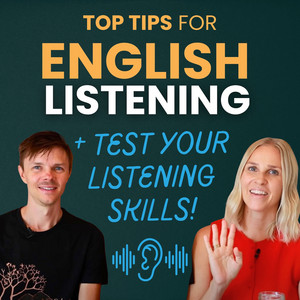
And so, in this video, we're going to give you five tips for improving your listening skills, followed by a short story, followed by some comprehension questions.
By the way, I have a 30-day listening challenge that you can join.
You can go to my website learnenglishwithcamillecom, and every day there are exercises with videos that I have done with real-life people.
There are comprehension quizzes dictation, different exercises to help you guys train your listening skills.
And if you didn't know, I have a YouTube community now.
So you can join and become a member.
The information, I think it's like become a member just right below this video.
So I would love to have you as a part of my YouTube community.
It helps me to create quality, good English content for you and the world.
So become a member today.
Thank you so much.
Thank you, guys.
So let's get started.
On it.
Okay.
Bringing out the laptop, the big gun.
Yes, I am because my notes are here and I don't want to forget anything.
So one of the biggest things, and this might sound obvious, but it's listen every day.
So be consistent and don't listen to something that's boring for you.
Don't listen to something that is just like I'm not interested in this at all, because your brain will just tune it out.
So I think it's better to listen, even if you set a small goal of 10 to 15 minutes a day, versus one time a week.
I'm going to listen for two hours.
So number one tip, listening daily, be consistent.
Number two tip is finding content at your level or a little bit above your level.
So the goal is to find content that you can understand 70 to 80% of.
You don't feel frustrated or overwhelmed with.
There should be a little bit of oh I didn't know this, I didn't know that, but I understand this, and that helps keep you motivated and not feel frustrated and give up, and It also helps you continue to learn.
Yes, exactly.
It's exciting when you can understand most of a video.
If you're like Calvin said, just like, what are they talking about?
I don't get anything.
I don't think it's the greatest way to learn a language or to improve your skills.
We need to find content that's interesting and at the right level for us to maximize our time and energy, because it takes a lot of energy.
So number three, use subtitles wisely.
So of course You can put subtitles on in the language like.
So you can put English subtitles on, especially because English is not a phonetic language.
So that way you're listening and you're hearing what is the rhythm?
How do they say these words?
How do they say these phrases together?
And subtitles really help.
You can also do it where you listen. without subtitles for a section or a whole video.
And then you go back and put them on and you're like, oh, or reverse.
You can put them on first and then listen again without them.
So I don't necessarily recommend if you're at an intermediate level trying to get to the next level, using subtitles in your native language.
I think it's better to try to put them in the language that you're listening to.
So that is my tip for number, my tip number three.
Yes.
And I always see Camille with subtitles when she's watching videos in other languages.
So she practices what she preaches.
It's true.
Okay, so number four.
There we go.
Number four is learn phrases, not just words.
Language is about patterns.
And if you're just learning words, you miss the structure and the patterns, naturally that words are in.
So as they say, context is king.
Learning a language is no different.
You want to learn the context around how you use a word.
Many times there's certain phrases that locals or natives use.
And you have to use the whole phrase.
Otherwise, you'll be lost.
Yeah.
And they'll be lost if you try and say it later.
So listening, listening for the phrases, don't get overwhelmed with just word for word translation.
Listen and translate the whole phrase, write it down.
And that way you'll learn quicker.
And you'll learn more vocabulary that way as well.
Instead of word by word, you'll learn sentence by sentence or phrase by phrase.
So our number five tip before we get into our story is listen actively, not passively.
Because when you're listening... actively, you're going to learn more.
So I encourage you to pause videos, write down these phrases, review your notes.
So really try to learn from what you're listening to.
So no multitasking?
No, I don't think multitasking is great for language learning, unless you're on a jog or exercising or something like that.
And you're listening to a podcast or you're listening to music or things like that.
Yeah, or you can be repeating it.
Yeah, or even if you're cooking or doing something like that.
But I don't think it's good to be texting your friends while trying to listen to something.
Your brain can't be that divided.
It won't.
You might think you can do it and you might be doing it.
Studies have shown that multitasking is not the best way to go.
No, it's true.
Yeah.
I used to like be really proud of my ability to multitask.
I used to be a huge multitasker.
And now I try to do more single task things.
And I think it's more efficient.
I agree.
Yeah.
We are done with our top tips.
There are more tips.
We could probably give you 10 more tips.
But those are some.
Start with those.
Let us know how they go.
And let's do a little practice.
So we're going to share just a couple minute story.
And then we're going to ask you questions based on the story to test your listening.
So you can start the story.
Okay.
So this summer, we went to Norway.
It was a great trip.
We love Norway.
And one of the cool things about Norwegian culture and Scandinavian culture is the sauna.
Yes.
Saunas are beautiful things.
You get into a hot room and then you put fire going with wood and then you put steam on top of hot rocks.
Yes.
And this sauna that we went to was an experience because it was a floating sauna on top of a body of water.
I don't remember which body of water it was.
The Baltic Sea.
Okay.
The Baltic Sea.
It was a two hour experience and it was a shared experience, meaning other people could go.
But for the first hour, we were the only ones in there.
And so we would go in the sauna and then we would go jump into the Baltic Sea.
And then we would go back into the sauna, into the sea.
And we did this for an hour and a half, I think.
Yes, it was a lot of fun.
The kids loved the experience.
Getting very hot in the sauna and then jumping into the waters, which they actually weren't too cold thankfully, but they were just cold enough that there was a contrast between the heat and the cold, and it gives you a unique experience.
Mm-hmm.
About an hour into our time one older Norwegian man came and he was in the sauna and he was quite chatty.
And at one point he had this non-alcoholic beer that he poured onto the hot rocks.
And he said, I learned this in Finland.
He said, if you do this, it just creates a homemade bread smell.
And it totally did.
So our sauna smelled like fresh baked bread.
So thank you, Finns, for developing that wonderful thing.
Yeah.
Afterwards, we made sure to drink a lot of water.
We were a little nervous because our son on the way home in the car, he's like six years old.
All of our kids loved it, by the way.
But he was like, kind of like, are you okay?
Like, it really takes a lot out of you.
It's a good detox.
You have to hydrate.
I
Drink electrolytes after.
And yeah.
Know your limits also.
Exactly.
Yes.
We really enjoyed the sauna experience in Norway.
And if you're ever there, we highly recommend a floating sauna experience.
Yes.
So now we're going to go into our questions.
So we're going to ask you guys a few questions.
And we're just going to have you fill in the blank or just respond with one word or two words.
So if you wanna write them in the comments, the correct answers you can, we will go ahead and give the answers to after a bit.
So what country did we have our sauna experience in?
What country?
So we'll just wait a few seconds.
Calvin.
Do I say the answer?
Yeah.
The answer?
Okay.
Norway.
The country was Norway.
Question number two, Calvin.
What body of water were we on with our floating sauna?
That's a tough one.
This is a tough one.
Give you guys a few more seconds.
Because I didn't even know what body of water it was.
But I did say it specifically.
Yes.
The Baltic Sea.
The Baltic Sea.
Number three.
What did the Norwegian man pour on top of the hot rocks?
Do you remember?
It was a non-alcoholic beer that he poured on the rocks in the sauna.
Very good.
And our last question is What did we do after sitting in the sauna for a bit of time and getting hot?
I think this one you guys can go ahead and write in the comments.
Let us know the answer to that.
Let us know how the little quiz was what you think of our advice for improving your listening skills.
Don't forget to subscribe to the channel.
Become a member, give it a thumbs up, and we'll see you real soon.
Bye.
Bye.