Hello, hello, hello, and welcome to English Learning for Curious Mines by Leonardo English, the show where you can listen to fascinating stories and learn weird and wonderful things about the world at the same time as improving your English.
I'm Alistair Bunch and today we are going to be talking about a drug called Ezembe.
To its greatest proponents, it is a miracle drug that will save millions of lives.
To its critics, its true dangers will only be understood in years to come.
So in this episode, we'll cover the history of the drug, how it works, why it is so popular, and what it tells us about the American food and healthcare systems.
But before we get right into today's episode, I want to remind you that you can become a member of Leonardo English and follow along with the interactive transcript and subtitles over on the website, which is LeonardoEnglish.com.
Membership of Leonardo English gives you access to all of our learning materials, including instant translations in 12 languages, study packs, all of our bonus episodes, and much, much more.
So if you are ready to take the next step on your English Learning Journey, the place to go is LeonardoEnglish.com.
And the final point before we start is to say just in case it wasn't obvious that I am not a doctor, this is not medical advice, so please do not take it as such.
Okay then, with that little and I hope superfluous to slamer out of the way, let's get going and talk about Ezembe.
It is August at the moment, and millions of Americans will come to Europe for their summer holiday.
For many, it will be an eye-opening experience.
Paris, Rome, Barcelona, museums, art galleries, restaurants, small, cobbled streets.
For some, it might even be the first time that they have left the United States.
And judging by posts on social media that tend to increase at this time of year, many will make a startling discovery.
They travel through Europe for a week or so, they drink coffee and eat power chocolate or filled pastries for breakfast, they eat pizza, pasta, cheese and meat, they drink beer and wine, they don't do any exercise for the duration of their trip.
Yet, when they get back home, they step on the scales and are met by a surprising revelation.
Despite having eaten and drunk to their hearts' contents and having made absolutely no effort to stay in shape, they have lost weight.
They then rush to social media to complain that American food is poison and list the reasons that American food is so unhealthy and why the US has one of the highest obesity rates in the world.
Now, to state the obvious, obesity is a global problem.
Europeans, Asians, Africans, Australians and South Americans are getting fatter and fatter too, and obesity rates tend to increase as a country develops economically.
But, America is unfortunately unique in the size and scale of its obesity epidemic.
As of the last CDC report, 41.9% of American adults are obese and they further 31.7% are overweight.
To put it another way, only 26% of American adults are not either overweight or obese.
And perhaps even more frightening is the situation with children.
20% or 1 in 5 American children aged between 10 and 17 are obese.
Even in very young children, those between 2 and 5 years old, 13% are obese.
As I'm sure you already know, children who are overweight and obese have difficulty losing this weight as adults and are much more likely to be played by health problems during their lifetime.
It is a big problem and it's no surprise that childhood obesity has been called one of the greatest public health challenges of the 21st century.
It is a challenge because decades of doctors and public health officials telling parents to make sure that their children eat healthy food and get enough exercise or telling adults that this is what we need to do to lose weight, well, it simply hasn't worked.
It requires a behaviour change.
It requires people to change their habits.
And people don't like doing that unless they absolutely have to.
But and it is a big but. What if there were a way to get people to change their behaviour?
What if there were a way to get people to eat less?
What if you could make someone want to eat less?
There is already one way gastric band surgery where an operation is performed and is sort of not is tied around the stomach which restricts the amount of food someone can eat.
This procedure is generally reserved for people with severe obesity.
After all, it is an operation that literally cuts someone open and ties a band around their stomach.
It is an extreme solution for a problem where there is also a theoretically simple solution, eat less and exercise more.
But in December of 2017, a new drug was approved that claimed to be a simple solution for this extreme problem.
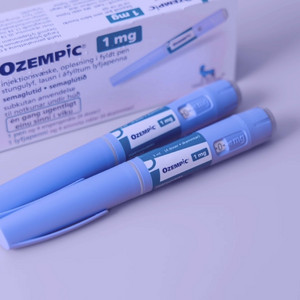
It was produced by a Danish pharmaceutical company and was given the brand name AZempik.
It was first approved for use with people with type 2 diabetes, which is the type of diabetes linked to being overweight or not doing enough exercise.
And in 2021, it was approved for use with people with obesity under the brand name Wikivi.
Wikivi and AZempik are the same drug just sold in slightly different doses and under different names.
To avoid confusion, going forward, I'll use the term AZempik to refer to both of them.
And in simple terms, in layman's terms, we could say, the drug works by making you feel full for longer and reducing the urge to eat.
No expensive surgery required.
Just a simple injection into the thigh or arm or abdomen once a week.
And in all of the extensive clinical trials, the drug has shown that it works remarkably well.
People who take AZempik want to eat less, so they eat less.
And unsurprisingly, they lose weight, 15% of their body weight on average.
And because they lose weight, they reduce the probability of cardiovascular disease, heart failure, all of these nasty health conditions that you are more likely to suffer if you are overweight or obese.
Hallelujah, some health commentators were saying, this was literally a miracle drug.
As if by magic, it tricked overweight and obese patients into feeling like they were full, so they didn't want to eat as much, so they lost weight.
As word spread, more and more doctors started recommending it to overweight and obese patients.
After all, it worked and it was cheap.
Well, sometimes it was cheap.
For Americans with insurance, the cost could be as little as $25 a month.
Without insurance, it can rise to over $1,000 a month.
But it was a small price to pay to shed some pounds and return to a more healthy weight.
And in 2023, just last year, the American Academy of Pediatrics recommended prescribing weight loss medication such as a Zempoch to all obese children over the age of 12.
After all, why not? Childhood obesity is a massive problem.
There are decades of evidence that a simple solution of recommending children get more exercise and eat more healthily is ineffective.
And if there is a drug that can help obese children lose weight and therefore have fewer health problems later on in life, well, that must surely be a good thing.
And it wasn't just for obese kids.
Zempoch also became increasingly used by adults who were not obese, but who simply wanted to lose weight.
Celebrities such as Elon Musk and Oprah Winfrey posted about how the drug could help them lose weight.
And the hashtag Zempoch quickly gained over half a billion views on social media.
To the producers of Zempoch, the company behind the miracle drug, this was of course music to their ears.
The share price increased by almost 60 times.
The Danish company that makes it is now bigger than the entire Danish economy.
And this company, the company that produces the drug, was responsible for the entire growth of the Danish economy in 2023.
It made record profits and paid a whopping $2.3 billion in income tax to the Danish state, equivalent to almost $400 for every Danish citizen.
And this was driven primarily by the sales of its weight loss drugs.
Obviously this was good news for Noa Nordisk, the company behind the drug.
It was good news for Denmark and its citizens, who were almost literally having dollars transferred from American waistlines to their pension pots and already generous healthcare systems.
And it was good news for the American patients, who were shedding pounds in record numbers.
Or was it? As you might imagine, there are many prominent voices that have questioned Americans' appetite for Zempoch.
Firstly, there are criticisms of the way the drug works and what it does to people.
To some, it reportedly alters the way that food tastes and results in people losing all pleasure in eating.
Secondly, there is the criticism that the long-term effects of Zempoch are not yet fully understood.
It has approval from the FDA, the Food and Drug Administration, but it is new and rushing to recommend putting children as young as 12 on the drug.
Well, that is irresponsible.
But, the third category of criticism is perhaps the most important.
And that's that Zempoch is not a cure.
It doesn't go to the root of the problem.
To lose weight with Zempoch, you need to take it continuously.
It isn't like a medicine where there is a treatment period of one or two months or even a year and then its work is done.
Many patients will need to remain on it forever, and many Zempoch users report gaining weight as soon as they stop taking the drug.
If a 12-year-old starts taking a Zempoch, it is unlikely that they will ever be able to stop taking it.
When you think about the way the drug works, this is kind of obvious.
It doesn't make permanent changes to your body.
It simply reduces your appetite while you are taking it.
And as soon as you stop taking it, your appetite returns to its normal levels.
You eat more and, surprise, surprise, you will probably end up gaining weight.
The root of the problem to the greatest critics of Zempoch is both the unhealthy nature of American food and the sedentary lifestyle that most Americans lead.
To go back to the start of the episode, you heard about the classic and perhaps even now cliché experience of the American tourist in Europe, who finds that they lose weight after a couple of weeks in Europe eating pastries, pizza and pasta, and drinking wine.
And when they returned the US and returned to American food, they find that they put that weight right back on.
As you may know, American food is somewhat unique in its ultra-process nature.
73% of food in the American market is ultra-processed, with the average American getting 60% of their daily calories from ultra-processed foods.
And as I'm sure you know, ultra-processed foods aren't really bad for you.
They are linked with all sorts of health conditions and have been expressly designed to be addictive.
That's exactly why doctors and public health professionals telling people to eat better or eat less has been so ineffective.
The majority of American food is ultra-processed, and when you eat ultra-processed food, it is hard to eat it in moderation.
The criticism, therefore, is that Americans are being poisoned and fattened up by unhealthy food, and they are then being sold the cure in the form of a zempick.
So what's the solution?
Well one proposed solution is to make American food healthier by increasing regulations on ultra-processed food producers.
If we could just remove the most unhealthy elements from the average American diet, this would be a start.
After all, lots of the most dangerous ingredients in American food are simply not allowed in large parts of the rest of the world.
But clearly, this is easier said than done.
American food manufacturers wield vast power and spend huge amounts of money each year on lobbyists and consultants to influence government policy.
Big food, as it is called, is simply too big and too powerful.
There is too much money at stake, too many jobs, too many palms being greased for anything to be done about it.
And talking of money at stake, pharmaceutical companies, such as the manufacturer of a zempick, have a huge financial interest in making sure that they have an obese population to prescribe medicine to.
A United States of salad eating joggers with 32-inch wastes would be a disaster for the pharmaceutical industry.
Unfortunately, for no other Nordisk.
Fortunately for American food manufacturers.
And fortunately for Danish pensioners.
There are no signs that Americans have any intention of putting down the bag of Cheetos or extra large sodas.
And for as long as that's the case, a zempick will continue to reign supreme.
Okay, then, that is it for today's episode on ozempick.
I hope it's been an interesting one and that you've learned something new.
We're actually going to be following up this episode with another episode on another controversial new invention, e-cigarettes.
That's going to come out next week and will be one of our member only episodes.
So this is where I remind you that you can unlock that episode and more than 250 other bonus episodes by becoming a member of Leonardo English.
You'll also get all the interactive transcripts, study packs, subtitle, skewer capillary and more.
You can find out more about that at LeonardoEnglish.com.
And if you aren't yet ready to become a member, but you'd like to do something to support the show, then I would love for you to think about leaving a review or a star rating on your favourite podcast app.
It takes less than 30 seconds to do, but they are super helpful and each one brings a smile to my face.
You've been listening to English Learning or Curious Mines by Leonardo English.
I'm Alistair Bunch, you stay safe and I'll catch you in the next episode.