Hello,hello,hello, and welcome to English Learning for Curious Mines by LeonardoEnglish, the show where you can listen to fascinating stories and learn weird and wonderful things about the world at the same time as improving yourEnglish.
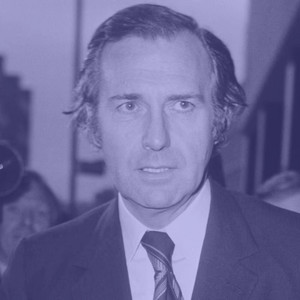
I'm Alistair Bunch and today we are going to be talking about the story of a man called JohnStonehouse.
Being was a charismatic Britishpolitician, once even tipped to be PrimeMinister, who made a series of very baddecisions.
I won't give too muchaway, but this is a story that involvespolitics, the ColdWar, sexualaffairs,secrets,spies, a beach inMiami, andmore.
But before we get right into this almost unbelievablestory, I want to remind you that you can become a member of Leonardo English and follow along with the interactive transcript and subtitles over on thewebsite, which isLeonardoEnglish.com.
Membership of Leonardo English gives you access to all of our learningmaterials, including instant translations in 12languages, studypacks, all of our bonusepisodes, andmuch, muchmore.
So, if you are ready to take the next step on your English learningjourney, the place to go isLeonardoEnglish.com.
OKthen, the story of JohnStonehouse.
In the winter of1974, Britain was a nation grappling with uncertainty andupheaval.
It was a time of economic strife and politicalinstability, which saw two general elections in the sameyear.
Neighbors Harold Wilson had managed to secure a tenuous grip on power inOctober, following a hung parliament inFebruary.
The specter of industrial action loomedlarge, with minus strikes crippling the nation and leading to the implementation of the three-day working week in an attempt to conserveelectricity.
Amidst this backdrop ofturmoil, two high-profile disappearances captured the public's imagination and dominated newspaperheadlines.
The first was one you may remember from episode number354, or indeed from a recent interview I did on Luke's Englishpodcast, that of LordLuke.
He was the aristocratic gambler who vanished in November1974, following the brutal murder of his children'snanny, SandraRivet.
Luke's car was foundabandoned, spattered withblood, but the man himself seemed to have vanished into thinair.
Just twelve dayslater, in November1974, the nation was stunned once more when JohnStonehouse, a former Labour Minister andMP, mysteriouslydisappeared.
Stonehouse was presumeddrowned, or even eaten bysharks, after his clothes were found neatly folded on a MiamiBeach.
Both men had disappeared into thinair.
Have they died at sea in tragicaccidents?
Have they killed themselves out of shame of what they haddone, or was there anotherexplanation?
The case of John Stonehouse seemed to be moreclear-cut, moreobvious, and indeed he was declareddead, and his obituary was published in thenewspapers.
The case of Lord Luke was lessso, and he was the chief suspect in a brutalmurder.
These around the world were told to keep a lookout for atall, handsome British man with asmooth, polishedaccent.
He might have changedappearance, he might have even changedname, and he would probably be behaving in an unusualway.
On the other side of theworld, inMelbourne,Australia, in December of1974, a bank clerk did notice something a littleodd.
A tall and handsome British man had come into the bank one day and made a largewithdrawal, only to stroll across the street and go into anotherbank.
The man had given his name as CliveMildune, and he seemed to have all the requireddocuments, but something seemedoff, something just didn't feelright.
She asked around and heard from an associate working in the other bank that the tall Englishman had given his name as JosephMarkham, not CliveMildune, but again he seemed to have all the requireddocuments.
But Teller had read about the murdered nanny and the fugitive British aristocrat and suspected Clive Mildune and Joseph Markham were in fact LordLuke.
She called the police and several days later the tall handsome man was tracked down and stopped by thepolice.
The Australians had contacted their British counterparts before making the arrest to ask how they could confirm whether it was indeed LordLuke.
There was a way they had beentold.
Ask him to pull down his trousers that British police instructedthem.
Luke had a largeskull, 30 centimetres long on his rightthigh.
Nobody could cover thatup.
Find the skull and you foundLuke.
So the Australian police plighted the ass of thisman, CliveMildune, to pull down histrousers.
To their surprise there was noskull.
The man was not LordLuke, but if he wasn't the disappeared suspectedmurderer, who washe?
It was only after they consulted photographs of the other high profile disappearance that year that they made theconnection.
Clive Mildune was the spittingimage.
He was an exact match for JohnStonehouse, the Labour politician who had either drowned or been eaten by sharks off the coast of Miami a monthprior.
On furtherquestioning, Clive Mildunecracked, or rather John Stonehouse admitted that there was noMildune.
He had faked his own death and had been living in Australia under a fakename.
He was brought back toBritain.
Bizarrely was allowed to continue as a member of Parliament before being sent to prison a year and a halflater.
And tothink, this was a man who many had tipped to become the British PrimeMinister.
According to his universityclassmates, he had had his eyes set on the top job since he was a youngman.
He came from a politically activefamily.
His father was a trade union leader and his mother was the mayor ofSouthampton, a city on the south coast ofEngland.
John Stonehouse had strong political beliefs from a young age and joined the British Labour Party at the age of16.
After a stint in Uganda where he worked with corporatebusinesses, he entered the world of politics and successfully won a seat as anMP, a member of Parliament at the age of32.
He wascharismatic, decisive andprincipled.
People hung on his every word and soon he found that people clung tohim, believing that this was not just a future leader of the LabourParty, but a future British PrimeMinister.
His political rise was not stellar but he was rewarded with increasingresponsibility.
He became the Minister of States for technology and then something called the PostmasterGeneral, which was a political role related to the postoffice.
When the Labour Party then lost the election in1970, his ministerial career wasover, but he remained a member ofParliament, representing the constituency of Wensbury in NorthBirmingham.
He also had a busy life outsidepolitics.
He had gotten involved in numerous businessinterests, even attempting to start his own bank and profit from London's propertyboom.
He was well known around London for his snappystyle, being welldressed, good looking andstylish, and he had all of the trimmings of a wealthy and successfulbusinessman.
But a combination of bad luck and poor judgement had meant that several of these businesses were heavily in debt and Stonehouse owed today's equivalent of millions ofpounds.
He might have looked thepart, but his finances were amess.
On a personallevel, he had also made some baddecisions.
He had been married since1948, since he was23.
His wife had stood by him while he pursued his politicalambitions, and the pair had two daughterstogether.
But sometime in the late1960s, he started an affair with hissecretary, a woman 21 years hisjunior.
His wife had discovered theaffair, was understandablyfurious, and had threatened to leavehim.
So he was in deep financialtrouble.
His marriage was instatus, and he was having a now open affair with hissecretary, who he had refused to leave even after his wife had discovered theaffair.
His political ambitions had also beenscuppard, they wereover, because the then Labourleader, HaroldWilson, had decided that Stonehouse wascorruptible, that he could becorrupted.
And it is here that we must go into some controversialterritory.
It would later be alleged that Stonehouse had been spying for Czechoslovakia since the late1960s.
He had been passing the Czechs information about Britishtechnology.
He had been asking questions in Parliament that his Czech handlers had passedhim.
He was a fool onspy, although he was never agreed how effective a spy hewas.
Hehad,reportedly, been targeted right at the start of his politicalcareer, because the Czechoslovakian intelligence agency had thought that this was a man who was on thetop, someone whocould, intheory, ascend right to the top of Britishpolitics, becoming PrimeMinister.
If they got himyoung, then by the time he was at thetop, he would be an invaluableasset.
Hehad,again, reportedly beencompromised, because Czechoslovakian intelligence agents had taken photographs of him in bed with anotherwoman, and had threatened to show these to hiswife.
What'smore, they had paid himhandsomely, which partially helped explain his unusually lavishlifestyle.
Now, I should add that he always deniedthis, and his daughter vehemently denied it in a book from2021.
He was nospy, shesays. He was arabid,anti-communist, and the claims that he was one come from his politicalenemies.
Unfortunately, forStonehouse, and for hisdaughter, there is some evidence to suggest that he was passing secrets to theCzechs.
There is a photograph of him strolling around London with a well-known Czechspy, and there is the testimony of a high-ranking Czech spy who had no discernible motive tolie.
Anyway, spy or nospy, John Stonehouse was in a bit of a pickle by1974.
He was drowning indebt, and was at risk of having to declare personalbankruptcy.
And the UK isn't quite as forgiving as countries like the United States when it comes tobankruptcy.
If you declare bankruptcy in theUK, there are several things you cannotdo, including Starrant as anMP, as a member ofparliament.
So this was the backdrop to the disappearance of JohnStonehouse.
He was on holiday in Miami in November of1974.
He has had lunch with a businessassociate, and the pair had arranged to meet in the bar later that evening for a drink beforedinner.
Stonehouse had told his friend that he was going to go for a quickswim, and then perhaps do a bit of shopping for his wife andkids.
His afternoon turned toevening, and his friend sat waiting in thebar, but there was no sign ofStonehouse.
His friend askedaround, and the last anyone had seen of him was at about 4pm at the hotel's privatebeach.
Stonehouse was in his swimmingtrunks.
He had handed his clothes to an attendant and waited out into the crystal clearwater.
And that was the last anyone had seen ofhim, until he was apprehended on the other side of the world in Melbourne just over a monthlater.
It's now believed that he swam a little out into thewater, and then swam along the shore to the beach of anotherhotel, retrieved his getawaykit, which he had stashedearlier, and then made a beelinefor.
He rushed to MiamiAirport.
He had a series of fakeidentities, which he had created from recently deceased members of hisconstituency, so he was able to get onto flightsundetected.
And when he was finally apprehended inAustralia, he insisted that he had done nothingwrong.
He said that he had been suffering a psychotic episode in which he was trying to escape the problems athome, and that he had tried to commit psychiatricsuicide, killing the identity of JohnStonehouse, and resurrecting himself with a completely newidentity.
Few people bought thisexcuse.
After some tense diplomaticnegotiations, he was eventually ex-righted to Britain in July of1975, eight months after he was found inMelbourne.
And there was this utterly bizarresituation, in which he was both on trial for the crime ofconspiracy, fraud andtheft, and acting as anMP, a member ofparliament.
Under normalcircumstances, the Labour Party would have most likely dismissed himimmediately, but they had a very small majority inparliament, a majority of only threeMPs.
It was a very tensesituation, and although he might have committed a seriouscrime, they couldn't risk losing him as anMP, otherwise they risked losing politicalpower.
Stonehouse clearly thought that he was going to get away withit, and he even proudly announced at his criminal trial that he didn't need to be represented by a professionallawyer, despite having no legaltraining, he was going to representhimself.
It didn'twork. He was found guilty and sent toprison, and this had a knock on consequences for Britishpolitics.
It meant that he had to resign as anMP, Labour lost its majority and had to form a coalition with theLiberals, which some argue cleared the path for Margaret Thatcher's route topower.
He ended up serving just three years inprison, and was released early because of good behaviour and healthproblems.
He died in 1988 at the age of62, and to his last breath he insisted he had done nothingwrong, and that he certainly had not been achecksby.
Whether this is true ornot, I can't tellyou, but what is undoubtedly true is that this is the story of a man who could have had itall, perhaps would have had itall, now managed to blow it in the most spectacularfashion.
He said he'd been overwhelmed and had created a parallel personality forhimself.
It certainly seems that he lost all grip onreality.
He assumed that he could keep both his marriage and hislover, that he could start a new life for himselfunnoticed, that he could simply kill John Stonehouse and reemerge as CliveNildune.
Perhaps the greatest example of his losing all grip on reality was that he thought he would get away withit.
Okaythen, that is it for today's episode on JohnStonehouse, the potential future prime minister who faked his owndeath.
I hope it's been an interestingone, and that you've learned somethingnew.
Asalways, I would love to know what you thought of thisepisode, are there similar stories of politicians getting into trouble and resorting to desperate measures in yourcountry?
For the members amongyou, you can head right into our communityforum, which is at community.linadowenglish.com and get chatting away to other curiousminds.
And as a finalreminder, if you enjoy this episode and you're wondering where to get all of our bonusepisodes, plus the interactivetranscripts, subtitles and keyboardcapery, then the place to go for thatislinadowenglish.com, and if you aren't yet ready to become amember, but you would like to do something to support theshow, then I would love for you to think about leaving areview, boy starrating, on your favourite podcastapp.
It takes less than 30 seconds todo, but they are superhelpful, and each one brings a smile to myface.
You've been listening to English Learning for Curious Mines byLionadowenglish.