Hello, hello, hello, and welcome to English Learning for Curious Mines by Leonardo English,
the show where you can listen to fascinating stories and learn weird and wonderful things
about the world at the same time as improving your English.
I'm Alistair Budge and today is the start of a new three-part mini-series on thinkers
and philosophers.
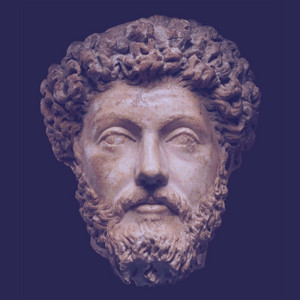
In part one, in this episode, we'll talk about Marcus Orrillis, the so-called philosopher
emperor.
In part two, which is going to be one of our member-only bonus episodes, we'll talk about
a gloomy German, the so-called philosopher of pessimism, Arthur Schopenhauer.
And in part three, we will talk about Iron Rand, the self-proclaimed radical for capitalism.
They are all very different people, with very different outlooks of life.
So I hope this mini-series will provide you with some interesting variety on how these
individuals saw the world.
Okay then, Marcus Orrillis, the philosopher emperor.
It might sound like the world's greatest understatement, to say that a lot has changed
since the year 80-170.
Clearly, a lot has changed.
It has been almost 2,000 years.
About millions of people around the world, perhaps more accurately tens of millions, or even
hundreds of millions of people, find themselves turning to the words of a man from the second
century.
To be precise, they find themselves turning to the philosophy of Marcus Orrillis, the
last of the so-called five good Roman emperors.
Those of his philosophical musings, meditations, have boomed in recent years, going from
a mere 16,000 in 2012 to more than 100,000 by 2019, the last year that figures were released.
And judging by how many posts and videos that are all over Twitter, Instagram and TikTok,
that number is presumably a lot higher in 2024.
The interesting thing is that meditations, this now best-selling book, wasn't even written
as a book.
It wasn't intended for public consumption.
It was Marcus Orrillis' own notes to himself.
It wasn't even called meditations, and wasn't published and made available to the public
until the 16th century, 1,400 years after its author's death.
Now let me tell you a bit about the man Marcus Orrillis before we go on to his philosophy.
He was born in AD 121, in a time of relative peace, at least if you were a Roman.
He became emperor shortly before his 40th birthday.
And this transition to emperor did not come as a surprise.
He'd been groomed for it from a young man, and had had plenty of time to contemplate
what such power would entail.
And if you know anything about Roman emperors, it's that very few managed to resist the
temptations that this power afforded them.
Tiberius, Caligua and Nero, these are all names of men who were completely corrupted by
the power of Rome, and who did truly atrocious things.
But Marcus Orrillis was different.
There were no orgies, incest, executions of family members or declarations that he was
a god.
The path he chose was of simplicity, of striving above everything else to live a virtuous life.
We know from historical records that Marcus Orrillis was considered to be a good man and
a benevolent emperor, but to really understand why he behaved in this way, especially when
so many other Roman emperors didn't.
We need to look at meditations, his writings on his philosophical outlook on life.
It's here that we can understand the why.
Now, the first thing to underline about meditations is that the major difference between it and
other philosophical works is that it was never intended to be published.
Marcus Orrillis might be known as a modern philosopher, but in life he was an emperor,
not a philosopher.
Meditations was Marcus Orrillis' personal notes to himself, kind of like a diary, but
without the today I did this.
It was more his own account of how to be human, of what the purpose of life truly is.
So this gives it an authenticity that is unusual.
Orrillis wasn't trying to impress anyone.
He wasn't trying to debate or argue or make complicated philosophical arguments.
He was writing down these thoughts for one person and one person only.
I should add that if you haven't read meditations, it is pretty short and accessible.
Something like 150 pages, spread over 12 different short books, which you don't have to
read in order.
So pick up a copy if this sounds like an idea that you would like to explore further.
Right, let's go through five key ideas and themes that you can find in meditations.
The first and perhaps overriding idea in meditations is about what you can control in life and
what you can't and how that should impact your behaviour.
Orrillis writes about how external events are beyond our control and therefore it is
pointless worrying about them.
If there is a tsunami on the other side of the world or a stranger insults you or you
are stung by a bee, there is no point in getting angry or upset.
You have no control over these events.
They are outside your sphere of influence and worrying about them can bring you unnecessary
distress.
What you should focus on instead is on what you can control, your actions and behaviour
and your reaction to external events.
And if you cannot do anything about something that has already happened, there is no value
in worrying about it.
The second idea in meditations is about the importance of living according to nature.
Now this doesn't mean going out into nature and putting up a house of sticks, it is to
do with the natural laws of the universe.
Marcus Orrillis believed that every individual has a role to play in the cosmos.
He's Gavernectum, sheep, eagross, fish swim around in the rivers and seas and do whatever
fish do.
Four humans living according to nature means behaving in a way that is rational and virtuous,
aligning one's actions with the inherent rational structure of the universe.
There is a right way to behave according to Marcus Orrillis and this way is by helping
and cooperating with other people.
Our purpose, our role in the world is to use reason to understand nature and live by its
principles.
The third theme explored in meditations is the practice of reflection and self-examination.
Orrillis advocates for a life of continuous self-assessment and visions over your own
thoughts and actions.
He writes about the importance of questioning your impulses and desires, to ensure they
are rooted in reason and not in fleeting emotions or external pressures.
This introspection helps to cultivate a disciplined mind and leads to greater personal integrity
and inner peace.
In other words, when you feel like you want to do something, ask yourself, why?
Is there a good reason for it or are you acting on instinct or because you are being pressured
into doing something that you would not do if you were thinking rationally?
The fourth major idea is the acceptance of fate or to be precise to embrace and welcome
fate, and more fatty for the Latinists among you, a love of one's fate.
Use Orrillis writes that we should embrace whatever happens to us, even suffering and
adversity, as necessary parts of the universe's plan.
This does not mean we are all passive, thropping over and accepting whatever life throws at
us.
Instead, it's an encouragement to face challenges with courage and to find meaning in them,
rather than getting upset or trying to avoid them.
Finally, the fifth key idea in meditations is the concept of impermanence and mortality.
Orrillis repeatedly reminds himself of the transient nature of life, urging himself to
focus on living virtuously in the present moment without attachment to material things
or external recognition.
This awareness of mortality is meant to heighten the appreciation of life and the urgency
to live well, as everything and everyone is subject to the inevitable decay of time.
Now, that is clearly a very abridged version of some of the key ideas in meditations, and
as I said, I'd certainly encourage you to pick up a copy if you'd like to explore
these further.
If you hadn't heard these before, perhaps you might be thinking, well, it's easy enough
for him to say that we shouldn't worry about events beyond our control and that we
should accept whatever life throws at us.
He was Roman Emperor after all, I guess, he didn't have to worry about all that much.
Yes, on one level, you're right, he was Roman Emperor.
And he didn't have to worry about putting enough food on the table, but his life was full
of managing conflicts, dealing with rivalries and managing, pretty successful, I should
add, one of the largest empires of all time.
But it's worth remembering a few things.
Firstly, as we've said multiple times, Marcus Aurelius was not writing this for anyone
other than himself.
He was not trying to preach to anyone and tell them what they should do.
When he wrote, you should do this.
The reader he was referring to was not me, was not you, it was himself.
And in meditations, he does not claim to be a paradigm of virtue and to always live
by his own rules and guidelines.
That's exactly the point.
He is at times weak and he struggles to live by his own rules.
He writes about how he finds it difficult to get out of bed in the morning.
He writes about his own moments of frustration with others, his impatience with servants,
and about the temptations that he faces.
When he realizes that he is displayed arrogance or anger, he recognises it and warns himself
not to do it again.
That's precisely why he needs these guidelines, so that he can constantly refer back to them
and remind himself what the virtuous course of action is.
And when you read about his advice to embrace suffering rather than to get upset, you
might think, well, he probably never really suffered or experienced any real pain.
No, he also experienced great pain and suffering in his personal life.
He had 13 children, but he lost 9 of them in childhood, only 4 of his children survived.
He is completely unbearable for any parent to contemplate using any child, but to think
that this man went through it 9 times.
Yes, infant mortality was significantly higher back then, but it shows remarkable character
that he did not allow these 9 heartbreaking experiences to change his philosophy and
outlook on life, instead reminding himself that he should embrace fate and not allow
it to break him.
Now you heard that Marcus Aurelius is enjoying a large resurgence in the 21st century, as
is stoicism, the ancient Greek philosophy from which a lot of these ideas come from.
As to the question of why?
Well, perhaps you've been listening to this, and you've been nodding along thinking, yes,
that makes sense.
But in that case, you can probably understand why.
These philosophy and writings are very accessible.
Unlike more traditional philosophers, Aurelius didn't deal in dense theoretical concepts,
but practical advice rooted in principles like resilience, acceptance of fate, and consciousness
of mortality.
It is pragmatic, easy to understand, and easy to follow, or at least if you are prepared
to go the lengths to follow it, it is easy to follow.
Secondly, this accessibility and bite-sized nature is almost perfectly applicable to
the way in which many people consume information nowadays.
Instead of lengthy philosophical papers, people want sound bites, short sentences that
can be put on a social media post or short video.
Clearly, Marcus Aurelius was not writing for an audience with a short attention span,
but his world outlook was strangely enough, perfectly crafted for the TikTok generation.
Thirdly, it is authentic and raw.
As you heard, he never claims to be perfect, and meditations is full of his personal struggles
to live a good and virtuous life.
Anyone reading this can empathize.
We all struggle to do the right thing.
To wrap things up, meditations serves as a timeless reminder that no station in life
is immune to suffering, and that everyone, no matter how different, no matter how rich
and powerful, struggles with the same things, temptations, making bad decisions, even getting
out of bed in the morning.
The only thing we can do as Marcus Aurelius wrote is understand what we can control and
what we cannot and do our best to live a virtuous life.
We won't always manage, but we must try.
That is the key to inner peace if you ask Marcus Aurelius.
So to leave you with a quote from meditations, you have power over your mind, not outside
events.
Realise this, and you will find strength.
OK, that is it for today's episode on Marcus Aurelius.
I hope it's been an interesting one, and that it might have inspired you to go and pick
up a copy of meditations.
Read in your language, or even read it in English.
The language is remarkably accessible, so you can learn some philosophy and some English
at the same time.
As a quick reminder, this is going to be followed up by another couple of philosophical episodes.
Next up, in one of our member only episodes, we'll be learning about Arthur Schopenhauer,
the so-called philosopher of pessimism.
And then in part three, it will be on the Queen of Capitalism I round.
And talking about bonus episodes, if you're wondering where you can get, are more than
250 bonus episodes, plus the interactive transcripts, subtitles and Keevo Cabri, then
the place to go for that is LeonardoEnglish.com.
And if you aren't yet ready to become a member, but you would like to do something to support
the show, then I would love for you to think about leaving a review or a star rating on
your favourite podcast app.
It takes less than 30 seconds to do, but they are super helpful, and each one brings a
smile to my face.
You've been listening to English Learning for Curious Minds by LeonardoEnglish.
I'm Alistair Budge, you stay safe, and I'll catch you in the next episode.