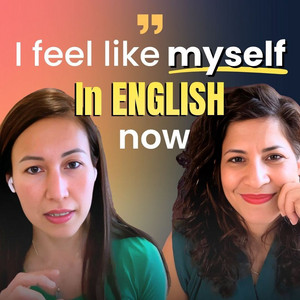
Hey everyone, thank you so much for joining me.
In today's episode, you are going to listen to a conversation I had with Luciana, my student.
Luciana, originally from Brazil, now lives in Portugal, is going to share with you her fluency journey.
And the challenges that she faced on her way to becoming more confident, more expressive and also landing a job in English.
But not just any job the job of her dreams.
She's going to talk about all the things that she did and all the mindset shifts that she had to make and the advantages of a non-native speaker in the global world that we live in.
This is going to be such an interesting conversation, so let's go ahead and listen.
Hi, Luciana.
How are you doing?
Hey, Hadar.
I'm doing great.
I'm really excited to be here.
How are you?
I'm good.
I'm good.
You're not as excited as me having the opportunity to speak with you and to hear a little bit more about your story.
So thank you for making the time to come here and talk today.
It's a pleasure.
So for those who don't know you, who are not our students and who don't know you, give us kind of like the background of who you are and why you started your English journey to begin with, where you're from and all your backstory.
Yeah.
So my name is Luciana.
I'm originally from Brazil and I currently live in Portugal.
I've been living here for more than six years and my first language is Portuguese, and Portuguese is what I use in my daily life.
However, I needed English for work, so I will tell how it was.
More about me is that I'm 42 years old, I'm married and my hobbies are some sports, gym and also doing creative things like drawing, creating videos, creating scripts.
I really like to create stories and i work as a ux designer and so i work with websites and apps and we make the visual part and also the user experience.
That is related to empathy, to understand the user journey what is the best way to help them to reach their goals using an app or website?
And it's a kind of work that have many international opportunities.
So when I learned that if I could speak English fluently, I would have many more opportunities and chances, I thought I think I should invest in this so I can apply for better jobs and have better salary.
And I started applying, but I got a freelance job and I was really struggling, really having a hard time during meetings.
I got stuck.
I felt really awkward when I needed to speak English and also my listening skills weren't so good.
And why is that?
I thought, I know English.
I can understand English.
What is happening?
Is that because in school we stood for tests and the tests are mainly read and write, or read and choose an option from multiple choices?
We barely practiced speaking.
So in real life, you need to speak a lot.
And I thought, oh, no, I wish it was everything through Slack, through messages.
Why do I need to speak?
It's so hard.
And I am a good designer, but I'm not doing my job well because I can't speak English very well.
So I started looking for programs for ways to improve my English.
At first, the internet has a lot of free content.
So I started watching many contents about English and listening to podcasts and reading blogs.
But...
This was actually illusion of learning.
I was immersing myself in English, but I wasn't being active.
Everything was passive, so I wasn't making any progress.
I thought no, I spent most of my time thinking about this, learning about this, but not actively practicing.
Yeah.
So I thought, no, I need to work with real people.
So let's look for a paid program.
And I found some.
And before joining New Sound, I went to four different programs.
And they were good.
They had good content, good exercises, but they are not engaging for me.
They weren't working for me.
I felt it was like homework, an obligation.
So I had a weekly meeting with a coach, but I thought, oh no, again.
And I felt relieved when she canceled sometimes the meeting.
It was not pleasant for me.
I still was feeling awkward when I had to speak in English.
And again, I wasn't making progress.
I needed English to work, but I didn't feel it was working for me.
But then I found your channel on YouTube.
I found a video about pronunciation.
And when you said that you are a non-native speaker of English and also that you learned pronunciation as an adult, Then I think wow, so it's possible.
I thought that to speak fluently like this, with a good pronunciation, I needed to learn as a child, really young age, or I needed to be immersed in an English-speaking country.
So I would have many opportunities.
That was the only way.
The way that I am more than 40 years old and living in a country that the main language is not English, I believed that it wasn't possible to reach a good level.
But then I saw your video, I subscribed, and I started listening to your podcast.
And I went to your website.
New Sound wasn't open.
I put my name in the wish list.
And I listened to an episode where some students gave their testimonials.
And I remember they talked a lot about the community, how they were, the program was engaging, the exercises they were willing to do their exercises every day, and also the results.
I couldn't listen that.
They were speaking very well and some of them are brazilian, like me, so they have the same background and they were having great results.
So I thought yeah, it sounds incredible.
Maybe they are exaggerating, but let's see.
So when New Sound opened, I thought, I think I should try again.
I tried four times.
It didn't work.
But let's give myself this chance because there's something different about this program.
So I need to try.
And the four times that you try the courses that you've taken before, were they about pronunciation at all?
Or was it just like you said you had the private coaching and that you have, or was this the first time that you were actually considering pronunciation work?
One of them was about pronunciation with a native speaker.
And yeah, it was really a good program, but there wasn't a community.
So the social part was zero.
And the lessons were too much.
We have this in our website.
You watch in the order you want and not so many live classes.
And so it relies a lot on the self-accountability, on discipline, and we are all too busy to fit another thing in our schedule.
Let's talk about that for a second, because I think, as you're describing your journey, like knowing you and seeing your work one of the things that I can attest is that you have taken consistent action right.
Like you showed up when come rain or come shine, right?
Like when it felt more successful and when it felt less successful, like you showed up, right?
Yeah.
And you did the work, and you did the mindset work, and you did the pronunciation work and you participated in the conversation groups.
And still technically, you know, you worked with a digital course with an online community.
It's not a face-to-face coaching, which is sometimes the assumption, is that only if you have like a teacher that teaches you one-on-one, then you'll be able to make progress.
Right.
So I want to ask you what is needed for a learner who's learning with an online product like with an online course.
So you do need to have a sense of discipline, but you said okay, this didn't work for me when I didn't have a plan and I didn't have a community.
And this has worked for me, being a new sound, which is my the signature pronunciation coaching program that we're talking about.
You've been a part of, you've also been a part of beyond, which is my English practice community.
What do you think is missing for most people?
Online courses that you found more helpful in New Sound and in Beyond.
So you said the community and the plan.
Can you elaborate more about that and why it's so important?
Yeah.
So I studied a little about human behavior, especially in apps and online products.
And I learned that we have two different the kind of motivators or core drives.
One of them is fear.
So we fear losing something or being behind others, or fear rejection, or we have a deadline so we need to hurry.
We fear missing the deadline.
We can be motivated by that.
But there is also another kind of motivator that is more positive.
That is autonomy creativity, community feeling that you are part of something greater than you mission, purpose.
And the first kind of motivator, the fear, is good for short term.
So you have a deadline, yeah, you hurry, you are laser focused to that.
The other kind of motivator is long term.
So if you are motivated by creativity or by the community, or ownership, that is yours.
So you want to make that the best possible.
It's long-term.
And I think I found many of the good motivators in New Sound.
There is the social part.
Everybody's supporting you and celebrating with you.
You feel progress.
I think it's very important.
I'm doing the exercises and I can see progress sometimes.
I can't see clear when I'm speaking, if I am doing one month of exercises of the course, but you can see progress in another way, so you see how much have you learned about pronunciation or how many lessons have you taken.
You can see look back and I gave so many steps until now.
This is a kind of way to see progress.
In my field, it's very important to show the user every time that they are making progress.
So they go until the end, they reach the goal.
I saw this in New Sound.
I felt that I was making progress.
I felt that I belonged to a community.
I felt that it's something greater than myself.
I felt that this is my English, this is my voice, so let's improve that kind of ownership.
And differently from...
The other motivators that I had before.
It was not fear that was motivating me anymore.
It was something positive.
Yeah, I love that so much.
And I think, you know, positivity and creativity are core values that we have.
Like we really want to make sure that people they don't operate just out of fear or not feeling good enough, which is very common for this industry, like the language learning industry, to operate from fear.
You know, kind of like you'll get punished if you don't speak well or make mistakes.
And this is not the direction that we're going.
And this is why also the community is comprised of people who share the same values.
And I love that.
I love, I feel like I'm getting feedback, not only from a student, but also from a UX designer.
And I'm like, okay, good.
Like we did something good there.
I want to talk about, because you had a very practical reason to start this journey, right?
Like it wasn't like nice to have it.
Like you knew that if you wanted to have a global or international job in the field that you love, speaking in English, you had to have that experience, that freedom and clarity and all of that around English.
So that has like, that has been a big motivator.
And I always say like we learn English not for the sake of learning English, but to For the sake of creating the best circumstances for our lives, right?
Like to improve our circumstances, financial, social, economical, right?
Like, so I think that that was a big part of your goal.
So talk...
Talk to me a little bit about that, and especially for people who think that because they speak English as a second language, they don't have a fair chance in today's global world.
And then what's the point of even investing?
And my English is not good enough, like, unless I sound like a native speaker.
So talk a little bit about working in a global market as a non-native speaker, in dealing with all those limiting beliefs and demons.
Mm-hmm.
Yeah, it's a very common limiting belief.
We think, I can't express myself so well in a second language as I can in my first language.
So, yes, you can.
You can work on this and become really good in expressing yourself in a second language.
And I first had experience working for companies in the US, so I was interacting mainly with native speakers and I saw that many respected this.
They think no, we were speaking very well.
Or you can convey your message in a second language, while I speak only one language.
So it's another layer of talent and we really respect that.
So don't be so afraid of this, of having an accent, or of showing that making some mistakes, because this is normal.
Being able to convey a message, a professional message, or even pass an interview, et cetera, is really something to be proud of.
And yes, you have a chance.
They are not...
They want people that communicate well, but they are not looking for perfect accent, because the important is the message, not really to speak like them.
If you want okay, it's great, but you have a chance even if you are not speaking like them, as long as you are clear, so you can really convey your message.
And now I'm working for another company that is in Europe and the common language, the language that we use, is English for every meeting, but there is no native speaker there.
So it's a very, it's rich.
It's interesting because there are people from Switzerland that speaks German and French and English.
There are people from Germany, from Austria, people from Portugal.
There are people from many different places.
Everybody speaking English and everybody understanding themselves and everybody in the same boat, because we can understand each other difficulties, challenges and we can Be very understanding with this.
If someone gets stuck with some words, how do I say this?
The other person will help because it's normal.
It's not a problem.
It's not what will make you not hireable.
Yeah.
Right.
Personality qualities.
And I think that you've written something in the show notes that stuck out to me.
It's kind of like The fact that you are a non-native speaker, the fact that you bring this experience you know, moving to Brazil, living in Portugal, speaking English, like really shows that you have a strong grasp of this of the world as it is now, where there are less boundaries.
And like when you think of online or when you think of our community, Like it's such a beautiful mix of languages and cultures and intentions and different people from around the world.
And I think this is where we're at.
And this also seeps into the workforce, right?
Like also global work and global companies.
Tell me a little bit about...
After doing all the work that you've done mindset pronunciation, constant conversation, taking action what are the things, except for you being able to work at a job that you love and you enjoy?
What are other things that you're doing now that you could never have imagined doing them a few years ago?
Yeah, many things.
It's incredible.
If I tell the story, people can believe that I was really an avoider.
I avoided speaking in English and sometimes in Portuguese, because I had a limiting belief that no one wants to listen to me.
I'm not that important, so i will be quiet.
And recording videos also.
It was something unimaginable.
I didn't like to see myself in a video, i didn't like my voice, so it was something that when i saw and i, when i joined the sound and i saw some People posting videos I thought I will never do that.
No, I'm fear of that.
But then I remember...
A member, Ivana, she asked me, let's go to a live together.
And I, oh no.
But then I thought, I'm here, so let's go.
Why not?
And the reception was really great.
People were watching.
They were supportive.
Ivana was great as well, making some very interesting questions, and then we practiced pronunciation together live, and I saw why not continue with this, and this is also a very good way to give feedback to myself so I can see.
Maybe I wasn't clear with this word.
Let's practice let's, let's repeat that and get the right pronunciation.
So recording videos, connecting to people from many different places in the world is incredible.
This is a great opportunity that a few people have to communicate with people that live in different countries and with different backgrounds.
Everything in a very positive way.
You can reach anyone and have a very pleasant conversation.
And also, I like the hosting experience that I couldn't imagine.
Speaking in public or teaching a lesson, skill sharing.
It was something that I thought, no, I am nervous.
Every time I am in a meeting, I get stuck.
I struggle.
How can I do that?
But deep down, I was dreaming with that.
Since I was young.
I remember I was a child and I was admiring people that could speak in public, or my teachers.
I thought it's very beautiful to be a teacher.
You are sharing knowledge with many people at the same time, but it's very challenging.
Imagine you are in the front, everybody's looking at you.
It's very challenging, but it's something that...
Someday I'm going to do.
And with the whole experience, I could do that, especially because I saw it was a safe environment.
It was not everybody will judge me, will point my mistakes every time, so I can't make any mistakes.
They were very supportive.
In my first session, the first time I hosted, they said I will try to be there.
And who could be there?
Really were supportive, welcome, and they...
It thanked me for the session that I remember.
It was about emotional vocabulary, that we need to know how to name our emotions to be able to deal with them.
And it was an unforgettable session.
And such an important topic, too.
Like, especially like, even in our native language.
To be able to name an emotion is not something that comes easily, definitely in a second language when there is also the language barrier.
So, for just for context, you started as a member, like in New Sound and then Inside Beyond the English practice community, where you participated in challenges, going live, making videos, joining conversation groups, and then you shifted into hosting your own conversation groups that are a huge hit in the community and your sketches and your videos.
So it's kind of like you almost became like a very dominant content creator inside the community right, working on that dream of speaking in public, sharing your thoughts, being able to speak confidently And being able to be yourself in public, which is, I think, like public speaking.
It's like really being able to be intimate or to express thoughts without thinking too much about how people want to perceive it or what people are going to think, and being able to do that in public, which I think you know.
I've seen your journey throughout the years.
And I'm like you know, like I've seen so much growth happen there in your work and in how you show up and in how you talk about yourself that I think that alone has been so inspiring for community members and now for probably, for people listening to this.
What would you say like for people who are really afraid of maybe, who don't know anything related to pronunciation?
Work Right.
Like, because you know my agenda.
Like I love pronunciation work, but not just because I think it's important to sound like a native speaker.
That is definitely not an incentive which is like the typical association when you think about accent work.
But to me, it really opens up speech.
It really allows you to understand others better, and it really helps with developing fluency.
So talk a little bit about that, how it has impacted your fluency, like how has pronunciation work impacted your fluency?
And what would you say to people who think that fluency is just luxury that you only do after you're fluent?
Yeah, it surprised me because first I thought no pronunciation is just something the cherry on the top.
I don't need that.
Yeah, exactly.
But yeah, when I started working on pronunciation, then I felt that speaking English could be more smooth, more relaxed, because you learn how to connect the words and you can improve your listening skills.
I think my listening skills improved a lot because when I know how to say, I know what to expect that others are saying and i can be much more clear.
I don't need to remove my accent completely.
But um, there are certain words that you need to know where to stress, or there are sounds that you need to know how to do, otherwise it can be mistaken by another word that is pretty similar.
So yeah, it helped me my listening skills.
It helped me to be clear.
It helped me to speak more fluently, smoothly, and not so chopped.
And also it gave me a lot of confidence because I feel that yes, I'm getting that sound, for example, the TH, that doesn't exist in my first language.
So it was really challenging, really strange to put the tongue in the teeth to make a sound.
But I practiced, practiced and when I got it, it gave me confidence to speak many different words and to feel fluently and know that now they will understand me.
You're not saying, I'm saying another word because I'm using a different sound.
So really develop that sense of confidence.
It's like a positive snowball, right?
Like, because then you're like, oh, I can make it.
And then that means that I can actually use more words.
So your vocabulary is a little bit bigger now because you're not limiting yourself because of pronunciation issues.
And because you have more confidence, you dare to speak more, right?
Yeah, exactly.
For example, TH is very common.
And I avoided saying number three.
Instead of saying three, I said... It's hard to go through life without the number three, you know?
Yeah.
So 3,000, I was avoiding because, no, there's a TH, THNR, THNR.
Two different and difficult sounds.
But then I thought my first language doesn't have this sound.
But if I repeat repeat repeat, I can get that because we all are humans and we have mouths and our mouths can learn how to make the sound.
Yeah.
And what would you tell people who struggle with showing up consistently?
What were the mindset blocks that you had to remove to be able to show up consistently?
I remember a day that really... was a game changer was when I was in a coaching session with you.
I asked for a hot seat and I said that I don't show up so much.
I don't speak so much because I think People don't like to listen to me, because I often get interrupted.
So I'm not meeting, I'm saying something and then I'm interrupted.
So people don't want to listen to me and I don't practice regularly.
I don't speak regularly.
And then you said, let's try thinking the opposite.
Instead of thinking that people don't want to listen to you, think that people are eager to listen to what I have to say, that your voice is important.
If I couldn't believe that, I told myself, let's make an experiment.
Let's try to think this way and act this way, act like it's true.
For a month, maybe, but as an experiment, I don't need to believe, but I need to act that way.
And that was game changer, because then I started participating more in the meetings, raising my hand and saying what I had to say.
And I liked that many times people said, well, you have a good point, good question.
Thanks for bringing this.
And I saw, well, so I will use my voice more often.
And regarding showing up regularly is I like to have routines.
I regularly go to the gym every day in the morning.
I feel that if I don't go, something is missing.
So the English practice also became a habit, like the gym.
I need to practice every day, do the sprints, and sometimes speak to people, have a conversation.
If I don't practice, well, there is something missing.
I don't know.
I need to do that.
Yeah, yeah.
Okay, so I have two things.
One about how you show up, and I think...
Something that people need to remember is that everything that you shared, like how I think about myself, determines how I show up in the actions that I take.
Therefore, trying to shift and trying to act according to the shift can be a game changer, which is what happened to you.
And I also think that when you think that you don't have anything interesting to say even though you do but when you're like oh, people are not interested, this is what you project.
And people feel it, right?
Like, and then they'll disregard or they won't listen.
Or like sometimes the point is not, does not come across because you don't even think that it is going to make a difference.
So people don't really hear you.
And therefore, and they respond to what they hear, because also people also think about themselves and about a billion other things than you and your English and what you have to say.
And in a world that is so populated with content and sort of like competition around ideas, Sometimes you need to advocate for yourself and be like no one's going to wait for me to speak right.
No one is going to be like hey, everyone just be quiet, because everyone wants to voice their opinion.
So sometimes we need to understand that if we want our voice to be heard, We can't wait for people to give us the microphone and speak.
We need to take up space, even though like, and that is hard work.
That is hard work, but we deserve it.
We were born worthy of speaking and having our voice be heard.
And I think that...
We can't give up that right that we were born with so easily because of the fear of what people are going to think about our English, you know.
It's like a birthright to speak and to make our voices heard.
And...
We need to honor that.
And I think that you making that shift is saying I deserve more, my voice deserves more and I'm going to be willing to feel uncomfortable to execute that right that I have right.
And that has become your habit.
And now you speak.
Yeah, and I think it's very beautiful how you put this, like a birthright.
We are all worthy and we have the right to use our voices.
So let's use that.
Yeah.
Let's use that and recognize all the things that are limiting us, whether it's other people's opinions, our thoughts about other people's opinions, having the wrong environment, not having an environment at all, not having a habit right.
Like to be like, okay, so if this is the essence of the work, like, or like the work in life, right?
Personal development, being able to express my voice in any language that I want that I choose right.
Like, okay, so let's reverse engineer it.
What needs to happen?
And really like everything that you shared.
You showing up consistently, you transforming your mindset, you being a part of the community and using the community to keep you accountable.
Doing the pronunciation work, like all of those things, have led to you being where you are now, which is you have a job that you love.
You are confident expressing yourself.
You have.
You use English as a creative outlet because you're like one of the most creative people I know and in the community.
And, and also like, I love how you don't take yourself too seriously.
And that what makes you so like, you know, and then you joke and then you make all these sketches.
And I think this is the asset.
It's almost like being able to tell jokes in a second language, where it's such a high level of confidence and fluency and trust in yourself and in others that allows you to make jokes or to show up really really, really like yourself.
Do you feel like yourself in English?
Yeah, today I feel, years ago I felt awkward every time I needed to speak English.
I thought, what's this sound that's coming out of my mouth?
It's so strange.
But now yes, I feel that I had many opportunities to make friends and to express myself and to say pass knowledge or acquire knowledge, to make connections.
And I think this is a person that was released.
You know, I now gave myself more permission.
Before I was blocking myself, even in my native language.
And now I have this person that wants to speak, wants to use their abilities and wants to share, and wants to connect.
So I feel like myself and I think I even like more myself nowadays because of this.
Yeah.
Before we wrap up, share with us a little bit about what your daily routine looks like when it comes to your English practice.
So in the morning I go to the gym and then I practice the daily sprints.
That is about 10 minutes of exercises.
Very good exercise to warm up our muscles, our speaking muscles and the pronunciation and our voice.
So I feel ready to start the day.
And I start working and I have meetings almost daily, every meeting in English.
So it's not really a practice because it's not intentional.
But I am using my English.
And then, if I have some time, I join a conversation group or a live class, or I host my conversation group.
I like to at least once or twice a week participate in a conversation group.
And I also have the passive learning, but I think it's good.
I watch everything in English and I listen to many podcasts and audio book in English.
Yeah.
Listen, I think passive learning is essential if combined with active learning, which obviously you do right.
Like if you do the sprints and you join conversation groups and you know, like when you learn something, when you listen to a podcast, you know to say it out loud and to kind of like, take note of it.
This is good passive learning and we're not just dependent on that.
Okay so, before we wrap up, one piece of advice that you would give someone who has been where you were three years ago.
So yeah, I remember that I was not considered a good communicator in my first language or second language when I was younger.
People said, no, that's not for you.
Imagine teaching or public speaking.
It's not for you.
You are very good writer.
And I developed my writing skills because of that, because I believed that I wasn't very good at speaking.
So let's write well.
So you're a very good writer, but you're not a good speaker.
So if there is something that someone needs to speak, ask another person.
That is more natural.
That have the communication skills.
And yes, it was difficult for me to develop this and maybe it took longer than for people that are younger or people that had more opportunities to practice.
But I want to say that difficult is not impossible.
You don't need to reach that so fast.
Direction is more important than speed.
Don't compare yourself with others.
I know that everybody says that, but it's really important to know that skills can be developed no matter your background.
You need to believe the work and believe yourself.
Even if your family or your friends, they don't believe in yourself, it doesn't matter.
You have to believe in yourself.
You are the only person that have to believe in yourself.
If you today are struggling with English, with pronunciation, feel that you get stuck every day When you try and you want to avoid this, know that there is a way out.
So you can practice.
It can take time, but you can reach that.
Believe that you can reach.
That is perfect.
Like, I love that.
And I want to reiterate things if someone missed it.
Difficult doesn't mean impossible and direction is more important than speed.
I feel like I want to write it down and have it posted everywhere.
Like that is so true about everything.
Definitely about English.
Luciana, thank you so, so much for this beautiful conversation.
But more than that, thank you so much for being a part of our community, for being a part, for letting us be a part of your journey, and for daring and for influencing other community members.
And I just wish for us to just keep going and keep exploring what's possible together.
And I love you very, very much.
And I already got to hug you in real life before, and I cannot wait for the next time.
Yeah, I hope it's soon.
And I thank you Hadar, for the opportunity to be here and also for all the positive impact that you have in my life and in others' lives, because I know that many people were impacted and they are much happier.
Like, I am very much happier today because of you.
Thank you.
Thank you so much.
Thank you, Luciana.
Thank you, Heather.