There are areas in your life where AI cannot help you, where you will still need to put in a lot of effort and work to get results.
Hey, you're listening to the Influency Podcast. I'm Hadar, your host, a pronunciation expert, fluency coach, and a proud non -native speaker.
speaker. With over 16 years of experience teaching, I am here to share with you all my secrets on how to show up in English clearly, with confidence and freedom.
On this podcast, I'll provide step -by -step strategies, lessons, stories, and practical tips to keep you inspired and motivated on your English journey.
Are you ready? Let's do it.
I want to tell you something interesting.
When TikTok just started and all of a sudden TikTok introduced those short form videos and then Instagram came out with their reels, I noticed something interesting.
As a content creator who creates YouTube content, and usually longer content, if you know my videos, 10, 12, 15, 20, and sometimes 30 minutes, I noticed that it was harder for people to get through longer content, and their attention span has changed.
Their ability to focus or to process information has completely changed.
And there is no right and wrong.
I just felt that this is how it was.
And recently, as I'm recording this in 2025, I'm noticing another trend and I want to share that with you.
After looking at my own industry, my students, my fellow business owners, other industries, I'm noticing something else.
I'm noticing that it's a lot harder for people to make a commitment, to finish programs courses, and to show up consistently.
And also, I feel like people are expecting results without wanting to put in all the work.
Let me explain. And let me tell you why I think that is.
So, over the past two years, AI has entered our lives.
And here's the amazing thing about AI.
I feel like it has completely 10x 'ed my abilities.
Everything that I was able to do before, now I can do faster and more.
whether it's processing information, searching for information, brainstorming ideas, or developing content, I can do more of what I was able to do in the past with the help of AI.
I'm actually teaching my students how to use AI to practice English effectively and getting better results with less time.
So I think that adding AI to your life is incredible, but also it develops the sense that you can achieve big things without working hard, which is true.
Like you can achieve big things without working as hard as you used to work before.
I just heard of someone who developed an app that helps people develop apps with ChatGPT, which is insane.
This was not possible before.
So where's the problem?
Here's what I think.
Because we've gotten to this experience of quick wins with less work, it almost feels like we want to experience that in other aspects of our lives.
And here's the rub.
There are areas in your life where AI cannot help you, where you will still need to put in a lot of effort and work to get results.
It can simplify your life, but it cannot replace certain things that you must have to be able to see the results that you want.
And we want to be mindful of that quick win, less effort, get results, not work so hard mentality that all of us developed thanks to AI and that has been extremely useful and helpful.
But we want to make sure that we understand where this does not work.
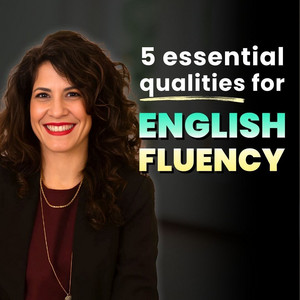
And today I want to talk to you about the five must -have qualities for you to master fluency that AI can help you with.
so let's get started the first one of course is consistency the ability to show up regularly for your English if English is your goal because at the end of the day if you want to improve you have to practice consistently ideally every day even if it's just 10 minutes a day as someone who's now learning Spanish I feel it in every part of my body if I don't do the work I'm not going to get results.
The work is easier thanks to AI, but if I don't sit down and do the work, if I don't manage my thoughts about finding time or managing my priorities or having the patience to sit down and do the work and managing the resistance that I have about doing the work, if I don't own that, then I won't be able to show up consistently and then I won't be able to practice, no matter how easy my practice has become.
So, being able to show up consistently is a quality that you have to develop and you won't get results, no matter how technology improves around us.
The next thing is a strong sense of purpose.
You need to know why you need to do this.
You need to want to do it.
You need to be motivated to do it.
Otherwise, you won't be able to stay consistent and you won't find joy in the work.
So you'll be working and it's going to feel ehh and generic and not interesting and you won't be able to get past the boredom.
You won't be able to get past the routine.
So having a strong sense of purpose and you can't ask JATGPT for what your purpose is, right?
You need to understand it yourself.
Is it because you want to create better circumstances for yourself and your family?
Is it because of your self -worth?
Is it because this is something that you have promised yourself that you're going to achieve and you want to prove to yourself that it's possible?
Do you want to move to a different country?
Do you want to study in English?
Do you want to work in English?
Whatever that is for you.
That is your sense of purpose.
And you are the only one who can come up with it and remind you of it and activate the motivation.
No robot or machine can do that for you.
The next quality is growth mindset.
Being able to work on your own confidence.
And confidence is a skill.
I always talk about it when it comes to being able to speak confidently in English, and you can develop it.
But the way to develop it is through your mindset, is understanding your thoughts, understanding how your thoughts affect your feelings, and how your feelings affect your actions.
And if you don't work on understanding the limiting beliefs that you have, the negative of self -talk, the judgment, self -judgment, the overthinking, and all the things that keep you small and limited, if you don't recognize that and deliberately work on that, you're not going to be able to show up no matter how good your English is.
You're going to be afraid to speak, you're going to be afraid of what people think of you, you're going to be afraid of not understanding others and all of these things can be solved or can be managed and improved if and when you work on your mindset yes you can improve your fluency yes you can practice your English but if you have a profound belief that people are going to make fun of you if you make mistakes or that they're going to think you're not intelligent or that you need to be perfect to be able to speak if you don't manage these thoughts and you understand what they do to you, how they
limit you, how they keep you small, and how they keep you quiet, if you don't understand that and start working on changing them or at least becoming aware and trusting that they are not true, if you don't do that work, no practice is going to give you the confidence that you want to connect and communicate.
And that That cannot happen with AI.
It can only happen with you doing the work.
Another must -have quality to master fluency is being able to understand subtext and nuances in conversation.
When we practice on our own or when we work with books or with AI, then a lot of times what happens is that we get really focused on the content and the structure and we forget that human interaction and human connection is so much more than what is said, right?
So, yes, maybe you'll be able to say something with the right grammatical structure and all the right words are going to be there.
But if you say it in a tone that might be perceived as aggressive or questioning or uncertain, it's going to impact your relationship with whoever it is that you're speaking to.
And it's going to really impact how you understand a situation.
If you don't know to recognize the tone of voice of sarcasm or anger or curiosity or friendliness, then you might be responding in a way that is not aligned with the actual situation.
These things are learned not through just texts and not through just lessons, sense, but through human interactions or by deliberately learning them, like I tried to do in the shadowing classes and intonation classes, where I teach you about the nuances and the tone of voice.
But if you don't learn that and practice it and pay attention to how people use their voice, if you don't do that and you don't think about it, then it's going to be really hard for you to succeed in conversations that are beyond the small talk and beyond the day -to -day you know, practical conversations.
So if you want to go deeper, you need to understand that subtext, that other aspect of communication, and you can only do that, again, through practice and intentional learning.
And usually that aspect when it comes to language learning is not covered by AI.
It's not something that AI could even detect because nuances and intonation and tone Tone of voice is like when something sounds angry or friendly or sarcastic or bored, right?
Even though you might be saying the same thing.
AI is not trained to detect that.
It is so profoundly human that only people who know the cues for this type of speech can understand the real meaning behind it.
Now, you can absolutely learn it, but like I said, this is something that you need to be intentional about and only you can do it as a human being.
And AI won't help you with that.
The last thing is authenticity.
AI is generic. People are not.
When you ask ChatGPT a question, usually it won't give you an answer with mistakes.
When you talk to people, they might respond with mistakes.
And while I know you want to be perfect and while I know you don't want to make mistakes, these things are the things that make you human.
They make you who you are.
We all make mistakes.
Native speakers make mistakes.
Perfection is not a goal.
Uniqueness is. And when you strive to have a generic voice and generic grammar and generic interaction, then what you lose is your authenticity.
And authenticity is something that only you have and you can bring to any situation.
It's your silly humor.
It's your voice when you're excited.
It's the silly mistake that you keep making even though you know that you're wrong, but it's always funny and you are able to joke about it.
It's the questions that you tend to ask that people don't usually get, and then you ask it again, and then people get it?
It's who you are and what you bring to the situation.
It's your accent. It's your strange grammar because you speak another language.
And that is okay because it means so much about you and how resourceful you are and resilient you are and how much you actually know because you speak more than one language.
That's what it means about you.
And if we think that AI can and help us perfect our English, I want you to remember this.
You don't need to be perfect.
And you don't want to sound like everyone else.
And you want to be okay with who you are.
Yes, you want to improve.
You want to understand better.
You want to be more expressive.
All of that is great.
I'm all about striving for more.
I'm a high achiever, just like you, so I know what it's like.
But you also need to be okay with who you are as you show up imperfectly because that is authenticity.
And the more okay you are with that, the more you can bring yourself to any conversation, the more natural you'll feel, the more authentic you'll feel.
And that is a combination of practice, trust, and mindset.
And with that, my friend, AI won't help you.
To wrap up, first of all, you're already awesome.
If you're here and you're you're learning and you're listening, you're doing the work, you're amazing, and I absolutely love you.
But you also need to remember that learning a second language, and not just learning it, owning it, mastering it, bringing yourself to the language, feeling like it belongs to you, it takes work.
And it's okay. This is our journey, okay?
It's okay. There are no shortcuts.
And even though there are incredible tools out there, there are a few things that you still need to do regularly.
What I want to do in this episode is to remind you that it's okay to feel like you're working hard sometimes.
It's okay for you to feel annoyed that you don't get quick results.
I want to remind you that this is just right.
What it is, the way your journey looks like is probably exactly how it needs to look like.
Just reflect and think how you can simplify things with ChatGPT, with AI, and also how you can work on yourself to strengthen these qualities that I talked about so that you can truly master fluency with a little bit of help and also consistent work.
I want you to know that I absolutely believe in you.
Now, if you want to learn more about how I can help you, then check out the description below.
I have a program called Beyond, where it's designed to help you reach your next level in English and master fluency.
In this program, we absolutely strengthen all these different qualities and also teach you all the content that you really need to level up your English, your confidence, and your freedom in English.
So check out the details in the description or the show notes if you're listening to the podcast. And in the meantime, just reflect on everything that I shared today.
And if you have have any thoughts, ideas, or if you absolutely disagree with me, please let me know in the comments or send me a private message on Instagram.
I'm at hadar .accentsway.
I would love, love, love to hear from you.
Have a beautiful, beautiful rest of the day, and I'll see you next week in the next video.
Bye.