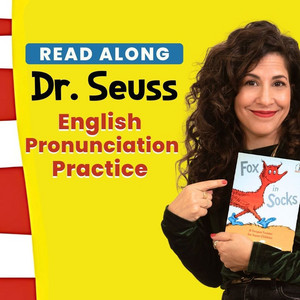
A tweedle, beadle, noodle, poodle, bottle, paddled, muddled, duddled, fuddled, wuddled, fox in socks, sir.
I am super excited for today's session because today we are going to read together Fox in Socks by Dr. Seuss.
One of my favorite books, really.
Hey, you're listening to the InFluency Podcast. I'm Hadar, your host, a pronunciation expert, fluency coach, and a proud non -native speaker.
With over 16 years of experience teaching, I am here to share with you all my secrets on how to show up in English clearly, with confidence and freedom.
On this podcast, I'll provide step -by -step strategies, lessons, stories, and practical tips to keep you inspired and motivated on your English journey.
Are you ready? Let's do it.
Hey everyone, it's Hadar.
Thank you so much for joining me.
I am super excited for today's session because today we are going to read together Box in Socks by Dr. Zeus.
One of my favorite books, really.
Fox in Socks is such a great book to practice pronunciation, explore the nuances and sounds, and definitely explore and enjoy the rhythm of English.
So today I'm going to read with you the entire book and explain specific things like sounds, intonation, melody, and also rhythm.
It's going to be great to improve your vowels, improve your pronunciation, and just have fun.
You don't have to have children to practice fox in socks with me.
I guarantee you are going to tap into your inner child and enjoy this practice with me.
So, close the door, turn the volume up, and let's get started.
In case you don't know me, my name is Hadar.
I'm a non -native speaker of English, I'm a speech and pronunciation and fluency coach and I'm here to help you speak English with clarity, confidence and freedom.
If you enjoy this lesson and you want to explore more lessons with me then go to hadarshemesh .com or follow me on social media where I share daily lessons with you.
Alright, so let's get started.
Fox in socks. Fox. Socks.
Box, Knox. These words are going to be repeated throughout the book.
Make sure you pronounce them clearly with the open A as in father sound, as it's pronounced in American English.
Fox. Socks. Box. Knox.
Relax your jaw. Knox in box.
Fox in socks. So notice here the rhythm.
person. When there is a content word, like a name or a noun, Nox and Fox, then it's stressed.
Box is stressed. In is a function word and it's reduced.
So we're going to say it quickly and not put a lot of effort there.
Nox and box, tah -dah -dah, fox and socks.
Now I'm teaching this to you right now because you'll see that pattern being repeated throughout the entire book, but also in English.
Nox on fox in socks in box.
Let's do it again because it's short.
Nox on fox in socks in box.
Socks on nox and nox in box.
Now, what you can do, by the way, you can pause the video after I read a line and then read after me.
The reason why it's good is because sometimes we were going to have long lines and it's going to be harder for you to follow if I pause myself for you to repeat, and the video is going to take 72 hours and we don't want that.
So let's do this part again.
Socks on knocks, and knocks in box.
Socks on knocks, and knocks in box.
Fox in socks. Unbox, unlocks.
Let's move to the I sound.
Practice the I, not i-, i -.
Chicks. Bricks. Chicks.
Bricks. Chicks. Bricks.
Let's do it. Chicks with bricks come.
Chicks with blocks come.
Chicks with bricks, and blocks, and clocks come.
them. Look, sir. Look.
Cook. Book. Shook. Look, sir.
Look, sir. Mr. Knox, sir.
Let's do tricks. Ih.
Tricks. Let's do tricks with bricks and blocks, sir.
Let's do tricks with chicks, and clocks, sir".
Now pause and repeat this.
First, I'll make a quick trick brick stack.
We're introducing the A sound.
So listen again. Quick ih, trick ih, brick ih, stack.
New sound. So every time we're introduced to a new sound and that sound starts to take over.
Okay? First, I'll make a quick trick brick stack.
Then, I'll make a quick trick block stack.
Block stack. Aah, aah.
You can make a quick trick chick stack.
Quick trick chick stack.
You can make a quick trick clock stack".
And here's a new trick, Mr. Knox.
Socks on chicks and chicks on fox.
Fox on clocks on bricks and blocks.
Da -da -da -da -da -da -da.
Let's do that part again.
Notice the rhythm. And also notice that I don't pronounce the word and fully.
It's short. En, en, en.
Okay. And here's a new trick, Mr. Knox.
K is not pronounced.
Socks on chicks and chicks on fox.
Fox on clocks on bricks and blocks.
Bricks and blocks on knocks on box.
Now we come to tics and talks, sir.
So again, we're still in the I and A.
i -o. TIK -tok. Tik -tok.
Tik -tok. Tik -tok. Now we come to ticks and talks, sir.
Try to say this. Mr. Knox, sir.
And you can connect it.
Mr. Knox, sir. Take a breath.
Clocks on fox tick.
Clocks on Knox talk.
Six -sick bricks tick.
You can say it again.
Six -sick bricks tick.
So now we're playing with consonants, not the vowels.
All the vowels are i, i, i, i.
Okay? And then the consonants around, shift, six, sick, bricks, tick.
Okay? So, one end with KS, and the other end with KK, six, sick, bricks, tick.
See the pattern? And then the last line, six, sick, chicks, talk.
Let's do this whole page again.
Clocks on Fox tick.
Clocks on Knox talk.
Six sick bricks tick.
Six sick chicks talk.
Pleaser. I don't like the strict, sir.
My tongue, tongue, tongue.
Don't pop the G. my tongue isn't quick or slick, Sir.
Quick -er slick. Quicker, quicker, quicker, quick or quicker slick, Sir.
I get all those ticks and clocks, Sir, mixed up with the chicks and talks, Sir.
I can't do it, Mr. Fox, Sir.
Pause and repeat. I'm so So sorry, Mr. Nox, sir.
Here's an easy game to play.
Here's an easy thing to say.
Are you ready? New socks, two socks.
Whose socks, Sue's socks.
Let's do it again. The rhythm changes.
Have you noticed? New socks, two socks.
The new sound that is introduced is the U as in food.
New socks. And you can also say new, both are correct.
New socks, two socks.
Whose socks? Sue's socks.
Who's so's whose socks.
So here's something really confusing.
The second word, to sew, right, is pronounced with the O as in go, even though the spelling looks like the U as in food.
food, it's deliberate.
We're trying to confuse you.
So, who sows whose socks?
Let's do it again. Who sows whose socks?
Sue sows Sue's socks.
This is a tricky one, so tense U, long Oh, and then we have the S sound that keeps popping up.
Who sews whose socks.
Sue sews Sue's socks.
Who sees who sew whose new socks, sir.
Let's do it again. Who sees who sew whose new socks, sir.
You see Sue sew Sue's new socks, sir.
Let's do that part again.
That's not easy, Mr. Fox sir." If you need to repeat it, pause the video, repeat the page, and let's move on.
Who comes? Crow comes.
Slow Joe Crow comes.
So, in the previous page, the sound O was introduced.
Now, the sound O takes over.
Who comes crow -o -o.
Crow comes slow -joe crow comes.
Who sews crow's clothes.
So here the word clothes has the TH sound, but actually you don't have to pronounce it so you can just say clothes, clothes.
Just like close the door and I'm wearing clothes.
Who sews crow's clothes.
Who sews crow's clothes.
Let's say it fast. Who sews crows clothes?
Who sews crows clothes?
Who sews crows clothes?
Good. Sue sews crows clothes.
Sue sews crows clothes.
Slow Joe Crow sews whose clothes, Sue's clothes.
Let's do it again. Slow Joe Crow sews whose clothes, Sue's clothes.
Do you feel your jaw a little?
Because I do. Su sews socks of fox and socks now.
Let's do it again. Su sews socks of fox and socks now.
Slow Joe Crow sew nocks and bocks now.
Slow Joe Crow, shadow me, sews nocks and bocks now.
Su sews rows on slow Joe Crow's clothes.
Let's do that part again.
Slowly. Pause the video when you need it.
Sue sews Rose on slow -jo crows' clothes.
Fox sews Hose on slow -jo crows' nose.
Now changing rhythm, repeat after me.
Hose goes, Rose grows, Nose hose goes some, Crow's rose grows some Mr. Fox.
I hate this game, sir.
This game makes my tongue quite lame, sir.
Mr. Knox, sir. What a shame, sir.
We'll find something new to do now.
Here is lots of new blue goo now.
Going back to the oo sound.
Oo, oo, nu, goo. So let's do that line again.
We'll find something new to do now.
Here's a lot of new blue goo now.
New goo, blue goo, gooey gooey, blue goo, nu goo, gluey gluey.
I hope no one can hear me outside this door.
Okay, going back to real text.
Goo -ee -goo for chewy chewing.
That's what that goo -goose is doing.
Do you choose to chew goo too, sir?
If, sir, you, sir, choose to chew, sir, with that goo goo's chew, sir, do, sir.
Mr Fox, sir. I won't do it.
I can't say it. I won't chew it.
Won't, won't, won't.
Let's do it again, because it's fun and easy.
Give me your attitude here, please.
Mr. Fox, sir, I won't do it.
I can't say it. I won't chew it.
Very well, sir. Step this way, we'll find another game to play.
Bim comes, Ben comes.
Bim brings Ben broom.
Bim broom. Ben brings bim broom.
i i i i, bim, ben. And then there is the M and the N.
For some speakers, this is going to be quite interesting.
Let's do it again. Bim comes, ben comes.
Bim brings ben broom, Ben brings bim broom.
You got this. Very good.
Let's continue. Portuguese speakers, I'm with you.
Bem bends, bems broom.
Bem bends, bems broom.
Bems bends. Bems bends.
Bems, bems broom breaks, bent broom.
The T is held. Bent broom.
So, bends bent broom breaks.
BIM's broom breaks.
BEN's band, BIM's band.
We're adding the A sound.
But the A before an N is a little bit like an E.
So it's a little different.
Eh Eh. Ben's band. Can you hear the difference?
BEN's band. BIM's band.
BIG band. PIG band.
BIM and BEN lead BANs with BROOMs. BEN 'S band BANs and BIM 'S band BOOMs. Do you get it?
Do you get what this means?
It's silly, but it has the meaning.
Like it makes sense.
BEN 'S band BANx and BIM 'S band BOOMs. Okay.
Different sounds. Different bands, different sounds, different people.
It's really important.
Big band, boom band, big band, broom band.
My poor mouth can't say that.
No, sir. My poor mouth is much too slow, sir.
Much too slow. Much too slow, sir.
Well, then. Bring your mouth this way.
I'll find it something it can say.
Take a breath. Especially you, Japanese speakers.
Luke Luck likes lakes.
Luke's duck likes lakes.
Luke Luck licks lakes.
Luke's duck licks lakes.
Let me explain. So, we're practicing the L sound.
L, l, l, and then we have the following sounds.
And it's tricky because of the spelling, because the spelling is the same, but the sounds are different.
Listen. Luke, u. Luck, u.
Likes, i. Lakes, ay.
So, if we're just L -U -Q -L -I -A.
Luke Luck likes lakes.
But then it changes.
Luke's duck likes lakes.
The vowels are the same but the consonants change.
Luke's luck licks lakes.
Now we have the i sound and then Luke's duck licks lakes.
Are you good? Are you still with me?
Stay until the end, okay?
You got this. You'll be proud of yourself at the end.
Duck takes slicks in lakes, Luke luck likes...
That's one of my favorite lines.
Duck takes slicks in lakes, Luke luck likes.
Luke luck takes slicks in lakes, duck likes.
So, Luke Luck is the name.
Like, first name, family name, right?
Luke Luck. Hi, my name is Luke Luck.
Right? And if you think of it like that, it's easier.
Duck takes licks. In lakes, Luke Luck likes.
Luke Luck takes licks.
In lakes, Duck likes.
I can't blab such blibber blubber.
My tongue isn't made of rubber.
Mr. Nox, now come now.
Come now. You don't have to be so dumb now.
I resent this word. And I just want to say you don't pronounce the B in the word dumb, but I shouldn't have used it.
Try to say this, Mr. Knox, please.
Okay, THs. If you don't have THs in your language, take a deep breath.
I got you. We're going to do it slowly.
I'll read one line and then you read right after me.
Through three cheese trees, three free fleas flew.
While these fleas flew, Freezie Breeze blew.
Freezie Breeze made these three trees freeze.
freeze. Freezy trees made these trees' cheese freeze.
That's what made these three free fleas sneeze.
Now pause it, and read it yourself, slowly.
Stop it, stop it. That's enough, sir.
I can't say. Such silly stuff, sir.
Very well, then, Mr. Knox, sir.
Very well, very well, Hindi speakers, Russian speakers, Ukrainian speakers.
Very well, very well, very well, Eastern European languages.
Very well, very well.
Very well, very well, Mr. Knox, sir.
Let's have a little talk about tweedle beetles.
Flap T and dark L. Are you ready?
Take a breath. What do you know about tweedle beetles?
Well, when tweedle beetles fight, it's called a tweedle beetle battle.
E .E. twee -r -l, roll, roll, roll.
So, it's like a R sound, light D, or like a very short R, like a tap, and then a dark L.
twee -r -l, twee -r -l, twee -r -l.
When twee -r -l beetles fight, it's called a twee -l beetle battle.
And when they battle in a puddle, cup puddle, it's a twee -l Tweedle -Beadle Puddle Battle.
I'm going to let you read that.
And, when Tweedle -Beatles battle with paddles in a puddle, they call it a Tweedle -Beatle Puddle Paddle Battle.
Pause the video and read that part.
And when Tweedle battle beetles in a puddle paddle battle And the beetle battle puddle is a puddle in a bottle.
They call this a tweedle, beetle, bottle, puddle, paddle, battle, muddle.
When beetles fight these battles in a bottle with their paddles and the bottles on a poodle and the poodle's eating noodles.
Just pause and repeat.
They call this, let's do it together.
I'm going to do it slowly and just follow me.
Don't make sense of it.
A muddle, puddle, Tweedle, poodle, beetle, noodle, bottle, paddle, battle.
You want to do it faster?
Let's do it. They call this a muddle, puddle, Tweedle, poodle, beetle, noodle, bottle, paddle, battle.
And, now wait a minute, Mr. Socks Fox, when the fox is in the bottle, where the Tweedle Beetles battle, with their paddles in a puddle, on a noodle eating poodle, this is what they call, a tweedle Beadle Noodle Poodle Bottled Paddled Muddled Duddled Fuddled Waddled Fox and Socks, Sir.
Fox and Socks, our game is done, Sir.
Thank you for a lot of fun, Sir.
And so is our practice, my friends.
Yes, it is. How are you feeling?
Did you enjoy it as much as I did, because I sure did practice recording this for you, except for some of the mispronunciations and outtakes I had, uh, this was such a great fun for me.
I used to read this book for my daughters all the time until they were like, mom, stop.
This is so annoying.
I was like, no, I want to continue.
And I tried to do it for myself more than for them, but then they won and I stopped reading it for them.
my daughter, Amalia, suggested that I do this for you guys, and then my team said, Hey, why don't you do fox in socks?
And I was like, I meant to do this.
So here I am recording this video for you.
I hope you enjoyed it.
I hope it wasn't too scary.
If it didn't make sense to you, it's okay.
It does not make sense.
Like technically it does, but it doesn't and you need to look at the drawings to and to understand what the heck you're actually saying.
But this is a great, great, great opportunity to practice rhythm, to practice pronunciation and that's it.
And to hang out with me, which is the main reason for why we are doing this, right?
If you'd like to practice pronunciation with me even more, go to my website, hadarshamesh .com.
And I also have a 14 day pronunciation plan if you'd like to dive deeper into practicing your pronunciation.
I have a lesson for you every single day with practice drills and audio recording, and it's completely free.
My 14 day pronunciation plan is available for you, so you can just click on the link below this video and download it.
If you're listening to the podcast, you can just click the link in the description and get the 14 day pronunciation plan, people absolutely love, love, love it.
And don't worry, we won't be practicing Dr. Seuss there.
Just other vicious pronunciation exercises that you're going to love.
All right. Have a beautiful, beautiful rest of the day.
Thank you so much for joining me.
And I will see you next week in the next video.
Now go take care of your tongue, okay?
Good. Bye.