Hello, hello, hello, and welcome to English Learning for Curious Bines by Leonardo English,
the show where you can listen to fascinating stories and learn weird and wonderful things
about the world at the same time as improving your English.
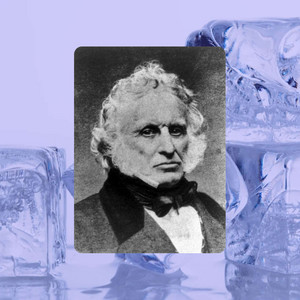
I'm Alistair Bunch and today we are going to be talking about a man called Frederick
Tudor.
He was a visionary in the true sense of a word and he single-handedly invented the global
ice transportation market.
It is a fascinating story of a man who most certainly deserves the nickname of the ice
king.
But before we get into this wonderful story, I want to remind you that you can become
a member of Leonardo English and follow along with the interactive transcript and subtitles
over on the website which is LeonardoEnglish.com. Membership of Leonardo English gives you access
to all of our learning materials including instant translations in 12 languages, study
packs, all of our bonus episodes and much much more.
So if you are ready to take the next step on your English learning journey, the place
to go is LeonardoEnglish.com.
Ok then, Frederick Tudor, the ice king.
There is an expression in English that someone could sell ice to the Eskimos.
It means that someone is a smooth and persuasive talker, that they could get anyone to do anything
they wanted even if it is against their best interests.
Eskimos, of course, have little need for ice.
People who live in the Arctic Circle are surrounded by more than enough ice if they want
it.
I imagine that the last thing anyone in sub-zero temperatures wants is an ice cold drink.
It would evidently be much easier to sell ice to someone living in a warm climate, someone
who would love a refreshing ice cold drink or who would benefit from ice's refrigerative
powers.
And in the days before industrial freezers, this was even more so.
People living in warm climates, especially those that weren't anywhere near mountain
ranges that might have snow or ice on them.
Well, they had no access to ice.
And further north, or also further south, I should add, large parts of the world were
covered in ice, or at least there were rivers and lakes that froze over every year, forming
huge masses of ice.
The only problem was getting this ice from where it occurred naturally to where it did
not.
It would take a brave person, a visionary, some might even say, to look at this challenge
and say, this is what I'm going to dedicate my life to solving.
This person's name was Frederick Tudor.
You may remember him from episode number 350 when we talked about the unusual names of cocktails.
He was born in Boston, Massachusetts in 1783, and by his death in 1864, he would have pioneered
the transport and sale of ice all over the world, earning himself the nickname of the ice
king.
He was born to a wealthy family and grew up partially in Boston and partially in a large
estate outside the city, where the family would spend the summers to escape the city heat
and get some fresh air.
As such, he had experienced first hand the benefits of having ice.
Boston is in the northeast of the United States, a region that gets very cold in winter and
enjoys warm summers.
In the grounds of the family's countryside residence, there was a large pond that always
froze over in the winter.
Ice would be cut from the pond and stored in an ice house, which was a sort of specially
designed insulated shed.
If the chunks of ice were large enough and they were cut into holes in the ground and
covered up, the ice would barely melt.
Allowing the family to use ice in the summer months when it was warmer.
This wasn't altogether unusual, and there were plenty of ice houses all over the north
eastern part of the country.
Ice would be harvested during the colder months and stored in these large warehouses, then
sold after businesses and individuals when the temperature rose in the summer.
Red rip toodah saw this and thought, well, I can see why someone in Boston or New York
buys ice in August.
The summer months are warm and ice is both refreshing in drinks and a useful way of preserving
food.
But, how about in the south of the country, or the Caribbean, or even India?
These are areas that don't have access to any form of ice, and they need it 365 days
a year.
He had experienced this first hand when travelling to Cuba.
It was scorching hot, and the young man would have paid any amount of money for some ice
to add to his drink.
In the summer of 1805, when he was 21, he bought a diary, which he called his ice house
diary, and in it he started to hatch his plan.
During the book, he detailed his thoughts and feelings about a business opportunity that
he felt was guaranteed to make him spectacularly wealthy.
He didn't go shouting from the rooftops about it, though, out of fear that someone else
would copy it.
He confided in his older brother, William, and the two set out to work on the problem of
how to transport ice from the rivers and lakes of New England to the south of the country.
Now I should probably add that there is some debate about whether the idea was Frederiks,
or whether it was his brothers.
This is a secret that will be consigned to the history books, but whichever of the pair
came up with the idea.
Clearly, it was Frederiks that was its main driver.
First was the problem of how to take this from a fledgling business idea to reality.
As anyone who's ever started a business will know, business is really a question of supply
and demand.
The supply is the thing that you have to sell.
The demand is the people who want to buy it.
The Tudor brothers had both, or at least they thought they did.
Buy was the ice, and that was available in huge quantities for free in the rivers and
lakes around them.
There was new ice every year, a seemingly inexhaustible supply.
The only cost was extracting it, removing the chunks from the rivers and lakes.
And the demand was the people sweltering away in the south of the country.
The brothers didn't think they needed to do any kind of sophisticated market research.
They had been to the area.
They knew it was hot, and people didn't have ice.
They knew that people would want their drinks to be cooler, and their food better preserved.
They didn't need to sell ice to the Eskimos.
They needed to sell ice to the Louisiana's and the Cubans.
It would be business on easy mode, at least from the point of convincing someone in a hot
climate that their life would be made more comfortable with the addition of ice.
They had the supply, and they knew where to find the demand.
But we're missing something.
Getting the supply to the demand.
To state the obvious, ice takes up a lot of space, and it melts.
Nobody thought it was possible.
Nobody was even trying.
But Frederick was young and full of enthusiasm.
He had heard stories about ice being transported from Norway to London, and even from Paris
to Trinidad.
It must be possible, he thought.
He just needed to figure out how.
His plan was to go to the areas that he wanted to sell the ice to, establish an agreement
with the local authorities that would grant him a monopoly on the ice trade, and then
repeat this over and over.
Now, at least when he got started, there was no ice trade.
So requesting a monopoly wasn't particularly difficult.
His main problem was convincing people that he would actually be able to transport ice
from Massachusetts, thousands of kilometres further south.
His first target was the French island of Martinique in the Caribbean.
He sent his brother and cousin there in late 1805 to present their case to the governor,
who granted the sought-after monopoly.
Back in Boston, after word had started to get out about the plan, the tutors found themselves
the object of ridicule, with merchants in Boston society thinking the plan stupid and
foolish.
This didn't deter Frederick Tudor, but it didn't make his life any easier.
People thought it simply wouldn't work, and he found it very hard to find any shit
owner willing to risk carrying his icy cargo.
And I do use the word risk intentionally.
Ice was heavy, it would melt on the way, most probably damaging whatever other goods
were being carried on the boat, and when the melted water went into the sea, the boat
would be considerably lighter, and this would make it less stable.
Carrying ice was risky for the other goods on the boat, and risky for the boat itself.
In the end, Tudor had to buy his own boat at huge expense.
What's more, he had not really figured out how to stop the ice melting.
At this time, there were some ideas about how temperature worked, but how to keep stuff
cold was still a bit of a mystery.
Ice houses tended to have thick walls, and the ice was typically packed tights and into
the ground, but there wasn't much more known about it than that.
Tudor didn't have any great ideas, he didn't have a scientific background or anything
like that, but he figured he would try his best and learn as he went along.
And back in Boston, he ran into another problem that he hadn't anticipated.
It had been a particularly cold winter, which was good in terms of ensuring that there
was more than enough ice to harvest, but the weather was so bad that the ship couldn't
leave on time.
Eventually, on the 13th of February 1806, the ship departed Boston Harbor, packed to the
brim with ice, 130 tonnes of the stuff.
It arrived three weeks later in Martinique, without major loss, but it's here that we
realized that the Tudors hadn't done all of their homework.
Because there was no ice industry in Martinique, nobody there had any idea what to do with
it.
There were no ice houses, no way of storing it.
The ice had to remain on the boat, with curious passes by coming to the boat to inspect
it and by directly, only to hurry home with the ice wrapped in cloth.
Frederick Tudor had hoped to sell $10,000 of the stuff, which is something like $250,000
in today's money.
In his first two days, he sold a grand total of $50, and the ice was melting before
his eyes.
He returned to Boston in late April, having made a significant loss on the trip.
He knew that he would face the wrath of the Boston business community, with scores of
people telling him that he was foolish and muttering.
I told you so.
But it seems that Frederick Tudor was incredibly stubborn, or too proud to give up, or possessing
remarkable foresight, or all three.
He had seen that it was possible to transport ice to the Caribbean, and people seemed
interested in it when it arrived.
Now it was a question of making sure that there were adequate storage facilities for his
merchandise when it arrived there.
They hadn't bought it, Tudor thought, because they didn't know how to store it.
He tried to secure a monopoly on the ice trade with Cuba, but it wasn't granted.
Nevertheless, he built an ice house in Havana, and proceeded to deliver ice to the island
the following year.
It was a moderate success, but far from the home run that he had hoped for.
What's more, his up until then, buoyant family finances were taking a hit.
In other words, his father was running out of money, and there wasn't much left to support
this seemingly full-hardy entrepreneurial venture.
And Tudor still hadn't properly figured out the best way to stop the ice melting.
He took it upon himself to do some crude experiments, and came to the conclusion that Pete, the
soil-like substance, was particularly good at insulating the ice.
If he could properly insulate the ice on the ship, and also when it got to its destination,
he would have cracked it.
The insulation on the ship was important not only to stop his precious ice melting, it
was also important because he needed to convince ship owners that melting ice wouldn't damage
their ship.
If he could convince ship owners to transport his cargo, he would also be doing them a
favour.
See, Boston was an import rather than an export port.
ships arrived packed to the brim with goods, which were unloaded and then sold.
And the ships then left empty.
This was a problem for the ship owners, not just because they weren't making any money
on the outward journey, but because the ships were very light and would capsize more easily.
As such, many ship owners would even fill up their ships with stones and rocks to make
them heavier, only to throw them overboard when they got to their final destination.
So, if Tudor could find a way to properly insulate the ice, he would be able to pay the ship
owners a very low rate to transport it, because he would be saving them money as they wouldn't
need the stones anymore.
It was the money-making opportunity of a lifetime.
The ice was free, he just needed to pay people to cut it out from the lakes.
The transport would be practically free, or at least very cheap, as he would be saving
the ship owners money.
And when it got to its final destination, there was no price, a sweltering merchant in Havana
or Charleston or later even Mumbai.
No price they wouldn't pay for some refreshing New England ice in their drink.
As I'm sure anyone who has started their own business will know firsthand, the process
was full of obstacles, full starts and near misses.
Frederick was arrested for nonpayment of a business debt.
His family almost went bankrupt.
They were unexpected bribes to be paid to local officials, shipwrecks, trade embargoes
and more.
The entire operation didn't turn a profit until 1810, and even men it was a profit of a
mere $1,000, around $25,000 in today's money.
But from then things soon started to go in a more positive direction.
Now his career as the ice king lasted almost 50 years, too long for me to give an accurate
chronological account.
But his success came down to technological advances, a cutthroat approach to competition,
and an understanding of the importance of monopoly.
On a technological level, he was a fighting nature.
He couldn't stop the ice melting, but he could do his utmost to get it to melt as slowly
as possible.
To do this he would constantly tinker and experiment with new designs for ice houses, making
them more and more efficient with every passing year.
And if you are wondering what the key to a successful ice house was, it involved a combination
of insulation and ventilation, and making sure that the melted water was taken away from
the ice as quickly as possible.
As sales grew, he also ran into a problem he hadn't anticipated, and a nice problem
to have.
He was running out of ice.
When rivers or ponds freeze, they freeze from the top downwards, and even in the freezing
winters of New England, only the top half a meter or so would become ice.
No matter how cold it got, the ice would be not much more than 50 centimeters thick.
So the water below would remain liquid.
A clever trick that Tudor figured out was that if he drilled into the ice until he hit
the water below, the water would rise up through the hole, the ice would sink, and the water
on top would freeze, thereby increasing the amount of ice that he could extract from
each pond.
In terms of the competition, his better understanding of insulation, as well as faster
ships, meant that his ice would melt less quickly than his competitors.
So he could charge a lower price, in the knowledge that selling their ice at the same price
would be unsustainable for all but the hardiest of his competitors.
And on the monopoly question, he managed to acquire monopolies in everywhere from Martin
Nick to the British West Indies, to a destination that would prove to be the jewel in his ice crown,
Calcutta.
Now he first sent ice to Calcutta in 1833, and he estimated that in the 20 years that
it was in operation, that single route made him $200,000, which is something like seven
and a half million dollars in today's money.
As you might expect, his success meant that the market became increasingly crowded and
competitive.
After all, ice was freely available in all of the ponds and rivers of New England, and
Tudor's technological advancements at the ice houses were visible for everyone to see.
He had used technology to his advantage, but perhaps ironically, it would be a technological
development that would cause Tudor's entire business to evaporate, but that wouldn't
be until well after his death in 1864.
Artificial ice plants, which were essentially huge freezers that created ice out of water,
started to become more widespread in the second half of the 19th century.
But they were initially very expensive, and it was cheaper to transport natural ice.
But with time, this changed, and moving into the 20th century, the market for ice, or
frozen water, as it was called by those in the industry, was starting to melt away.
Today, not much remains, with barely an ice house or ship from this time still standing.
What most certainly does remain is the legacy of Frederick Tudor, a man who undoubtedly
deserves the title of the Ice King.
Okay, then, that is it for today's episode on Frederick Tudor, the Ice King.
I hope it's been an interesting one, and that you've learned something new.
And as a final reminder, if you enjoyed this episode, and you are wondering where to
get all of our bonus episodes, plus the interactive transcripts, subtitles and key vocabulary,
in the place to go for that is LeonardoEnglish.com, and if you aren't yet ready to become a member,
but you would like to do something to support the show, then I would love for you to think
about leaving a review or a star rating on your favourite podcast app.
It takes less than 30 seconds to do, but they are super-health, and each one brings a smile
to my face.
You've been listening to English Learning for Curious Mines by LeonardoEnglish.
I'm Alistair Bunch, you stay safe, and I'll catch you in the next episode.