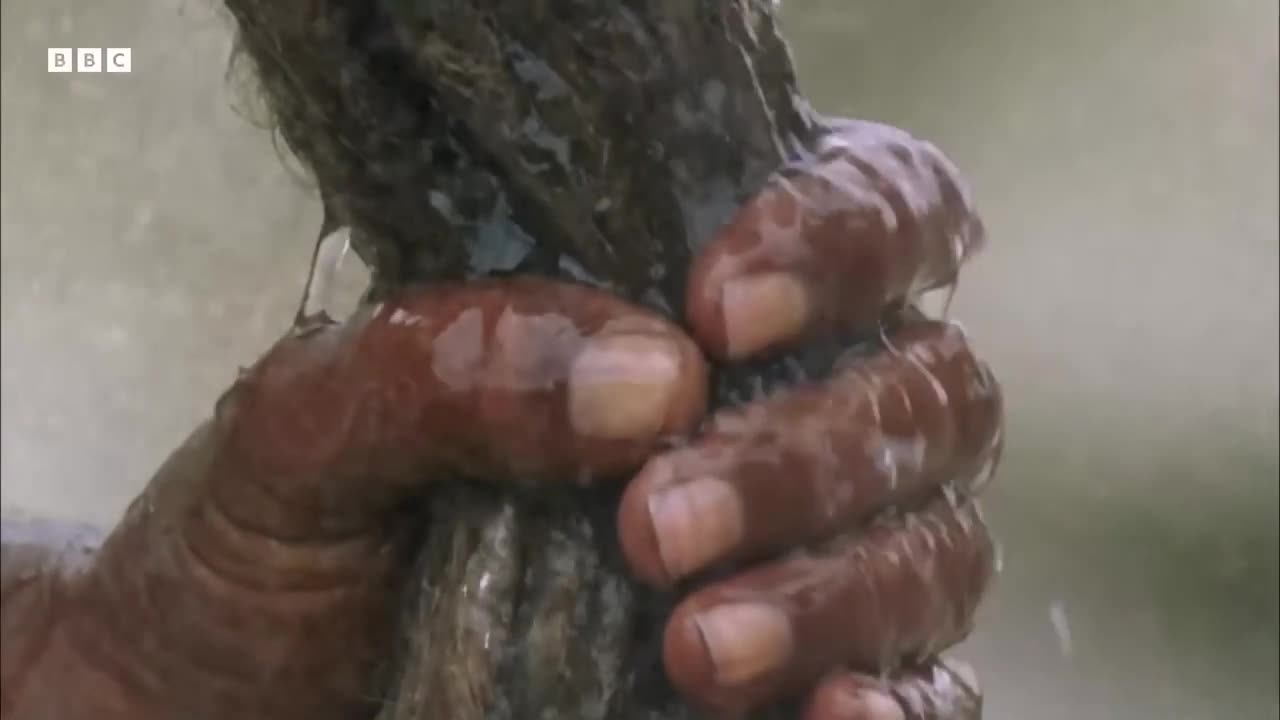
Here, in the Dev Bhumi, the spring melt is now in full swing.
It's said that the goddess Ganga was called to Earth to purify mankind and cleanse the ashes of the dead.
Ganga agreed to come, but fell from heaven with such force that she would have destroyed the Earth.
So another god, Shiva, caught the deluge in his hair, distributing it into gentle streams.
These sacred streams, cloudy with minerals washed off the land, merge with others, forming a river.
But it is not called Ganges until it reaches here, the village of Devprayag, where the Alaknanda and Bagrilathi join.
This is the point where it leaves its turbulent beginnings behind, slowing as it grows.
The pace of the river eases.
However, life around it begins to quicken.
Thousands of people cross this footbridge every day.
But it has a hidden danger.
There are bandits that require a payment to proceed.
Rhesus macaques.
As natural climbers, these monkeys have no trouble navigating the high wires of the bridge.
They are born opportunists and can't turn down the prospect of an easy meal.
Some travelers offer up payment freely, whilst others need more persuasion or a helping hand to give up their goods.
For the monkeys, it's easy living.
They've adapted well to the urban jungle.
The rivers that meet here are known only by their local names, the Alaknanda and the Bhagirathi.
But downstream from this promontory, the larger river is officially called the Ganga for the first time.
The river may have reached the gentler foothills, but there's life in her yet.
This region is known as the Shivalik Hills.
These are the ancient remnants of mountains much older than the Himalaya rock.
The powerful Ganges has been wearing down for millions of years.
Now the river's character begins to change.
The rapids become separated by increasingly longer stretches of deeper, more placid water.
The first large towns begin to appear on her banks.
The 120 metre long Lakshman Jhula footbridge spans the Ganges at the town of Rishikesh.
Every day, thousands pass back and forth, going about their daily business.
Although not everyone uses the more conventional route.
The chaos of the bridge is ripe for exploitation, and the resident macaques know just how to work it to their advantage.
They miss little, and there's nothing subtle about their tactics.
If begging doesn't work, direct action usually does.
They may not have the same protection of more sacred animals, but Hinduism has a fundamental respect for all life, and so they are tolerated.
Their antics just an accepted, if annoying, part of everyday life around the town.
The Rishikesh macaques span two worlds, with one foot in the Shivalik forests and the other in the urban jungle.
But their secret is out.
Nothing is safe in this forest.
Chimpanzees love hunting.
She seems oblivious to danger.
A fall from up here could be fatal.
But she does need a bigger stick.
Only a chimp has the ability to break into a stingless bee's nest as well hidden as this.
Chimps are extremely intelligent, but none is born with the skill to use a tool.
Youngsters like this one must learn by watching.
She uses special tools, one after another, to get all the honey she can.
And in a few minutes, she destroys what took the bees years to build.
In the rainforest, nothing is safe.
The macaques of the lower forests are as bold as their mountain cousins and often venture out in search of new opportunities.
There are all sorts of perils, but there are rewards, too, if you're willing to take some risks.
For over 100 years, people have been growing the finest fruit and vegetables on these warm, rich soils.
For these cheeky thieves, it's irresistible.
Growing perfect produce is a Japanese obsession.
So the last thing people want is marauding macaques.
As the day heats up, the farmers take a break.
The coast is clear.
They have to be cautious.
If they're spotted, there'll be trouble.
But every day, they brave the electric fences.
They know all the weak spots where they can stage their raids.
And they gorge themselves on the fruit of the farmers' labors.
They are almost impossible to stop, but the farmers are not prepared to give in.
They bring out their secret weapon, specially trained monkey dogs.
The Japanese Shiba Inu is one of the world's oldest breeds.
And people have trained them to protect their crops against monkeys.
There's even a Japanese saying that when people are fighting, they're like a dog and a monkey.
But the rewards outweigh the risks.
They'll be back again tomorrow.
Vincent has stolen a helpless baby.
Its mother is left empty-handed.
Why has he done this?
Dr Eric Shaw has been observing these macaques for over 18 years.
He's caught countless males in the act of infant stealing.
To people who are actually watching it for the first time, it looks somewhat aggressive, but it's not as bad as it actually looks.
So it's not an aggressive behavior then?
No, it's not aggressive at all.
It's what transpired beforehand that's brought about what looks aggressive to the human observer.
To understand what's going on, we need to backtrack to before the kidnapping.
Although Barbaries mostly lead a harmonious life, like humans, they sometimes fall out.
Basically, what happens is the males have arguments, a little bit like we have arguments with one another, and what they've got to do is have this conciliation very quickly.
We don't, we just don't speak to one another for months or years.
But because they live in a troop all together, they've got to make friends quickly.
They do that by stealing an infant.
It's the perfect reconciliation gift.
They borrow a baby from one of the females.
And this is the loser who borrows the baby.
In this case, it's Vincent, who's not very high up in the troop pecking order.
And then approaches the one that's just won the argument and presents it to him.
Our winner is Aristotle on the left, the alpha male.
Vincent needs him onside.
Currying favour with the Alpha could improve his position in the troop, and a higher rank means better access to food and females.
So they've had an altercation.
One male is more dominant than the other.
The baby is presented.
And then what happens?
It looks like they've been very brutal to the baby.
It's a little bit like the camera.
They're turning it up and down, both of them, and they're smelling it and looking at it.
And do you like it?
And you say, yes, I love it.
And you take it off me and I think, whew, got away with that one.
For our spy creatures, being immersed in the world of animals is not without its hazards.
In Rajasthan, the temple langurs have taken Spy Monkey into the heart of the family.
But some are keen to take the budding relationship to the next level and are getting a little too familiar.
One seems to want to babysit her.
But disaster strikes.
An injured baby is a cause for concern.
And this langur seems to believe she's died.
Then something extraordinary happens.
The monkeys gather round the motionless spy creature as if it is a real baby.
They react just as they do when their own babies die.
A calm and contemplative mood descends on the colony.
There's a sense of grief as well as empathy for one another.
Quite accidentally, our spy creature is at the center of something extraordinary, capturing emotions that have rarely been observed.
Such apparent expressions of grief may not be unique to primates.
The forests of central China.
Home to the golden snub-nosed monkey.
They will not survive the fast-approaching winter unless they stock up on calorie-rich food.
Top of their autumn menu, pine cones.
They grew during the summer sunlight and are rich in fats.
Few are now left and time to gather them is running out.
Dominant males patrol the troop, making sure they get the pick of the crop.
As the number of pine cones dwindles, tensions between the rival families increase.
Mere threats between two males may not be enough to settle disputes.
Conflict is in the air.
There's going to be a fight.
Vital food is at stake, so every pine cone is worth fighting for, and his family enjoy the spoils of war.
The losers get no more than a few dead leaves and will have fewer energy reserves for the coming winter.
It's absolute chaos, I'm not even joking.
This is crazy.
I'm Hannah Stipfel and I've spent the last 10 years filming and photographing animals in the wild.
But it's urban areas like this, like this, like this that are now our fastest growing habitat on earth.
So now I'm on a mission to photograph some of my favourite urban species and find out why and how they're living alongside us.
So I'm in Gibraltar, which is the British territory and the southern tip of Spain.
Now many of you would have guessed just from me saying where I am, what species I'm looking for today.
And of course it is the Barbary macaque.
Now, Barbary macaques are an endangered species, and they're the only monkey that you can find in Europe.
And they're actually increasing.
Whereas elsewhere in their range, which spans from Morocco to Algeria, they're actually declining.
So this endangered monkey here in Gibraltar is actually doing really, really well.
So this urban population could be the key to their survival.
So the macaques here are really celebrated for the tourism that they bring in, despite their mischievous reputation.
There's some macaques on there, macaques on there, macaques everywhere.
Look, Gibraltar, macaques.
So you can clearly see They bring in an awful lot of tourism.
But what I want to see is how they're interacting with people, the actual tourists.
So that's what I want to go and try and find out.
Millions of tourists visit Gibraltar every year, and many have the macaques at the top of their sightseeing checklist.
Wild primates across the world have shown themselves to be extreme adapters to the human environment.
Monkeys have made themselves homes in cities all over different continents.
But here in Gibraltar, this is the only place in Europe where you can see wild monkeys.
And hopefully that's what I'm going to see today.
To find the macaques, I have to climb up into their territory onto what is known as the rock.
Straight away.
I find them up to their mischievous ways absolute chaos.
I'm not even joking.
This is, this is crazy.
It's just cars and taxis and buses continually flowing through bringing more people up here and the macaques are just hanging out.
Look look at all this.
Look at all.
This must have been hundreds of people come up here the last couple of hours.
All these people coming into the monkeys' homes means that two species of primates, macaques and humans, are spending a lot of time together.
And like any close relationship, miscommunication can lead to conflict.
So these are the steps that lead to the Troop of the Upper Rock.
And as you can see, they're quite confined.
And these are really popular with tourists.
Now people would think that the macaques are laying in wait to jump on people to get food, but they're actually not, because the top troop live just here.
And then the second troop live at the bottom of these stairs.
So this is the causeway between the two troops.
So that often causes quite a lot of commotion.
Couple that with the really confined set of stairs with lots of tourists.
And of course you're going to get some issues.
So the best thing to do, don't touch them. take your time and keep your eyes out.
So I'm going to try and head up to the top.
As I get further into macaque territory, I think I need to get some more guidance.
Tessa Feeney is one of the experts here, and I'm hoping she can tell me a little more about how the macaques and humans are coexisting.
It's easy to see why these charismatic monkeys are so popular, but sometimes that can work against them.
So we're just heading to St.
Michael's cave where we've been told there are loads of tourists there.
They've just come off the buses.
So hopefully we're going to get some macaques interacting with humans and I'm not quite sure what to expect.
So we're going to have to wait and see.
There's a macaque.
That man just fed, did that man just feed him?
Yeah.
That's exactly what we don't want to see happening, because obviously macaques eating sugary human foods it's not good for them.
They need to be eating their wild foods.
So that is not a good sign straight away.
And of course, that's what makes them more aggressive with people because they're after our food.
So we're going to get out, have a look and be a bit careful as well.
Now in the wild, you can clearly see why two different species evolve different lifestyles and niches when they're competing with one another.
But essentially, that's what you've got here.
You've got two really intelligent primates sharing the same space.
And of course the macaques are here, And it's really good for tourism.
They're the stars of Gibraltar, but there's clearly conflict as well.
I mean, the biggest cause of death here for the macaques is road traffic incidents.
And today we've seen how many cars and buses and taxis are coming through.
So there clearly is conflict.
I want to learn more about the macaque human relationship.
So I asked Tessa to tell me more.
The macaques here coping, living alongside people uh, they can cope with it.
We have to understand that as human beings, we're big, we're tall, we're very capable of of inflicting harm onto other animals and, on average, we tend to get about a thousand tourists a day coming through here.
Real issue really is is with us.
We don't respect their living room.
You know this is their home And we're coming in here in huge numbers.
And if you imagine someone coming through your home in vast numbers, at some points this can get a little bit tense and frustrating.
I wouldn't like it at all.
It's amazing that they're here.
It's an amazing sight to see them just behind us.
But of course, being in the human environment, it's not great for them.
But they're doing quite well here, aren't they?
Yes, and when you say it's not great for them, it's structures like these are fine for them and they're able to kind of use certain aspects of the human environment to their own good.
For example, quite often the tarmac roads tend to be nice and warm in the mornings, so they'll often set on them to keep warm.
So if I want to try and get a photograph, what do I need to do?
Not look at them in the eyes.
Well, to take a photograph.
First of all, we'd be too close if you were going to take a photograph of me.
So I'd advise at least a half a metre and then just be aware of how you're standing.
So, for example, I'm going to kneel down.
So, because I'm more or less... Tessa, we've just met.
As you can see, you're now towering over me.
And that's where these things you've got to understand is how threatening we can be when we're looking down on a monkey.
Maybe kind of lowering your body so you're less frightening, making yourself smaller.
But for the most part, they're very relaxed.
They're very happy to have their photograph taken.
It's time to put this new knowledge to good use.
But first, I want to ask about the behaviour I've seen here most.
So we've seen loads of grooming and obviously that's really important for social hierarchy like this.
I mean, they seem to be doing it all the time.
They're doing it on the car over there.
They're doing it behind us.
They're just totally at home, aren't they?
Yeah, well, it's a full-time job kind of keeping good hair.
And it's, yeah, as you were saying, it's a great bonding and social experience for them, brilliant for them to connect. but it does also serve a purpose of keeping their coats clean.
They do have lice.
What we find interesting is that, even when macaques don't have lice and we know that because they've been picked up by the vet but when they're released after their medical check, the macaques will still groom them and still And all that we can think this is for is that maybe the groomer needs to prove that they're doing a good job.
So even if they don't find a lice, they'll pretend they found a louse.
That's incredible.
Yes.
Armed with all the knowledge I need, I head out to get my photo.
Now, people often confuse Barbary macaques with being apes when they're not apes at all.
They are monkeys.
And the best way to tell the difference between an ape like us and a monkey is the presence of a tail.
But Barbary macaques have lost their tail over time through evolution.
However, they still do have a vestigial tail, which is a tiny remnant at the bottom of their spine, which is exactly the same as us having a tailbone, which is a fused vertebrae.
Two species coexisting so closely and openly feel special, and I think it is proving successful here, to varying degrees.
One thing I've loved seeing here is just how many baby Barbary macaques there are.
As elsewhere they're declining, but here they're doing really well.
And I did manage to get a photograph that I'm really pleased with.
And it was one of the young ones up at the top of the upper rock.
Look at that.
What a face, beautiful.
And you know what?
I really do hope that the Barbary macaques can continue to coexist with the humans here in Gibraltar.