Chat with Traders is brought to you by Trade the Pool.
Becoming a funded trader means trading with a firm's money instead of your own.
At Trade the Pool, you first complete an evaluation by hitting profit targets while managing risk.
Once you pass, you get access to up to $260 ,000 of buying power.
You keep up to 80 % of your profits while the firm covers the risk.
It's the perfect way to trade big without risking your own funds.
Are you ready to become a funded trader?
Join Trade the Pool.
Chat with Traders is also brought to you by Tasty Trade.
Ditch those rookie trading apps.
Get Tasty Trade, the platform for serious traders.
Chart with 300 plus indicators, know your profit odds, and move fast.
Trade stocks, options, futures, and more, all in one account.
See why serious traders choose Tasty Trade.
Visit tastytrade .com.
Tasty Trade Inc. is a registered broker dealer and FINRA, NFA, and SIPC member.
Trading in the financial markets involves a risk of loss.
Podcast episodes and other content produced by Chat with Traders are for informational or educational purposes only, and do not constitute trading or investment recommendations or advice.
It's thinking through things before you come across that situation.
It's the same thing we do in the military.
As an officer, I have to create what's called a five paragraph order for any mission we go on.
Does the plan always accurately reflect what happens?
Rarely so, but I have preemptively thought through a ton of conditions.
So as these random things are popping up, there's no more shell shock like I went through in 2011 when I saw that losing trade just running against me, and I couldn't figure out what to do.
Being in that scenario is the worst spot to make a logical decision.
Markets, speculation, and risk.
This is the Chat with Traders podcast.
You're listening to the Chat with Traders podcast, and we're on episode 272.
I'm Tessa, Ian's co -host, and we're so excited to bring this episode to you today.
You know, one of the first things that I have observed from most of our guests that we've had on the show is that they had a deep why for doing what they do to get to the point where they had to get to.
It's like that back against the wall type of thing.
And the second thing I noticed is the sheer grit that they possessed.
Do the rest of us have grit?
I think I will coin this as the why -grit -factor.
Our guest today is someone, I believe, who has that why and that grit.
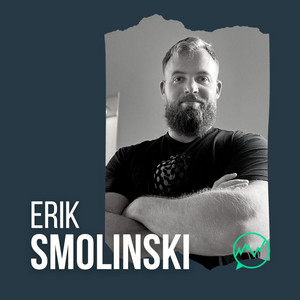
His name is Eric Smolinski.
Growing up poor with an alcoholic family member and living in a violent neighborhood, it didn't stop Eric from being self -motivated and curious.
Eric only needed to hear a few words about investing, including the power of compounding from his high school instructor to light the passion and determination to take immediate action.
How many high school kids do you know think about these things and take action?
The discipline, responsibility, accountability, and patience he cultivated as a Marine Corps officer strengthened his ability to stick with his well -thought out trading plans and persevere.
He has been honing his craft for over 16 years and uses derivative strategies to help him to minimize painful drawdowns while creating consistent long -term market beating returns.
You got to hear this.
Ladies and gentlemen, we are so pleased to introduce Eric Smolinski from San Diego, California.
Well, Eric, welcome to Chat with Traders.
Thank you, I'm stoked to be here.
I was actually talking with one of my buddies who runs a YouTube channel that's pretty big and he makes really great content and I was telling him that I was talking with you guys later today and he was super stoked because he also listens to you guys.
A lot of us enjoy the program.
Oh, fantastic, fantastic.
So where are you at right now?
San Diego, I am sitting in my home, in my office with a curled up puppy next to me on the ground, just chilling.
Oh, great, great. Well, tell us a little bit about your background.
Where did you grow up?
I started in New York actually.
So I was born in Hudson Valley, so just outside of New York City and I grew up in kind of a standard American town.
I definitely was really high gang violence.
It's a place called Newburgh, New York.
It's in the Hudson Valley.
So it has two and a half times the national rate for violent crime.
I actually got stabbed on this hand in school.
Yeah, it was just a party growing up, let me tell ya.
Oh, wow, wow. So tell us a little bit about your family life and what were your early interests?
Early on, I would say my interests were outdoors.
I grew up, I had a single mom, I had an alcoholic father.
He died like five or six years ago in his fifties.
So he just really was pretty brutal to himself.
He still loved us in his own way.
He was abusive, but I always like to put that part on there because I don't think he's genuinely a bad human being.
I think he just had his issues.
But my mom put up with a lot and my mom, she's an occupational therapist, so she doesn't make a lot of money.
She's a contractor, so she really doesn't have a retirement.
And I just remember throughout my entire life growing up, especially as a kid, money was tight.
It was palpable. And that's what got me started doing a lot of actually my hobbies now.
I think last time we were talking about how I'm into cars.
Well, that started because my mom didn't have the money to afford to bring our car somewhere if it needed to get fixed and she commuted long distances.
So my brother and I got good at mechanics and that since turned into a hobby, but she did a lot for us.
So I always thought that that was going to be something I needed to figure out how to take care of her.
So I started working really young.
There was a dude that I used to hunt on his property and I asked him like, do you have any work?
Do you essentially just labor?
So I started doing things like splitting wood.
I used to move shale for him.
I loved it. I loved being outside.
It was awesome. And then I started doing things like selling Christmas trees, worked at a bowling alley.
I tried to find ways to make money.
And that's what I spent a lot of my time in junior high school and high school doing.
Did you have any early connections with following the financial markets or did you know anything about them or was that not in your consciousness at that time?
2007 when I was still in high school is when it entered my life and it entered my life in hands down the most fortuitous way possible.
I had a junior ROTC instructor.
And for those that don't know, it's kind of like a military community program that they put on in schools.
And it's not necessarily a feeder for the actual military, although a lot of us do go that route.
And the organizer for that program knew my brother.
So he knew about my circumstance when I was coming in and he knew that I was working a lot.
So he asked like, what are you doing with this money that you are trying to make?
And I told him I'm saving because that is one thing I learned from my mom.
She doesn't have the best spending habits, right?
We lived a lot of our life in debt.
And it's a lot because not a lot of excess and then coupled that with not great spending habits.
So the one thing she did teach me unequivocally though, is what I refer to as the hustle.
She worked hard, really, really hard.
And there were periods where she would work a full -time job, go work a second job for a half, like she would hustle.
So he kind of saw me going down that route and he asked me like, you should look into investing.
And then that is literally when my entire life changed, hands down, like I can pinpoint the exact moment my life went down a completely different trajectory.
And it's all because of that man.
And I still refer to him as my stepdad today.
There's no relationship between him and my mom, but that's the role he's filled in my life is like a father figure.
I literally was just talking to him yesterday.
And he was one of those pivotal actors in my life that literally just because he shared information with me, I was fortunate enough to receive that opportunity and go down another path.
That's why I love doing things like this to hopefully share something that could potentially send somebody down a great path.
Was it just him mentioning the word investing that got you going and then you took it upon yourself to dive into it, or did he actually teach you different aspects of investing, what the stock market was?
Because he's a terrible investor.
I've talked to him a lot about his investments.
He has investments, but it's always been just buy and hold for him.
And that was his disposition.
And for awhile, he was in like dollar cost averaging kind of like these very basic concepts that we would subscribe to today.
So that's actually one of the biggest jokes between us is that like, I just went way off course compared to the route that he went.
But he essentially explained to me that the very common thing, you have to put your money to work, so you should invest it.
So from there, I actually went up to our library, which was right above where the ROTC room was like literally right then, as soon as he said that word.
And I talked to the woman behind the desk, she was awesome.
And I told her, I was just like, I'm trying to learn about investing, can you help me?
And instead of being an annoying librarian or anything, she's like, oh, well, there's a card catalog or whatever, go find it out.
She literally walked me over.
And she was like flipping through.
She didn't know anything about investing, but she was trying to find good books based on what she could tell.
And she was like, oh, I think this one would be good.
This one would be good.
And she walked me around and we grabbed like three books and then I started reading.
So it literally was him explaining to me two things.
One, the idea of compounding returns, right?
Having your money work for you.
And then the second thing was pointing out the opportunity cost of not doing that and how it very likely would have me continuing the cycle that my mom was going through, where you work really hard, but you are just keeping a flow.
And he was really smart.
And he knew that I had a massive motivation to make sure that I was going to be in a position young enough to take care of her.
And he would use that as motivation for me.
And he would say, so if you want to be able to take care of your mom, you have to think about these things now.
And he was 100 % correct.
Wow. And how old were you when you went up into the library?
I was probably, is 2007, I graduated in 09.
I'm never good with ages in school, but whatever that age is.
Oh, okay. So you graduated roughly 18.
So this would be around 16 or thereabouts?
Yeah, it was either end of my freshman or beginning of my sophomore year of college or college of high school.
Wow. So when did you open up your first brokerage account?
So 2007. Okay. So I went with the custodial account right away.
And he said, put in your money that you have, have your mom, you know, work with you on the custodial account.
And then that's exactly what we did.
Wow. So tell us about your first few investments.
That was one of the questions I asked him.
And this was, again, he's not an investor, but he had some just tremendously solid wisdom.
And he said, buy what you know.
So that's exactly what I did.
I remember thinking about the iPod and how cool that was.
So I scraped together what I could buy, literally like a share of Apple.
That's the downside to this part, is because when I first started buying stocks, I picked a lot of great names.
I picked Amazon, I picked Apple, I picked Netflix, cause I thought that was the coolest thing ever.
And I picked, I want to say Pfizer, but I couldn't afford much of any of them because I was so small.
So that, I just looked back at that.
And I think how funny that would be.
You always get to see those charts where people say like, if you had bought $10 ,000 of Coca -Cola back, and this would it be worth now?
Anytime I see one of those, I'm always just like, damn it.
Like what an opportunity, but that's what I started with.
I started with things that I knew.
And I also bought paychecks.
And the reason why I know paychecks is because for whatever reason, the guy's name I call him E -man.
So E -man's mom had stock in paychecks.
And he would always say to me that that's doing well.
So I was just like, I don't even know what it, I didn't even know what it was.
But I just like, okay, they're doing it.
It's doing well, I'll try that.
And it started with long equities like that for not that long because as most young men, I was known for my patience.
So I immediately was just like, I gotta do this faster.
I gotta accelerate this man, like this is gonna take forever.
So then I started looking into other ways you could trade.
And I tested a lot of different things, but literally in 2007 is when I also tested things like foreign exchange.
I did try foreign exchange for a little while.
I tried binary options for a little while, which were terrible.
I tried regular options and then futures were way too big for me.
At that point we didn't have all these minis and micros.
It was all very big products.
So that is essentially how my trajectory led me into derivatives specifically options.
I see. Wow. So you were on a tear there.
I mean, the first year, here you're a teenager, just set up your account.
And then you're testing out these different types of markets and...
If you ask most people about me, I have a very obsessive personality.
Once I find something that either I like or I think there's opportunity, I do not let up.
That's just how I operate.
And it's funny, my wife and I were talking about this not too long ago.
When I first started my YouTube channel, I would literally spend essentially like 18 hours a day just making videos back to back to back to back to back to back.
And that's not a good way to make content, to be very clear.
But I didn't know what I was doing and really the motivations for starting YouTube are very different.
Maybe we could talk about that later, but I have this thing where I get obsessed and I want to see specific progress.
I don't care if I've eaten, I don't care if I'm tired.
None of that matters to me.
What matters to me is the progress.
So that's exactly what happened.
I saw those first few stocks start to go up and then that was it, full in, there I go.
Wow, so you started off, you said with a very small account, were you motivated during this time to continue to work regular jobs and then save and pump more money in?
Yeah, so one of the most impactful things I came across was a compound interest calculator and I actually came across it on, it was a government website.
And I was playing with the numbers and I learned something very early.
You can, I call it win in the stock market a few different ways.
The way that I decided I was going to create my wealth was not by trying to maximize my return potential.
I wanted to be able to create a consistent outperformance on average, so at that time I set a target of 15 % per year and then I wanted to limit drawdowns.
So then I looked at where that would put me and then I was like, this still takes too long.
So then I started looking at regular savings.
So as soon as I realized that, I essentially turned into a monk because I wouldn't spend on anything and that is exactly what made probably the biggest difference in this whole story is up until my mid 20s, I was so resolute on saving that that is what rapidly built the principle that I could invest
with, so that never went away.
So did you pretty much put almost all of your liquid net worth into your brokerage account the first year?
Yeah, everything. So when I was in high school, obviously my mom was cool enough that we didn't have to pay for food or anything, right?
So I was able to divert all of my capital into that.
I did buy the occasional video game when it came out, but typically I would be so cheap that I would wait until Christmas and then I would ask my grandparents for it instead of buying it and just see if I can get it that way.
So I would use the holidays and my birthday, which were really perfectly timed because my birthday's in March, then you have the holidays in December, you can get pretty good exposure with asking for things.
And I was really fortunate to have a great family that would always try to help me out where they could, with those kinds of things.
But I still remember in my late time in high school and specifically in college, my family started saying how boring it was getting gifts for me because I'd always just ask for money to invest.
I would ask for one of two things, money to invest or give me shares of something so that I can, that's all I wanted.
And they all really got, they liked it, but yeah, they're like, well, we wanna like find something for you, but yeah.
Were you able to share this passion of investing with any of your colleagues, friends?
And if so, what did they think?
In high school, 0 % chance.
In college, maybe 2%, very, very limited.
It was difficult. But what started to happen was as I became a young slash mid -20s year old dude, people started to see how things were working for me.
Then people start to get interested.
The actually the entire reason, the impetus for starting the YouTube channel is because all of my time on active duty in the Marine Corps, I would meet up with my friends, whoever was willing to talk to me, and I would say, hey, I would love to talk to you guys about investing.
Kind of like this obsessive trait that I was explaining to you guys, it applies to a few things.
So investing is one of them, working out is another thing.
And I will talk to anybody about either of those.
So I always would hit them up and say, hey, can I talk to you guys about investing?
I was kind of like a Jehovah's Witness coming to the door.
And I found myself repeating a lot of the very basic things.
So I literally was like, oh, I'm gonna make a YouTube channel because it was during COVID.
I started on May 4th, 2020 on YouTube.
And I remember that day because it was during COVID and I was just like, I got them.
All of them are stuck at home.
They can't go to work because there is a shutdown.
So they can't shut me down.
And then I started reaching out to them.
So I made videos so that they could watch the videos and then we could have like a more productive specified conversation.
But I try to talk to everybody about the positive things I found and the things that have not worked well for me to try to help people learn from both sides of it.
But I try to talk to everybody about investing.
The reason why I laughed when you first brought it up is because my best friend, he has been like my biggest trouble case to get him to invest.
I mean, I offered to trade his account for me.
He's looked at all of my stuff.
He knows I do well, but he's one of those people that's like really, really difficult, he doesn't like committing to things and he hates making a decision.
So like the pain of making a decision is so oppressive for him that it just leads him to not make one.
But this year we actually cracked that code.
I'm very pleased to announce.
I got him to start just buying and holding into the spy and dollar cost averaging in, which big win there.
Oh wow. Congratulations.
Well, so going back to your first year.
So how did you do the first year in 2007 and did you concentrate mainly in just buy and hold?
You mentioned that you experimented with some other markets and tell us a little bit more about that.
Yeah, so I can tell you exactly what I did in 2007.
In 2007 I returned negative 1 .08 % and the S &P 500 that year returned like 5 .46 somewhere right around there.
So I underperformed pretty meaningfully that year.
I think a lot of it was, especially like I look back at my first like three years of trading and it was a mess.
It really was because as I was testing these different things, I had ideas on what I wanted to do but I don't even like blaming it on like being too immature.
I was just too lazy.
So I wasn't doing a good job tracking these things.
I was saying like, oh, I'll try this for a week and see how it goes.
And then I'll try this other variation for a little while.
And as you could imagine it's next to impossible to do that and then to be able to make a logical decision after you try these different things, especially for really short -term periods.
You're not getting any usable information of what it comes down to.
So my first like three years was just not great.
The year two for me, 2008, I was down negative 4 .2%, but that greatly outperformed the market but that's also partly because I was small and utilized.
So there wasn't much I could do and that was kind of a saving grace for myself as I think back at it.
What do you mean small and utilized?
So my account at that time was still not big.
My first year trading, I probably had less than $5 ,000.
I wanna say it was 3 ,500 bucks.
And then so the second year I had some positions on that were holding up okay during O8's contraction but I was also trading a lot of vertical spreads which I talk outwardly against those as much as I can now but it was fortuitous timing to mess with those because you can only lose so much.
So a lot of the stuff I was putting out was already risk defined.
So that was a fortunate, a good luck in that scenario.
So often we hear about traders blowing up their accounts multiple times when they first start, but didn't you, I mean how did you feel managing to lose so little your first year?
And I mean, that seems like a great learning opportunity and the cost of tuition was quite low for you.
I think in the beginning, I probably was too naive to like know what it was because in really up until I left high school again and I graduated in 2009, I didn't do a lot of contextual research.
I was operating in a vacuum.
So I was just trying to see what I could do.
I was trying to learn new strategies.
I wasn't doing any sort of like cross comparisons.
And again, I think it's just because I was too naive to like even really think about it.
So it wasn't up until I started getting into college where I spent a lot of time looking at statistics for my undergrad that I started to do a lot of these different kinds of comparisons.
And to your point, I definitely started to realize how incredible that was even to lose money in 08 but that much less money than the market, for example.
And for something at the time that I was actually really pissed off at myself or I still remember the first year I didn't care.
The first year I really had very low expectations but the second year, my goal was to make money.
Didn't know how much, but make something.
And then I didn't and I was so angry.
And then I started to get the broader context.
So overall I felt like that was actually a decent performance.
In college is when I actually had the largest percent drawdown on the account but I had been killing it up until that point.
So it ended up still being a good year but that was the real shot across the bow for me.
I was fortunate in that I've never blown up an account but I did have over a 30 % drawdown essentially in a single day.
Chat with Traders is brought to you by Tasty Trade.
Tired of trading on rookie apps?
Then get the platform for serious trading.
Tasty Trade. Tasty Trade gives you the tools to trade your way.
Chart your heart out with over 300 indicators.
Know your odds with probability of profit and move fast with quick roll.
Trade what you want and trade it your way.
Stocks, options, futures and more.
All in one account on one platform.
No wonder why serious traders choose Tasty Trade.
Visit tastytrade .com and see for yourself.
Tasty Trade Inc is a registered broker dealer and member of FINRA, NFA and SIPC.
Hey, I got a great update from Trade the Pool.
Now it's even easier to get funded.
As you know, Trade the Pool built a unique program to evaluate stock traders like yourself and provide you with the company's funds to trade with.
It's real shares and you no longer need to worry about the PDT rule.
But that's not all.
Trade the Pool has introduced a new tier with $20 ,000 in buying power, making it easier to pass the evaluation and speeding up the process of getting funded much faster.
You don't wanna miss this opportunity.
Wow. Yeah, that was eye opening to me.
That's when I realized like, okay, like you're getting too comfortable.
This stuff has teeth.
Wow, well, what year was that?
When you have that 30 % drawdown.
I wanna say it was 2013 or 14, somewhere in there.
It was when I was either a senior or I started my MBA because there was a year before I went to the Marine Corps, I had a Marine Corps scholarships.
That's why I was able to go to an undergrad.
So it was like towards the end of my time there or maybe it was 2011.
Let me look, I can tell you right now.
Yeah, it was 2011, perfect.
And it was in the rut, which I distinctly remember and it was a 34 % drawdown.
That was an eye opening trade because it was a really wide iron condor.
So for the options traders out there, you'll know what that was, it was a short iron condor.
For those that don't trade options, it's essentially a directionally neutral trade that we want something to stay in between a range.
And for a period of that trade, it had moved outside of the range I wanted it to stay in.
And obviously I was way too big, way too big.
And it's because I still remember this, I wanted to make $600 on that trade.
It was like a three day trade.
I wanted to make $600.
I couldn't tell you why.
I think that there was a psychological draw to making half a grand.
I really think that that's what it was.
And as the trade started to move against me, I realized the statistics when I first put on the trade changed because it was a very high probability trade.
The short strikes were super far out of the money.
So anybody that does these, they know you don't collect that much upfront, but if you get a move against you, it's massively painful if it's a big move.
And this is exactly what it was.
It was a big move. So I ended up closing the trade because I was frozen, actually like completely decision locked, couldn't make a decision.
And then when I just saw it keep going against me, I didn't want to go to the max loss on the iron condor cause it was big.
So I exited the position.
I just said, gotta get out.
And just because the stock market has an undefeated sense of humor, it settled almost smack dab in the middle of where I needed it to.
It would have been a 100 % profitable trade if I had not gotten shaken out, but I did.
Oh wow, wow. So reflecting back, was there something in what you studied, how you, if you had any plans that you adhered to any rules that you either didn't know about or you didn't implement properly that led to this?
Tons, tons. At that point I had just started coming across this idea of a trading plan.
This is when I met my second like pivotal mentor, at least when it comes to finances in my life.
And it was a dude that I met online.
It was in a group like an options group online.
And he didn't really wanna like mentor me.
He was an old grumpy dude, but I kind of started like forcing him to.
I would say things, I would ask things that I know are wrong and he couldn't not respond.
So then I would do that to like lure him into a dialogue.
And he at one point told me that he wasn't going to talk to me anymore unless I had a written trading plan.
So that's when I started writing a trading plan.
The problem was I didn't know what I was doing.
So I was just writing things down and I didn't have an effective system for testing.
At that point in time, the rules were grossly inadequate for what I was trying to do.
Because if I placed that same trade but I even sized reasonably, it would have been fine.
It would have been absolutely fine.
But I was so grossly oversized that it essentially just sent me down this massive emotional path that I was not prepared for.
Because when I entered that trade, at no point that I even conceive of the possibility of the position being challenged because it was so far out of the money.
It was so far away.
I was thinking that's not gonna get there.
I'm good. I just have to hold this.
What was the position that you were in?
Like what was the ticker symbol?
What was it? It was a short iron condor and rut.
Yeah, Russell 2000?
Yeah, exactly. The index itself.
I see. And so it had a big pop against you in a very short period of time, which then blew out of the range.
And so essentially in a very short period of time, you kind of hit close to your max loss.
In general though, what attracted you to add options or to dive into options instead of, sticking with buy and hold or just sticking with regular stock trading?
Leverage. Yeah, it comes down to leverage because like I said, I like, I'm not kidding when I said like I grew up poor.
I remember I could be able to like walk into my bathroom and we could like the floor around the toilets, the toilet was leaking had deteriorated and I can see down into the basement floor.
And rather than repairing it because my mom was really embarrassed that that exists, she just put a rug on it to hide it.
Like that's where we were at.
So I needed to find a way to make good money because my target was by the time I was in my late 20s, I wanted to make sure my mom was good.
She was a lifetime smoker.
So I had a very high expectation of medical expenses.
So I knew I needed to be in a position, honestly to do something for her if needed.
I love my brother to death, I have an older brother, but he's not super great with money.
So where is she gonna go?
So that is exactly why I went to options is because I wanted leverage.
And when did you start writing down a plan?
Was it right after you met your second mentor?
Yeah, exactly right.
So it would have been right around 2010, 2011 is when I would have began sketching it out.
I see and tell us a little bit about this plan like kind of what are the components that go into it?
Yeah, this is probably one of the most passionate projects that I have that I try to share with people is the idea of kind of two documents, a trading plan and a trading log.
So as I'll open up my trading plan right now, as it stands today, the trading plan, and to be clear, I call it wealth development in trading plan.
And it's because this documented has evolved beyond just my stock market endeavors.
I also track things like my angel investing in here.
I outlined how I approach real estate investing.
Everything at this point started to get outlined.
And like right now it's 300 pages long.
And it's because I've built on it over time.
So the way that it's broken up right now is I have a bunch of kind of prelim sections.
I have who I am, I think about my motivations as a human being, what I think about money, all of those things are outlined in the document.
Then I have things like market structure.
So I go through the background of the stock market.
Markets as a discounting mechanism, how markets are built, different kinds of market hypothesis, how markets execute from open outcry to the exchange systems, down to economic functions.
Then from there, I go into things like financial statements, bond markets, option markets, history, all the way back to 350 BC, so on and so forth.
So what I wanted to do is have a thought wear dump.
Everything that I'm learning should be able to be referenced.
So as I'm learning these things, I'm putting all of it in a document.
Then I start making sure I can understand things like option pricing, option Greeks, different pricing models.
What is volatility?
All of those things are broken down in there.
Then I kind of have like the trading sections.
So I have a section on portfolio management.
So what's my money management strategy?
How do I think about leverage?
How do I categorize my returns?
How do I think about the use of cash?
How do I size according to modified Kelly criterion?
That kind of stuff.
And then I go into all of my analysis tools.
So technical analysis, fundamental analysis, I list everything that I've learned.
And then I bubble up to the top, the primary tools that I use, and I highlight what they are.
But then on all of these, I force myself to write like three to five sentences, outlining the tool.
That is just for me to fully synthesize whatever it is so that I have an understanding of what it is.
And then from there I go into the actual strategies.
So I split my portfolio into two buckets, my core allocation and a speculative allocation.
And then I have specific strategies and products specifically that I trade for the core allocation.
The speculative is a little more open -ended.
So then I have subsets of the trading plan called strategy outlines.
And that's where I outline the strategy.
It starts with something like an executive summary.
Again, to demonstrate that I can succinctly summarize what this thing is, how it operates.
Then I have things like the trade setup.
What am I looking for?
How does this trade operate?
What are the legs? Then I have scanning.
What am I looking for specifically for this specific strategy?
Then I have management.
Then I have tracking.
Tracking is a really important thing.
So that's where I outline what I think impacts this strategy most, what data points are most important to me.
I list those all out and I make sure that they're reflected in my trading log so that then I can assess the performance of things and slowly optimize over time.
So it is a really big document at this point.
But what I tell people otherwise is if you don't have a trading plan, just start one.
Because if you think about the ego that goes behind the idea that you can just remember all of this stuff and never really have something to reference or hold yourself accountable.
And the other thing I offer to people is one of the most impactful parts of creating a trading plan.
It's the preemptive process.
It's thinking through things before you come across that situation.
It's the same thing we do in the military.
As an officer, I have to create what's called a five paragraph order for any mission we go on.
And it's an outline essentially of what we're gonna do.
It's a plan. Does the plan always accurately reflect what happens?
Rarely so, very rarely does the actual actions completely reflect the plan.
Things happen, curve balls come up.
But I have preemptively thought through a ton of conditions.
So as these random things are popping up, there's no more shell shock like I went through in 2011 when I saw that losing trade just running against me.
And I couldn't figure out what to do.
Being in that scenario is the worst spot to make a logical decision.
So I forced myself to think through all of it ahead of time through the trading plan.
Wow. So having this trading plan is a great way to manage the psychology aspects of trading, which are so critical, right?
I mean, to know when to cut the position and what proper sizing and that kind of thing.
So in writing this plan, you're like you're burning into your memory, this whole process, right?
So that it becomes almost second nature.
That's exactly right.
And when I went through mine, it also entailed a lot of audits.
Because again, that mentor that I told you that I met online, he didn't wanna really help me, but I still would put stuff in front of him.
And then he would just punch incessant holes through the entire plan.
Where he would say, well, what are you gonna do in this scenario?
Oh, I would do X, Y, and Z.
Oh, that's interesting, cause it's not in the plan.
I don't think you're gonna do that.
Hey, where's this part of your plan?
How do you pick between these different products?
You say that you're gonna follow the trend to secure profit.
What does that actually mean?
Are you gonna use moving averages?
Are you like, it was to that level of detail.
It's an insanely documented process to force myself to think through things.
That's why when I try to get people to make trading plans, I encourage them to find somebody else that's also trying to do this kind of thing and throw it back and forth.
Because the way that I think about it is you should be able to put the trading plan in front of somebody and they might not be able to trade it perfectly.
It's not an automated system.
I don't think that's really quite there for retail traders yet in terms of market structure for us to be able to reliably extract alpha that way.
So there's discretion.
But I think you should be able to put your trading plan in front of somebody and they should be able to generally follow it if they know nothing about markets.
What was the catalyst for you to become a Marine Corps officer?
That's an interesting question.
My brother went into the Marine Corps and that was a big thing.
I remember he enlisted though.
He was actually my first salute, which was a really humbling experience.
But I went down to Parris Island for his graduation and I saw them and I knew that that's what I was doing.
Both of my grandparents were in the army in World War II.
So we grew up in awe of them.
And then for me, when 9 -11 happened, I was still young, but I knew that I wanted to get involved.
So that's exactly what I ended up doing after my brother went.
I think my brother went that route probably because he didn't have a lot of choices.
Like he wasn't gonna go to college.
He wasn't a great student and he needed something and it was perfect for him.
So then I was actually going to enlist.
That was my game plan because that's what my brother did.
I thought it was a decent model.
And then that same guy that introduced investing to me, he used that same kind of psychology trick where he essentially explained to me that if I had enlisted, it would have been selfish.
And I was thinking, how, how could this be selfish?
Like the whole idea is to serve.
And what he explained to me is that he felt that I had a certain skillset that really is beneficial as an officer, which you can then use that skillset to impact more people than you could as an unlisted person.
So that was his argument, that it essentially would be a selfish use of my skills because I really wanted to go like the more active route.
If you think about the name officer, the word office is in it.
That's not where I wanted to be.
So that's not where I wanted to go.
But the way that he explained it, it felt more, it felt like I could make a bigger impact that way.
And I obviously really revere his opinion.
He's never steered me wrong.
So that's the direction I ended up going.
At first, it was also not a possibility to go to college.
So you have to be a college student in order to go in as an officer.
And then he connected me with a resource, the Marine Corps Scholarship.
I didn't know about that.
So this individual dude, just sharing information with me, literally completely pivoted the entire direction of my life.
Oh, great. It sounds like you've got some people in your life that helped you out quite a bit with their - I actually think that's one of the biggest benefits of growing up the way I did.
Sometimes I used to think, like the situation with my father, having a single mother, like that stuff kinda sucked.
But then I look at how thankful I was to be around people and have such a supportive family, that it literally turned into a village raising me.
Like the guy that really got me into auto mechanics and taught me how to do that was my aunt's husband, my uncle on that side.
Then my other uncle got me into kayaking.
All of these people now had an outsized impact on my life because I was open to it.
I didn't have a father figure anymore, so I was looking for it.
And I was fortunate to come across people who just loved me and they cared about me.
So yeah, I am 100 % a product of an insanely fortunate experience with people who cared about me.
What did you learn and experience as a Marine Corps officer that would help you in the world of trading and money management?
Ultimate accountability.
I think hands down, that's it.
The planning aspect I already shared to some degree, and I think that that helps a lot.
But I think accountability.
I find traders all the time, they'll say things like, oh, the market should have done this, or why did this happen?
And I always think how foolish of an endeavor that is as a trader.
I think it's really important to separate these two sides of our trading brain.
You can have the functional trader that's actually trading, and then you can have the person that's interested in things.
Oh, well, I'm curious why the market made its movement today.
But at the end of the day, why the market made its movement today could be helpful peripheral information.
But your job as a trader isn't to be able to explain everything that happened in these succinct sentences.
It's to be able to trade.
So when I look at my time in the military, specifically as an officer, there are these really frustrating instances where somebody that reports to you, they do something wrong.
And then your boss is mad at you for it.
And you think, how could I have influenced what he did at home?
I'm not there. And as a junior officer, you have this resentful response to that.
Over time, you start to embrace it and you understand why it's there.
It's because as an officer, you have to exert a certain amount of control over your environment, the way you raise your people to behave on a day -to -day, the culture that surrounds you.
You're not gonna be able to control everything all the time.
And like, to be clear, your bosses do know that.
But they can also still demand that at the end of the day, you, the leader, are responsible.
And the reason for that is in the military, we say you can delegate authority, but not responsibility.
I can have some of my guys, I can empower them with authority to make decisions and do things.
But the outcome of that is me.
It's not them, it's me.
So in trading, traders all too often forget that they are the only variable you can control.
You cannot control what J Powell says.
You cannot control what the bond market does today.
The only thing you can control is yourself.
So the sooner you embrace that fact and you accept ultimate accountability for you as the trader, the person interacting, making the decisions, making the plans, clicking the button, the better off you are.
Because then when a trade doesn't go well, you don't hide from it because of our ego doesn't like seeing losing things.
We wanna avert ourselves from that uncomfortable scenario and you embrace that scenario.
You say, I put that trade on, I thought it was good.
It didn't do what I thought, why?
What could I have done differently?
What did I miss? You learn to take accountability for everything around you and that does nothing but positively impact you as a trader in my opinion.
I'd like to go into a little bit more about your trading specifics.
Now, by what year were you mainly in using options?
Was that pretty early on?
Did you gravitate in 2007?
So it was really early on.
Literally like three months after I started buying stocks and the stock started to go up, I immediately wanted to accelerate it.
So I started options that year.
I didn't always trade the majority of the account that way because some of the money still was tied up.
I didn't hold those holdings for too long, maybe a year, but I was already paper trading and testing options.
I was still deploying vertical spreads.
So small options plays, but yeah, it started essentially less than a half a year from when I first started trading.
I'd like to go back to the year of 2020 because that year is quite famous other than being COVID, but that's a year where we saw volatility spike to crazy highs and the implied volatility of so many options rose to very high levels.
And that is the premium that is paid to buy these options got really expensive.
So I'm very curious, how did you trade during that high volatility time?
And did you concentrate mostly on shorting volatility to collect these insanely high premiums?
I use essentially the same ensemble of strategies as I typically use.
I scale in and out based on market conditions.
So 2020 really for any options trader, volatility is life because even if you want to be long volatility when volatility is high, I know that's a taboo, you're never supposed to do that, but guess what's also high at that point?
Price movements. So you can still trade directional strategies like ratio diagonals.
You can be super far in the money on the long option.
That's 180 days out in time.
So there's little extrinsic value.
You're not really paying that much for the volatility on it, although you are and it's higher than if it would be a volatility was lower.
It's still not that crazy, but you're getting movement now.
All of a sudden those strategies are killing it.
So for me, anytime I see volatility popping, it's just good days.
Now, a lot of the things that work well depend on what volatility regime we're in and where we're clustering because the issue is if you get caught in that transitory phase to your point, in 2020 from what?
The beginning of February up until the beginning of March.
So at about a month, the VIX ran from 22 to 85.
If you get caught with any strategy while volatility is moving like that, if you're on the wrong side, it's painful.
There's no safe place there.
So when volatility starts creeping up like that, I don't necessarily immediately gravitate to selling strategies.
That's a really common misconception, I think, because when we're selling premium, the idea is to capture at least as far as I trade.
When I'm selling premium, I'm trying to capture variance risk premiums more often than not, which is the function that implied volatility tends to be overstated to realize volatility.
A lot of times you can capture that the best is in low volatility periods.
A lot of people think that that's crazy.
The reason why people are really promulgating the idea of selling premium or volatility when volatility is very high is two reasons.
Volatility is mean reverting, and that is probably one of the most deterministic functions and it's a great thing to trade, which I do trade that.
The second thing is there's the assumption that as implied volatility expands, that it's more likely to be overpriced, which that is also accurate.
So it's a good time to sell volatility, no doubt, but I don't discriminate buying or selling only based on volatility levels.
So in 2020, it still was a lot of directional trades, and it definitely was a lot of volatility capture strategies because I was trying to trade the mean reversion.
So I was trading things like short straddles, short strangles, those were kind of my go -to for volatility pure plays.
I used to spend a lot of time gamma hedging around those, but then I did a lot of studies on that, and it helps, but not that much.
So I just sized them very carefully.
So hands down the most prevalent strategies in 2020, ratio diagonals, short straddles, short strangles, and then the strategy I almost always have exposure to is the covered strangle that is essentially always out in some capacity.
I remember quite vividly in 2021, the meme stock craze hit us, and stocks like GameStop and AMC for a period of time had ludicrously, insanely high IVs.
And I was wondering if you got into any of those, if you just followed it.
Had you ever seen anything like this ever before?
It was fascinating.
I was trying to call everybody's attention to it because when you're trading, a lot of the time you are beholden to what the market happens to be doing.
So for some people, you might not ever see that again.
It was absolutely insane.
So the only way I participated in it though, is I bought shares.
And the only reason why I bought shares is because I thought the whole ape movement was funny, and I literally allocated a small amount of the portfolio when I said, I will never sell these.
So I still have them, and I'm never not gonna not have them.
I bought them, I wanna say I bought them sub 10, so they were doing great, and then obviously now they're not doing great, they're doing fine.
But I'm never gonna sell those.
In that instance, I was too gun shy to trade personally.
And the reason why I wasn't trying to capture that is because it was an anomaly.
I'd never seen it before to your point.
I hadn't studied it before.
And at this point in my trading career, specifically my late 20s, this is down to like a business for me.
I have very specific thresholds that I go through as I'm testing deploying things.
And I can see something like that and definitely know it's a money -making opportunity.
But at that point in my trading career, I was already at a pretty good spot with what I was making that I wasn't super concerned if I missed out on that opportunity.
So it was fascinating for me to watch.
I still own shares of both AMC and GameStop, literally, because I said I would, and I will hold those into perpetuity, literally, because I said I would, but otherwise it was just a really fun exercise to watch it.
You have a video on your channel where you talked about implied volatility and implied volatility rank.
And you showed an example of Hutt, which at that time had over 400 % IV and Apple with just a 40 % IV.
Do you ever encounter some raw IV numbers that are so obscenely high?
Because you posed the question in the video, is this a high IV or not?
And then you didn't answer it, but then you went to talk about Apple.
Are there any IVs that are high enough for you to say, okay, I've got to take advantage of this opportunity?
And assuming it's not a biotech stock.
It's less about where raw IV is, and it's more about where the relationship between implied volatility and historic volatility is.
That's what matters to me.
Because if implied volatility is very high and historic volatility is also very high, for buying strategies, it tells me it's going to be relatively expensive.
Again, you can get around that in a lot of different ways, but still relatively, it will be more expensive.
And it also tells me it's moving a lot if historic volatility is high.
So then, if I'm trying to sell and capture that elevated implied volatility, it's actually going to be a more painful experience because of that.
So for me, I actually care far more about tracking variance risk premiums, which is exactly the relationship between implied and historic as compared to raw implied.
Aha, I see. In one of your videos, you also had a chart where you showed the explosive rise in the amount of zero days to expiration options traded, starting in 2020.
And my question is, why have traders recently suddenly flocked to this strategy?
What's so special about it?
Good old gambling. It's honestly, I think it's because most people think it's a way to make money fast.
I genuinely believe that.
And I also think during 2020, people were in a fascinating scenario.
They were stuck at home.
They were getting stimulus checks.
What are you going to do?
So we saw a massive rise in retail trading behaviors during that timeframe for those reasons as is.
But I think a lot of people viewed them as a slightly less risky lottery ticket, which unfortunately is just not the case.
In that video, and I have a couple of videos that talk about the phenomenon more and more in depth, because I trade zero DTE options.
It's a very small subset of my overall portfolio, but I still do trade them.
And there was great opportunity there.
But like most things in trading, it's not quite what people think it is on the surface level, whereas a lot of people get into it with these expectations of, Oh, I'm going to YOLO, whatever I got from this stimmy check into this Friday expiration and hope it works.
As just not a great way to make money in markets.
However, we definitely can see the market does struggle to price now with the advent of zero DTE expirations and something like SPX all throughout the week.
You can see that they still are struggling to dial in the IV for those.
So there's a lot of opportunity.
It's come down meaningfully since they were launched.
And that's because of people like me that are just arbing it out or just starting to add more and more volume to it that decreases the edge.
We're essentially pricing the market.
That's one of the functions of all the participants.
So it's still there though.
It's a very well -documented phenomenon.
You can check out a bunch of those studies actually from that video.
I always tell people I'm very data -minded.
I spent a lot of time on that in my undergrad and grad degree, and I track my own data sets.
I have a stack at my house that I can query against with Python.
I'm not a coder. I actually had one of my nerd friends that I played rugby with, which is a hilarious combination to me.
He's a big giant dude, but he's a coder.
I had him teach me and kind of like the rudimentary things.
So I track all this data myself, but I always tell people don't take my word for it.
I am just a dude on the internet.
You should not trust random people on the internet.
Look at the studies that I try to share people.
You go to SSRN and you can look up tons of great free studies on these phenomenon.
And that is one of them, zero DTE.
But yeah, the explosion in them is fascinating.
And if you look at the cost associated with it and whatnot, it's massive.
It's really interesting stuff to me.
Many investors look at an annual drawdown as a natural price to pay for having many other higher than average annual returns.
Talk to us about the tables you shared in your video and your annual returns and your annual drawdowns and the power of compounding.
Yeah, so if I'm thinking about the correct table that you're talking about, it's the one that modeled those three portfolios.
Yeah, okay. So the reason why I made that table is because again, going all the way back to the way that I first envisioned interacting with markets.
Like I talked to some of my friends like Matt Caruso or I just had Jim Ropel on the podcast.
These are like Kanslim style traders but they have massive years.
Like Matt had a year that was like over 300%.
So some of these guys have a very different mind on how they approach markets.
And for me, I was really focused on a reliable consistent way because going all the way back to the sob story about my mom, it was a no failure scenario for me.
That's the way I thought about it.
There is no failure here.
I have to figure this out.
So I wanted to find a balance.
And one of the things as I was working through that compound growth calculator, I quickly started to realize that you can pretty modestly outperform the market if you just about keep up with it when it's up but you don't participate with it anywhere near as much when it's going down.
So that's what I started to look at.
How can I create an approach to the market that allows me to generally pace the upsides or when it starts coming down to not participate or even to take the other side of those trades.
So when I look at how we can succeed in trading, you can either ramp up your returns as much as possible, you can decrease your drawdowns.
And my approach as per usual is a combination of both.
I don't think you have to specialize in one or the other.
So for me, I'm very careful about the risk that I carry.
I always have offsetting beta weighted deltas because you never know when the market is gonna capitulate in one way or another.
And I am very quick to follow a trend.
So as soon as I'm proven wrong, if I'm in a directional strategy, for example, before I enter any single directional trade, I'm gonna have what I call an allocation.
How much money do I give to this trade in total?
What is the initial outlay?
How much am I gonna enter with upfront?
How am I going to scale into this position over the life cycle of the trade?
And then I always have, where am I wrong?
If this does not do X, Y, or Z, I know I'm wrong and I get out.
So the beauty of doing that is if I put on 35 trades and I get kicked out of 30 of them, that's not a great time, that's a lot of losing positions but it tells me something.
If I'm getting kicked out of that many, the market is probably capitulating to some degree.
So then I'm not immediately jumping into more trades.
I'm now cautious and I will wait to see how it behaves before I allocate more money to the market.
So I aim especially to avoid significant drawdowns, especially after my good old experience back in 2011, that was a pretty big eye opener to be honest.
Excuse the last interruption here, this is Tessa.
We hope you're enjoying this episode so far.
If you love the podcast, please give Chat with Traders the best review you can on whatever platform you're listening from.
This will help us to keep the episodes coming.
Also, if you haven't subscribed to our email list, please hop on to chatwithtraders .com and click on subscribe so we can keep you posted of information that may be of importance.
Thank you. Now back to the chat with our guest.
Yeah, what really struck me about those tables that you shared was that the table which had no drawdown in any given year had very moderate gains year over year, but that table outperformed the other table which showed a significant gains in most of the years, but just had one drawdown year of 30%.
And just that one drawdown made it underperform the very moderately performing strategy.
Yeah, and to your point, the portfolio referencing in that on the website, it's called Portfolio 3, it has an average return of 8 .6 % which is better than the first portfolio that you're referencing with the more modest returns of 7 .4%.
This is why I try to tell people that average return is one metric and it has its purpose, but you can have something with a subpar average return that actually grows money better via compound annual growth rate than something else.
And that's exactly why I made that table the way I did because a lot of people go through those kinds of cycles where they'll have really good years, but the power of a drawdown is massive.
And really the goal there is to share at least my psychological approach to markets because I also do make very clear when a trader is interacting with markets, you have to align with your psyche because somebody like Matt, he doesn't like to trade the way I trade.
He'd rather wait for his pitch and he'll watch.
He'll watch for a year if he has to before he'll start putting on positions and doing his thing.
Whereas that's not the way that I work.
So the whole idea of that graph is to show exactly that, that you can still perform very well if you limit drawdowns and maintain good, not necessarily superb, good performance.
Many investors look for reasons to say yes to a trade.
Whereas I've heard you say that you're looking for reasons to say no to the trade, expand on that.
I think it's probably one of the most fascinating things about trading to me is how so many day -to -day psychological thought processes apply so poorly to trading.
So one of them is in my day -to -day life, I'm typically looking for the good in things.
I want to be generally happy and I want to have a positive experience.
So I will look past a lot of the negative, not ideal components and I'll focus on the good part.
In trading, it's the exact opposite.
My entire objective is to look at a position and to identify why does this trade earn my money?
And unless there's a clear reason why this trade earns my money, it doesn't get my money.
So it's not a function of, could I conceivably put a trade on in this?
Or even could this trade conceivably work out?
That's not what I'm looking for.
I'm looking to take in all of the evidence in front of me.
And if that waiting is so overpowering that I think there is a clear opportunity, then that is something I essentially cannot say no to because the risk to reward in that scenario is so attractive to me that it would be irresponsible to not gain exposure to it.
Otherwise, if that's not there, I'm not interested.
Are you passionate about trading or do you see trading as just a business?
That's a really fascinating question.
I think I'm passionate about markets.
I'm fascinated by them.
But if I could apply this skillset somewhere else, I would be somewhere else.
I am very clear about the difference between the money -making function of trading and the general interest.
I would always have a general interest in markets because to me, it's such a cool way to learn about the world around us.
If you're paying attention to things, especially if you read the normal news, it's so polarizing.
I don't wanna look at it, man.
It's like, everything's burning.
This person hates that person.
I don't care about any of that.
The coolest part about markets is if you look through it through the market lens, they care about money.
They don't care about the rest of it.
So you get to lose a lot of that other nonsense and you get to stay up to date with so many cool things.
You get to learn about upcoming products, upcoming innovations.
I am a naturally fascinated person.
I am intellectually curious about everything.
I actually make the joke that I spend most of my day listening to YouTube videos, to podcasts, and listening to audio books.
I probably ingest around six hours of not just general content, not like he said, she said podcast, literally educational content essentially every day.
And sometimes I'm learning about the international space station.
Sometimes I'm learning about the way that Vice was reviewing.
There is like some halfway house and they put somebody through it.
And I'm learning how that works in another country.
Like I'm just learning about a lot of different things, different markets, but the stock market, the way that it teaches me about the world and the way that it functions is so intellectually stimulating.
And it is very rewarding when you can start connecting dots and building a thesis off of it that you can then make money.
But I mean, and I'm very open about this with my audience.
Over the past year, specifically this year, I moved a bunch of my money into commercial real estate that I started investing with some partners.
So we procured things.
There's a ski resort that we bought, student housing, a couple golf courses, and it's a business decision.
So a lot of people are like, wait, you trade.
Why would you move your money from this to that?
I'm not so egotistical to think that what I do today is guaranteed to work in 10 years from now.
Do I believe it will?
Yes, I do believe it will, but it might not.
So part of it is just a diversification of wealth.
The other thing is to create uncorrelated returns.
I do that within the stock market.
I do that outside of the stock market.
So the way that I approach my money management is very much business.
That's the only thing I care about.
This seems to tie into the statement you made in one of your videos that the money I'm trading with will not be the source of my future wealth.
Yeah, so what I tried to remind people, and this is specifically for small accounts, because I feel like, and that's where my mindset started thinking that way.
If you have like a $3 ,500 account, you're not gonna trade that into your future wealth.
You might, to be clear.
There's a very small probability, and I'm very specific to discern between improbable and impossible.
It's not impossible.
It's insanely improbable.
So the sooner you get over that threshold, the sooner you can then accept that fact and figure out what you need to do in order to create your future wealth.
Maybe it's from trading with really aggressive saving tied into it.
So I view that essential picture and I just expand it out so that as I'm at a point now where I'm successful financially, very thankful for that, and I have different buckets around, it decreases the risk of anyone failing and then me losing that potential source of income.
In one of your videos, you also talked about the problems with a high win rate and what's called the disposition effect.
Well, what's the problem with a high win rate?
I thought that's what we all seek.
That's right. It's just, they're just so great.
So I make jokes about this because a lot of this comes from the tasty trade gang and this isn't to talk crap about them.
I like those guys. I've interviewed Tom Sosnoff a few times.
I think there's great content there, but we've created this myopic view that win rate means profitable.
And in a couple of my videos, I demonstrate you can literally have a 95 % plus win rate and still lose.
And that's when I tried to get people to take the leap of faith from win rate to expected return or expectancy, because to me, that's what matters.
The really tricky part with a high win rate is who doesn't want that?
Again, the subconscious drive of your ego, we don't like conflict, we don't like being confronted, we don't like being wrong.
All of these things are subconscious to us.
So when we have a really high win rate, you don't have to encounter being wrong that frequently.
Our ego loves that.
That is fantastic. The problem, however, is that in all things trading, there is give and take.
And what I can almost guarantee you, not impossible, but super improbable, people with really high win rates tend to have much smaller average wins.
And then if you look at the inverse side, you can have a very low loss rate, but if those average losses are big, you now have a negatively expectant strategy.
So one of the worst possible issues with win rates is that they are so misleading.
They feel good, your ego likes it.
You think you're making a bunch of money because you're winning most of the time, you wanna continue doing that.
But then if you actually look at the math, more often than not, you are losing money.
It is what it is. It's an uncomfortable thing.
People hate hearing that.
But it's my hope to try to red pill people into opening their eyes and accept the fact that a high win rate is an awful benchmark.
And what you were talking about in terms of the disposition effect, it leverages that exact concept where retail traders have a disposition effect where we like to realize winning trades, which leads to us holding winners too briefly, and we avoid losing trades, which leads us to tend to allow losses
to expand massively.
And again, don't take Eric's word for it.
This is from the behavior of individual investors by Barbara and Odean from the University of California.
They go through all of these things.
And that is exactly what's happening with a high win rate.
You get to enjoy the disposition effect, which unfortunately is not a great way to make money.
Yeah, great lessons for all of us.
You mentioned earlier about expected return.
What do you mean by that exactly?
How can we expect a return?
Yeah, bunch of different ways you can think about it.
But essentially expected return is a simple formula.
We're gonna take our average win size as a dollar, our average win rate as a percentage, this could be for an entire portfolio, it could be for a system, it could be for an individual trade.
You can look at it in a bunch of different levels.
There's obviously different drawbacks, depending on what sample size you're looking at and how representative it is of the expected outcomes going forward.
But you take that side of the equation, kind of the win size, and then you look and compare it against the loss side.
So your loss rate as a percentage, and then your average loss size.
So at the end of this, you're essentially not just taking win rate in a vacuum, you're actually taking a couple other really important data points, your trade sizes, and then you're seeing how something can perform.
And again, you can take this in individual trades.
You could say, I hate vertical spreads.
I'm trading a short put.
And in that short put, you look at either just the option probabilities, or you have a probability forecasting tool.
Some platforms have that.
And you can say, the probability of this thing expiring in the money at expiration is 30%.
Okay, now we have some data that we can work with.
And you can even turn this expected return concept into a non -binary outcome where it's, yes, I make full money, no, I lose full money.
And you can actually adjust the mass so that it's a gradient based on probabilities.
And what this does, it gives you a much higher fidelity view of the performance of a strategy.
So then if you wanna forecast it going forward, I'm actually going through my end of year review right now.
So I look at all of the different strategies that I run and I calculate the expected return for all of them.
I look at those metrics for the strategies as I deploy them.
And then you can run a Monte Carlo simulation if you're so inclined to forecast how it could perform the next year.
Or you can look at a large data set that you build over time and continue to build on.
That then gives you a pretty clear picture on what works and what scenario.
But for me, expected return is the guiding force.
It's not win rate. I simply need to know does what I do make money and is it more likely to make money in the future than not?
That's what I care about.
Fantastic. So to wrap up, what do you struggle with most as a trader?
I think I still struggle with risk.
I think that I am too risk averse.
And I think it's because of growing up with a significant amount of scarcity.
I have gotten light years better at it.
And honestly, if you compare me to the average person, I definitely am way more risk open than the average person is.
But I still wish I was more risk open.
When I talk to people like Tom Sosnoff, that dude is literally an inspiration for me when I think about his dealings towards risk.
I love the way he views risk and I'm not quite there yet.
I have embraced it.
Like I said, I would probably say compared to most traders, I am way more accepting of risk, but I still have work to do there for sure.
Anything next on the horizon for you?
Yeah, I think really my primary goal for 2024 is to start making more beginner friendly trading content.
So a lot of what I do now, I actually think is pretty distilled down, but I've been very clearly notified by my audience that some of them are like, I can't understand any of this.
So it's a clear shot across the bow that I am misunderstanding what I think I'm putting out and what level it is and what they're receiving.
So that's very clear input that I need to make a change.
So that is hands down my primary goal.
When it comes to like my personal investing at this point, it's autopilot.
I have all of this stuff systematized to a point where I still get to enjoy the experience of applying my discretion, but I already know what I'm doing in most scenarios.
And I'm at a point financially where the return that I target is super low, but I still do not allow myself to ease up on opportunities when I see it.
Like I was telling you guys via our email chain, this will be my best year to date for sure.
Like right now I think I'm at like a 64 % return on the account, which is insane for me.
My previous best year was low fifties.
And all of that is because I'm still looking for opportunities.
I find that very intellectually stimulating.
So I fully intend to continue that going forward.
I like the idea of spending so much over 16 years honing this craft and now just getting to the point where like I can really deploy it, like really get it out there.
And I just enjoy the benefit of having a mentor that got me started on this stuff early.
So I'm in my early thirties now and I get to enjoy a lot of the benefits of it still.
Wow, congratulations on your performance this year.
You haven't yet shared with us what has been your average return compounded over the year since you started in 2007?
Yeah, so my compound annual growth rate is low 21%.
I can tell you exactly what it is right now.
This year, obviously we'll skew it a bit.
So my compound annual growth rate from 2007 until the end of the year 2022 is 21 .3%.
The reference period for that timeframe, the S &P 500 is 8 .5 % over that timeframe.
Wow, fantastic, fantastic.
In your YouTube channel, I really loved your drone video of Iceland with stunning scenery.
That was one of the coolest places I've ever been.
And I got this really neat drone, it's super small.
It's like 249 grams.
So it's actually right there.
It's super, super light.
And it is one of the coolest purchases I've ever made because it lets me experience places in such a different view.
So yeah, I'm glad you enjoyed that.
I had so much fun exploring Iceland and then shooting that footage, it was just a blast.
It's a eye opening place.
Yeah, yeah, I was very impressed by the scenery.
Well, Eric, thanks for your service to this country.
And thank you for coming on Chat with Traders.
I'm so stoked to have been here with you guys.
Thank you so much for having me and thank you for doing what you do.
Like I was telling you before, we set all this up, I really respect your platform, I'm honored to be on it.
And I think the service that you guys do, putting information out there for people to come across and just digest what works, that's so massive because you never know like what single individual will pick up what single thing that can then change their route.
So I am really, really stoked and so happy to have been here with you guys.
Thank you for having me.
Yeah, great. How can our listeners learn more about you?
Yeah, you can find me, I have a website, esinvests .com.
And that's really just a how some of these resources I was telling you guys about.
I just built that compound return calculator, I have that loss recovery and that portfolio test.
That's really what I use that for and then mostly on YouTube, ES Invest.
Great, fantastic. Thanks for coming on.
Thank you. You've reached the end of this episode of Chat with Traders, but rest assured, there are more episodes loaded with real market insight and zero hype on the way soon.
So to stay updated with each great new release, subscribe to the podcast and iTunes and we'd love it if you'd leave a rating and review.
We'll catch you next time on Chat with Traders.
Thank you.