Chat with Traders is brought to you by Trade the Pool.
Becoming a funded trader means trading with a firm's money instead of your own.
At Trade the Pool, you first complete an evaluation by hitting profit targets while managing risk.
Once you pass, you get access to up to $260 ,000 of buying power.
You keep up to 80 % of your profits while the firm covers the risk.
It's the perfect way to trade big without risking your own funds.
Are you ready to become a funded trader?
Join Trade the Pool.
Chat with Traders is also brought to you by Tasty Trade.
Ditch those rookie trading apps.
Get Tasty Trade, the platform for serious traders.
Chart with 300 plus indicators.
Know your profit odds and move fast.
Trade stocks, options, futures, and more, all in one account.
See why serious traders choose Tasty Trade.
Visit tastytrade .com.
Tasty Trade Inc. is a registered broker dealer and FINRA, NFA, and SIPC member.
Trading in the financial markets involves a risk of loss.
Podcast episodes and other content produced by chat with traders are for informational or educational purposes only and do not constitute trading or investment recommendations or advice.
... ... ... ... This is episode 264.
I'm Tessa, co -host of Chat with Traders.
We have a different episode today apart from our regular programming.
So we will continue with our regular programming in the upcoming episode.
Do you think trading contests are not a big deal?
For this trader, he didn't think so either.
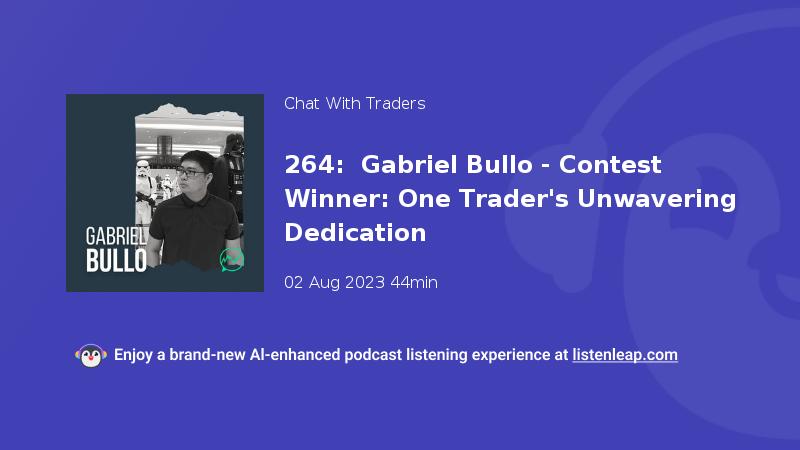
At first. His name is Gabriel Bulo, and he's the first place winner of the 21 -day trading challenge contest that we hosted in partnership with Trade The Pool a couple of months ago back in mid -May inside the chat with traders community.
Before we get to Ian Cox's interview with Gabriel, I wanted to explain a little bit about this contest.
About 450 traders participated and around 50 of them ended up positive at the end of 21 days.
In this contest, if you lost $2 ,000 in one day, you can trade anymore for that day.
And if your total drawdown reached $20 ,000, you were out of the game.
The account size was $200 ,000.
Participants could trade US stocks and could also short sell.
After 21 days, the top 10 winners with the best results received prizes, including evaluation accounts of different sizes from Trade The Pool.
We chose to run the contest for 21 days because if it was shorter, someone could get lucky and win without a real strategy.
On the other hand, if it was too short, someone could be eliminated too quickly due to a big loss, even if they knew how to trade and recover given more time.
A lot of the feedback we received from the contestants, even from those who were eliminated early on, mentioned that they learned a great deal from the experience, pushing them outside their comfort zone.
Let me give you an example.
Several Forex traders participating in the contest had never traded US stocks before, but this experience gave them the confidence to consider it.
Other feedback highlighted the pressure to perform in the contest, which brought a new dynamic to their trading.
For some, it helped them understand what it's like to trade with a larger account size, requiring a different mindset compared to trading with a smaller account.
I could keep going, but I'll stop here.
We've archived two recordings of the contest's recaps and pre -market analysis related to the contest for members inside the Chat With Traders community.
If you're interested in having access to those, just join us inside the community and reach out to me.
Or if you have any questions about the community, just get on the Chat With Traders website and contact us.
Please note Trade The Pool is currently one of the sponsors for Chat With Traders, and although we partnered with them for the contest event, we do not endorse any prop trading firms.
Now let's get straight to the interview to learn a little bit more about our contest winner, Gabriel Bulo.
Well, Gabriel, welcome to Chat With Traders.
Hi, Tessa. Hi, Ian.
Nice to meet you. Share with us a little bit about your early background, kind of where you are now, and where did you grow up?
Okay, I'm from Philippines, and I am currently in Australia right now.
I guess my wife wants to pursue culinary, so we just moved here recently.
But before that, I have worked in Dubai for six years.
That's why my flag in the competition was in UAE.
I'm an accounting graduate, but I never used it, and I even forget all about it, because I've been working in the U .S.
for too long. Now I'm just a normal guy who works his 90s -5 job to earn some money and pay bills.
How old were you when you first got interested in the financial markets?
It was 2020. The pandemic came.
Then one of my classmates in college who is in the insurance company, she posted the pictures on Facebook that the prices of blue chips companies are dipping down.
So she said it's the best time to buy insurance because the prices are low.
So me, I didn't buy the insurance, so I went to YouTube and searched on how to buy shares of stocks in the Philippines.
So that was my first encounter with the market.
Okay, so this is back right as COVID is unfolding, and the markets are taking a big dive.
You approached the markets initially from a more of a buy -and -hold long -term investor?
Yeah, it is, but it just took only one year.
It was supposed to be like five years, but my mental capacity is shaking when it dips down again.
So I removed all my positions.
Oh, I see. So you sold out of your buy -and -hold type positions that you had?
Yes, exactly. I see.
Because you were presumably wanting to take some profits or at least avoid losing some of the gains.
So did you have another area that you wanted to go into?
Did you just say, hey, I've gotten some profits, I'm good enough, let me just pull out, and I don't need to interact with the financial markets much anymore?
Or did you have a different area that you wanted to go into?
No, the thing is, the reason why I became a trader, it's because of that.
When I bought it, it was 2 .8, the stock was in 2 .8 and it shipped up to 19.
So I didn't sell it.
Well, that's the problem.
So when it crashes to seven in just one month, I sold it and it damaged my mental capacity.
So I decided to become a trader to know what happened or what did I do wrong because I should have gains or not.
I see. So the volatility in your long -term holdings actually was a catalyst to get you into trading?
Yes, it is. I see. And did you have any kind of early strategies that you focused in on early on?
What were you influenced by?
I mean, technicals, kind of what type of technicals?
I was using before when I was starting MA bounces, like in the RSI range trade, I also using divergences.
And I was hopping strategies again and again, which is normal for a beginner dude.
And you were just in equities on the US markets?
Before I was in the Philippines stock market, then I ventured to the US market and I trade like cryptos, anything like commodities, but there's no luck with it.
I see. So you traded a variety of instruments and like what would be the catalyst to get you into a trade?
Like what were you looking for to buy and what were you looking for to sell?
When it bounces to 50 MA and it breaks out, I started buying, but it's the other way around because I'm buying when it's in a downtrend.
So it should be like a short sell.
And I'm not having any stop loss before.
So this early trading where you say you didn't have a stop loss, what did you experience during that time?
I was devastated because if I cut my losses, it's too late already and it will damage my psychology also.
And it blew a lot of accounts already.
So you got caught in the often too familiar trap that so many investors or so many traders experience by holding on to your losers because the pain of getting out of that position was greater than the pain of holding onto it.
Yes, it is. And much more, what do they call this one?
The leverage. If you're trading the Philippines, there's no leverage.
When I went to US stock market, there was a leverage like six times your equity.
I just blew out a lot of accounts and I still remember I was always like crying in my bed.
It's too bad for me for my mental health also.
So just curious. So in 2021, you started trading and how long was this period of not having stop losses, buying the dip and holding on and seeing your accounts blow up?
It's just, it will be just a year in 2021.
So when I got a lot of experience growing up accounts, so I was much disciplined now than before.
And whenever I take a trade, I have my stop loss already.
So when you were blowing up your accounts, how did you get back in the game?
Did you just save up money from your jobs and open up another trading account?
Yes, I'm always depositing my money into the brokers.
Then I start trading again, because I know in my stuff that I can't do this and there's no turning back.
Despite blowing up your accounts, you had the determination and the confidence that someday you will get this.
And is that accurate?
Yes, it is. Yes. I see.
And so during this process of turning yourself around, did you read any books?
Did you watch videos?
How did you educate yourself?
Okay. I bought a course in the Philippines and I learned the strategies, the psychology.
And this was after I blew a lot of accounts.
So in that course, I learned a lot with my trading, my strategies.
Share with us a little bit about what you learned.
Putting stop loss, the structure, the trend, the support and resistance, which is very important.
The risk management, which is also very important.
Elaborate a little bit on, you mentioned there was no turning back.
Tell us a little bit more about that.
Yeah, the thing is, I have a dream before that to become an accountant, but it was like shattered because in the Philippines you have lesser salary.
So I went to UAE to work in sales, so that I will have a lot of income.
But the thing is, the position is not there.
So I was planning to have better career, like to become a trader, which is very possible if you are just if you are going to be a lot more confident in your trading.
And if you have a lot of dedication.
Chat with Traders is brought to you by Tasty Trade.
Tired of trading on rookie apps?
Then get the platform for serious trading.
Tasty Trade gives you the tools to trade your way.
Chart your heart out with over 300 indicators.
Know your odds with probability of profit, and move fast with quick roll.
Trade what you want and trade it your way.
Stocks, options, futures, and more.
All in one account, on one platform.
No wonder why serious traders choose Tasty Trade.
Visit TastyTrade .com and see for yourself.
Tasty Trade Inc. is a registered broker -dealer and member of FINRA, NFA, and SIPC.
Hey, I got a great update from Trade the Pool.
Now it's even easier to get funded.
As you know, Trade the Pool built a unique program to evaluate stock traders like yourself and provide you with the company's funds to trade with.
It's real shares and you no longer need to rule.
But that's not all.
Trade the Pool has introduced a new tier with $20 ,000 in buying power, making it easier to pass the evaluation and speeding up the process of getting funded much faster.
You don't want to miss this opportunity.
Did you have any kind of role models that you looked at?
Or did you know anyone in the trading sphere?
Any friends, family that did this?
Uh, no. I don't have any connection with the the like financial markets or anything.
Just watching YouTube like while you're trading or like mid -bar, that's my, you know, like my mentors.
I see mentors. Did you have contact with teachers?
Sorry, how about that?
Oh, your teachers, I see.
I see. Well, speaking of mentors, did you have anyone, or did you know anyone in the trading community that was able to, you were able to talk with and or hold you accountable?
No, nothing at all.
It's just me and the market.
So as you take this course and you start implementing the things that you're learning from this, describe to us a little bit about what changed in your trading.
The mistakes that I've got for trading, like if the candles doesn't close above, I will not take the trade.
The discipline in the candles, the discipline in your risk management, like risk only one percent per trade, the psychology within every trade.
Once you, once every trade, you need to journal anything, everything.
So you're keeping track of each trade you make and why you make it, right?
Yes, yes, it is. And so you established a discipline around both getting in and out of trades when they cross certain technical indicators, certain moving averages.
Could you break that down a little bit more?
Actually, right now, I am not using any indicators anymore.
Just price action. My charges are very clean.
So I guess if I'm going to be using indicators, it's lagging indicators.
So I focus much on the price action.
What made you move away from using technical indicators to just price action?
It's because of my experiences that we have some strategies, which is only for candle sticks.
Like there will be some range with the candlesticks.
If it breaks, I'll start buying.
And if I use some indicators, it will give me some false alarms, something like that.
So you got a lot of false alarms in the past using the various indicators?
Yeah, like the MAs, if it's breaking, then I start buying.
It breaks down again.
So it was kind of depressing.
And how did you select the kind of stocks that you wanted to trade?
I mean, where did you find them?
I have a parameter in my average trade.
And if you talk about the competition, I'm using two strategies in the competition, it should be gapping stocks, because gaps indicate stress.
We'll get to the competition in just a moment.
Back when you were trading, so you traded for how long did you trade using technical indicators?
I would say I was trading focus for two years.
The investing was like three years ago.
So when was it that you transitioned away from using indicators to just price action?
And the inspiration to do so was from your group?
That's my own decision to not use them.
I started using without any indicators last year.
Because if I use any indicators, it's cool of my parameters.
Go into a little more detail when you say you just use price action.
So give us a typical example of how you find the particular stock that you want to trade.
And are you trading day trade or are you swing trading?
I'm day trading and I'm also swing trading with another account.
My strategies are like consolidation breakouts or breakdowns, sometimes flags or some head and shoulders.
So when you say, for example, consolidation breakouts, so what does it look like on the chart?
During what time period?
What are you looking for?
I'm looking at the first business of opening up the market, like three to four candles consolidating in a range.
So once it breaks out, I'm starting buying.
Okay, three to four candle.
What time frame are you using?
One minute. Okay, interesting.
And so do you hold your positions overnight or is this just a just in and out same day?
You did mention about some swing trading as well?
On my personal account, I was using only one is to one.
So I'm just I'm trading for 10 to 15 minutes per day.
10 to 15 minutes. That's the time that you're trading per day or you're using a 10 or 15 minute chart?
No, I'm using one minute and I finished my trading in just 10 to 15 minutes.
So how was that? How are you able to trade for such a short period of time?
What kind of tricks are you looking at to get in and get out?
Yeah, just one is to one.
One is to one ration and I'm good.
I'm good for the day.
Oh, one for one. So you risk a dollar and your target is $1 profit, is that?
Yes, it is. Yes. I see.
Great. Let's move into the trading contest.
You were, first of all, congratulations on being first place winner of the chat with traders community 21 day trading contest that we put on with Trade the Pool back in May.
Thank you so much for that.
Yeah, what motivated you to join the trading contest?
The thing was, I have only small account which is I have the trade the pool, it's only 20K.
So the motivation was to win the contest so that I can get the 260 account.
So I started chatting and what my risks are, my stocks are the trade.
So to be clear, are you saying that you had already been trading a $20 ,000 account with Trade the Pool, is that correct?
Yes, but it's an evaluation still.
Okay, so you were going through the process of a $20 ,000 evaluation account.
And if I understand correctly, if you pass that $20 ,000 evaluation account, then you would be given $20 ,000 house money to trade.
Is that accurate? Yes, it is.
Yes, that's accurate.
I see. So you joined the trading contest so that you would have a shot at winning the $250 ,000 account.
That was your kind of motivation for joining?
Yes, because for me the $30 ,000 account is too small for me.
So I tried to win this thing.
So I got it. I won the competition.
Good for you. So take us through the journey, this 21 day journey of this trading contest and what was it like each week that you were in there and what did you do, like kind of your strategies and what you traded?
I used two different strategies in the competition.
First was I was trading gap stocks, gapping stocks, because gap indicates strength.
But before all of that, I have some parameters on picking my stocks, which is very important.
So there's parameters on each stock.
It should be in an upchant or in a downshred and it should be in mid caps or big caps that moves 10 % to 20 % a day.
So penny stock is a big no for me.
It's a big no, because it will eat a lot of commission.
And lastly, it should be gapping.
So the strategy is this in the first week.
In the first five to 10 minutes after the market opens, the stock will create range.
After creating the range, there will be high and lows.
If it breaks out to the highs, I will start buying.
Then if it goes to back and retest, I will buy again.
And if it breaks out again, I will buy again, my stop posts will be under the lows.
So the TP is only one is to one and just 10 to 15 minutes, I'm done trading.
I see you're done trading for this contest and for your personal account, or are there differences?
It's the same as the personal account.
Got it. Yeah. But in the first four days, it's not working at all.
And it resulted in almost like 8K drawdown in the first week.
Why do you think that is like reflecting back?
What was it that caused this big drawdown?
Had you used this strategy before?
Yeah. Yes, I did. The problem was I was counter trading.
The stock is moving higher, but I'm still keep on.
So I realized I need to change my strategies from gap and go strategy to buy and support, buy on support and short on the system strategy.
I see. And so this new strategy that you're transitioning to, had you used that strategy in your personal account prior to the contest?
Yeah, that's one of the playbook.
So I changed to that strategy.
But that strategy has one is to three, one is to four ratio.
Okay. So you increased your risk reward ratio from one to one to three to one or four to one?
Yes, it is. Yes. I see.
So you're trying to let your winners run rather than just selling out.
So at the second week, the bad part was I made an objective that I won't sell unless or until the platform will close it by himself.
So there was no taking profits.
So I have four days of Jordan.
So on that Friday, I shorted the banks, I short in the resistance.
And in just 15 minutes, I was in positive 20K, but I didn't close the trade.
Well, aren't the rules of the trading contest?
Isn't it just day trading?
Aren't you supposed to close your trade by the end of the day?
Yes. I was using the platform automatic sell.
I see. So you were holding on to the trade and then you just allowed the system to automatically sell you out by the close of the day.
Is that accurate? Yes, it's accurate.
Oh, okay. Okay, great.
So were you long or short the banks?
I shorted the banks, which is the PACW, which is from 8K Jordan.
And I was in, after like 15 minutes, I was in 20K, positive 20K, but they didn't close the trade on that and that gains.
Were most of your gains as a result of shorting these banks, which had a big drop?
Yes, it is. That's the one other reason.
So was it actually a strategy of yours to let the system close you out or did you kind of what was your thinking around that?
That's my objective because if I will sell too early, especially for volatile stocks that runs 10 % to 20%, that's the place for me.
Because I backed it a lot.
If I hold into that position, there's a big possibility that it will go up more.
I see. So was it a way of kind of not sabotaging your own trade by getting out too early, but rather just hold your winners and then let the system close you out automatically?
Yes. So when you're selecting the stocks to trade, are you looking at the big movers of the day in the 5 -10 minutes, the big gap ups and gap downs?
And you look at the stocks making the biggest moves.
Is that accurate? And then you trade those?
I was trading the same stocks at the same week.
Because if I move to another stock, the problem is the other stock that you left will move much higher.
That's why I'm sticking with four watch lists for this week.
I will trade it in the whole week.
Okay. So are you saying that you're concentrating your attention on a few select stocks in your watch list and trade them long and short because you get to know them?
Yes. You had the stock.
How it moves and what is it going to do?
So then, did you discover this during the trading contest or was this one of your many strategies that you've acquired over the year?
On my day trading, I have all the two strategies, which is that gapping up and buying support and the settlement resistance.
So that's the only two in my arsenal.
So as far as concentrating your attention on a few select stocks for the week, rather than jumping from one stock to another stock that you hadn't been following, did you find that this is helpful and you continue to use this idea of concentrating attention on a few select stocks during the week?
Yes, it really has me.
And as my experience, if there will be an exhaustion, there will be a big move after.
Describe that when there's an exhaustion.
It's like there will be a pause in the daily.
There will be a pause of data and once it breaks out in like one hour, one hour time frame, it will move much higher.
So you're looking at this both on a daily chart and one minute chart?
Yes, one day of one -day time frame and one minute.
Okay. So you're looking to trade, like give us an example of a stock that fits this parameter.
And what you're looking at to describe to us, what is that like?
It's like AI. Okay.
Yeah. When it moves higher, then there's a pause after the next day if it gaps up and if it nears the resistance and if it cannot go through, I'm shorting it.
Okay, so you're saying that if it can't break through the first level of resistance, after the pop, then you're shorting it?
Yes, I'm shorting it.
I see. So you're shorting a stock that hasn't yet broke down, but has failed to break out to new highs and that it's consolidating.
Is that accurate? Yeah, first, it's like it has a big move in the first day.
Second day, it has a pause.
It doesn't have any highs or new highs.
Then at the third day, it will break down.
Okay. So you're looking to short over extended stocks for looking for retracement of part of that gain that it made a couple of days earlier?
It's near the resistance and short.
I see. And then you're setting what kind of risk reward on this retracement?
In the competition, there was no profit.
There was no taking profit because the objective was not to sell unless the platform was closed by himself.
Right. So it sounds like in your own trading account, you can hold for a number of days, but obviously in the contest, it was day trading only.
Day trading, yes. I'm trading in the first minutes, then I will sell in the last minute.
So while you were trading in the contest, you were also trading your own personal account or not?
When I started the competition, I did not trade anymore of my personal account.
So I was focusing on it.
So you put that on hold while you concentrated on the contest?
I see. So you won through this trading contest, you won a first prize, free evaluation account where you will get funded with $250 ,000 of prop firm money.
If you pass $260 ,000, excuse me, how is this going for you?
And how is it different from the trading contest?
It was giving me a big break in my career.
Like if I have the big can of money for trading, it will change my life forever.
That may be of importance.
Thank you. Now back to the chat with our guests.
How is this $260 ,000 evaluation account going for you right now?
Because they have different rules than the trading contest, right?
And I was just curious on how, what is it like?
How is, what are the differences between trading this evaluation account and the contest?
What I like about the contest is I can use the full 2K risk per day in just one trade.
The problem with the evaluation is I can use only like 30 % on every trade.
And yeah, in one trade, I can only use 30 % of the daily drawdown, which is kind of bad for me because I only trade once per day.
Is this restriction, has it pushed you to try to find new ways, maybe trade more frequently or trade multiple stocks?
For that one, I'm going to, you know, to add more risk to the reward.
Like one is to five, I think I want this to six, if it is possible, but it's going to be too risky.
I'm still going to use the 30%, but with a higher risk reward.
I see. So would you say the evaluation account is significantly more difficult than the trading contest?
Yes, it is for me because there was, there was limits for like for drawdowns.
So it's kind of hard.
Do you think that these limitations in the evaluation account are an effective form of risk management that helps to protect traders from themselves?
Yes, it is. But if you have better discipline, it's better to have no limits because not all the traders are the same.
So yeah, that's my comment about the evaluation.
And so do you have, so kind of, what is your game plan for trading the evaluation account?
You mentioned about increasing your risk reward to higher levels.
Is there anything else that you've been thinking about?
Actually, on my competition account right now, I mean, the account that I won, I'm currently in halfway to be funded.
So hopefully next month or next two months, I will have the, I will get the full funded account.
Oh, okay. So you're saying your, how long is this evaluation account on for?
Like what's the time duration that you have to prove that?
So it has 45 days. So I started last June 16.
So I finished two weeks already.
So I'm halfway to be funded.
And if you do get funded, do you know, do they still have these same rules that you currently have in the evaluation account, moving forward?
What I know it's gonna be the same as the evaluation account, but I'm not really sure I haven't been with all the the rules and regulations and the trading pool, you know.
Some people don't take contests seriously, but what are your views on that?
Honestly, I was not serious about it in the first place, because I was, I have the account.
So when I started to think that the 60k is a big, a big account, I started to focus on it.
So it's, if you, because see, I don't, I don't have any connections and I, what I can see is there's a lot of traders better than me.
But if you focus on yourself, focus on your performance every day, you can be competitions.
Good. So, so this experience has been, how has it been for you kind of psychologically this transition from the trading contest to the evaluation account?
And how do you reflect that on your own trading accounts?
Like what, what are some of the things that you've learned?
I learned a lot of the competition, like, I was not taking profits, even I'm having like four, four, four is to one already, three is to one, I'm still not taking profits and it goes down, it hits my stop loss.
So I was not putting, like taking, taking profits and near resistance, near resistance.
So I learned to put a profit taking thing.
Anything else that you'd like to share with us?
Or advice for beginners, like if they are listening to, listening to this podcast, if you, if you work hard and if you have a lot of strategies already, you need to back test it, need to forward test it a thousand times, you need, you need to remove strategies that is not working for you and keep what is important.
Trading is a performance game.
If you don't perform well, the market will punch you in the face without any gloves.
Now, start on an account that you can afford to lose, but big enough to hurt you when you lose.
You have to journey out the chain.
Why did you buy it?
Why did you sell it?
Or what are the mistakes and learnings of every single chain?
The psychology and discipline, you will learn that on your journey through, through experience.
Do not focus on the money, focus on the process.
And eventually you will go parabolic.
So if there was one thing that you could zero in on, to what degree would you say the importance of journaling, of writing down the trades as you feel them on that day?
And then, and then reflecting back on them, you know, a day later or, or, or even a week later, how much did that impact you?
See, if you have a lot of mistakes, you will learn from it because if you see your journalist, it can track what you did wrong, what you did right.
That's the importance of the journaling.
Did you also journal, um, kind of how you felt anything psychological or how you felt about the trade?
Because often, uh, after we write something down, you know, days or weeks in the future or months, we go back and reflect our mental state is not the same as it was when we first wrote it down.
Are you able to capture or did you try to capture your emotional state?
Yes. If you're too, if you're too happy, write it down because it will be more greedy on that particular day.
And if you lose, it damages your mental capacity, then write it down again.
So, and the next trade idea, you'll be more defensive.
Great. So do you have any goals in the next two to five years you'd like to share?
My long -term goal is to quit my job and get a lot and get a lot of payouts as possible.
Well, I want to create my own trading, a big trading account so that I can, I won't use any uh, profit accounts anymore.
So, but before that, I need to reach my short -term goal first to, um, to be funded.
What do you struggle with most in trading?
Um, if I'm too happy and if I'm too like depressed, I do trade more often.
So if that happens, if I have, I trade three times in a day, I'm not going to trade the next day.
So I keep my discipline intact.
Are you able to share, um, your trading journey with, uh, friends or family?
No, not at all. Like they don't know that I am trading and, um, they just know it recently that I am trading.
Oh, wow. Um, how was in the Philippine culture, how is trading looked on as a, as a profession?
Do our Filipinos, um, into taking risks and individual, uh, accomplishments like this, is this considered a, uh, you know, somewhat respectable type of profession?
Well, in the Philippines, if you are trading, you're like a gambler, like they don't see you as a like a professional.
You see, like you're having a lot of money because you're like gambling, something like that.
So does that make it difficult for you to share yourself with, uh, friends and family because they may, uh, potentially judge you as not having a real, a real job or not wanting a real job?
Yes. Yes. It is. They want me to become a professional.
But if you see it practically in, in, in, in life in the Philippines, and if you're not having money, you're like, you're like nothing.
So there's a, you're saying there's a lot of judgment, uh, for those who don't have money.
Yes. I see. And, uh, you, you experienced no problems, opening up a U S trading account, uh, while living in the Philippines.
It's, um, open and available to all Philippine citizens.
Actually I was in Dubai when I started, uh, trading.
So that was not hard to create an, an U S account.
So it was easy. You can just use your debit account and start trading.
Uh, well, Greber. Well, thank you very much for coming on chat with traders.
Uh, how can our listeners get in touch with you?
Um, I'll be in the discord and, uh, trade the pool.
If they have some question, they can reach me or can, they can, uh, message me via discord.
Okay. Great. Well, we all wish you, um, you know, great fortune and good luck, uh, in your evaluation account and certainly hope you get funded, uh, be a good example for the rest of us and, uh, would love to, uh, talk with you again and, and, um, and see how that process, uh, all turned out.
Thank you so much for that.
I want to give you a quick update.
I just caught up with Gabriel recently and learned that he has passed the prize evaluation account after just two weeks of winning the prize and got funded and now is even ready for a payout as he has been making a lot of progress in his trading.
He's planning to get an even higher evaluation account to continue pushing and challenging himself to improve.
Gabriel, congratulations.
Well done and keep going.