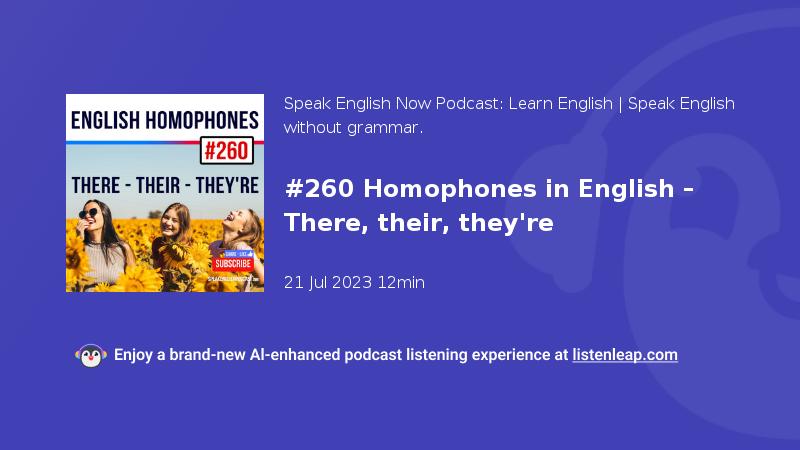
In today's lesson, we're going to explore the fascinating world of homophones.
These are words that sound the same but have different meanings and sometimes can be tricky for English learners.
Don't worry, though.
By the end of this episode, you'll have a solid understanding of homophones and be able to use them confidently in your everyday conversations.
Before you start listening, make sure to get the transcript.
Visit speakenglishpodcastcom.
It's free, so let's dive in.
Homophones are words that are pronounced the same but have different meanings and may be spelled differently.
They can often cause confusion, as they sound identical but their meanings can vary.
Let's explore some common examples of homophones to help clarify their usage.
Example number one.
Two, two, and two.
Although they sound alike, they have different meanings and uses.
Two refers to number two, such as I have two cats.
To means also or in addition.
For example, I want to go to.
And to is a preposition used to express direction, purpose or recipient.
As in, I'm going to the park.
Example number two.
There, there, there.
There is used to indicate a location or a point being discussed, like the keys are over there.
There is a possessive pronoun that shows ownership, such as They brought their books.
There is a contraction of they are.
As in, they're going to the movies.
Example number three.
Write and write.
Our final example focuses on two words that sound identical but have distinct meanings.
Write. means to put words on a paper or create text, like, please write your name.
And right can refer to correctness, direction or the opposite of left, such as the answer is right or turn right at the intersection.
As you can see, homophones can be quite challenging, but with practice you'll become comfortable distinguishing their meanings and using them correctly.
Remember it's important to pay attention to context and understand the specific definitions of each homophone to avoid confusion.
By expanding your knowledge of homophones, you'll enhance your English skills and improve your ability to communicate effectively.
Great!
That's all for now.
I hope you found this topic helpful.
Let's continue with a point-of-view lesson.
I will tell the same story twice, so make sure to focus on the changes.
You can find these techniques fully implemented in my premium courses at speakenglishpodcastcom slash courses.
Okay, let's start.
Once, there were two friends named Tim and Sue.
They lived in a small town by the sea and loved adventure too.
One day, they decided to go on a trip to their neighboring village.
Tim went to the market to buy some snacks for their journey.
He bought two bags of chips, two bottles of water and two sandwiches.
Sue, on the other hand, was responsible for packing their bags.
She packed everything neatly and included a map to guide them.
They set off on their bicycles, excited about the trip.
The road was long and they had each other for company.
As they pedaled, they sang their favorite songs together.
After a while, they reached a crossroads.
Confused, they looked at each other.
Tim took out the map to find the right direction.
We need to turn left to reach the village, he said.
As they continued on their journey, the weather started to change.
Dark clouds gathered in the sky, and the wind picked up.
Thunder rumbled and rain started to pour.
Tim and Sue had to find shelter quickly.
They spotted a small cafe by the road and decided to take a break there.
Inside, they ordered two cups of hot chocolate to warm themselves up.
They sat by the window sipping their drinks. and waved bye-bye to the rain.
After a while, the rain stopped, and they resumed their journey.
The village was just a few miles away.
Tim and Sue reached their destination and explored the quaint streets, admiring the local shops and friendly people.
As the day ended, they realized it was time to return home.
They cycled back tired but content.
The trip was filled with laughter, surprises and new experiences.
When they arrived back in their town, they said bye-bye to each other, promising to plan another adventure soon.
Tim and Sue knew that their friendship was a treasure worth more than anything money could buy.
Great!
Let's listen to the same story in the present tense.
Hi, I'm Tim and I have a friend named Sue.
The two of us live in a small town by the sea.
And we love adventure, too.
Today we decide to go on a trip to the neighboring village.
I go to the market to buy some snacks for our journey.
I purchase two bags of chips, two bottles of water, and two sandwiches.
Sue, on the other hand, is responsible for packing our bags.
She packs everything neatly and includes a map to guide us.
We set off on our bicycles, excited about the trip.
The road is long, but we have each other for company.
As we pedal, we sing our favorite songs together.
After a while, we reach a crossroad.
Confused, we look at each other.
I take out the map to find the right direction.
We need to turn left to reach the village I say.
As we continue on our journey, the weather starts to change.
Dark clouds gather in the sky and the wind picks up.
Thunder rumbles. and rain starts to pour.
Sue and I have to find shelter quickly.
We spot a small cafe by the road and decide to take a break there.
Inside, we order two cups of hot chocolate to warm ourselves up.
We sit by the window, sipping our drinks, and wave bye-bye to the rain.
After a while, the rain stops and we resume our journey.
The village is just a few miles away.
Sue and I reach our destination and explore the quaint streets, admiring the local shops and friendly people.
As the day ends, we realize it's time to return home.
We cycle back, tired but content.
The trip is filled with laughter, surprises and new experiences.
When we return to our town, we say bye-bye to each other, promising to plan another adventure soon.
Sue and I know our friendship is a treasure worth more than anything money can buy.
Okay, that's the end of this short exercise.
Notice that the changes between grammar points are subtle but important.
With this method, you don't need to memorize any boring rules.
It's better to see the changes in the proper context.
And with a story, it is much easier to remember all this.
Visit speakenglishpodcast.com slash courses to get my premium courses.
They are designed for learning by listening.
It's the perfect time to start a new course.
Okay, we have reached the end of this episode.
See you soon.
Bye-bye.