I think models over time get more different rather than more similar.
I still think we are in like day one around is AI an indispensable part of most people's work?
And I think the answer is no.
I think, the deep sync piece.
People seem surprised that there were cutting edge research teams there.
And if you were paying attention, that part should not have been the surprising piece.
I think we've, if anything, under-invested a bit in two things.
One is just having a faster iteration speed on first-party products.
And then on the second part, on the API side, This is 20VC with me, Harry Stebbings, and today our guest is incredible.
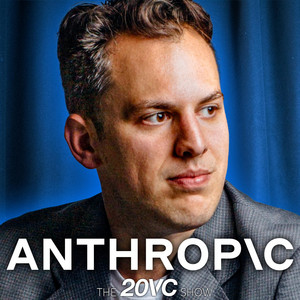
Mike Krieger, co-founder of Instagram and now CPO at Anthropic.
One of the best placed individuals to speak about the state of models today and where they are going.
This was an incredible discussion for me to have. and I so appreciate Mike being so open.
But before we dive in today, turning your back of a napkin idea into a billion dollar startup requires countless hours of collaboration and teamwork.
It can be really difficult to build a team that's aligned on everything from values to workflow, But that's exactly what Coda was made to do.
Coda is an all-in-one collaborative workspace that started as a napkin sketch.
Now, just five years since launching in beta, Coda has helped 50000 teams all over the world get on the same page.
Now at 20VC, we've used Coda to bring structure to our content planning and episode prep And it's made a huge difference.
Instead of bouncing between different tools, we can keep everything from guest research to scheduling and notes all in one place, which saves us so much time.
With Kodi you get the flexibility of docs, the structure of spreadsheets and the power of applications, all built for enterprise.
And it's got the intelligence of AI, which makes it even more awesome.
If you're a startup team looking to increase alignment and agility, Coda can help you move from planning to execution in record time.
To try it for yourself, go to codaio slash 20VC today and get six free months of the team plan for startups.
That's coda.io slash 20VC to get started for free and get six free months of the team plan.
Now that your team is aligned and collaborating, let's tackle those messy expense reports.
You know those receipts that seem to multiply like rabbits in your wallet, the endless email chains asking can you approve this?
Don't even get me started on a month-end panic when you realize you have to reconcile it all.
Well, PLEO offers smart company cards physical, virtual and vendor-specific so teams can buy what they need while finance stays in control.
Automate your expense reports, process invoices seamlessly and manage reimbursements effortlessly all in one platforms.
With integrations to tools like Xero, QuickBooks and NetSuite, Plio fits right into your workflow, saving time and giving you full visibility over every entity, payment and subscription.
Join over 37,000 companies already using Plio to streamline their finances.
Try Plio today.
It's like magic, but with fewer rabbits.
Find out more at plio.io forward slash 20VC.
Don't forget to secure trust with your customers.
Trust isn't just earned though, it's demanded.
That's why over 9000 companies, including Atlassian, Quora and Factory, rely on Vanta to automate their security compliance.
So Vanta helps businesses achieve certifications like SOC 2 and ISO 27001, turning months of tedious work into this beautifully fast and straightforward process.
Their platform automates compliance across over 35 frameworks.
It centralizes workflows and it proactively manages risk, all while saving you time with automation and AI.
So, whether you're just starting or scaling your security program, Vanta connects you with auditors and experts to get audit ready quickly and build trust with your customers.
Get $1,000 off your first year by visiting vanta.com forward slash 20VC.
That's V-A-N-T-A dot com forward slash 20VC.
You have now arrived at your destination.
Mike, dude, I am so excited for this.
I've literally just been out for a walk and I've been listening to like every show that you've done in the last year.
And so I told you before I don't want to start with oh, how did you get into tech and all the normal rubbish?
I want to start with a very challenging first question, which is I, as a venture investor today, have to determine where value is in the future.
And I look at the world today and I don't know.
And so my question to you is when we look forward, where will value be generated in an AI driven decade that we have ahead of us?
Yeah, I think it's an awesome question.
I get a version of this question often from entrepreneurs who I went from, you know, purely building startups myself to now running a company that is partly enabling new startups to get created or helping boost their fortunes.
And the question I get often is like well, What can I build that is not going to be in the lane of an anthropic or another one of these labs?
And I don't have a perfect answer, because it's hard to have the crystal ball, but my sense of where it ends up being most valuable to exist is places where you have some differentiated go-to-market, some differentiated knowledge of some particular industry or some special data that only you have access to.
Two or even three of those as well.
So companies that are, you know, within a financial sector, within a legal sector, within health care, I mean health care.
I've like gotten exposed to, and it is, you know, a tremendously complex ball of yarn, and like the work up front.
It's not the sexy work.
It's actually not the work that you're going to be able to really do in a accelerator, or you know, a short amount of time.
But it is the work that, the legwork that you've put in.
I think those are durable places to generate value.
And then you can sit in a place where you can pull on what's great from the foundation models.
You can do your own fine tuning if you need it.
You can do your own AI specialization if needed.
But the thing that's going to give you legs and be durable over the long run is being able to sell into those places, have something that you understand about those places uniquely and then get better for being deployed there over time.
When you say about the legwork there, what I think to you and you said about differentiated GTM and differentiated data pools or data sources, does this next generation wave of AI benefit existing vertical SaaS companies who have those already and can implement AI, or does it benefit bottoms up net newly created companies in those spaces?
Which one more so?
That's a great question.
I think it can be both.
At the highest level.
The way I think about AI and product design is you have to dance this very delicate dance of showing the future and dreaming up what the models are currently capable at their edges, because you want to design for where they'll be gosh three months from now, which is how quickly things are moving.
But not over promise and under deliver because that's like a very trust breaking piece.
And now, if you're a startup, you can do a little bit more of the over promising, because people are kicking your tire with early adopters.
They have a little bit more of that sort of willingness to engage.
It's much harder if you're like an existing vertical SaaS company and you say, We've added AI.
And then people try it and it's like, it's not that good.
Or like, oh, I thought I was going to do all these things.
Or you said it could do these 30 things.
It does like two of them well.
I think that like each of those two groups have like a very different challenge.
On the former, it's you have established products, you have established behaviors.
You want to skate to where the puck is going without alienating your existing customers.
I think we can dive in.
I think there's some good patterns for doing that.
And on the startup front, you probably don't yet have the data.
And it's like landing the initial sort of lighthouse customers, or you don't have the relationship but you have some hypothesis about where AI will have an impact on a given industry or given vertical.
And then your differentiation is not the established relationships.
It's painting the future and finding ways of delivering that value quickly within a company that might be willing to take that bet on you.
You mentioned there about startups building for where models will be.
It's a very challenging time where startup products are so determined quality-wise, by the quality of the models, and a change in model can seismically change a startup's output, be it a coding software or a legal platform, whatever that is.
Should startups build for what we have today, or should we build for what we can project forward in time?
That's a really good question.
I've heard from multiple people that say, like my startup was not a startup until Cloud 35 Sonnet or the second Cloud 35 Sonnet.
But I hear that from entrepreneurs that this company was not a company until this model breakthrough, where now you know, the accuracy went up I don't know from 95 to 99.
And now that's, you know, close enough for this industry.
Or sometimes it's like from 70 to 90.
Sometimes you get those kind of generational leaps as well.
So how to figure out where that is like.
There's times where entrepreneurs have been knocking their heads against the wall within a particular space.
Whether it's helping people code, whether it's helping with legal analysis, whether it's I mentioned healthcare there's something in that space.
And the lovingly assembled version of what they did, which probably involved multiple tools, was either price uncompetitive because it required an Opus class model that was not going to be supported by the underlying business is still worth doing because when the model arrives, you're not starting from square zero.
And so often the companies that do benefit from those model generation shifts are not the ones that suddenly start that day.
Like, gosh, you know, it sounds like cloud three, seven tonic can do that.
It's the ones that have been beating against the wall.
I take cursor as an example.
Somebody showed me a um list of hacker news front page submissions from the cursor founders over time and it finally broke through.
But that was not their first product or their first sort of like iteration on it.
They've been trying and going.
I don't know exactly how long it was, but it was.
You know it was not just quickly enabled by the model.
It came from that sort of building context, building knowledge, building sort of experience about what has gone wrong or gone well with that space, so that the model can unlock you.
So I guess to be more succinct, don't wait around for the models to be perfect.
Be exploring in the space, be frustrated by the current generation of the models and then be very aggressively trying the next one, so that you can feel like you can now finally deliver on the thing that you saw in your head.
If only the models were just a bit more capable.
I have to ask, when you said about differentiated GTM, differentiated data, and then you said wow, you know, there's so many different releases and they come so thick and fast.
I don't know how to say this.
Is there value in the model layer if it's not a differentiated data game?
Is it a differentiated GTM game?
How do you think about that?
I think it's a couple of different pieces on the model layer and like on the foundation model layer especially, I think of like three places where it's worth investing for sort of a long-term place in the market.
One is talent.
I know it's hard to quantify, you know, exactly what does talent mean?
What does talent density mean?
But talent begets talent, right?
And you become an attractor, and especially talent, around money.
Sort of a cohesive mission or a story about why you're building what you're building.
And so you know that's a, it's a an advantage you have to cultivate and also maintain, because people are obviously free agents and they can do what they want to do.
So you have to maintain that whatever was attractive in the first place.
But that is important because to stay at the frontier, it requires more than just more of the same.
It requires also figuring out what the right breakthroughs are.
So that's one.
The second one is, I think models over time get more different rather than more similar.
Of course there's a lot of similar benchmarks that people are looking towards, but there is something cloddy about clod and I think there is something GPT about GPT and they have their pros and cons, and that's both from a character and tone side of things.
But then there's also sort of the places where those models really excel.
And for us, it's clearly been coding as one really big vertical, right, that we've gone after.
And it wasn't an accident.
And it's also not a thing that we just say, great, let's get a code.
Let's just, they need to be kind of good at code.
It's seeing that traction and seeing how many companies are now relying on cloud models for code, for example, or for agentic planning, inspires the next generation of what you want to do from a reinforcement learning perspective.
The first one's talent.
The second one is focus and model characteristics over time that you sort of develop deeper.
And then the third one is and I got this question a bunch with DeepSeek when DeepSeek came out like all right, what does DeepSeek mean for you?
And I think there's things that we learned from on the tech side, just looking at what they were doing.
But from a go-to-market and place-in-the-market perspective, it has almost no impact.
And that's because the relationships we end up having with companies are not.
They sign up for the API, they want to just exchange their input tokens for output tokens, at some rate.
It's actually, hey, I want to be your long-term AI partner.
I want to help co-design products with your applied AI team.
I want to dream big with you.
I want to think about not just your API, but also Cloud for Work.
And so it looks more like being a company, which I know sounds trite, but is sort of what you're providing people.
Is AI partnership, not just AI models.
I think the more you are just like maybe it's good inverting that all to see like what the failure mode looks like.
I think it is resting on your laurels or not retaining your best people.
Just believing that making the models incrementally better in every benchmark is enough, and then treating the API as just like a way of exchanging money for intelligence, without figuring out how to be more of that AI partnership.
If you can't do all three of those, I think you're in trouble.
I do want to go into the coding element in a minute.
I do just have to ask, when we look at kind of um blockers or barriers to progression, when you look today, what do you think the biggest blockers are?
Because this is one where i have completely disparate opinions from different people, whether it's alex wang or whether it's, you know, jonathan ross at grok.
What is the blocker?
Say compute data algorithms?
It's getting the environments by which the models get trained in to better and better match real world challenges that aren't sort of single shot.
I know Alex has been thinking about this problem as well, because we talked about evals for our genetic behavior as like one sort of very specific version of the broader thing that I'm talking about, which is even within the realm of software engineering.
The work of a software engineer is not just to produce code.
It's to understand what needs to get produced, to work out the timelines with their product management counterparts, to deeply understand the requirements and deeply understand the user use case that they're building for.
And then also delivering whatever they built in a way that they can be tested and iterated on.
And then as user feedback at the other end, if they're building some kind of public facing product.
There's no evil for that, right?
There's like it's interesting that we call the sort of most common software engineering things suite bench right.
Like to actually be a suite is a lot more than just you know.
I looked at a pull request.
I produced this pull request.
You know, or pull this to stiff and then you're going to accept it or not.
So building environments and evaluations that better mirror that.
We think a lot about office professionals at Anthropic in terms of one of the use cases that is going to be potentially really multiplied by these models in the future.
Nobody's really evaluating that well.
There's like something around research that we're starting to get a bit better on evaluations.
There's extremely like convoluted I mean that in the best way evals like humanities last exam, which like very much like okay, multi-step reasoning.
But there's yet to be the sort of I show up to a new job, I quickly understand what my role is, who is who in the organization, what are the relationships that are being mapped, where to go find extra information if I need it and then be in the sort of run loop of the functioning of the business.
That's a hard environment to sort of capture.
And so that, to me, is figuring out how we better either break that down into component parts, which is probably part of the story, but also think about it holistically is the biggest blocker to at least one slice of progress, which is how do models go from being extremely good at extreme slices of things to being more generally like helpful collaborators?
Before we dive into those specialized products.
On the data side, I had Adarsh on from McCaw recently.
I asked him the question and I'd love your thoughts which is when we look at the future of data within models, will there be more synthetic data that compounds on top of each other, or will human data continue to be the predominant data source that drives model progression?
How do you think about that?
I think for the models to improve you do need a story around.
How do you perhaps seed it with the original human data but then can generate all these synthetic environments by which it can sort of pathfind and explore.
Claude's been having fun playing Pokemon this week, which is, you know uh, It has been a good but kind of funny distraction for our own research and engineering teams.
I'm like, what is everybody doing?
They're like, oh, we're watching the Cloud Place Pokemon livestream.
But I think games are an interesting example where you can imagine a lot of different runs through the same game within some constraint and rules.
That gets a lot harder when the problem space is less well-defined than did you make it out of the Viridian Forest.
I never played Pokemon.
I'm learning just watching this livestream.
But it's still important to be able to take sort of golden paths but also synthesize a variety of approaches through it, so that you can still think about how the model can progress in the face of uncertainty.
So I think it absolutely has to be a mix.
And I think the best models will come from that combination of great like for code.
It's having good foundational understanding of code and good examples, but then also being able to explore a really wide variety of paths through that.
The other part that is still, I think, underappreciated is how do you measure and evaluate and get data in for character?
And I'm going to use a very loose word, which is vibes.
What is exactly the feel of using a model?
We don't really know until we actually like sit down and play with it, which is in some ways kind of a nice property of it, because it means it's almost this like very like qualitative, like human-like aspect to it.
But it also means that you don't have good regression testing on it.
Like sometimes we'll go from plot 35 to 37 and people will say Oh, Claude seems friendlier, but more terse.
Or Claude seems more willing to answer my questions, but I wish it was better at creative writing.
These things are not easily available.
This goes to the data question.
And so I think it is important to both be able to have the data in there around these more softer skills, but then also have the evaluations for them.
You know what I find bizarre?
I find it bizarre that we're able to choose models.
And you may go, well, duh, you will do because there's specializations within them.
But I think when you project yourself forward three to five years, you will not be selecting which model you use.
It's like selecting which Google you use.
Am I completely wrong or do I completely miss the point?
There's a concept that I love from my background was in human-computer interaction.
And you might have heard this term of leaky abstractions, right?
Which is, I guess, with software builders.
We try to do a perfect job, of sort, of encapsulating all the complexity under some little shell.
And then the users should not have to think about any of these things.
And the reality is.
The current state of most AI product design is an extraordinarily leaky abstraction.
The take... having to choose the model.
Why should you choose between Opus, Haiku or Sonnet?
Most people don't understand the difference, right?
Or, you know, if you go to the opening, I dropped and selected, there's a lot of models in there.
And like every single one of them has a good reason for being there.
And yet the like overall experience is one of, why would I choose one over the other?
Oh, this capability is available here, but not there.
I mean, we suffer from this problem as well.
So model selection.
The second one is the.
Once you understand how these models are built, you know they build up context, they have turns.
Every turn actually has the full context replayed to it.
That's how it's able to make the next inference.
What that leads to is this experience where every chat is different, which I always think of.
You know, when you're talking to a coworker, you might have different email threads, but it's still one coworker behind all of that.
And if you reference you know some their favorite sports team, or you reference a project you've worked on together, it's not like oh, I don't know what you're talking about, or whatever.
I'm going to have to go retrieve my memory.
It's sort of like a shared underlying piece.
That's like another.
It's forcing people into a understanding of the models that I don't feel like we should be having.
People need there.
And the last one is prompting, which is as much as things have evolved and we've done a bunch of work around like how do we take simple human prompts and then translate some of the ones that are very model optimal?
I want to make that absolutely transparent to people where it's not something that they're like, they're engaging with it.
And if the model has a lack of clarity on the problem or needs help understanding better that, then it engages in conversation rather than you know seeing the difference between somebody who's an extremely good prompter versus not.
Now that gap closes generation to generation, but I like, we need to collapse it even further.
How do you think about model quality versus product to UX and how to prioritize and think about those two and the relationship between the two?
You can't separate the two anymore.
And I think to be a UX designer, I was just in a product review right before our call.
And, you know, I was thinking about like Instagram product design sessions.
It was pixels, some synthetic data or maybe real data.
You know, we took my feed and then we reformatted it to this UX that we're proposing.
But there's not a lot of non-determinism there.
You know, you're going to put it out to the world and maybe like people will use it in some ways.
But designers and product managers and definitely engineers today need to think all right, What I'm actually doing is I'm designing a scaffold and like a product around a fundamentally non-deterministic system, which means the evaluation, the model quality, the prompting, you know, on the backend, all is part of the product design, which is it's going to have direct implications.
So one example is you can prompt Cloud to ask follow-up questions or not.
And that might be what you want in one part of the product, but not another part of the product.
Right, you might prompt Claude to want to go and think longer about a problem and do more reasoning, or not?
Again, these are all decisions that upfront, you are making in product design and they're going to have this manifestation in the actual product.
Then the other piece we talked a little bit earlier about.
As a startup founder, as somebody who's doing maybe classic B2B SaaS, you need to figure out, triangulate where the models are, where they're going and what the user needs are together.
That's going to be the case in your product design as well, where you're doing the evaluations, hopefully up front, to see if what you're doing is even possible with the car models, or at least having an eye out for where they might be.
Models change over time.
Products change over time.
If you don't have a good framework around evaluation, even regression testing those evaluations, you might end up launching a product that three months later people are like oh, the product used to be good, but something else has happened where it's no longer serving that purpose.
And you're like, but I'm not sure which of these three things change.
Is it the model?
Is it the product design?
Is it the introduction of a different feature?
The system prop got longer.
It's in many ways the most complex product development work I'll ever do.
I interviewed Sam in London from OpenAI and he said one of the joys that they have as a startup is that they can just release things much quicker and it doesn't have to be perfect.
And actually the challenge is as they've got bigger, you have more and more weight and pressure placed on every release.
How do you think about that?
Releasing it doesn't have to be perfect.
Let's get it in the hands of users versus now Anthropic is a massive company with millions of users.
It does.
How do you think about that as the product leader?
I think about this a lot, and especially because you have different surfaces and different audiences that have different both expectations of stability or sort of desire to be on the cutting edge.
And so in an API product like when people value is predictability and stability and the opt-in of something that's more future facing right.
And so it can be a very opt-in thing.
So I remember we launched prompt caching, which is a big cost savings for people.
But initially we did that via like a beta header that you had to opt into.
And a lot of what we do on the API is in that bar.
If you do that for our customer facing like our more consumer stuff, that's really lame to have to like have people opt in or like really you want to be able to sort of iteratively release and be experimental with folks.
And you don't want to totally break their experience, but you've got a little bit more of that permission.
And then we have all these enterprise customers that are using Cloud for Work in an enterprise.
Now, I think AI adoption in the enterprise is still a early adopter product in the enterprise.
So you can get away with more than if you're...
I don't know how many releases Salesforce does a year, but I know a lot of these companies do like two or three.
And it's usually oriented around some big event that they can do.
We're really far from that.
We're still launching pretty quickly, but we're honestly still finding the balance there.
Is it a monthly drop?
You ship as often as you can, but there's an admin opt-in on each kind of thing.
That adds complexity as well.
And so it's a great question.
I would say it's an active topic of conversation today.
How raw or how quickly we can ship, knowing that we want to bring things out to the world and you don't know they're going to be received.
And you want to learn.
But as you accumulate sort of notoriety or you know, people start depending on you for workflows.
You can't treat that completely sort of wantonly.
Are we in a product marketing nightmare?
And what I mean by that.
We have DeepSeat released something this week.
We have OpenAI released something this week.
We have Anthropic released something this week.
We have Mistral released something 10 days ago.
Where bloody, every single day there's a new release that the world maybe gets apathetic.
How do you think about that?
And how does that inform how you think about product launches, messaging?
Yeah.
I mean, it is much more composed than Instagram.
The things that you had to watch out for the big rocks were very known in advance.
It's like, don't launch anything during WWC week.
That's going to be a flurry of allow announcements with the September iOS event.
You know, there might be some other big rock like holidays.
It's so much easier from a product marketing perspective.
We're here.
It reminds me a little bit of Crossy Road where you're like, okay.
The car's going by.
All right, there's a gap in the car, like launch tomorrow or like now it's good.
But oh, now we hear there's a rumor.
It's so much harder.
And I've heard from folks at other labs as well that everybody's kind of trying to read the tea leaves and be like all right, is anybody?
Is it quiet?
Is it okay to launch now?
Or like, I think we're gonna, we can do it next Tuesday.
So it's much harder.
Go, go, go.
It requires a completely different approach.
And you know I give credit to our literally our product marketing team because they've had to orient from a point where you know we were Cloud37 Sunup.
We launched on Monday and we locked the blog post for that Sunday night at 9pm, which is not best practice from a marketing perspective.
We were briefing press that day on Sunday.
Thank you to folks that helped on the phone with us on Sunday.
But that's the point where everything is done and ready and locked and we can go.
And so it does involve that sort of ability to react quickly and be nimble.
I mean even things like when we release a model, there's a model card and there's evaluations and a comparison table.
There are things in that comparison table that were released the week before, right?
Like Grok 3 was just a week prior.
So in What happens when those are released?
When Grok 3 releases, there's like jokes aside, like does everyone at Anthropic and OpenAI get by?
Oh shit, they beat us again.
Oh shit, we won.
Yeah.
One of the things I try to do, you know, to support the team there is remind, like you know it's the model releases are going to happen and at any given point you are going to be.
You know it's the, you know it's so over, we're so back like that cycle.
It's like that is you have to live that in ai and you can't get too down about one release because yeah for sure, it is inevitable.
And sometimes you you're lucky and there's like two or three months where the model that you launched or the product that you launched is still state-of-the-art across all the things you really care about.
Sometimes it lasts a week and And you can't over-rotate on either of those.
You can't rest on your laurels.
You can't be like that.
Like.
I think the thing that's really useful too is it's a chart I show to like almost every and every sales call which is just mapping from, like Anthropix, founding to where we are today and the milestones.
And at any given point, you could say, wow, like, cloud two, that's, like, pretty far behind.
Oh, cloud three, city of the art.
And then, no, it's not.
You got to look at the trajectory and like trust that you are going to continue to make improvements is number one.
And then number two remind yourself that if everybody switched every single day purely due to a eval being changed one, that would be an insane thing to do to your user base as a provider of software.
But two, that would make for an even crazier industry.
Over time, you start learning that people don't just deploy models.
They're doing fine tunes or they're deploying models.
Plus, they've done a lot of really bespoke work to make that model be great for that use case.
It's not a thing that's going to switch overnight.
Or you're one of three or four options within a model selector, right?
Which like, for example, in a coding environment.
So you're still in the mix and you still have a chance.
But I'm not sure if it's like finding the meditative zoom out angle of it or just like get used to the bumpy ride of some combination of the two.
But it is for sure a thing that, like every time there's a model launch, I assume every one of those labs is like either watching the launch stream, looking at the reveals and being either whew or all right, now we got work to do.
I would argue that brand is the most important thing to your point.
People aren't switching every day.
They're kind of like, oh I'm a Claude person or oh, I'm a chat GPT person.
And they kind of identify already with their models.
Do you agree with that statement or do you think that's too glib?
I don't, I think that is right.
I think especially on the consumer front.
You know I was just reading Ben Thompson.
You know he has Nat Foodman and Daniel Gross on there pretty often.
And they're talking about some people being Claude people and some people with chat GPT people.
And I think that definitely happens where they you like the personality, you like the interface design, you like the vibe again.
It actually reminds me a lot.
You know, we have this interesting back and forth with Snapchat over the years with Instagram.
And then, even before that, people would launch a new product that's like Instagram, but just for super high-end photographers, or with this like additional twist, or just one photo a day.
You know it's be real.
And I had this like fake formula.
I'm not the mathematician, clearly an anthropic, but it was.
You know, social networks are made up format or formats that you have in your product, audience and vibes.
And Format, you know, for Instagram, we got stories, we had feed, and then eventually we had video.
Audience.
You know initially was sort of hipstery photographers eventually grew to be anybody that's really interested in sort of visual storytelling or visual media.
But the vibes of Instagram, even when we had more product similarities to a Snapchat, even to a Facebook, the vibes were very different overall.
And I don't know what that fake formula is for AI products yet, but I think it's some version of that where there's like model personality is probably one of them.
There's likely something around the scaffolding prescriptiveness of the product that you're working around it.
And then there's vibes and like, again, hard to measure, but absolutely there.
Can I ask you a hard one?
When we have so many different models and so many different providers, open source is a very viable possible route right.
And distillation is looked to have in a shady way.
Is distillation really wrong if it ultimately propels spaces forward?
Well, even like let's take within the labs, like I assume every single one of the labs is using, like we, even within themselves, like it is very valuable to be able to take the knowledge of your highest end model and then be able to make it, you know, lower latency, more affordable, et cetera.
So there's that loop, et cetera, overall.
I think the places where this gets interesting are one do we want any nation to be able to be able to distill models from any other ones?
Personal answer is no.
I think that there's value in, even as AI gains in capabilities, being really thoughtful about that from a national security perspective.
And then the other piece is to have the advancements happen at the rate that they're happening and be sustainable long term.
Like you, do need the labs to be able to be able to commercialize all of that training and innovation, et cetera.
And I think finding the right models for that long term is important.
I think the open source models take Lama, for example.
They've been able to do that from their own experience research and perspective and data ingestion and trading.
And so I guess I would say distillation does not feel essential in order to unlock those things and poses other issues, even just, you know, from a terms of service perspective.
Does Lama show that there is no value in the model and all the value is in the data?
If Facebook are willing to give it away for free because they know that no one can copy the data that they have, is that what that shows?
I think it's a good interesting question is like whether Lama Is the quality of Llama, due to the fact that they can I don't know if they've said that they do, but they clearly can train on Instagram and Facebook and et cetera data.
Or is Gemini better for being able to train on YouTube?
It's actually clear to me that Gemini benefits from that.
Like Whenever they have a good video understanding demo, for example.
I'm like well, somebody has probably the largest repository of video in the world and can likely train on a lot of those pieces.
Less clear on the Facebook front.
I've never heard from people gosh.
You know what Lama does extremely well is generate good content.
That would work well on social media.
It just seems like a good general purpose model.
So I'd actually go back to the value is all in how good is your team?
Do you have the underlying data that you need to do it?
But then also, how useful is your model in actual use cases?
And that is the highest order bit.
I almost wish I'd started with that because, evals aside, evals are really useful for hill climbing and for internal research.
They don't tell the story of like is the model going to be excellent at what it needs to be excellent or deployed for?
Or even if it is excellent at that thing, is it only excellent at that thing in very narrow situations?
Or is it something that, as an entrepreneur, you know outside the labs, you can rely on the model to be, like your representative, I guess, in that product?
So Yeah, I think for the labs, the values in the team, it's in the model's ability to actually perform the right actions in the real world without so much non-determinism that it becomes sort of unreliable.
I'm going to ask one question on this.
It's not a trap to go down, but I've spoke to Alex Wang about it on the show and ISA poolside on the show.
And they said, we deeply underestimate China's ability in AI.
Do you agree that we underestimate it?
Yeah, I think the deep sick piece that people seem surprised that there were sort of cutting edge research teams there.
If you were paying attention, that part should not have been the surprising piece.
We saw Instagram was blocked in China fairly early, and then we saw the sort of emergence of a parallel world of startups.
If you take out Facebook and Instagram, what happens and what emerges?
And those products were often like, very high quality.
They, like demonstrate a lot of creative thinking and uh, and were built at scale too, like they were solving problems.
You know, people love talking about the like, the super app and, and we chat, and there was some technical challenges solved by those at scale that were of the same scale of challenges that facebook was challenged was doing.
So it was absolutely be a mistake to have underestimated or continue to underestimate, like China's ability to both train at the frontier, especially like if they get access to compute, and then continue to innovate there too.
So I think it's a pretty Western-centric view that I've definitely seen happen in more traditional software around like well like, Maybe it's like caught in this, like you know 90s, early 2000s view of like oh, all they're doing is like replicating what's already been working elsewhere and doing that.
There's been products that I think take a differentiated view and grow, you know, internal to the Chinese market.
And then sometimes make that very extraordinary.
I mean, TikTok being an interesting example of that on the other side.
Final one before we move into like verticalized products.
Did DeepSeat cause you to rethink anything or change anything about the way that you progress?
There's some architectural pieces and I won't speak for the research team because they're definitely the deep experts, but they're like oh, interesting.
That's worth us considering, or some ideas that have been considered and maybe were worth re-evaluating.
So I think there's that piece there as well.
It's interesting.
Our plan was already to show the chain of thought when we launched our reasoning model.
So that was not a reconsideration, but maybe it was interesting to see somebody else do that.
And there's some user interface kind of details in there.
And I think Grok does as well now.
So I'd be curious to see how that evolves to your distillation question.
That might be a reason why more labs either choose to not show or otherwise obscure the chain of thought down the line.
The other piece that...
From a product perspective, there were two.
I think that's like the under talked about piece of deep seek.
It's, I think, they were able to go from nobody knowing about them to them being like frankly, in many circles, better known than Claude right.
Like I, like great aunt was calling me about deep seek.
I'm not even joking.
Like it was like cliche was actually happening.
Like i gotta think, like what do you think about deep stick?
I'm like great, like it's broken through and that to me, what do you think they did to break through that?
Maybe claude hadn't?
I think there is a uh lot of interest, of course, in like world politics right now and like have the narrative be, you know this was much cheaper, and whether that was exactly true or like what you know, but like oh, they were able to figure something out.
Like that was, you know, it's the story.
And like, frankly, and I've had this conversation with our, with our, our marketing team as well.
Like, I don't think we tell the, the cloud story well enough externally yet around what is different or what is notable about the fact that, you know, that cloud three, we were training a model at the frontier that was state-of-the-art with a team that was much, much, much smaller than any other lab.
Right.
And I think we're, we've been always very like efficient with our, with our compute as we train.
So yeah, I think whether that was a story that they told or was just told for them by the media, because it was a really compelling story, the uniqueness of the moment was a big piece there.
I think especially it's January, new presidency, China relations.
It fit into the moment really, really, really well.
So I think that worked well.
And the second part of the product.
Like they went from not having a product to having like an iOS stuff that actually had a lot of like good details.
And for me, it was like a good, like let's say nudge, but it was like stronger than that.
Like I'd shove around, like We need to be getting some of the ideas out to market quicker without, to your earlier question, focusing as much on exactly the polish that it needs to happen in every situation, and instead be willing to put it out there and learn, because sometimes the novelty of experience is itself valuable right.
It was the first time most people experienced the live chain of thought.
That's interesting.
And like I wish we had done that sooner, because it would have been novel for people to experience that.
When you look at usage, you see emerging markets usage retains and you see Western markets not really at all.
How do you think about them as a staining credible threat?
I think that they already have this sort of like.
They're known at a level where that has some like ability to generate that ongoing like staying powder et cetera.
On a retention front, I think of all we're doing in these AI first sort of like lab generated products, even six months from now.
I was like asking questions, maybe sometimes having like slight proactivity.
I don't think that's differentiated or interesting in the long run.
It should be wow.
I can now do something uniquely because I am using Cloud or I'm using DeepSync or any one of these products.
And it unlocked hours of work for me.
And it made me smarter.
And it made me a better partner to whoever are the important people in my life.
It has to transcend beyond surface-level utility.
Some people find the deeper level.
Don't get me wrong.
And those are the people that are your DAUs right now.
But for a lot of people, they'll try it.
They generate a poem with it.
They write a letter to their son.
There's all this stuff that they can do that provides some value in the moment.
But I still think we are in day one around... is AI an indispensable part of most people's work?
And I think the answer is no for most of them.
And so I think deep seek and all of our honest product staying power will come from who can get there and do that sustainably over time and have the right product design, the right integrations and the right deployment of that to actually succeed.
And who can build those products?
My, as an investor's, big question often, which is when does a model provider move into an application provider?
I think the two main criteria that I look at is because our team for all of Anthropic being big, you know, I think we crossed a thousand people.
Our product team is, you know, maybe a tenth of that.
By Instagram year two standards, very large, but by, you know, large SaaS company, very small.
We're somewhere in between all of those.
And we're supporting.
Like you know, you have Cloud Code now we have the API, we have Cloud AI, we have Cloud for Work.
So it is across a lot of different surfaces.
So I think generalizability is really important.
Even if we pick a persona or a vertical to go after, we are going to be building things that are general purpose as a rule, with maybe some specialization at the user level, but not at the.
I don't anticipate us building a lot of verticalized experiences that are fairly bespoke to a given workflow or use case.
So I think that's one piece.
But I think that translation transcription, customer service quite horizontal, kind of homogenous things that seems like right in the pathway.
I think it does, except for the fact that i think that there's a lot of valuable workflow knowledge that means that you can retain a differentiated product over time, like If you're a power user.
Perhaps, yeah.
But if you're not a translator and you're your mom, who maybe uses it once a month for that odd thing that she needs?
Yes.
Yeah, I think the role of the great.
We can help you translate this and from like a, you know, individual user will get you to pay, you know, 10 monthly subscription.
That feels iffy because I think that the models are quite good at that already, right?
And maybe, you're right, there's not the like, if you play with Eleven's like console and workbench, a lot of the features that they've built are very clearly for people that are translating hours or voicing hours of content with a reliable voice across a whole workstream, descript as some of the best product design in AI.
And they've clearly put so much time into the workflow.
I had to use it once for a personal podcast.
It was like oh, this has clearly been built by people who are day in, day out sitting in this workflow and understanding it.
Yeah, I think that maybe we've come to some synthesis of our views, which is there's value in the more professional use cases and the workflows that are unlocked by that.
And I think on the consumer and maybe even prosumer side it gets good enough from a basic AI product perspective.
When you look at what you're brilliant at today, you do so well, as we said, on the code front.
Is there a roadmap here to put your own ID in, code agent in?
How do you think about that?
You know again, with the product focused lens, I think we have to pick our bets carefully.
And even building.
We built PlotCode, which we just released as a sort of command line agentic coding tool internally, first because we just wanted to accelerate our own team.
And after seeing it play out for a couple of months, we're like, this is good.
Like.
It's not a solution to all coding problems and doesn't obviate the IDE, but it's useful enough to us in enough cases that we want to see people use it out in the real world.
And so, and shipping is never free, right?
There's like You've got to name it something externally.
We've got to find the right packaging around it.
There's a better market piece.
We do it carefully.
I think my view of where the models are today is you still need hands-on keyboard and you still need that exchange of hey.
I did this.
Is this right?
Well, let's pursue this direction down.
Yes, this is great.
Let's put up a lower request.
Or, no, we went down kind of like a false trail.
Let's unwind the stack metaphorically and maybe an actual usage and then keep going.
That's why I think that there is a role for this sort of in-between IDE and the full-on cognition dev and full-on delegation of tasks within can be used for a certain category of tasks.
Our product engineers love Cloud Code because a lot of product engineering is...
All right, we got to update the backend.
We've got to create the front end.
We've got to like submit these things for translation.
We're going to like, you know, oh, this still doesn't work.
Let me do this.
And it's that sort of build the product end-to-end workflow that does well with a thing that can work agentically across a lot of different things.
I did two pull requests last week. since joining Anthropic, which made me sad.
And so I got to finally use Cloud Code.
I have not opened our code base before.
So I don't really know like how it's even structured, but Cloud Code is very good at finding the file that has the right piece and then going on and making edits.
Obviously not everybody's in the same situation i'm in, but it is really valuable for those use cases.
So when i think about the coding space and where we can play and add value, it really is on the agentic side, it's not on the ide side.
There are other companies are spending like they wake up and go to bed every night thinking about how do we make a great ide, and that involves things like low latency, autocomplete.
That involves like the right integrations, figuring out how you play with the vs code plug-in ecosystem and all of that complexity.
Right, there's a bunch of work there that is valuable and different than what we're doing.
I think we can really play in.
Let's be talking to these models and be doing real work with them in that agentic loop, but recognize that they're not yet at the place where, for many use cases, you can let them kind of run free for hours.
You need that more human in the loop piece.
You power and you work with Cursor, Codium, StatBlitz.
My question to you is when you look at bluntly as you said that, the first time you've coded since joining Anthropic and the changes that we see in developer behavior, what will the role of a software developer be in three to five years time, do you think?
Yeah.
I mean, I think it already looks, starts to look different already.
I was a huge early proponent of GitHub Copilot.
I think my quote was on the homepage for a while.
I don't know if it still is because I saw the potential.
And then even GPT-4 came out before they had multimodal and I was trying to do Swift with it.
I would draw ASCII art of the screens I was trying to build for Artifact and then go make coffee because it was at that time quite slow.
It'd come back and it had like an 80% version.
Obviously now it would be a 95 to 99% version of it, something like 3.7 Sonnet.
I think the skills have become important.
One, I think it becomes multi, what am I looking for?
Like multidisciplinary, where it's knowing what to build as much as it is knowing what, like the exact implementation that you want.
I love that about our engineers.
Like many, maybe even most of our good product ideas come from our engineers and comes from them prototyping.
And I think that's like what the role ends up looking like for a lot of them.
The second piece is code review really changes when all of a sudden you're mostly evaluating things.
AI generated code.
I even experienced this.
I put up a pull request and some of the comments that came back were yeah, Cloud Code does this sometimes.
We don't actually use default arguments in this case.
And I was like, oh, well, damn it.
So it was sheepish.
If I was coding it, I would have probably noticed those patterns a little bit better.
And so there's kind of two sides that need to happen.
One models and just the infrastructure.
On models, need to learn from code bases and code reviews better so that they can produce code that feels idiomatic to that company.
But then also, how do we evolve from being mostly code writers to mostly delegators to the models and code reviewers?
That's what I think the work looks like three years from now.
It's coming up with the right ideas, doing the right user interaction design, figuring out how to delegate work correctly and then figuring out how to review things at scale.
And that's probably some combination of maybe a comeback of some static analysis or maybe AI-driven analysis tools of what was actually produced.
Like, is there security vulnerability?
Is there some other flaw?
Is there a bug?
Computer use plays a part.
So you can tell I'm very excited about this space.
Automated testing of UI, so that what would be great is you delegate the task, you know, a year from now.
Three years is crazy.
Let's even take a year from now.
You delegate a task to it.
When you come back to it, it says, I evaluated these three approaches.
I tested them all out.
I had a different agent actually try them out in a browser.
This one is the one that worked best.
I've run it through this additional agent that did a vulnerability test.
It all looks good.
All we need to do is help you resolve this one question.
Let's review this particular critical section of code to make sure it's what you really wanted.
That feels like you're suddenly empowered to be more of a manager and delegator to these things, rather than just a partner in the loop.
You said three years sounds ridiculous.
A year would be much more realistic.
I agree and I get you when we look at the speed of scaling.
Do we think that we hit a plateau or an asymptote in product releases, the speed of development?
Because it feels so fast now to our point earlier.
Do we hit that plateau or do we continue in this exponential progression movement?
There's a question I think a lot about.
I started the year by looking at our product development process and looking at where we are cloudified, like where are we using cloud and where we're not.
And you look at it and say okay, you know, cloud can be useful in sort of taking an initial idea and creating a PR idea out of it.
And cloud can be useful, obviously, in the coding side.
Cloud can be useful in synthesizing a lot of conversations that people are having about a product and kind of like finding like the kind of thorny issues of disagreement.
Driving alignment and actually figuring out what to build is still the hardest part, right?
Like that is actually like the only thing that is still best resolved by just getting together in a room and talking through the pros and cons, or going off and exploring it in Figma and coming back.
And so, like any dynamic system, if you optimize one piece, all of a sudden something else becomes the blocker, or the critical blocker.
Path and alignment, deciding what to build, solving real user problems and like figuring out a piece of product strategy still very hard and probably like the models are more than a year away from solving that.
That is the constraint.
It's why i'm really bullish on at least startups to be able to explore the space, because i remember this from my both instagram and artifact days, like when it's just a couple of you, like alignment is a coffee conversation in an afternoon rather than steering the ship of a large company that has commitments to customers and all of those things.
That's still a very human problem that I think we're at least three years away from the models being solving at that level of abstraction.
Final one I just have to ask before we do a quick fire.
But we mentioned kind of some end products there and building them.
When you think about building end products for consumers versus building the API division of the company, which is very significant?
How do you think about the balance and the trade-offs there between building an API business and building an end-user consumer business?
There's what we get out of each, I think, about that trade-off.
So I think we learn a lot more quickly with first-party products.
So, as a specific example, with Cloud Code within a week of it being deployed internally, we had found a way in which one of the tools that it has access to, the model wasn't using as well as it could have.
And that made its way directly into 3.7 Sonnet.
That's a way in which internal dogfooding of the first-party tool directly led to a model improvement in the next generation.
There's a few other places where we've hit that even building first-party products much harder with a third-party product.
They'll tell you if something's wrong, but it's a bit more arms-length.
And even though we work really closely, including with some of those coding startups that you mentioned, it's still not the same.
So there's a lot of value in what we learn there.
Then there's the sort of stickiness and sort of... We talked about brand and loyalty.
I think it's easier from a consumer if you can build a brand around a product than just an API.
The fact that we power a lot of these coding products is visible to people.
It's often the default in the dropdown selector.
And if you're in the know, you know.
But not everybody does.
And it's still not...
Not the thing that they downloaded, not the thing that they installed that they're going to tell their folks about.
But yeah, it's also a place where we've gotten tremendous distribution and we're not going to invent every company.
And we're not.
You know, this way we can kind of play.
This sort of.
It reminds me of my, like investing days, where you get to see a lot more and there's more than one shot on goal.
And it's not all of those things.
It's been actually a fairly, from like a resource allocation perspective, fairly even split.
I think we've, if anything, under-invested a bit in two things.
One is just having a faster iteration speed on first-party products.
It's like my current obsession.
And then on the second part, on the API side, how do we build abstractions beyond tokens in and tokens out?
And every time we do that, we get great feedback from people.
Yeah, whether that's helping the model plan and work agentically, whether it's having the model build more knowledge graphs and repositories of how companies operate internally, if you're using the API to build more of an internal knowledge product.
Whether it's perfecting tool use, whether it's Understanding very large bits of context and having memory that transcends conversations.
Those are problems that I think are worth us solving on the API, because there are things that we can take what we learned on the training side and directly map it to the API and build good products around it.
So that's how I think about those two.
But it's a new problem.
On Instagram, it was easy.
It was like 95% product, 5% API.
And it was, you know, that's all we really needed to do.
What can and will you do to increase product speed on the first person consumer side?
I think there's two things.
One is recognizing that we were running, I think, a larger company playbook for what is actually like.
We're still on like start.
Our products are.
Even if the company has good traction and like the business is doing well, while people are using cloud ai and upgrading cloud ai pro, it's still early days and it's still like do or die or like make it or break it.
So we need to operate in that way and so getting the right people together sooner faster, and ignoring organizational boundaries.
We got too calcified, i think, and like oh well, this is on this team's plate versus this team's plate and oh, you can't get this done this quarter because it's not on this team's.
Like, thank you.
I mean, I get why organizations evolve and some of that is natural, but we can't afford that right now.
So it's been a lot more, we're the right people.
Let's get them together.
Let's clear out all the other distractions.
And then let's clear out my calendar so that I spend more of my time in product review and design review than I do in administration.
Deepsea showed the benefits of constraints.
Do Western companies, respectfully you and OpenAI, have too much money?
The way I would put it is the adoption that we've gotten of our products is ahead of their actual true product market fit, because they are still the best ways of getting the models.
And I don't think that's durable over time.
So I think that's not a thing to rest on.
And two, I just think we're underserving people because I don't think we've gotten the right products yet.
So it's what I wake up stressed out about every morning or inspired by, depending on the day.
It's like i think we've got.
We've got so much work to do on that side.
Listen, i want to do a quick fire round, so i say a short statement.
You give me your immediate thoughts.
Does that sound okay?
That sounds great.
What's open ai done better than you on they've um moved faster at shipping v1s, even ahead of where the model is sometimes.
What have they done worse than you?
On probably personality and having the features they built be cohesive.
Which alternate model provider do you most respect?
OpenAI.
I think that they've balanced first-party product development and an API that people use at scale as well.
But we had an Instagram principle that was do the simple thing first, and I think they often do the simple thing first.
If you could rebuild the Anthropic product and stack from scratch, what would you do differently?
I love this question.
I do too.
It's a good one, isn't it?
It's a really, really good one.
I think the things that we built that were actually very valuable last year are now feeling like they're having, this is a long answer rather than a quick fire, I'm sorry, have some cost to the information architecture, which I know sounds like a very nerdy way of describing it, but basically like people should not have to think about like, projects versus artifacts versus chats and how they all relate.
And I think tearing it all down and being like what actually matters is do you have the right context into the right conversations?
Do you feel like you can always know where to go next in the product?
And is Anthropic, and Cloud itself being a helpful sort of guide to what work is most important to do.
Next is a different paradigm than, like I know, to create a project.
And then like, if you get good at that, it's an amazing product.
There's a lot of steps along the way.
So that was that on the product side.
I think that's the fundamental thing.
On the stack.
I mean Cloud AI and probably chat2btcom were very much initially just built to be sort of showcases of the models and not really built in a lot of ways to be the foundational for a much more complex model, sort of multi-product sort of thing.
And I think we have an active effort right now around tearing down some of that and rebuilding the core UX to just feel good.
It doesn't feel great right now.
It feels a little bit like it's been an evolution of a product that served a purpose at the time, but now is being asked to do way more things, such that the incremental thing is now both harder to add and getting slow.
What have you changed your mind on in the last 12 months?
How much first party stuff is important.
I think I saw the growth in the APN.
I was like, this is what we should just invest a lot more of our time in.
And I think that you'll miss out and not have enough of a durable moat if you're not equally investing maybe even investing even more on the first party side of things.
How much did it hurt you being late to that?
I think significantly if you take a deep-seek moment, right?
Like ideally.
The story of oh, there's more than one leading-edge AI product to be used is a narrative that we should have captured.
I think it hurt us there.
What's a major technical or product challenge on the horizon in AI that no one's talking about?
That, you think, is critical.
The models as they get more.
I'll give you the headline, which is basically like discernment and privacy.
So as the models get more capable...
They'll also become more knowledgeable, right?
They'll have.
You'll be in conversations with them about everything, from something that might be quite intimate or something that's quite sensitive from a company perspective, or they'll have access to all of your particular company's things.
And then everybody loves to talk about agent to agent interaction, right?
The intersection of those two.
Not enough people think or talk about, I think, which is, do you trust your Mike agent or your Harry agent to be out in the world and then not be jailbreakable or reveal something that it knows that is quite personal or sensitive?
I think my metaphor is my five-year-old.
It's great watching her with something that she's just met, because she doesn't quite differentiate between like, stuff that's secret and private to our family and stuff that is like things that are okay to talk about with a new friend or somebody at the checkout aisle.
So that discernment is something you acquire over time for people.
And I think, models.
This is very underappreciated and probably under-researched as well from like a model capabilities perspective, because models fundamentally want to be helpful.
And that is not always what you want them to be.
And there's a safety case for that.
But then I think there's also a privacy and data security case for it too.
Do you worry about your five-year-old becoming more comfortable talking to models and agents than they are humans?
I've had so many conversations with Alex Wang about this, because he has this whole thing about how, in the future, most friends will be AI friends.
And, you know, I don't think he's wrong.
And I think that there's ways in which that's already starting to be the case with you, you know, having lots of online game experiences, and some of those are NPCs, and you might just have like more of like a comfortable sort of existence in there as well, even if you're not breaking through.
So I do I worry.
She is so gregarious that like I'm not actually worried in her particular case, but like let's abstract to the broader sense.
There is a lot you can learn from what it feels like, like here's the bull case.
I was a fairly awkward teenager and I probably could have benefited from some practice mode like AI, interactions around some of these things to build it up.
And at the same time that's like not the real, it doesn't feel like it's totally closing the loop around, like the consequences of real interaction.
Like it's the difference between reading about what it's like to have your first like really hard argument with your high school girlfriend and then actually having it and like when you're in that moment you know it's.
This is like now the, the classic, like the chinese room experiment, where it's like you're it's not the chinese room experiment, it's a different uh, thought experiment, where like somebody's in you know a black and white room, only reading about red, and they got in the role and they see red and like is there something qualitative differently about that?
Absolutely.
And is there something different between talking to a model and engaging a model, even an emotional role play, and then having that same interaction with a real human?
Absolutely.
And so it is probably a helpful piece of future human interaction and absolutely insufficient as the whole.
Does Europe become more or less relevant in an AI-driven decade?
Europe?
I want them to do well because I love a lot of Europe and I lived in Portugal growing up as well.
I saw a funny, maybe somewhat defeatist argument where, if real world experiences and human interaction become more valued, Europe becomes more valuable itself as the perhaps world capital of sensory and experiences.
That feels weird.
If that's all you're resting on, that feels a little limited in there as well.
What I think will be really interesting from a Europe perspective or European perspective is what are the things?
A thing I really respect about Europe is there's often been the case that there are things about the lifestyle or the society that they hold very, very strongly that then they not always elegantly, but at least attempt to enshrine in, either like best practices or even laws.
And so, even as we think about doing our product design and data privacy and selling to German users or German companies, there's a different set of questions that get asked that are often very helpful questions.
And so maybe the bull case there is that those are actually questions that are relevant to everybody and they will just be at the leading edge of asking some of those questions.
I think from a lab's perspective, it's a lot harder question to answer.
I think there's maybe some combination of like access to compute.
Maybe they move further up the value chain.
And if it is the case that building applications on top of these models becomes, it is a lot easier and you can go from zero to one and you can be more nimble than even these labs that are going to all have like tens or hundreds of millions of users and you have to move slowly at that pace.
Can innovation happen there?
Probably, but it probably involves a different, both regulatory and startup ecosystem environment to really make that actually the case.
Final one.
Dario has said that this will be the generation that could live to 150.
I'm slightly butchering and summarizing his quote, obviously.
But this could be the generation.
I'm very optimistic.
My mother has multiple cirrhosis that will find cures for diseases like MS with AI.
Do you agree with his optimism?
And how do you think about AI increasing longevity and human lifespan?
I think the potential is huge.
I think there's everything from today where AI is helping, which is in closing the loop on drug discovery and closing the loop on clinical trials.
Novo Nordisk used to take I think it was something like 15 weeks to do their clinical trial reports.
Now they use cloud and get it done in 20 minutes.
And that's a step change.
Now, there is years of research that proceeded that.
So I'm not saying that we've cut years to weeks or years to minutes, but that's a point of the process that we can make faster.
And that's like with the models today.
Then you see ARC, which is this science and research institute that Patrick Collison and some others have started and funded.
They're working on foundational models for cells, right?
Where you have all of a sudden a real cell model that you can run experiments on.
And that kind of thing should also accelerate drug discovery and experimentation there tremendously, because all of a sudden you're cutting the loop there.
So I'm very optimistic.
There's a lot of places where AI is, I think, underutilized relative to its potential.
And I think some of the smartest people in the field and the smartest minds of my generation were working on serving more targeted ads.
Maybe that was true at one point.
I think a lot of them today are working on.
How do you make models that are tremendously useful and valuable and intelligent across a lot of domains?
Mike, you've been fantastic.
Thank you so much for letting me just completely unpack all of my questions on you without warning, but you've been amazing.
My pleasure.
Really fun to do this.
I just love doing that show with Mike.
And if you wanted to see more from the episode, you can find it on YouTube by searching for 20VC.
That's 20VC on YouTube.
But before we leave you today, turning your back of a napkin idea into a billion dollar startup requires countless hours of collaboration and teamwork.
It can be really difficult to build a team that's aligned on everything from values to workflow.
That's exactly what Coda was made to do.
Coda is an all-in-one collaborative workspace that started as a napkin sketch.
Now, just five years since launching in beta, Coda has helped 50000 teams all over the world get on the same page.
Now at 20VC, we've used Coda to bring structure to our content planning and episode prep And it's made a huge difference.
Instead of bouncing between different tools, we can keep everything from guest research to scheduling and notes all in one place, which saves us so much time.
With Kodi, you get the flexibility of docs, the structure of spreadsheets and the power of applications, all built for enterprise.
And it's got the intelligence of AI, which makes it even more awesome.
If you're a startup team looking to increase alignment and agility, Coda can help you move from planning to execution in record time.
To try it for yourself, go to codaio slash 20VC today and get six free months of the team plan for startups.
That's coda.io slash 20VC to get started for free and get six free months of the team plan.
Now that your team is aligned and collaborating, let's tackle those messy expense reports.
You know those receipts that seem to multiply like rabbits in your wallet, the endless email chains asking can you approve this?
Don't even get me started on a month-end panic when you realize you have to reconcile it all.
Well, PLEO offers smart company cards physical, virtual and vendor-specific so teams can buy what they need while finance stays in control.
Automate your expense reports, process invoices seamlessly and manage reimbursements effortlessly all in one platforms.
With integrations to tools like Xero, QuickBooks and NetSuite, Plio fits right into your workflow, saving time and giving you full visibility over every entity, payment and subscription.
Join over 37,000 companies already using Plio to streamline their finances.
Try Plio today.
It's like magic, but with fewer rabbits.
Find out more at plio.io forward slash 20VC.
Don't forget to secure trust with your customers.
Trust isn't just earned though, it's demanded.
That's why over 9000 companies, including Atlassian, Quora and Factory, rely on Vanta to automate their security compliance.
So Vanta helps businesses achieve certifications like SOC 2 and ISO 27001, turning months of tedious work into this beautifully fast and straightforward process.
Their platform automates compliance across over 35 frameworks.
It centralizes workflows and it proactively manages risk, all while saving you time with automation and AI.
So, whether you're just starting or scaling your security program, Vanta connects you with auditors and experts to get audit ready quickly and build trust with your customers.
Get $1,000 off your first year by visiting vanta.com forward slash 20VC.
That's V-A-N-T-A dot com forward slash 20VC.
As always, I so appreciate all your support and stay tuned for an incredible episode this coming Wednesday with Anton at Lovable, the fastest growing company in Europe.