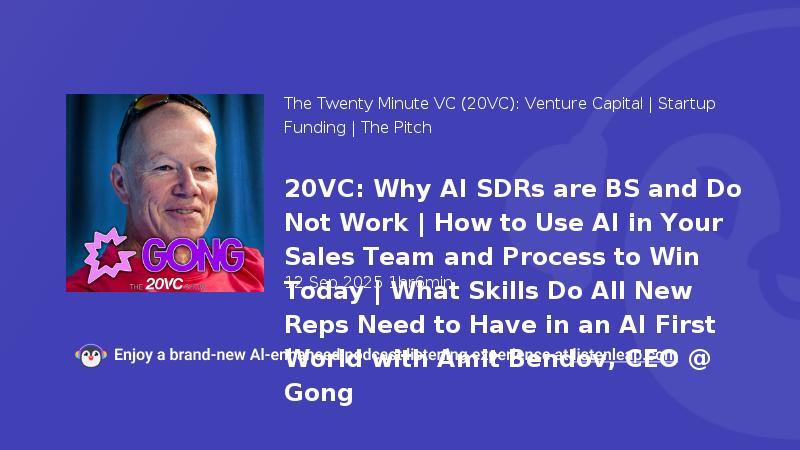
This is 20 Sales with me, Harry Stebbings.
Now 20.
Sales is the monthly show where we sit down with the best sales minds in the business to discuss how they start, scale and master sales teams.
Today, we're joined by Amit Bendov, co-founder and CEO of Gong, the leading AI sales platform.
Now the company has raised over 600 million from some of the best, including Sequoia Thrive, Salesforce and more.
And Gong has surpassed 400 million in ARR and serves thousands of customers, including multiple Fortune 100s, and is valued at over 7 billion.
But before we dive into the show, today is your finance team a cost center tied up in enforcing policies, bogged down by cumbersome processes and drowning in operational busy work.
Well, what if you could unlock seamless, strategic finance that actually fuels your business growth?
This is why leading global growth companies use PayHawk, the finance orchestration platform that unifies global spam management with conversational AI, to deliver best user experience for everybody dealing with company spending.
Finance teams using PayHawk report a major shift from operational to strategic work.
New AI agents for each finance role.
Handle the busy work acting with the same governance as your finance team, like having a small team of expert assistants that work 24 7, but also providing an exceptional user experience to your employees.
Payhawk is built for growth and enterprise businesses that operate globally.
No six-month implementations, no consultant dependencies, just immediate finance transformation that scales with your business.
Leading growth companies like vinted, wallbox and hundreds more across 32 countries use payhawk to move finance forward, not just keep up.
Ready to turn your finance processes into a competitive advantage?
PayHawk is offering a staggering 30 discount to everybody switching from a qualifying expense management or company card provider.
Who mentioned the 20VC podcast?
Visit payhawk.com forward slash switch to learn more and make the intelligent switch today.
And speaking of game-changing products like Payhawk, there no sales team can be the best without attention.
Attention creates AI agents that learn from your best sales conversations so they record your sales touch points across a ton of different areas, like meetings emails calls, crms and more.
They then use these ai agents and learn from that data to automate busy work like follow-ups, next steps, crm updates coaching, scorecards bluntly, all the manual that your sales team has to do but takes away from their creativity and closing deals.
So stop losing winnable deals to process and start automating.
Take the grunt away from your sales team, use attention.com, the best sales teams all are.
While attention is helping your sales team focus on closing more deals, let's look at how you can bring that same edge to your website.
Still using a copy-paste website?
Break the template trap with Framer.
I've been rebuilding our show site and honestly, it felt like redesigning in Figma, but this time it went live.
What surprised me was how smooth it was to add bold animations and even localize the entire site with one click.
And yeah, Our whole team jumped in and edited the same page together.
No mess, no back and forth.
Framer is the design-first no-code website builder that just lets anyone ship a production-ready site in minutes.
So if you're ready to build a site that looks hand-coded without hiring a developer, launch your site for free at framercom and use the code SALES to get your first month of pro on the house.
That's framer.com, promo code SALES. framer.com promo code sales rules and restrictions may apply you have now arrived at your destination dude listen i've wanted to do this one for a long time i interview the world's best cro's on 20 sales everyone obviously uses gong so thank you so much for joining me today dude My pleasure.
Thanks for having me.
Dude, I think most companies are founded on insight developments, which is a way that you see the world that other people don't agree with.
When you think back to starting Gong, how did you see the world and sales that other people didn't agree with?
You know, if you take like Peter Thiel said, like great companies are built on secrets, right?
Our secret was that everybody thought, still do, that CRM is a single source of truth.
This is not true.
CRM doesn't have truth.
The only thing that's true out there is like who your customers are, what they bought, how much they're paying you maybe their phone numbers.
Everything else is not true.
It's like information that sellers are bothering to put in.
It's highly subjective.
They put maybe like 1% of the information that's actually happening.
I experienced it firsthand.
In 2015, I was like a CEO of a software company.
We're growing really fast.
And all of a sudden, I had a shitty quarter that sales were just not... just taking a nosedive and i have no idea what's going on i started digging like in our crm like uh you know do we have enough opportunities do we have enough people making enough calls enough emails everything looked fine except for like we weren't selling so it dawned on me that the secrets is not like how much work we're doing or how many people we have but it's like the essence of the the conversations with customers And I sent my product manager to sift through CRM notes and they spent a couple of weeks, load everything to Excel.
And they came back, said there's nothing there.
I mean, I realized.
The problem is that CRM was built for the leaders to give them the information so they can roll their forecasts and reporting based on sweat that people at the bottom in the trenches need to put in.
They need to go in.
So i met this customer.
They're very excited with the demo when we're gonna meet again next week, and then nothing happens and never really know why.
So serum tells you, like what you won and how much they paid and what you've lost, but you never really know why and it doesn't tell you how.
This was 2015.
For those who remember, this was the year where deep mind was already beating the world champion in chess and AI was starting to diagnose cancer better than the doctors.
The question I asked, like how hard would it be for AI to tell us what's going on better than sellers?
That was the insight that ultimately led to Gong.
I go off in many tangents, but you said there about kind of CRM is not really having a lot of data.
It's a pain in the ass for sales reps to put a load of data in.
Do you think in an agentic world?
Your CRM providers literally just become data storage holders and actually you just have agents crawling over them to retrieve information that users will never go back to those providers for.
Absolutely.
Like, I mean, who wants to fill in forms or flip the web pages?
This is like people punching cards in the 70s.
There's no doubt in a couple years at most, and I used to say like in 10 years, right?
Now I say like in one to two years, nobody's going to be filling in forms.
Nobody's going to run those like reports and go and like update their managers and all of that.
It's all going to be done by agents automatically with AI, better, faster, cheaper than people.
What would you do if you're Mark Benioff?
Well, I think he's doing the right thing.
He's a building agent.
I think they also recognize the opportunity with AI and they need to move fast, as fast as they can.
We spoke about kind of insights when you started the company.
I think some of the biggest lessons come from changing one's mind.
When you think about what you believed that you now no longer believe.
What did you believe that now you don't believe anymore?
Our store is actually boring.
Our presentation, I still have the pitch deck from series A. How much did you raise?
We raised 6 million.
It was really hard.
Nobody wanted to invest in us, Harry.
Believe it or not, we struggled.
99% of people said no.
Passed on the opportunity.
I kid you not.
6 million at what price?
I don't even remember.
Like 20?
It was like 2016 evaluations.
Why did they say no?
They thought that sellers are going to hate Gong because they're going to see it as a big brother.
That Google and Amazon are going to own the AI technology.
They're going to own this market, whatever it is.
Legal and compliance reason.
They said you can't really record.
It's illegal, which is not true.
It is legal.
As long as you have consent, everything is legit.
One of the reasons like oh, there's no company made it in sales tech.
At that time, there are companies that most of them like don't exist inside sales and ClearSlide.
I know you might remember those like.
So it was like you know.
Is this like even worth an investment as a category right?
And these are not stupid people.
These are smart people that I know, right, personally.
And to hear those no's was gutting.
So you raised 6126.
What happens then?
Do we have product market fit then?
It was insane.
We raised the money.
We started developing first year 2016.
We haven't been weren't planning any revenue.
And we just coerced a few friends and family companies to try the product, so we can get data, so we can start training our models.
We didn't plan on charging anything.
And people think, oh, free product people would be surprised. you know, happy to try it out.
No, like people don't want to waste their time, but we use anything from emotional extortion to bending people's arms that you does favor.
They tried it.
So we started like the system started to work.
I think it was January 2016.
We launched like not even an alpha, kind of like hey, kick the tires, tell us if things like even make sense.
And then we started seeing that the sellers are actually logging in like engagement was not zero because oh that's, that's pretty interesting.
What are they doing over there?
So we started looking at logs, we saw how they're using the product and we started tweaking the GUI a little bit, moved some buttons, relabeling.
We thought people were going to search for keywords, like a competitor name.
But that's not what they're looking for.
They're looking like, okay, my customer name, right?
Where am I calling the customer?
Or like a person's name, like a seller's name.
So we tweaked, engagement improved.
We started getting complaints, which is like a very good thing.
People, oh, Gong missed that meeting, like why he did this.
So, which is a very good signal.
Why is complaints a good signal?
You know what's worse than no complaints?
Silence, crickets, right?
Means people don't care.
The ideal, the product just works amazing and nobody complains, right?
The reality.
Most products aren't amazing, especially on.
But when people complain it means that they want it to work right.
That they care.
So customer complaints, most people panic.
It's a phenomenal opportunity if you react.
So people complained, which was good.
Oh, Gong was like five minutes late or like, you know, I was talking behind my manager's back.
So all those things, right, that Gong captured somehow.
It was good.
And then around April, I was telling Elon, Elon is my co-founder.
You know what?
Let's do a little experiment.
Like, let's do a trial close.
A trial close in sales is like, you go and ask for the order.
If you're working on a deal, you're going to ask for money and it tells you where you are, right?
You get a yes or a no.
Do they know it's a trial or they don't?
No, you just say, hey, are you ready to buy?
And people say, yes and no.
No, usually it's a no, right?
But at least you know what you're missing.
So we wanted to know.
We didn't need the money, we didn't have any revenue goals, but do we have something that is valuable enough that people would be willing to pay?
We saw that they're using it, they're engaged.
Is it valuable enough?
Because there are plenty of products people use and love.
When you go and ask for money, they're not willing to pay.
So we didn't even have a price list.
But we said you know what, let's start something like you know, 30 to 50K, which is a non-trivial amount.
We wanted to be like somewhat painful, but not outrageous.
We had a dozen customers and we reached out to all of them and said hey, sorry boys, the beta is over.
It's time to pay.
And they hated us.
But 11 out of 12 bought.
So within six months we had like paying customers and I said, okay, like that's really good.
And they were paying 30 to 50 grand.
Something like that.
Wow.
Even less.
Doesn't matter.
We ask, maybe they pay less.
We didn't care, like what it is, but they didn't want it to be like a dollar, because that wouldn't say anything, or a million.
It was just an experiment.
It works extremely well.
Okay, so these are all like people that knew us, right?
Friends and family, which is like stage one.
Then the next step would be, can you sell like total strangers?
People that don't know like a meat or a lawn or aren't my cousins, right?
So I went to this first conference in Chicago in 2016, April.
And I present, like, I still have the deck, like, how AI will transform sales.
And people's jaws dropped.
You could see that, oh, wow, that's new.
And right there, I got our first, you know, random stranger.
He saw.
I showed him a demo.
And he saw.
I said, this is great.
Like, I need it.
And a month later, he bought.
So, that's how it started.
So, it's clear that the product market fit.
We nailed it on, it was a hole in one.
Do you think founders should be the one to build the sales playbook?
You there are very provocative in terms of being the one on stage getting your friends as customers.
Should the founder be the one to create that playbook?
Yes yes, absolutely.
It is very difficult to change things after that once you start bringing like we still think it's gone.
That i said i wish we've changed it now, because once you have the momentum, it's never like important enough to change things Now.
If you're like an extreme introvert engineers, maybe not.
I think a mediocre founder can do probably the best job early on because you understand the picture, you have the passion, you understand you still don't have a playbook.
So if you're an average communication skills founder, do it yourself.
Just figure it out, because you understand the vision, you understand what people understand, what they don't understand, probably better than anyone else.
You're not a better seller, but overall, I think it's a great experience.
What do you wish you had changed, but it was too late to change?
Our sales are doing extremely well.
So, but you know, I think our sales stages, right?
For example, Gong, like don't make like the most sense.
They work, but they're created like in 2016.
And why didn't they make sense?
It's just technicalities.
It's like, you know, they call it presentation one, presentation two.
Some of them are kind of like more like customer milestone and activities.
They're not the best practice, but they work well.
And it'll be like very difficult to change.
It's not impossible.
Maybe like one day, like, If our sales team decide they'll, they'll put the effort to put it in.
So little things nothing, nothing major.
But you know fortunately, after we started selling to a stranger, I brought like a really strong VP of sales and he started crushing and brought like real professional salespeople and then the team took off.
Can you help me then?
I'm a young founder who has done pretty well.
I've got to a million in ARR.
You're my angel investor.
Well done.
I hope I do well.
And I'm hiring that VP of sales like you were at that time.
What advice would you have for me on hiring a VP of sales for my company at a million in ARR?
And I've never done it before.
You know, I wouldn't hire that like high pedigree VP from Salesforce or Adobe or whatever.
Salesforce is a great team.
You need someone who's still hungry, scrappy, and will figure out the playbook, right?
That has, like I say, enough experience that have been successful.
I'd say a deal like two or three other companies.
One company is a little dangerous.
Maybe it's not a good deal sample size, but I've been successful in a number of companies I've seen, because every company is different.
Your company is probably different than the two or three others that your VP of sales have done before.
So it's important to hire someone with a diverse experience.
If they've been successful at three companies, why are they going to join our shitty little startup?
Well, first, your startup isn't shitty.
Like, you need to sell the dream, right?
Sure, but we're a millionaire and they're a sales leader that's had three successful albums.
Yeah, but you say, yeah, let's do like a billion like in five years, right?
I mean, that's like, first, you need to sell.
Hire the best talent, it's hard.
Now it's not necessarily being like CRO at like three companies, but they've been like a seller at company one crushed it.
They've been like a sales lead at company two crushed it, crushed it and a director like Company 3 crushed it.
The ACV.
Really?
Yeah.
Why is that?
Industry knowledge can be acquired like fairly quickly and salesmanship is extremely hard and takes time.
Now, ACV doesn't mean it's like, you know, between like 15 and 50K, there's no difference.
But you're selling like, you know, seven figure deals.
It's a very different ballgame than like 10K deals.
One's like very high velocity and the other one is like traditional enterprise sales.
So these are the two categories, like enterprise or transactional selling.
How does the art of salesmanship change in a world of AI?
I think the art stays the art.
The drudgery goes away.
AI does not generate great art.
You try it like with imagery, right?
Or whatever, with Sora or whatever.
So art is created by our creativity and intuition that people still outperform AI.
But the numbers are sellers spend 75% of their time on non-selling activities.
This is insane.
It's like updating forms.
It's like the forecast calls.
It's like one-on-one meetings sifting through lists, running workflows, researching information, preparing for meetings.
This is insane.
You're paying three out of four dollars.
You're paying them is to do uninteresting work that can be decimated with AI.
And the salespeople would be willing to pay out of their own pocket for this because they hate it.
That's definitely going away.
The bigger thing is the sales effectiveness, just to know how to sell.
Like, obviously, there is a very big variance between the best sellers and the worst sellers.
Just look at the graphs, right?
Look at the payment graphs.
Even the best sellers, right?
Not like every deal to show at the best form.
Just everybody, you know, LeBron has like a bad day, right?
So...
The performance is very uneven across people within the same people.
So AI can make sure that you show up in the best form, best shape, every time, every game.
And maybe some people shouldn't even be in a profession.
Some people shouldn't be in the profession.
Interesting one.
We just released a show today with Jason Lemkin and Rory O'Driscoll, who I love dearly.
And we're talking about Microsoft laying off 9,000 people.
Yes, yes, I've heard that.
That's a really good episode.
Oh, thank you.
But what we're seeing is, like you know FDEs, Forward Deployed Engineers at Palantir Microsoft, laying off 9000 people, largely sales, and replacing them with kind of product-centric solutions engineers.
Clay, a smaller company, but still a fast-growing company, doesn't have a sales team.
It just has kind of product specialists that sell.
Are we moving away from a world of respectfully, less technically-minded salespeople?
No, no.
So salespeople are required.
There'll be fewer sellers, I'm pretty sure.
And I'll give you some numbers to think about it, right?
There are roughly 9 million sellers in the world.
Let's say 10, just for even...
Let's say that they're all on average are making like $150,000 a year.
So that's like one and a half trillion dollars in cost.
Remember, three quarters of that, you pay them not to sell, but to do administrative work.
So that's the opportunity.
Now that's the petty cash.
So let's say average quota or average revenue per seller, let's say 700K a year.
I'm just throwing a number.
So that's like $7 trillion.
$7 trillion a year sold by the sales community.
This is bigger.
People talk about like, you know, cursor for engineers or Harvey for lawyers.
Gong or revenue AI is for sellers.
It's way bigger because it's not just the cost or the headcount.
It's the revenue they're generating.
It's like a magnitude of order bigger.
So this is a multi-trillion dollar opportunity that AI can tap into.
If we make reps dramatically more efficient, we will need much fewer.
Yes.
Great.
Yes.
If we need much fewer, we cannot stay on a seat model.
Of course not.
So we move to a usage-based model.
Yes.
How do we do a usage-based model when there's a lot of ambiguity in attribution?
It needs to reflect the value.
Usage is like one way to do it.
Let's say that people pay like.
If you have like one-tenth of the seller, you increase the price per seat like 10x, right?
So it's like 10,000 per seller, but they're 100 times more productive.
That's a core assumption that I think no one is spending enough time thinking about just with AI in general, which is will we see the transition of these tools from software budget to human labor budget?
Oh, I have it in my pitch deck from 2017.
I said like revenue AI will be bigger than CRM, not because it has like a big ego, but just the economics.
Because you needed to get your A done.
Well, I think people dismissed it at the time.
You're right, whatever.
You do everything to get a round done.
Add them to the right.
No, I don't think it landed, but it was obvious to me.
If you think, like, it's not gone, but AI is bigger than cloud, now people get it.
Because cloud was an IT revolution.
If I'm a seller, I don't care if I use Salesforce or Siebel.
Yeah, one is a little easier than the other, but the IT is the beneficiary.
It's true that there is no software, but as a user, you know, I feel opportunity, feels like here and there.
I create opportunities here and there.
I create quotes here and there.
It's very similar, right?
The benefit is the IT that there's no software, there's no upgrade, no infrastructure.
But IT is 6% of a company's budget.
The biggest item is payroll.
And AI taps into payroll.
The 70% that people are spending on admin work goes away.
Now it has to reflect the value.
And that's why it's like it's a magnitude of order bigger.
What does it?
Because if you look at say, like a windsurf or a cursor, actually the commoditization of technology means that they don't have leverage and the switching is much easier.
And so what you're seeing is actually they're not able to charge and move into the labor bucket because there is such little leverage in switching between the two.
They might have little leverage if you're a thin wrapper.
And I hope I'm not offending.
I'm not using cursor.
It's a great thing.
But if what you do is a thin layer over, like LLMs, it's very hard, because now there'll be others that are doing it and there'll be an efficient market.
So the pricing will actually go down because someone can do the same thing better or as good, but cheaper.
You'll not be competitive.
So it's up to the company to develop the modes that allow it to capture the full value.
If you're doing something trivial, then yeah, you're not able to do the pricing.
Are you moving into the human labor budget now?
We have not yet.
So we're building the foundation.
The key asset that companies have, especially like in our domain and even like in other domains, is the data that you're sitting on.
Because you could go to any of the labs, you could load a couple of cold transcripts and tell like, what do you make of this?
Like, help me sell.
But it'll not, and it'll give you an answer, but it'll not be like a good answer.
And you wouldn't even know it.
The real answer, have you captured like everything?
What's in the emails?
What's in the back channels in Slack?
What's like and is it the right information?
So the battle is now for two things, data or in LLM words, context, and the second workflow.
Is it like something that is weaved into the workflows of people?
That's where we spend like, most of our effort, but future products that are coming will transition to more value-based pricing than a per seat.
When will you move into the human labor budget?
Because that's the cool question for me as a VC.
We already are.
So sometimes, you know, I speak with a CFO and he says, oh, we don't have budget for Gong.
Like it's $100,000.
So it's like, okay, like how many sellers do you have?
A hundred.
Now, stack rank them.
Surely there are two at the bottom that aren't going to come even close to quota?
You'd say yes.
Okay, like two is 98, but given the technology to do it.
So you're already like tapping into things.
But if you're asking about usage, that's probably coming like next year.
I think it's real.
And again it'll be applicable to companies that create a unique offering with like strong moats that is not easily replicable by anybody else out there.
How do you think about the rise of AI SDRs?
We've seen a lot come with big brands and flashy sayings.
How do you think about them?
That was a pretty stupid thing.
We knew it.
And Elon and I said, what do you think?
I said, this is not going to work.
Why did you think it was stupid?
We have a framework for categorizing and stack ranking worthy opportunities.
So one is the difficulty of the task for humans, and the other is the risk.
What happens if it goes wrong?
Outbound calling is probably the most difficult thing for humans to do.
It's like try to ride a bull at the rodeo, right?
People just want to shake you off their back, right?
And just very few people are capable of doing it.
So that's one.
It's very difficult for AI to do that, to keep someone on the phone.
Second, the risk, right?
What if it says something wrong?
What if it's doing something unethical, like lying to people, right?
You give it a goal, right?
So the risk to the brand is massive.
So you take on both dimensions, like it scores like pretty poor.
Now, that said, I wouldn't write that direction off.
I think certainly there are cases for inbound that can be handled pretty well with AI.
But this was like well ahead of its time.
The technology is non-deterministic.
It's not 100% right.
Now, their task is perfectly okay.
If I want, like an account summary, and if it's not always right actually, it's not always right, but that's still okay.
It's like 100 times better.
It's very difficult for a person to do that, right?
It's very easy to do it with AI.
The risk is not massive.
So that's like a very great use case.
But I wouldn't let it send a proposal for a million dollars.
Who knows what it's going to put out there?
Even if it works like 98% of the time really well, that 1% is a massive risk.
So you wouldn't let it sign a contract.
You wouldn't let it like fire people.
So there are things that... Does it work for low ACV quick sale cycle conversions?
It's good.
I think that the first thing that will be replaced will be the transactional AI.
If I'm selling phones right or cell phone plans, that's easy enough as long as there are guardrails and there is, like you know, I spoke with a customer.
You know we're looking to do like AI, that's monitoring, supervising the AI.
So it'll be like an ai coach for ai agents, if you follow me.
Yeah, you need to make sure because even if it works well you know there's this famous case about the canadian airline who's offering like free travel for life or something right yeah ai, the agent offered it, they have.
They had to honor it.
So it's a liability for uh, for companies.
Who do you sit on top of model wise with a bunch?
First, like we have a lot of our own models uh, we have probably 40 or 50 gong models And then we use like Claude, we use like or Sonnet, we use like OpenAI.
Which do you use most prolifically?
We dynamically switch between them.
So sometimes they're good for one purpose or another.
Costs are going down, quality is improvements, or we're also monitoring what's out there and what's the best that we could get.
What do you not know about how AI changes your business that you would like to know?
I wrote a post.
That is real observation, that you know, people think it's like AI destroying the world, which is a real risk.
I don't know.
I'm optimistic by nature, but I think it can drive mediocrity.
The way that LLMs work, they're very consensus driven.
So they aggregate like everything that they've heard and create something.
It doesn't create great copy, for example.
So I'm a pretty good writer, I think, maybe not the best, but pretty good.
And whenever I try to say create something like witty or it's not, it's okay.
So the risk is I have someone at the company says, okay, come up with a strategy for this market.
And they've actually used like one of the LLMs to generate the plan.
That's a terrible idea.
Because I could get like an average.
It is sensible, it makes sense, but it's not the best plan, right?
So how do I know that work, strategic work, that done by people at my company, is not like a product of LLMs?
I don't know, dude.
I think 90 of the plants that they produce will be better than the plants that the people in your team produce.
No, absolutely not.
I review them all the time and they're okay.
They're okay.
But with okay, you do not create like an extraordinary business.
You need the brilliance, the spark, always like the angle that's unique.
So yeah, if you want like an okay company, it's okay.
I don't know if that changes pretty quickly.
I mean like within a year.
If you feed it the right data with the right prompts, I think you're going to get there in a year.
I mean, are you going to get to like a CRO creating a full end-to-end year long strategic plan?
No.
But if you're thinking of from a more simplistic sales plan.
Well, super like, okay, this is the competitor over here.
Create a competitive strategy for me.
That's like a simple question.
That's what most people do.
What you're going to get like is not great.
Wow.
Yeah, you must have really good people then, because i would i have really good people.
I'm sorry, i didn't mean that rudely, but i maybe i'm negative, but i meet loads of sellers.
Most sellers are shit.
First, most of our sellers are phenomenal at gong, i kid you not.
And it's not just sellers like i mean.
You give you know someone in product marketing.
I mean it could be like anywhere in a company.
It could be in it.
You know what should we?
So it's across the company and not necessarily gong.
By the way, it could be like in any company.
I call it the convergent mediocrity, right?
That's like a big risk that you should pay attention.
I get some work, like sometimes I say, hey, was this written by an LLM?
Because it looks like too sensible, right?
Sometimes they're a little bit like... Do you not want that?
I don't want that.
So Canva this week announced that they are doing the discovery week, where they give everyone a week to try new AI products.
Do you not want your team to be actively using AI in there?
No, that's an amazing idea.
But if you do the creative work, you do your messaging with AI, you do the strategic plan for the company with AI.
I think that's not good.
How do you think about how the structure of sales teams changes with AI?
There's a lot of supporting roles in sales teams.
How do you think about how the actual org structure changes with AI self-prospecting by AEs?
That's a trend regardless of AI.
I think the whole unit economics for SDRs don't work for like hyper growth companies, not for companies that are growing 10, 20.
So SDRs goes away.
Yeah, it'll definitely not be a trend.
And this is like independent of AR.
A lot of companies like, yeah, is it even worth it, right?
I see like how much revenue is generating versus like how many appointments.
So a lot are moving.
They still have SDRs.
The value in SDR, they do generate some revenue, right?
So if you're trying to scrape, like every five, 10 of extra revenue, that's great, but they become the best sellers.
So we'd gone see like SDRs as a sales school and we get some of our most amazing sellers start like doing nine months of SDRs and then they move into sales and then they go to commercial sales and go to mid-market.
Then some become like monster enterprise sellers.
Do you worry if we remove that SDR role, you'll lose that training?
Oh, we will not remove it.
Like, why would we?
We just said we'd lose SDRs.
We, no, I think that first, not necessarily us.
Gong is growing at an incredible pace.
So for us, it does make sense.
But if companies, SDRs did not exist like 25 years ago.
The whole idea, sellers used to do their own prospecting.
Remember like, you know, Glen Ross, like, you know, here are your leads.
That's how it started.
But When companies started to scale in the early 2000s at an incredible pace, people said okay, you know what?
We can't hire sellers fast enough and train them.
Let's break the role and do two.
We'll have people doing the upstream, the top of the funnel, and people monetizing, the sellers.
That's a new invention that actually did not take off at all industries.
It's a tech industry thing for hyper growth.
It does come with a lot of benefits because you do get like very focused team that knows how to generate appointments and qualified leads and pipeline.
But it creates a fragmented buyer experience.
People want to know like what does Gong do or what does the, you know, Figma do?
And then they have to go through like a series of interviews.
What specifically do you learn as an SDR that makes you a weapon later on as a seller?
Oh, first, like to create your own pipeline.
People don't like cold calling.
It's an unnatural work for most of us.
The fear of rejection.
So they get really good.
Do you buy the future of cold calling?
Yes, yes.
I think well, it could be like I don't know what the communication means going to be, but the idea is like reaching out to someone.
Yeah, definitely.
Like, you know, you reach to a stranger or create an introduction.
Absolutely.
I think that they'll stay like one way or another.
So they know how to create their own pipeline.
They get a lot of like, I call like abuse, right?
People and develop the resilience.
They know how to position the product.
People say, oh, we already use this.
But they build so much strength and resilience.
It's unbelievable, right?
And they go into sales.
It's almost like they have the hard part behind them.
Now it comes the easier part.
I do believe that it's a great school, especially for people that did not come from tech.
But now there are companies that aren't growing.
Why do you need something that's optimized for hyper growth and have like SDRs and move it?
I think we'll have like fewer roles that are more able to do multiple jobs.
You know, maybe sellers should be able to support customers as customer success.
So I think we'll see like a blend of these roles, like in a one person, almost like a one person band that is doing like multiple roles at the same time because they have the tools to do it right.
They use agents.
How much smaller are those sales teams?
20%, 50%, 75%?
We said 77%.
I don't know if we can reach the full potential because there will always be some addition.
Plus, there is a limit to how much people can actually absorb.
I throw food at you, right?
You can't eat all that much.
So there is a limit to how many customers people can help.
So most companies, they have a quota capacity, right?
If you build a plan, let's say your plan for the year, you need to generate like $80 million, right?
So you want to make sure your quotas add up to, let's say, $100 million.
Because, you know, not everyone's going to hit it, so you build some buffer, right?
And then most companies hit like 66% or whatever, 70%, or 70 people hitting 70%.
And Gong were like at 130 of capacity, we perform well over 100.
I don't know if it's exactly 120 130, well above our capacity.
So that shows the power of AI to make people more productive and more effective.
Can I be direct?
You said beforehand that I could ask anything.
Please, yes.
There was a time when you guys were flat, or it was a tougher time.
Yeah.
What happened there?
Yeah, that was like early 2023.
Absolutely.
These are like dark times.
We're not growing, even like slightly shrinking.
So it was a combination of things.
First, people bought like crazy in 2022 in the post-COVID world.
Did you know they were irrationally buying at the time?
No.
I have to say I shared the excitement of everybody, to be honest.
We're excited.
We're drinking the Kool-Aid.
And you raised a pretty big fucking round then, didn't you?
We raised a lot of money.
Most of it is still in the bank.
Gong is not burning cash.
How much money have you raised?
550, give or take.
I mean, don't take the exact number.
How much have you got left?
The vast majority of it.
Great.
Well done.
We're not burning.
When you raised it, what was the price on that biggest last round?
Seven and a quarter.
Were you like, that's a high price to raise that?
It was a high multiple.
Definitely the multiples are different today, but still I don't think it's something like you know, we're thinking like such a big company.
If you take like a 20-year view, then yeah, still think like the potential is like far greater.
It was a number of things.
First, time got tough.
We had like a lot of concentration, a lot of like companies in technology business who were hurt by interest rates.
So money wasn't cheap.
So a lot of our customers, what happened?
Like in 2022, they would buy.
Let's say that they bought.
They had like 100 people and the sales are gone.
So, okay, like, you know, how much are you growing?
I said 50%.
Okay, I'll throw in like 50 more licenses.
So they bought like 150 seats, right?
Comes the renewal.
Now not only they don't have the 50, now they have like 70, so really high like downgrade and churn.
So we lost a lot of seats that were not real because company didn't have the growth.
So that's number one and it was painful.
Second, i think we lost some of our muscle tissue, like when we were told about the hustle.
Like when we're like three people at the company but all of a sudden people just bought.
So our game like we just gave them licenses and moved on to the next thing The way we supported the customer was not as tight as you need to.
But all of a sudden, you know, CFO shows, ask you like, show me the ROI.
Why should I spend on you, right?
So we had to learn that things.
And the third thing, we had like one product.
We had the conversation intelligence product.
Our customers were looking to consolidate on one platform and say oh, like we absolutely love Gong, but outreach is giving us both the engagement and the CI or sales law.
So we're like behind, right?
We had the deepest AI technology, but not the breadth of the platform.
And companies just couldn't care.
I mean, we lost, you know, sometimes the CRO that bought Gong was out of a job.
So there's not even like, so we lost a lot of customers.
What are your reflections on that, on breadth versus depth of product?
For us.
We just caught like in bad timing where we're like hyper growth, like in a lot of like licensed people bought that didn't get to use because of what happened with the economy.
We're planning to expand the platform, but we this is like okay, it's happening now and we're not ready.
And I still remember, like, the old hands call of the company was, like, really tough.
And people were not used to that.
Gong is like a rocket ship.
What?
Like, we slow down?
Like, this is, like, inconceivable.
When you say slow down, what is slow down?
Like, no growth.
Yeah.
Yeah, no, it's slow down.
Yeah, yeah.
High churn.
Can I ask you, you're a pretty chill dude.
Maybe you're, like, just, sorry, ice cold Israeli.
But, like, are you stressing out at this point internally?
Yeah.
No, no, absolutely not.
I think it's important.
Like it's not the first time.
So I've, you know, I've experienced like 2000, 2008 COVID.
So this is the first time, you know, the cycles like are things.
Second, I know, listen, we have like plenty of cash.
When you have enough experience, you know like a crisis in a crisis, there are like plenty of opportunities.
Just look around, like keep your head up.
And we knew, listen, we have cash.
Our competitors are going to struggle.
We're going to step on a R&D gas pedal and develop like crazy.
First, we need to write to expand the platform and they're not going to be able to do it.
So this is a great opportunity.
This is what we're seeing right now.
I knew that we're going to win.
It's going to take a while.
I didn't know like how long or how fast, but I was very transparent with the team.
No doubt, like this team is going to win.
I don't know how long it's going to take.
And we saw like first there was like no growth.
There was, like you know, a little bit.
You know maybe like 3 and then like 5 and 10, and you know 20 and 30 and higher.
So the company is accelerating.
What did you do to re-accelerate?
Because that seemed like a very cyclical.
In a nice way it's nice, it's not you, but in a bad way fuck, if it's not me, i can't change much.
So what did you do to re-accelerate?
No, as part of it was us.
First, we didn't have like, the products that people wanted, so we we, we had to develop them.
Second, we really improved how we support customers, like that we, we measure our usage engagement.
Do they see strategic value?
So we move to outcomes.
Did you build a team that's focused on data presentation of outcomes?
Absolutely.
We have value engineering.
This is what they do.
And their job is to prove to a CFO we imagine, the most cold-hearted cynical person out there and prove to them why this is the best investment, that they can't do without it.
Is it not just another cost that makes these businesses more and more margin light?
And what I mean by that is when you have like, the SDRs and the BDRs, and then the AEs, and then you have the CS team, and now we need another fucking team doing value engineering.
And this is just in the acquisition and retention before we get to product marketing eng.
The margin on these businesses is getting crushed.
Well, we have great margins.
Do you think most SaaS businesses have good margins there?
Because when you see the structure, The good ones listen.
There's a bell curve of companies and some are, you know, top decile, some are bottom decile.
So not everybody.
So you need to understand what makes sense for your own business.
Gong is fairly efficient as a business and it's growing fast.
So the number one thing you did was expansion of product line?
That's probably the most impactful thing.
So it took us a year to get something out there that was not even like fully mature.
And now it's like mature.
And we also, I think there's very important things for us.
I think the biggest benefit that we learned how to scale from like one product to three and now we're getting like four and five and six products, right.
So, to become a big company, we need like, a bigger solution, which is a skill that the company needs to learn.
It's not just like developing a product.
How we train the sales team to position it is something that they don't know all of a sudden.
Do you have different sales teams for different products?
No, we don't.
We don't because we have the benefit that we sell to the same buyer.
It all goes largely to the CRO and sales operations.
If we had to have other products for, let's say, maybe like a CHRO or whatever.
Well, Rippling very much have verticalized sales teams for verticalized products.
Yes, yes.
We have one sales team and we have subject matter experts.
So people are kind of product experts because some of the products are very technical.
Like you know forecasting, for example, is like extremely nuanced and detailed and a lot of minutia.
Do you think we're totally into the world of the bundling of sales tools?
You mentioned forecasting there.
Obviously, Clary is one of the leading forecasting tools.
Does Clary just get eaten up by you?
Listen, Gong like within a year added a thousand engagement customers.
Most of them are had like either outreach or sales loft or groove right.
So think about the pace like a thousand companies move to gong and uh, we have close to 800 customers on forecasting like within a year, most of them probably using like nothing or clary or like there are a few other smaller companies.
So yeah, when you see a competitor like sales loft bought by pe, are you guys all like high-fiving?
No, no.
There's a couple of reasons why.
Like 2.1 billion, it was an expensive buy given where they were at.
And two, innovation and product instantly is degraded when PE buys.
I'd be doing a victory lap in the boardroom.
First, I always liked the company.
I liked the people.
They're a good partner for us until we became like a competitor.
And even after that, I've not lost my respect.
This is another reason I do a victory lap.
Carl's fucking happy.
It doesn't make me happy that my competitors are failing.
And again, I never saw them as like our ultimate competitor.
I'm extremely competitive type.
Competition like fires me up, but I'm not obsessed with the competitors, right?
Because remember the opportunity we're looking at.
We're looking at $7 trillion being sold with human labor and sweat that doesn't make sense.
Why would I even like worry about like a little forecasting for some mid-market enterprise companies?
This is not like the big prize, and you should keep your eyes on the prize where you're going, and not on the other companies.
This is like what we're building.
When did you take your eyes off the prize and how do you reflect on that?
Like, when did you get distracted by something that shouldn't have distracted you?
A shiny object that you shouldn't have spent time on?
Not Chinese, but sometimes there's real.
You know where you want to get.
And there are some things that are real that aren't a straight line to where you want to get.
And you take a little detour because you need to do it.
Building an engagement product, kind of like took him from sales and outreach.
We had other plans that are even bigger potentials.
But 2023 came and said, if we don't develop it now...
I don't know that we'll get a chance, because once a country gets like really bruised, like it's very difficult to get over.
So we said, okay, like forget the strategic plans.
Let's develop this like right now, like really fast.
So we crossed this hurdle.
And then, from a power position, a position of strengths, we can continue with our more strategic plans.
So this was like a little detour.
Again, it's not.
It's not a waste and it's it's created a ton of revenue and strength in the market leadership position.
But it's always like a judgment call between the same kind of the long term vision of the company and some things that you need to do technically.
You know, the customer has a problem, right?
You need to take care of it now.
You know, realize our customers need like more stability with the system.
The system is mission critical right now.
So we said we halted like all engineering work for four weeks.
No features, right?
Just to improve the stability and performance of the system.
I hate it, but you got to do it.
Security.
I mean, you need to invest in security.
Gong touches like very sensitive data.
We have to be super secure.
So we do a lot of things that aren't necessarily the most strategic thing for you, but you just have to do it.
Are the best CEOs the best resource allocators?
Yeah, I think you can't suck at resource allocation, right?
I mean, it has to be reasonable.
The most important thing for the company is the strategy.
So I think if the execution is like 80% okay and a good strategy, you will still win.
Yeah, you could do better or worse.
There are two things that matter, right?
The team, which is basically execution, and the market.
The market is the most important thing.
And this is the strategy.
The strategy like what do you sell to whom and what's your unique positioning, unique value that you're creating?
Nobody else.
That's the most important thing for the company.
I've seen companies that are doing extremely well, and I know the team, they're okay.
I mean, they're not bad, they're not phenomenal, and I've seen smarter people that fail.
The most important thing is the strategy of the company.
In a hypothetical situation okay, I'm your son and I've just got a job in a sales team and I have a great company.
And I say Dad, knowing all that you know now, what do you advise me in terms of building my career, starting from the bottom in a new sales team that I want to grow in?
First, I wish that my sons would go into sales, but they probably will not.
Why do you wish they went into sales?
That's a good question.
I think it's a very useful skill.
I mean, they're doing things that are like as interesting and not more like in other ways.
But sales is a very, very useful skill in life.
And again, it's not like selling like a phone.
You sell ideas.
You asked me how can a young founder bring like a hotshot CRO, right?
You sell the dream.
Why do you want to ditch their successful company?
Because it's not exciting and come to your company that you said is like shitty right now.
You want to sell to investors.
You want to sell to your kids sometimes, like an idea.
You want to promote ideas.
So it is a very useful skill and it takes.
So what would you advise me, as your hypothetical son, in this situation?
Join, like, one of the best teams out there.
The company is doing really well and has good culture.
And then you learn.
It doesn't matter what the role is.
Just a learning experience is way more important than whatever you, you know, even if it's like at extreme, like for free.
Even if they don't pay.
Well, just what you learn is a hundred times more valuable than what they're paying you.
And have fun and pride and make sure.
Obviously, it has to be, like, an ethical company as well.
Do you think that actually being in an OpenAI Accursor sales team is actually useful as an experience base?
Because it's so non-reflective.
You're basically an order taker.
They're going to kill me for that, but it's true.
I don't know.
I mean, I haven't worked there, so I know this is so unique.
I think that eventually, every company has competition, right?
People think, oh, you're just taking orders.
But you want to be at a company that is not like.
I hope that people don't think I'm picking up on Salesforce.
Salesforce is a great company.
But again, there it's already very structured and a known brand and all of that.
So you want to sell to an underdog, on one hand, but not something that will not take off.
I mean you, that's the right trick, right?
If some products are just hard to sell because it's not good, right?
Or it's not competitive in the market, right?
You don't want to be there.
I totally agree with you in terms of not wanting to be there.
One of the reasons you don't want to be there is because of comp plans, and a lot of comp plans are based on obviously selling a lot of product.
How do you think we'll see sales comp plans change in the future?
You know, I haven't spent a ton of time thinking about it, but I think there'll be fewer sellers.
They could make like a lot more money because they're, they're generating a lot more.
So.
How's the way that you sell changed over time?
Well, we're better like in- I'm saying you personally.
Me personally?
Yeah.
Well, don't allow me to sell anymore.
But selling is fundraising.
Selling is hiring.
We're not raising funds.
I am always like speaking.
I'm speaking with customers like a lot of time and I- Will you still go and close customers?
I don't close.
The team is doing a phenomenal job.
You wouldn't go and close a customer?
I would, but they don't need me.
But I usually go.
Sorry, I'm so naive here.
Why does banning off still need it in customers?
With customer want.
They want the vision of the company and they want access to the person that can decide.
So if we're doing, like you know, a large, like seven or eight figure deals, the customer want to know.
Listen, I'm making investment.
I want to know when something goes wrong, I can call and meet like in the middle of the night.
That's the role that leaders are usually doing in those deals.
Plus sometimes I can make things outside of the ordinary.
How many customers do you think you have who have that can call you in the middle of the night relationship?
Any customer can call me.
Like even if it's a $10,000 account, like people reach out to me, I respond.
Literally, I had like someone reach out to me on LinkedIn.
Hey, like I'm a startup from YC.
I just need two seats.
Gong is like, I can't afford it.
Like, and he talked to, I respond to them.
No.
Absolutely.
Absolutely, yes.
No, you can't have two Cs.
Pay your fucking C price.
No, I didn't say that.
But I said, like, listen, it is what it is.
I hope, let me connect you with the sales team and see.
I take a look, right?
So I respond to any customers and I'll get, if a seller asks me, again, there's got to be a reason.
Like, not bring me that, you know, we failed to articulate value.
Now Mitt will save the day by with his charm or whatever.
You got to do your work, right?
But I get on calls with customers like almost any size.
When you think about deal wins, what deal win is most memorable to you and why?
You know, I told you about the event that we went to in April 2016.
And one of the customers that I met was the senior buyer from ADP.
So it's a big payroll in HR company globally, but mostly in the US.
And he asked he was impressed with the AI technology.
But I told him, like you know, I don't think we're ready for you, which he actually, like was pretty, pretty impressed, because not a lot of people would say that.
But we met the following year and then they bought, which was incredible.
They're using some other things that didn't work well.
So they already had a budget and they bought Gong.
LinkedIn was our first customer, first large customer.
Like early on, before we even like thought that we will sell.
We said one day we're going to sell to bigger companies, but there was never like an idea.
They evaluated us and they evaluated like a chorus at the time.
And for those who remember, and they said, okay, we decided to go with Gong.
And now they're, you know, they're growing and expanding and that's very exciting.
So there are plenty.
Not naming names, but what's your single largest contract today?
We're definitely now in the seven and eight-figure ARDs.
You're an eight-figure customer?
Yeah.
Wow, that's a lot of dough.
Well, big companies.
Half of the Fortune 10 companies use Gong today.
Wow.
Yeah.
Which churn hurt the most, and what did you learn?
Well, I think 2023 was like a very painful moment, because I was able to actually use the technology to understand what is going on.
It was like a breakup conversation, right?
I said, listen, we absolutely love Gong.
We have no choice.
It's like we choose you or the other guys because they provide like three products and our CFO just wouldn't listen.
Companies didn't have a choice.
It was like you know customers are like super happy and you're still losing them.
And so that was like...
Very painful.
But the good news, a lot of them are coming back now.
So we have a lot of like boomerang employees and boomerang customers.
What happens to outreach?
I don't know.
I wish them the best.
Like, you know, I don't want people to fail.
Is this another PE sale?
I don't want to like comment on them specifically.
I think if a company like isn't growing or isn't growing fast and doesn't have like plenty of cash, that could go like 20 years.
I don't know what their cash position.
They can't IPO.
And somehow people need to get paid, right?
Whatever the investor.
So a P might make sense for, there are quite a few companies like that.
The hard thing is you need to be 20 grower and profitable to be attractive for P.
That's the hard thing.
That's the hard part.
Yeah.
So, and I don't know like which strategics would want them.
Did you ever have an offer to sell to Salesforce?
No, no, no.
Were you ever tempted by an offer?
Listen, someone comes like, oh, like here's like a trillion dollars.
Like, you know, everything is something that we consider.
I'm not naive, but-
You can't have it even as a plan, right?
I believe in controlling your own destiny.
We have a great company.
We're really in the early innings and we're growing and we're generating cash.
We don't need anything.
Do you want to be a public company CEO? this is not something that is like a personal desire.
I mean it makes sense for Gong to become public, like one day, as some people invest in the company and need to see a return.
But I don't think it's like, you know, some people see it as like their mission in life.
Certainly it comes with a lot of like Sure, the IPO is kind of cool and some people get paid, but there's also comes with a lot of like restrictions on what the company can do and the flexibility and where your attention goes.
Do I end up the next generation of AI or like focus on, you know, 3% EPS like on this quarter?
I mean, listen, you have expanding secondary markets, which provide liquidity more and more.
Yes.
On secondaries, different founders have different takes on them.
If you're advising a founder friend on yours, what do you know now about secondaries that you would advise them?
What advice would you give them?
Well, it's actually like a pretty good option.
There are companies, not a lot, but that are growing fast.
So you go public, for either you need cash, you want the brand recognition to come, and it does come with more brand recognition and some liquidity.
Many companies don't need the cash, they have enough and they're generating cash, so that's like one second.
Liquidity is is a good option with secondary.
Now the market is actually evolving and the brand okay, like it's real.
But let's say, you know, if you think about the cost of and of being a public company, take that money and buy super bowl ads.
So there's a alternative ways to get the publicity that aren't don't come with the restrictions, but secondary um Yeah.
Don't go crazy with valuation.
Sometimes a little bit of like an ego thing, right?
Then you want to think about the next round.
So you don't, because otherwise it can create like problems for employees like down the road.
What are you at ARR wise now?
300 or?
Oh, we crossed like 300 last year.
We're not sharing what it is, but we're well over.
Because if you apply like the 10x multiple, Bill Gurley is a genius, I think.
I love the man.
And he always has like the 10x multiple, which is kind of the heuristic in finance that holds true.
Do you worry about what it takes to get back to the 7.2 price or not?
No, not at all.
Because the difference is how much time.
If you believe that the company has trillions of dollars of potential market value, then it could take a year, two years, five years or 10 years.
But at some point the question do you see it becoming one day?
Does it have potential to become a 100 billion company?
Then all of a sudden, it doesn't matter.
Just take high enough altitude.
And we're not pricing the company right now.
We're not doing it.
So...
Are you ready to do a quick fire with me, Amit?
Oh, should I be nervous?
Absolutely.
Bring it on.
Okay.
What do people most get wrong about Gong today?
It's a call recording.
You know what the funny story?
Before I started, I had call recording.
We were like recording.
And I hate listening to recordings.
I wanted to... A solution that will use AI so I don't need to listen to conversations, right?
So...
It's the insights that's generated from the data that is the real value.
And now the action automation.
Which competitor do you most respect and why them?
I think both Salesforce and Microsoft are incredible companies, you know.
You would put Microsoft as a competitor?
They're also, Microsoft is also a great partner.
They have some revenue intelligence capabilities with their own.
So they're a good partner.
They're integrating Gong as part of a co-pilot, but they have in CRM.
So everybody in CRM is both a partner.
Salesforce is a partner, Microsoft is a partner, HubSpot is a partner, but they also have their features that are competitive with Gong.
What $500 purchase most changed your life?
Oh, I love the question.
All right.
You know, I was like 250.
Sure.
My Bose QuietComfort earphones.
Why?
I spend like half of my life on airplanes and it makes such a huge difference.
I come out of the airplane like so fresh that just noise cancelling is unbelievable.
It makes like huge.
I don't go anywhere without them.
What is the most non-obvious but hugely important skill for CRO to have?
The ability to look at things sometimes from the sidelines.
Sometimes there are problems or something great going on.
I think for leaders in general, the ability to almost have an outer body experience.
Just detach yourself emotionally.
What is going on here?
Understand what's the deeper issue and then fix it and improve.
What do you know is bad but continue to do anyway?
Check my email first thing in the morning when I get out of bed.
I try to be disciplined not to do it all the time, but sometimes I just can't resist.
Do you get up early?
Really early, yeah.
I don't sleep a lot.
How early?
Usually between 5 and 6.
When do you go to bed?
Midnight, 1 a.m.
And you just never needed much sleep?
I don't know if I need or not.
I just don't sleep a lot.
I wake up with a lot of energy, and I guess my body needs very little sleep.
What's the biggest challenge or worry that you have today?
Well, right now, hiring.
We have like 200 open positions and we're behind.
So Jason on our show today said that B2B AI hiring will be the single biggest problem in 2025 and 2026.
He did.
Okay, you know what?
I'm feeling it firsthand.
But he also was blunt.
He was like, listen, if you are not open AI, cursor, anthropic, you name it, good fucking luck.
Even if you've got a super exciting vision, you don't have budget.
Matt is paying 10 million in AI engineering.
Yeah.
We're not too far behind, but definitely I need to like step in and make sure that.
Would you pay five million for AI engineers?
No, I mean, we're not a foundation AI company.
We're an AI application.
Gong uses AI.
I want like every engineer at Gong to become excellent in AI.
Totally, like Cursor does too, and they're paying through the nose.
I have no idea what they're doing, but we're not even in the same market.
Does that worry you though, the hiring pipeline?
No, I'm not feeling it.
But you have 200 open applications.
Yeah. but they're progressing.
Like, I mean, we're hiring people.
We're just cross like 400 like engineers like today.
Will Gong have more engineers or less engineers in 10 years time?
More.
Why do you say that?
Well, because the business would outgrow, right?
So yeah, they're using AI, like everybody, like vibe coding.
Okay, that says like, you know, today, like maybe like 10, 15% productivity improvement.
But the business is growing at a much faster pace.
So I would need more if I can seize the opportunity.
Being a CEO is a very demanding job.
Being a husband is also a very demanding job.
What's your biggest advice on marriage?
The most important decision in your life, like who do you choose as a partner, right?
This is like more important than the VCs or employees.
Yeah, by far.
So choose well.
Think of it really as a partnership, right?
That's like there's a bit like helping each other give and take compromises, but choosing well is like super important.
What compromise did you make that was the most challenging to make?
Oh, now I'm going to get in trouble.
I don't know.
It's like, you know, sometimes it's like little things.
And if you have like enough of them over time, things can tend to pick up volume because it's a little like irritation.
So there's nothing major right now that I feel I'm compromising.
We've been together, together, like not necessarily marriage, like almost 30 years now.
So it's working really well.
2030, where's Gong then?
ARR wise, company headcount wise, hit me.
We are now working on a plan.
How quickly can we cross the billion in ARR?
And they're like different bets, but they're not.
We think within a few years we can get there.
But the most important thing is that our vision is to become the revenue AI operating system for companies right.
That's the central system that we move from like a data entry world to a system of intelligence that runs the entire organization, and we want it to be used by a more diverse set of companies.
So we're expanding the industries that we're in and want, like every company, to be benefit from ai.
So selling becomes easy.
You just need to compete on having the best products.
Incredibly direct and aggressive question of me, which is a yes or no, when you sat down with your team for the billionaire bet is your back before or after 2030?
Before.
Yeah, absolutely before.
Where did your bet land?
Now the question is like, I'm not getting to the internal discussion, but how fast?
There's like things that are like extremely aggressive and still aggressive, but a little less.
Amit, listen, at the beginning, you said that I could ask any question.
I did that very literally.
So I appreciate you answering very directly.
You've been fantastic, dude.
I really appreciate the time.
So thank you for joining me.
My pleasure.
It was fun.
But before we leave you today is your finance team a cost center tied up in enforcing policies, bogged down by cumbersome processes and drowning in operational busy work.
Well, what if you could unlock seamless, strategic finance that actually fuels your business growth?
This is why leading global growth companies use Payhawk, the finance orchestration platform that unifies global spend management with conversational AI, to deliver best user experience for everybody dealing with company spending.
Finance teams using PayHawk report a major shift from operational to strategic work.
New AI agents for each finance role.
Handle the busy work acting with the same governance as your finance team, like having a small team of expert assistants that work 24 seven, but also providing an exceptional user experience to your employees.
PayHawk is built for growth and enterprise businesses that operate globally.
No six-month implementations, no consultant dependencies, just immediate finance transformation that scales with your business.
Leading growth companies like Vinted Wallbox and hundreds more across 32 countries.
Use PayHawk to move finance forward, not just keep up.
Ready to turn your finance processes into a competitive advantage?
PayHawk is offering a staggering 30 discount to everybody switching from a qualifying expense management or company card provider.
Who mentioned the 20VC podcast?
Visit payhawk.com forward slash switch to learn more and make the intelligent switch today.
And speaking of game-changing products like Payhawk, there no sales team can be the best without attention.
Attention creates ai agents that learn from your best sales conversations, so they record your sales touch points across a ton of different areas, like meetings emails calls, crms and more.
They then use these ai agents and learn from that data to automate busy work like follow-ups, next steps, crm updates, coaching scorecards bluntly, all the manual that your sales team has to do but takes away from their creativity and closing deals.
So stop losing winnable deals to process and start automating.
Take the grunt away from your sales team.
Use attention.com.
The best sales teams all are.
While attention is helping your sales team focus on closing more deals, let's look at how you can bring that same edge to your website.
Still using a copy-paste website?
Break the template trap with Framer.
I've been rebuilding our show site and honestly, it felt like redesigning in Figma, but this time it went live.
What surprised me was how smooth it was to add bold animations and even localize the entire site with one click.
And yeah, our whole team jumped in and edited the same page together.
No mess, no back and forth.
Framer is the design-first no-code website builder that just lets anyone ship a production-ready site in minutes.
So if you're ready to build a site that looks hand-coded without hiring a developer, launch your site for free at framercom and use the code SALES to get your first month of pro on the house.
That's framer.com, promo code SALES. framer.com promo code sales.
Rules and restrictions may apply.
As always, I so appreciate all your support and stay tuned for a fantastic episode with the founder of McCore Brendan, on the show on Monday.