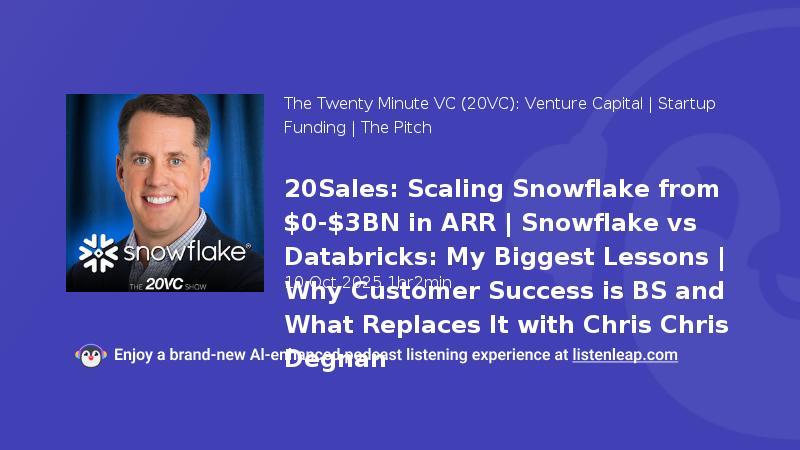
This is 20 Sales with me, Harry Stebbings, and I'm so excited to welcome a great back to the hot seat, Chris Degnan.
Chris is the former CRO at Snowflake, where he was instrumental in scaling the company from less than a million in revenue to over 3 billion in annual revenue.
He joined as first sales hire and he built Snowflake's go-to-market engine from scratch, growing the team to more than 6000 globally.
And under his leadership, Snowflake became one of the fastest growing enterprise software companies in history.
I cannot emphasize enough how few people are able to scale with the company growth like Chris did with Snowflake.
This was an incredible discussion.
But before we dive into the show, today is your finance team a cost center tied up in enforcing policies, bogged down by cumbersome processes and drowning in operational busy work.
Well, what if you could unlock seamless, strategic finance that actually fuels your business growth?
This is why leading global growth companies use PayHawk, the finance orchestration platform that unifies global spend management with conversational AI, to deliver best user experience for everybody dealing with company spending.
Finance teams using PayHawk report a major shift from operational to strategic work.
New AI agents for each finance role.
Handle the busy work acting with the same governance as your finance team.
Like having a small team of expert assistants that work 24-7, but also providing an exceptional user experience to your employees.
Payhawk is built for growth and enterprise businesses that operate globally.
No six-month implementations, no consultant dependencies, just immediate finance transformation that scales with your business.
Leading growth companies like Vinted, Wallbox and hundreds more across 32 countries.
Use Payhawk to move finance forward, not just keep up.
Ready to turn your finance processes into a competitive advantage?
Payhawk is offering a staggering 30 discount to everybody switching from a qualifying expense management or company card provider.
Who mentioned the 20VC podcast?
Visit payhawk.com forward slash switch to learn more and make the intelligent switch today.
And speaking of game-changing products like PayHawk, there no sales team can be the best without attention.
Attention creates AI agents that learn from your best sales conversations.
So they record your sales touchpoints across a ton of different areas like meetings emails calls, CRMs and more.
They then use these AI agents and learn from that data to automate busy work like follow-ups, next steps, CRM updates, coaching scorecards bluntly, all the manual shit that your sales team has to do but takes away from their creativity and closing deals.
So stop losing winnable deals to process and start automating.
Take the grunt away from your sales team.
Use attention.com.
The best sales teams all are.
While attention is helping your sales team focus on closing more deals, let's look at how you can bring that same edge to your website.
Are you still jumping between tools just to update your website?
Don't do this!
Framer unifies design, CMS, and publishing all on one canvas.
No handoff, no hassle.
Everything you need to design and publish in one place.
Framer already built the fastest way to publish beautiful, production ready websites, and it's now redefining how we design for the web with the recent launch of design pages, a free canvas based design tool.
Framer is more than a site builder it's a true all-in-one design platform, from social assets to campaign visuals, to vectors and icons, all the way to a live site.
Framer is where ideas go to live, start, and finish.
No Figma imports, no messy HTML, just design, iterate, and ship all in one place.
And it's completely free to start.
Ready to design, iterate, and publish all in one tool?
Start creating for free at framercom.
Slash design and use the code.
Sales for a free month of Framer Pro.
That's framer.com slash design and use the promo code sales. framer.com slash design.
Use the promo code sales.
Rules and restrictions may apply.
You have now arrived at your destination.
Chris, dude, I am so excited for this.
I think you are one of the great leaders of our time.
You have built the Snowflake sales org into an absolute machine.
Thank you so much for joining me today first, dude.
Harry, as always, it's great to see you and thanks for having me and congrats on all your success, Harry.
Dan is very, very kind.
I just wanted to start with the book.
If you were to summarize, what do you most want people to get from doing the book?
So I co-wrote it with Snowflake's chief marketing officer, Denise Pearson.
And really the reason that three years ago that we decided to write the book was that in most organizations especially I'm seeing it from the outside now looking in is as I become an advisor to many companies.
A lot of founding CEOs feel like it's great to have friction between sales and marketing.
And Denise and I never had friction.
And if we had friction, we dealt with it ourselves.
We didn't go to mom or dad with going to our CEO.
We dealt with it internally.
And I think it's really important to have this really close relationship between sales and marketing and for marketing to treat sales as their customer.
And that's what Denise and I really focused on in the book.
And that's why we do it, is that people ask me advice all the time around how to build their companies, how to build, go to market.
Well, I hate patting myself on the back, but Denise and I did a very good job of building a world class go to market organization at Snowflake.
And that's what we talk about in the book.
Help me understand, what does it mean for sales to be the customer of marketing?
Prior to Denise coming to Snowflake, I was arguing with the previous team on what the definition of a marketing qualified lead MQL was.
My head was exploding and I was becoming very angry.
And so Denise came in and she said we're not going to talk about MQLs or SQLs or anything like that.
We're just going to talk about qualified meetings.
And so from there you know, we were 3 million in revenue.
When Denise joined and she came in didn't necessarily bother me came in and sat down with every one of our SDRs who the SDRs were working for me, every one of our inside sales reps, every one of our sales reps interviewed them all herself, rolled up her sleeves, got in and then figured out how the hell are we gonna get these sales reps leads?
And that's what she focused on.
And so she said, look, without sales, without us hitting our revenue targets, why am I here?
That's how she, that's her attitude.
Cause she's like, revenue is everything.
Dude, what was the revenue when you joined Snowflake?
Zero.
I had zero.
I had no customers.
There was not a single person using the product when I joined.
So it's zero dollars when you get brought in.
That is completely counter the advice that we hear today, where the founder needs to build out the playbook.
They need to be the ones messaging with customers.
How do you advise founders given your own experience?
Founder-led sales is great.
I think founder-led sales should always happen, especially when you're innovating on your product and you're learning.
So I'm a huge fan of the founders being a part of the sales process, but ultimately I want the founders building product and building a world-class product and building a deep competitive moat.
If you have the foresight to go out and hire a strong sales team or a strong sales leader who is a product salesperson like, understands how to sell a product not a service, but a product, they'll go out and iterate on the sales pitch and they'll pull the founders in.
They'll pull engineering or product or marketing into the campaigns.
But the right sales leader will actually teach you a lot about what's good about your product and what's bad about your product and where you have to fix things.
How can a founder who's never hired a sales leader before hire a sales leader when they don't know what good looks like?
First of all, hopefully, Harry, you know, you're a venture capitalist.
You're pretty good at talking to people.
You know, a lot of go to market people.
Hopefully some of your investments, they ask for your advice.
I'm hoping when you invest in their companies.
I'm hoping they're smart enough to take advantage of the network that you have.
I think when I joined Snowflake, Mike Spicer was was recruiting me. but Mike didn't know sales.
And so I said to Mike I need someone like a John McMahon on our board, just simply because I need someone who cares about me.
And that was so consequential.
It helped me so much in so many ways.
I can't even begin to, I would never have stayed in my job without John.
But I think that the advice I would give to these founders is go find a sales leader that you like and put them on your board, or at least have them as an advisor.
And the reason why is like, to your point, Harry, they don't know what good looks like.
Some of these companies have hired just crap sales leaders like don't have sales methodology or sales process or anything, because they don't know what good looks like.
And then they're disappointed by the results.
So surprisingly, if you don't know what you're looking for, you're not going to get anything good.
So that's where someone that actually has built a go-to-market organization and having them as an advisor is so important.
Chris, I'm a founder in this situation and I need your advice.
I've hired a head of sales and they seem okay.
How do I know if they're good or not?
If they're in the role already and I'm saying, hey, they seem okay.
It's not great.
How do I know what great is if they're in the role?
You have to have measuring sticks.
So you have to be like, OK, are you hitting your numbers?
OK, that's one.
How many sales calls are they doing?
How are the people doing that they're hiring?
The ultimate measuring stick for a head of sales is can you hire great people and make them productive?
And to me productive means within six months can a sales rep get onboarded, understand how to sell the product, generate their own pipeline and then close north of 250000 of new ACV a quarter consistently.
So if you can do that, that says that the sales leader knows what they're doing.
The most important thing is the productivity of the sales team.
So number two, you said number of meetings, I think it was correct.
Yes.
What should I be looking for that?
I tell everyone look, mileage may vary, but I tell everyone you know, when I started at Snowflake, I went on eight face-to-face meetings a week and there were weeks that I couldn't get eight face-to-face.
And then the accountability was.
I would send out emails to the entire company around my previous week's efforts.
And sometimes it was like I went on 10 sales calls and sometimes I went on five.
I held myself accountable by sharing my results with the rest of the company.
And I think transparency is super important.
So to the founders it's like hey, every week have your head of sales send out an email of what they did.
Now, if you have too big of a company, then send it just to the leadership team.
But let them know like, hey, this is what I did this week.
Because then all of a sudden you can start figuring out, is this person working or not?
Okay.
And so you say number of meetings, you say the name of the meeting you had and the takeaways from it.
Just for people like real granularity, what you actually put in that email.
Yeah.
So I went out and I had eight face-to-face meetings, two to three net new business meetings, meaning I've never met with these customers before.
This is what we talked about.
This is the competitive situation that we're in.
And three of those I have next step meetings.
Five of those I have next step meetings, whatever it was.
When I did that early on.
So I'm still friendly with the founding engineers, like the people that were there before me building the product at Snowflake.
And they kept.
Even when Snowflake came up with the email policy that you couldn't keep emails longer than a year, they archived a bunch of the emails that I had sent out from my earliest days because they were so curious.
And a lot of these engineers don't interact with customers.
They're just in their world building a product.
And i kind of brought them in with me because i said here's my learnings here's, here's why we're losing.
Because we didn't like we were database, we didn't have updates.
I'm like dude, we need freaking updates, you need to be able to update the database, right.
And they were like yeah, you're right, or we didn't have this function or we didn't have that function.
And that would actually help the engineers like get motivated and they would start building those features, because I would lose a deal or not get you know, move forward in a process because we didn't have a feature set.
And that transparency that I had around what I was doing and I developed credibility with them, even though sometimes what I said was not always right because I'm not this database expert.
It made this relationship with these engineers strong and they trusted me.
And then they started building product that customers wanted to use.
I just want to understand, in that email, what is in it?
It's the eight meetings that you had, the names, the takeaways, and any subsequent actions?
That's right.
Yes, yes.
So, hey everybody, here's what I did last week.
I went on eight calls.
In those eight calls, I talked to... five existing customers, three new prospects.
The use cases that they're doing in these five ones, boom, boom, boom, boom.
The three new ones, here's what they have.
Here's what I'm trying to do.
And oh, by the way, here's what I'm doing next week.
And that's what I would do.
Yes.
Of the new leads, how much was marketing sourced versus your sourcing?
I mean, in the early days, it was all sourced by me.
I mean, there's definitely easier ways to do it nowadays, but the way I did it is.
I searched job board.
So indeedcom, I go to indeedcom.
Look for people posting jobs for Amazon Redshift.
Find the company, find the head of data VP of engineering on LinkedIn.
I had an intern help me do this as well, Alyssa.
And Alyssa and I would build these lists and we would send out 2500 emails a week by just hand building lists.
Do you think Outbound is dead today?
I do not.
People get so many emails, it's hard. but you have to pick up the phone.
You have to figure out ways to do it.
So that's where marketing is incredibly valuable as well, because I think to this day, I do think, that the field marketing events are probably some of the best ways to meet people and some of the best lead generation tools out there.
But people who say outbound is dead, no, I don't want you as my sales leader.
So sales should be responsible for their own pipe.
That's right.
And marketing is a cherry on top.
Yeah.
I mean, depends on the phase, but like we were trying to figure out product market fit.
And then once we figured out product market fit, but the cherry on top for us was Denise.
I'll give you an awful example.
I advised a company.
They hired a famous athlete.
They were less than $50 million in revenue.
They paid this famous athlete $5 million to brand their product.
And my head exploded.
I'm like, that's the most idiotic thing I've ever heard in my entire life.
Because who gives a crap about your brand when you're $50 million in revenue?
But alternatively you could have taken that 5 million and done case studies on your customers and then spammed the world with those case studies.
So, hey, build those case studies, get those case studies in the hands of prospects.
You can do that by whether it's Google ads, whether that's sending spam emails, whether that's having field marketing events.
There's all sorts of ways to do it.
And that's what Denise and the Snowflake marketing team to this day does a world-class job of is they basically take use cases that customers are doing it and putting it in the hands of prospects.
That's how you get magic to happen.
What did you get wrong and what did you learn in the early days of snowflake sales?
As much as I am a trusting person, you cannot trust people to do everything that you ask them to do at scale.
So for me, I learned a lot of times a hard way that even though I said something, hey, go do that.
Someone would say they're going to go do that or act a certain way.
They would say that to me but not actually do those things, or Or they would be nice to me but not nice to other people.
And so I think that that can ruin a culture.
And so I had many examples of people managing up to me in different ways and me not seeing through that bullshit.
So to me, that's the biggest problem.
What would you have done differently?
Number one is I would stay close, do skip level meetings on a regular basis more often than I did.
Because you find out the truth.
There are people, there are truth tellers.
There are people.
When you build an organization from the ground up, like I did, there are people that I just knew super well.
But as we brought in bigger company, people that candidly had had more experience than I had, they would not want people to talk to me.
And they would like get mad at those people if they came to me.
I was so busy, right?
That I was like, yeah, just deal with it.
Now, in reality, what I should have done is I should have spent more energy going down to the front lines asking the hard questions on a regular basis.
And if I had done that, I would have caught some of these bad behaviors.
Bigger company people never work.
Fair?
Yes.
Yeah, I mean even at Snowflake.
I think what people thought along the way at Snowflake is Snowflake was successful because of them.
And never was that the case.
Snowflake was not successful because of me.
Snowflake was successful because it is an amazing product.
And we did... on the go-to-market side of things pretty well.
And I'm sure there are things we could have done better.
That said, we did them pretty well, and so we took advantage of that opportunity.
And sometimes your egos get in the way of these things, and people's egos get so giant.
And so to me, that's like, dude, I feel like I was super lucky.
It's almost like I'm in the Matrix, that I had this experience at Snowflake.
I'm like, how the hell did I get here?
And I feel super fortunate that I met the founders.
It's super fortunate that I had Bob Muglia as my first CEO, who promoted me from director to VP, to CRO, that I got the ability to work for Frank Slootman.
These are things that I just can't believe I had those experiences.
And I think I'm super fortunate to have worked with those people.
There are people that worked at Snowflake that, on the inverse, thought it was the company was successful because of them, which was not never the case.
Never.
You mentioned hiring and making people productive earlier.
The timelines have shifted in terms of revenue expectations and growth expectations.
You said six months on board, closed, 250K new ACV.
Well, in that time, Lovable and Replit and Brett and Sierra and everyone in between have scaled to 100 million.
So that's cute that we've got six months for a ramping and onboarding.
Do we need to change the way we think about sales rep productivity in today's age?
There's no way I'm going to like sit here and say things are not changing, because I'd be a fool to say that.
You and I have had this conversation earlier in these AI worlds.
What I'm not clear on is if these AI companies, if they have sustainable revenue.
Maybe they do.
And maybe at a hundred million dollars.
So, so for example, at Snowflake, we could do that with our inside sales team.
We could get them up and running and quota caring and successful in three months because the sales cycles were three months.
But in the field, just look at how long your sales cycle is.
How long does it take you to close one deal?
And that's what you look at is how long does it take to open up a new pipeline opportunity and then bring it to closure?
That's really what productivity is.
So geez man, if you can hire a rep in two months, get them up and running and them closing, you know five million dollars of ACB, then God bless you.
You've got something magical.
Unless you're AI, there's no budget for you.
Not true.
I think there's a reckoning coming here.
I think there are some very great use cases around AI that are great, but the fundamentals still have to be there.
You have to have some sort of return on investment.
Either you're generating more revenue or you're saving the company money.
One of those two things have to be true.
Otherwise, then why the hell are you buying that product?
I'm an advisor for a company called Zip.
They're procured a paid tool.
They're growing astronomically.
And they're not this.
They have AI in their product, but they're a traditional SaaS company and they're kicking ass.
So I just think anyone who says that is just naive.
You know I don't want to compare the AI boom to the dot-com boom, but it's kind of a little bit like that.
There will be companies that are real that come out of this.
There will be a lot of giant failures.
There'll be money flushed down the toilet on stupid companies.
And I'm sure that's happening right now.
As a sales leader, is there anything you need to change your mindset on with regards to AI?
How do you think about tooling?
How do you think about the people that you hire?
What do I need to change to win this game?
Frank Slootman, to quote Frank, people would always ask, hey, Frank, what's your playbook?
And he's like, dude, I don't have a playbook.
It's situational.
And he's spot on.
And this is the crazy part of what's happening with AI is because you bought a tool six months ago Doesn't mean that tool's great.
Like I hope to God that someone's building a competitive product to Salesforce because God, what a terrible product that is.
It is awful.
And it would be wonderful if someone built this AI Salesforce product.
I know there's a bunch of companies wanting to do it, but geez, it would be wonderful if someone could go out there and replace Salesforce.
And so I'm hopeful that there are a bunch of innovative tools.
I would be very open, if I was building a company today, to looking at the newest tools because, you know geez, I would love to not have to use some of the traditional garbage that we've used in the past.
You mentioned before 3, 15, 55, 150 was that scaling revenue journey at Snowflake.
What was the hardest period?
The zero to three.
Because for the first two years, I didn't get any revenue.
And as a salesperson, who you are, it's like you're supposed to bring revenue to the company.
And so... there were pivotal moments where like I would get customers to use the product.
And I'm like, I remember like specifically, I'm in New York city on the streets in New York.
And I get a call from Mike Spizer thinking, okay, we're, I'm ready to hire.
There's, I had like three sales reps and I'm ready to go hire a bunch of people.
And Mike calls me and says Hey dude, we're going to have to hold off on hiring people because there's a heart transplant that we're going to have to do to the product because the customers that were using the product were breaking it.
And we had MySQL as the metadata store and it was just puking on itself.
And so they had to take that and bring in a new thing called FoundationDB to do that.
And doing that was a six-month project.
To me, that was like the, should I be doing this anymore?
Yeah.
Because I'm like, I'm sick of not selling anything.
And that's just hard on the soul.
I mean, you're just begging people to try a product for free, man.
I got to tell you, that's not great.
It was dark times for me, for sure.
I totally agree.
Like, you're sick of not selling something.
My advice to salespeople is go to somewhere where it's easy to sell.
It's really fun when you're closing deals and you're an order taker.
God, what a joy it is to be at OpenAI right now.
Or Anthropic or, you know, Claude Code.
Do you agree?
Would you advise salespeople just go where it's easy to sell?
Yeah.
But on the inverse, we talk about, like when I'm talking to founders, like when they're looking for heads of sales.
What I say is go find that someone A, who's been a second line manager or, B a head of sales at a crappy software company.
And that's been successful.
That's hit their numbers.
Because can you imagine if you actually could sell a crappy product and then you go to a company with a great product?
Think about how much better your sales org will be.
And so to me, that's you're right, Harry, but what happens when you're working at Anthropic, for example, my guess is you're not really learning how to competitively knife fight in a sale.
And I think What you're looking for, depending on your time in your career, is you're looking for yes, to make money.
But more importantly is, you're looking to be developed so that you know how to sell, you know how to manage.
So look at the leadership.
Is that leadership people that develop their their people?
Do they actually teach them how to sell?
Do they have sales methodology?
Those are things that are super important, because there are companies that I've spoken to that I'm like blown away that they don't even believe in traditional sales and they're idiots.
They're literally idiots.
They drive me crazy because like, oh, we're different.
And I'm like, no, you're not.
You're not different.
Someday someone's going to punch you in the mouth.
Some competitor is going to punch you in the mouth and you have this shit sales team and there's nothing you can do about it, because you've done something that you thought you were unique.
And so you have to pay the piper someday.
Do you think startups can actually hire people who've been successful sales leaders before?
Like you mentioned there, have someone who's been successful, hopefully in a ship product.
Why would they go through that pain again?
I'll tell you what.
So I retired from Snowflake in May.
And it's super interesting for me to now get engaged with companies.
And I advise roughly eight companies.
And what I've realized about myself is I turn down anyone pretty much over $100 million.
I don't want to do it.
Because what I love, love, love, love is the early stage.
Even though I said it was so painful, so painful.
Building a company from nothing or earliest stages is the best.
It's So you think that's because you don't need the money?
Yeah.
Yes.
Oh, yes.
Yeah.
I mean, but because I'm picking passion over money.
Yeah.
100%.
I mean, there are guys that I know that used to work for me that are making tons of money.
They could go take heads of sales at any company, but they're just so highly paid.
But you would never join full time.
That's my point.
So like for startup founders, you can't get that.
But like even much less than you, you can't get them because they don't want to go back.
Even if they have the fuck you money and they're like, ah, you know what?
It's interesting.
It's intellectually challenging.
You'll do an advisor role, but you're not going to join full time.
I don't know, man.
I just hired, I mean, I'm an advisor of a company called factory.ai.
We just hired a kick-ass sales leader.
He was making a ton of money and they're, they're relatively small.
And so it's like, I still think you can get great people.
Cause I think people look at my story and they say they, they want to go do that.
Now my coaching to anyone who wants to go do what I did go get a baseline, go get your education in sales.
Go to a company that develops those people and then come back to that startup.
If you've never done sales and you come into a startup, you're not learning anything.
There's no one teaching.
The founder doesn't know how to do sales.
But then take those learnings.
Make some money, have a baseline and go to a well-funded company who can afford to pay you.
But you shouldn't expect to get the same amount of cash that you would at a big company.
But geez, if you don't have this crazy lifestyle which some people do, you have to stay at these big companies.
But make sure burn isn't too high, but take a risk.
That's what Silicon Valley is all about, man.
How do you analyze the state of sales teams today?
It depends on the companies, but I think culturally there's generation issues.
There's entitlement issues.
Like for me, I'm old, right?
And so I came from a background of like, I had to show up in the office every day.
I had to be the first in the office and the last to leave.
I had to make sure that I was out working everybody else.
Coming back from COVID, it was hard to get people to back back into the offices at Snowflake.
And they're like entitled about it.
Like oh you know, there was a kid that reached out to me about he wanted to get a job at Snowflake.
And I was like, well, OK.
And he was just out of college.
I'm like, find a job on our website and send me what you want.
And he sent me and I'm like.
Oh, okay.
One's in Atlanta, one's in Denver and one's in California.
I'm like, well, are you going to live in any of those places?
And he's like, no.
I'm like, okay, well then you don't have a job at Snowflake.
And I think there's this like weird world where they, some of these kids, expect to make a bunch of money and not work that hard.
And I think you have to put in that grind.
And so what do I want to look for?
Yeah, I look at companies like MongoDB, companies like Wiz or, you know, Dolly Rodgick, you know, or Cedric Pesch.
Those guys built world-class sales organizations.
They developed those people.
There's grind in a lot of those young people that they've developed.
I may not want to work for those guys, but geez, those guys are great at what they do.
And I respect their craft for sure.
Talking about kind of putting the work in.
I listened to all of your shows before this that you've done with other people or where you've spoken publicly talks you've given.
And you said that you gave air to Databricks by delaying certain product moves.
Can you talk to me on how you reflect on that?
I'm still like pissed about it.
So there's two things that we screwed up on.
Number one, I'm very much like a technical product seller.
Like I love a technical product.
I learned how to sell technical products.
What was happening, Snowflake was super fat and happy being the cloud data warehouse.
And I was going to the engineering team, founders and everyone saying look, I'm diagnosing where the patient, our customer, is getting sick with Databricks.
What was happening is, every company needed a data science notebook and they need a world-class data science experience.
Our best customers would tell us that.
And our engineering team just said, no, like, no, we're not doing that.
And that's stupid.
Well, guess what?
It wasn't that stupid because look at frigging Databricks now.
And so number one, that's, that's one thing that we screwed up on the go to market side.
We also screwed up because what happened was we optimized to go public.
And when you optimize to go public, you stop hiring.
And guess what's really hard to do at Snowflake or any company is open up a new logo.
New logos are way harder than upselling.
And Snowflake had this ridiculous net retention rate of 177% when we were going public.
Yeah, that was our net retention rate.
So guess what the sales reps would do when we stopped hiring or slowed hiring on the go-to-market side to optimize for going public?
The sales reps would go to where the revenue was.
But the engine that makes the company grow is the new logo.
And so we took our eye off the ball for, I want to say like two years on new logo acquisition.
And that hurt us.
Is that, I'm so sorry to be blunt.
Is that your fault?
Ultimately, yes.
But there are things you're doing where we had been set up to do one thing and we pivoted to generate free cash flow.
I mean, you kind of have to do those things.
Wall Street likes free cash flow.
Okay, so let's just go to those.
You said about the notebook element there and the product feedback that you gave.
With the benefit of hindsight, what should you have done differently?
I should have demanded.
I should have.
So there are two things.
Number one is I should have never taken my eye off or focus on the new logo acquisition stuff.
And to Sridhar Ramaswamy's credit, he's really helped reinvigorate that at Snowflake.
So that's number one.
When I left, we had trialed it last year at Snowflake.
The beginning of this fiscal year we had someone who was a direct report to me running all acquisition, only acquisition, as a fourth line manager down.
That works fabulously.
So number one, that works and we should have done that earlier.
And then on the product side I should have, there was a company that I wanted to buy that had a world-class notebook, and I should have been more forceful about it.
Because it was one of those.
Like one of the things that I always would say is like hey man, I don't make product decisions.
I let the smart people do that.
In hindsight, I should have forced it.
I should have forced it.
Do you think it was the right decision for Snowflake to go public?
At the time, yeah.
I mean, that was the thing.
It was at the time.
But given how it changed the focus, created a negative incentive function within sales teams...
One could argue not.
You're right.
I mean, look at Databricks.
Their sales team is, they're less revenue than Snowflake.
Their sales team is twice the size of Snowflake.
Their engineering team is twice the size of the engineering team.
They buy companies that Snowflake has had term sheets on for three times or two times the amount of money that Snowflake is offering to buy the companies for, because there's no consequence.
There's no public investors worrying about that.
So they can dilute the crap out of their shareholders because it doesn't matter.
It doesn't matter.
There's this like infinite amount of money.
And so it's like, I don't know.
Is that good or bad?
I don't know.
There's never been a company that has done what they're doing at this scale.
And so, you know, they could be brilliant.
I don't know.
So they've got two ISA sales team.
Are they very inefficient or is Snowflake very efficient?
I think Snowflake is way more efficient.
I mean, for sure, way more efficient.
Sridhar, the current CEO, I will give him 100% credit on that.
He is a world-class operator, and that guy knows how to squeeze as much juice out of anything.
So look, he's awesome at it.
I'm sorry if they have less sales and two acts of sales team, are they not then just very inefficient?
They're growing faster.
They are growing faster.
They are behind Snowflake, but they are growing faster than Snowflake.
Do you disagree with the view that they are kind of the anointed winner in the space?
I think that's a narrative that their CEO has done a good job of talking about, but I do disagree with it.
I think Snowflake's still growing at 30% year over year at billions of dollars in revenue.
So customers are speaking with their wallet.
Are they in there?
It's like rising tide carries all boats where it's like everyone just needs the product so much that everyone grows.
I think Snowflake and Databricks are both winners.
I think they will continue to be both winners.
You know I strongly dislike the CEO of Databricks, but I think my, because he's a dick and he's a liar.
But you know, I look, I think at the end of the day, if I, if I'm honest about it, I think the two companies as a combined entity, that would be an amazing thing, because they would, they would dominate the industry.
I don't think it could never happen.
But Amazon, Microsoft and Google are the primary competitors to Databricks and so forth.
And if Snowflake and Databricks were together, they could be their own cloud.
They're a pretty dominant in terms of the data estate.
Snowflake and Databricks own the data estate together.
And they're complimentary for the most part, not really competitive.
I love Slootman.
What a fucking hero.
What an unbelievable force.
Do you think he was the right CEO for the phases that Snowflake was going through in terms of the product?
Mind that you need to have to iterate onto the next wave.
Yes, there were some things that were wrong when Suitman came in.
And Suitman is a general.
He's a world-class leader.
And people would run through walls for him, including me.
Ideally, what would have happened is I would have loved for Bob and Suitman to have worked together.
So Bob got let go.
Bob's a world-class product guy.
World-class.
I don't think there's anyone better.
It would have been wonderful for Bob and Suitman to stay on together.
That obviously didn't work.
You need both a world-class operator like Slootman, but you also need a world-class product person.
And I think those two things matter.
And it would have been wonderful for us to figure out how to make that happen.
So yeah, I think that, you know, having strong product people is incredibly important.
Is there anything you would have done differently in terms of how you sold the Snowflake product in competition with Databricks?
I would just would have hired more salespeople and focused on new logo acquisition and pounded on product to give me a notebook and a spark connector.
And we would have kicked the shit out of Databricks and they would be dead.
You think you could have cut them off?
We could have a hundred percent, a hundred percent.
We had it.
We were the leader.
We were kicking their ass a hundred percent.
We would have killed them.
If we'd had a notebook and if we had a spark connector, we would have kicked their ass.
Is there a limit to how many sales reps you can hire at once?
There's a bunch of mistakes that you'll make along the way.
It's hard.
I mean because yeah, what ends up happening is you have new leaders who maybe have never managed or have never worked at the company, and they're sitting there hiring new people.
So there's a bunch of mistakes.
So in doing that, I think having the instrumentation to measure along the way of are they going to be successful.
Not just like, hey, have a good interview process.
Make sure you vet out people when they onboard.
Make sure that you have things that you're measuring from day one to day 90 to day 120 to make sure that they're doing those things.
Because you want the leading indicators to show up of, are they going to fail?
And you want to know, are they failing?
If they're failing, you need to get ahead of those things.
What are the most common ways that you see people failing?
What should I be looking for?
The first thing that I'm super focused on is be a student of what you sell.
So enablement, you should have some sort of tests of do they know how to sell the product?
And you should have some way of knowing, have they done those certifications?
That's a must have.
If you do not know how to sell the product, I don't want you.
And that includes managers.
So we have fired managers.
Last year I went through a certification of second line managers and we fired people because they couldn't sell the product.
When you say they couldn't sell the product, you mean they just couldn't do the pitch?
They couldn't do the pitch.
I'm like how the hell you came from XYZ big company that is an order taker and you know how to manage, but you have no idea how to sell.
I'm not being rude.
Is that not an indication of your hiring process?
How did they get in the door?
We got lazy, Harry.
We got lazy.
We said oh, because you're at I don't want to call the names, but because you're at this company and you've had success, you'll be great.
Well, it turns out that's not true.
So we went through some pretty hard decisions last year on making some changes.
And that was hard.
It was super hard.
But the company is way stronger because we went through that.
What are other ways that it shows up that they're not working? then it's pipeline.
It's you need to make sure that you're clear to them on what their expectations are.
So if I'm going into a company like companies I advise today, you as a sales rep should know what great looks like.
So you should know how many sales calls you have to go on, how much pipeline you have to generate by your first month on the job, by your second month, third month, whatever.
Because if you don't know, if the expectations aren't there, then you're just going to say Oh, whatever.
And you're going to ask your buddy, you know, over there versus like, okay.
So to me, I love it if there's more transparency.
So if you could send out an email to the entirety of your sales team saying here's how many sales calls each human went on for that week.
And you made it a competitive situation.
And you shared with every seller that, hey, Johnny over here went on 15 sales calls.
And Timmy over here went on two.
Timmy's saying, holy cow, I'm in trouble.
I would get in front of Snowflake's new hire class and I would tell them.
I would say there are people in this room that have come to Snowflake thinking it's easy to sell Snowflake.
And I'm going to tell you right now, it's not easy.
And I've had this conversation with a million people and it's a hard thing to do.
And so if you don't generate your own pipeline, if you don't go on any face-to-face meetings a week, you're probably going to fail.
What was the hardest deal that you sold?
And what was your biggest lesson in how you got it over the line?
I would say the most impactful deal that I sold was relatively early on at Snowflake.
And it was a company that's now not around to a company called Localytics.
And Localytics had a 500 terabyte Vertica environment that was in the cloud.
It was breaking.
It was failing.
And they were in Boston and we went into their account and we were getting like small workloads, not 500 terabyte workloads.
And they're like okay, we like what you're doing, but there's, like these list of things that you need to do.
And those lists of things were long and hard.
And so I, you know, this is like, bring the founders with you.
This is founder led sales.
So I brought the founders in.
They made a technical decision, or a business decision.
That said, of the list of things that Localytics wants us to do, we need to do most of these things.
It's going to take us probably seven months to do that.
And so the entirety of the Snowflake engineering team is probably one of the most expensive data migrations in the history of data migrations, because we were a well-funded startup and the engineering team and the founders had weekly calls with the team at Localytics.
And that decision took away from us winning other deals in the short run.
But in the long run, What happened was we got all those things.
I got into a full on yelling match with the economic buyer like swears and made him it was the most negotiating like hardest negotiating I've ever done.
And then we had milestones built into the deal.
And we got them to sign.
We agreed on it.
We hit most of those milestones.
And they were a relatively good partner along the way.
Why that was important was we got through it.
We built the features.
And, at the time, one of my other sales reps.
We were losing a deal at Nielsen Marketing Cloud to this company that is dead called Kubel.
We were losing a deal there.
One of the founders, Thierry, says, well, why are we losing?
And we tell them why.
And he's like, oh...
I just need to turn on this feature that we had been building for Localytics.
We turn it on and we went from being like 5x more expensive to 10x less expensive by just flipping that switch.
That switch became so important because that Nielsen became Snowflake's biggest customer ever.
And so the decision they made seven months ago for Localytics then turned out to becoming us winning the most important customer we could possibly win.
Your smallest customers are often the most annoying and difficult.
True?
Yes.
So only focus on the whales?
No.
Go cut your teeth.
Like, I hate whale hunting only.
And the reason I hate whale hunting only as a sales leader is it's too spiky.
And spikes get you fired.
Spikes on one end are great, but if you miss a quarter, guess what?
The head of sales, you're fired.
If you can build a velocity sales business and you have customers that are going to be annoying and then you have a spiky deal every once in a while, that's great.
And you learn a lot, especially like you can fail, like you can fail in the mid market a bunch and then not be super consequential.
If you fail in the, in the, you know, fortune 100, good luck getting another, another chance.
So to me, fail and fail a lot in the beginning.
And that's what we did is we were only selling to ad tech companies and online gaming companies in the beginning.
And that's where we failed and broke the product and learned a lot.
And then we were ready for prime time.
And then we were ready to go and sell up market.
And like I remember our founders, we went to meet with the premier investment bank and they were like when are you going to run on premise?
And our founder, Benoit, was like, you will run in the cloud ever before we run on-premise.
And sure enough, he was right.
And so you have to say no to some of these big companies.
How important are case studies?
We think of these big companies, the logos.
How important are they to the subsequent customer acquisition?
And what I mean by that is, if you have Dropbox and Stripe and Visa as your customers do, people really go oh wow gosh, I must sign up.
Yes, not only that.
So real real life scenario is to continue on.
My story is we won nielsen marketing cloud and we were trying to sell it to nike and nike was like who the hell is this little company with a weird name called snowflake?
And what nike's decision makers did is they cold called the nielsen marketing team without our knowledge to say is this a real product?
And actually did a blind reference on it.
So those people are smart.
And the earliest customers, you cannot thank them enough for taking the risks that they do.
And then the big companies, they're smart.
They're going out and making sure that, like they're talking to everyone, is you know?
Hey, are you using this product?
And so when they call and say, hey, are you using this product?
You want them to say, yes, I am, and I love it, and da-da-da, da-da-da, it's so great.
And CS teams are the ones who make that happen, right?
They make your customers successful, right?
That's how it works.
No, they're wrong.
Why?
CS is an industry, Chris.
Why is CS wrong?
Yeah.
So, I mean, this is one of those things like, I guess, define what CS is, Harry.
I think, like a lot of CS, is a separate function post-sale, that enables your customers to achieve the most from the product and then is also ultimately responsible for upselling them new products and new features.
So there are successful CS functions like a Datadog does a really good job of customer success.
So what I found is that when I took over customer success at Snowflake the customer success team I was like could they be salespeople?
No, they could not.
Could they be implementation people?
No, they could not.
Well, what do they do?
They show people where documentation is.
And then I was like I don't understand that role at Snowflake because ultimately I viewed it as the responsibility of the sales team.
We had this world-class net retention rate, 177%.
I viewed it as a responsibility of the sales team to upsell.
And by the way, it was also their responsibility to make sure the customer renewed.
I don't want to have a million-dollar renewal go to some inside sales rep who doesn't know what competition looks like, because Snowflake was in a hyper-competitive environment.
So for Snowflake, I was not willing to give the B team access to my A accounts.
And so I got rid of customer success.
Now, customer success is a responsibility of the entire company.
And so what we found at Snowflake was we built a professional services organization.
That professional services organization.
We would give away free professional services not always free, but we would give some away.
What I found was that people would actually, if they pay for something, even if you're splitting the cost of it with the customer, a lot of times when they pay for something versus get something for free, they value it more.
And so to me, whether you call it customer success or professional services, you have to show that they can at least be breakeven.
If they're a cost of sale, then I think it's not worthwhile.
Well, I mean, there is a fundamental difference there, because obviously professional services is like an opt-in and it's a paid for.
And so fundamentally, do you think we should replace customer success with professional services?
Well, we would sell professional services.
Out of professional services came training and enablement for our customers, for our partners.
And so I'm a fan of them at least being break even, not costing the company money.
So, like at Amazon, when you buy a contract from Amazon, you're paying some percentage of that for support.
And that support, you get these architects, but they're paid for.
All I'm saying on this is like don't just give away these services for free, like these people.
This customer success function.
And in a technical product, If they're customer success, they need to be implementation people.
They should not be like these, like crappy salespeople that don't know how to sell and do just do renewals.
I hate that function.
How do you evaluate the rise of FDs, forward deployed engineers?
I'm intrigued because it's another kind of slant on professional services companies.
Look, it's worked for Palantir.
Obviously Palantir is a very highly valued company, but it limits you on who you can go after.
You only are going after large companies, because you're basically custom building solutions for every company.
And so the companies that I work with.
I prefer that you take the learnings from say, you're doing those forward deployed engineers, but you're doing that and you're taking that and you're putting that into the product so that you can do that.
Because if you need a ton of people and you don't have that functionality either being built or built into the product, you're a professional services company.
And at some point you're only limited to this high end of the market because it doesn't fit the mid market.
And the mid market is huge.
It's a huge business at scale.
So you're limiting your access to a market because you have these four deployed engineers that only will sell to large enterprises.
So we should have them or we shouldn't have them.
For the high end of the market, it works well.
Palantir shows that.
For the mid market, it is not a scalable business.
If you're just going to sell into the high end of the market and you're going to be the next Palantir.
God bless you.
I fundamentally believe that it's better to have a product that you can implement and you can have pre-sales engineers that can sell it and with a post-sales services teams that can implement it.
That would be my preference.
And that is.
I think that's better.
But there are things like Palantir that prove me wrong.
But you're only.
They are limited to very high end of the market.
They're not a mid-market solution.
In a world of AI?
Are we completely ignorant to think that we will retain seat-based pricing moving forwards?
Yeah, I think that's dead.
I think consumption is the future, for sure.
That changed the way we need to operate our sales teams.
Yeah, it's hard.
Yeah.
Even at Snowflake.
Can you imagine having a sales team do a 200 million deal and not have anything to sell the customer for two years?
Snowflake had one SKU, a credit.
And so we had to measure use cases and use case wins that have no purchase order.
Use case go lives.
So you're project managing those deals and you're trying to beat out Databricks in these other use cases to make sure that you can go out and get a contract renewal sooner.
So yeah, it's hard, man.
And I think that's like to the point that we've talked earlier.
It'd be great for someone to have a consumption-based CRM tool that could help with some of this stuff.
When you're measuring use cases, you're measuring go-lives, you're measuring these things that are super important on a consumption model.
Can I ask you, you've seen so much, dude.
When you reflect on yourself as a sales leader, what did you believe that you don't believe anymore?
I think I was just so desperate, Harry, in the early days to not lose.
I think that's the thing that like I think you said it earlier is, as I look at the opportunities that I have now, I can choose things that I wouldn't have necessarily chosen before, just because, from a financial standpoint, it's not consequential to me if one of these things fails.
Did you become a better or a worse sales leader the more money you made?
Worse.
Worse.
Because I don't want to do the hard things.
When I say the hard things, the hard things for a CRO is when you're 500 million, a billion dollars in revenue, getting on a plane and traveling around the world, going on two-week trips away from your family.
Those are the hard things, man.
It's awful.
And then trying to run the business at the same time.
Do you still have to get on a plane?
Absolutely.
Because, dude, guess what?
You don't know what the hell's happening.
Zoom does not tell you what's happening in an office.
You don't know if you have a tyrant running a country for you unless you're there and you're going and having coffee with someone.
You're having breakfast with someone, you're having dinner with them a beer, a glass of wine, whatever it is.
But like, go find those people in here.
That goes to what I said earlier skip level.
You don't have a skip level.
You don't develop those relationships unless you're sitting there in front of people, aren't going to tell you like harry, you and i can have a conversation and i'm like you know how's life?
It's great, it's awesome, it's amazing.
Okay great harry, let's have another beer.
Boom, how's life?
I'll ask you the question after your third beer and by the third time you're like well, this sucks, this sucks and this sucks, like it takes a little bit to get that and you're not going to get that in a 30 minute one-on-one.
You're just not Getting out in the field, being with your people.
There's nothing that replaces that.
Is there anything else that you hated that, with the benefit of hindsight, you're very happy to leave behind?
What I love in doing my job is I love selling.
I love competing.
That is the favorite part and why I chose the career I'm in.
The thing I hated which is what you need to do well at when you're running a multi-billion dollar organization is operations.
And so to me, the looking at spreadsheets or not spreadsheets now it's dashboards, whatever and measuring and measuring and measuring, and having internal meeting after internal meeting after internal meeting.
That's what a CRO of a company like Snowflake or anyone that's a multibillion dollar organization does.
I hate that.
And I realize that.
And so I'm not good at it.
What makes me good is I bring passion and conviction.
And if I don't have passion and conviction, I'm not good at it.
So if I'm sitting in this chair and I'm sitting on eight hours of internal meetings, it's not for me.
Does this AIPLG wave that we see where everyone tries first grassroots adoption and then it scales into an enterprise sale.
Does that remove the importance of seller relationships?
I don't think so, because I think if you follow a sales methodology like Medic and you qualify those deals and you teach your sales team how to sell in that sales methodology, that will end up differentiating you as an organization.
So PLG is great.
But if you want to sell to the enterprise.
The enterprise is hyper-political, and you have to have a sales process to do that.
And at some point, the PLG motion will fail you, or it won't get you to that large enterprise.
And if you aspire to sell a large enterprise, you need a sales motion.
I don't care who you are, if you're OpenAI, if you're Anthropic, if you're Google.
You need an enterprise motion and you need a good qualification process to do that and good sales teams to do that.
Do you think OpenAI wins the consumer and Anthropic wins the enterprise?
Well, it certainly looks like OpenAI has won the consumer, and I think it's not even debatable.
I really like the Anthropic people.
I hope they win.
My friend Chad Peets is helping build the sales team at XAI.
I wouldn't want to compete against the team that he's building right now and they're going after the enterprise.
We mentioned Denise earlier, go to markets, marketing.
It seems in a world of AI, it's basically a who can shout the loudest.
Funding rounds are so important, shout them.
Clue Lee has taught shock and awe is everything.
Has go to market fundamentally changed?
I think that's the arrogance of AI is I think there are people that think that way.
And it could be just me being old school.
But again, if you have a world-class sales organization and you have a world-class product, you will win.
But saying that because I shout loud loudly.
I mean, look Ali at Databricks.
He shouts pretty loud and he's done a good job.
And I don't necessarily agree about how he goes about doing things, but it's worked for Databricks.
So I don't know, maybe.
Maybe, but I still fundamentally believe in ethical sales and sales processes and outworking the competition.
All right, let's do a quick fire.
So what's the most creative thing you've done to win a deal?
I mean, I've sat in lobbies.
I mean, I mean literally stalked people, you know, in their office, waiting until nine o'clock at night, getting kicked out of offices.
I mean, that was when I was at EMC, I would do that.
So that was just like old school, just show up.
I don't know if that's creative, but... What's the most memorable logo win you have?
Probably the first two customers.
The first two customers that Snowflake ever got.
So Accordant Media and White Ops, now called Human.
It was just proving that we had someone that was willing to pay Snowflake money.
What's the biggest BS belief about the future of sales and AI? that AI will replace salespeople.
It won't?
I think there will be telemarketers that will get replaced for sure.
If I'm getting a call from my cable provider on upselling me on a new wireless plan or something like that.
I think that those types of things will be more AI driven for sure.
Call centers for sure.
But people buy from people.
The human emotion side of things.
That's why good salespeople, they have this sixth sense of looking at people and reading the rooms and reading people.
So I do think that there will be elements of it, that AI will either augment it or replace it, but I don't think it will replace field sales teams.
I do not.
What's the biggest mistake sales leaders continue to make?
That they know all that.
They're arrogant enough to believe that they can run the same playbook over and, over and over again.
Be humble.
Do not come in saying it has to be this way.
Listen, do not speak louder than everybody else.
Which companies are the best companies to hire sales talent from?
I think I said earlier, I think John McMahon built a bench of world-class sales leaders, you know, at MongoDB.
Mongo's done a wonderful job of developing their salespeople.
This guy, Dali Rajic, who was at Zscaler and now at Wiz, he's world-class at developing people.
I wouldn't want to work for him, but I think he's world-class at it.
So going after those types of people, I would recommend.
What companies are salespeople generally terrible coming from?
Salesforce.
Terrible.
Terrible.
Just why?
Out of interest?
Because they have no idea how to sell.
They're order takers.
To your point earlier, if you go to a place that's just an order taker, they'd have no idea how to do it.
They have no idea how to sell.
Give me a deal.
Why?
What's the metrics?
Awful.
Dave, what are you most excited about today?
Helping find the next great sales leader and helping these founders build real companies.
I love it.
I get up, I'm super excited about some of these companies I'm working with and I just find joy.
I hadn't found joy in my job in a long time and I'm finding that joy in helping these companies now.
If you didn't find joy, why did you keep doing it?
Felt an obligation to the people in the company.
It's like uh, sridhar came in and i felt very much that i wanted him to be successful.
He is the right guy to run the company and i felt obligated to make sure that i didn't just bail on him.
And so i wanted him to be successful and and i stayed in that role to help him become the ceo and let him, you know, find his own, my replacement.
But I really felt obligated to the people of Snowflake and the company that I care so deeply.
Still to this day, I care deeply.
Founders ask me, who should I hire from Snowflake?
And I'm like, I'm not nobody.
I'm not recommending you take anyone.
I love the company.
You can put all of your money into one company.
Which company do you put it into?
Well, I'd love to.
I just like the people at Anthropic.
I'd love to see Anthropic win.
Dude, I cannot wait for the book.
I thank you so much for putting up with my pressing and prying questions.
I love doing this.
I learned so much from you, dude.
And so thank you for being so brilliant.
Harry, thank you.
You're super kind and you're kind with your time.
And I've always enjoyed speaking with you and super impressed with everything you've done.
So congratulations on all your success and thanks for having me.
But before we leave you today is your finance team a cost center tied up in enforcing policies, bogged down by cumbersome processes and drowning in operational busy work.
Well, what if you could unlock seamless, strategic finance that actually fuels your business growth?
This is why leading global growth companies use Payhawk, the finance orchestration platform that unifies global spam management with conversational AI, to deliver best user experience for everybody dealing with company spending.
Finance teams using PayHawk report a major shift from operational to strategic work.
New AI agents for each finance role.
Handle the busy work acting with the same governance as your finance team.
Like having a small team of expert assistants that work 24-7, but also providing an exceptional user experience to your employees.
PayHawk is built for growth and enterprise businesses that operate globally.
No six-month implementations, no consultant dependencies, just immediate finance transformation that scales with your business.
Leading growth companies like Vinted Wallbox and hundreds more across 32 countries.
Use PayHawk to move finance forward, not just keep up.
Ready to turn your finance processes into a competitive advantage?
PayHawk is offering a staggering 30 discount to everybody switching from a qualifying expense management or company card provider.
Who mentioned the 20VC podcast?
Visit payhawk.com forward slash switch to learn more and make the intelligent switch today.
And speaking of game-changing products like PayHawk there, no sales team can be the best without attention.
Attention creates ai agents that learn from your best sales conversations so they record your sales touch points across a ton of different areas, like meetings emails calls, crms and more.
They then use these ai agents and learn from that data to automate busy work like follow-ups, next steps, crm updates, coaching scorecards bluntly, all the manual that your sales team has to do but takes away from their creativity and closing deals.
So stop losing winnable deals to process and start automating.
Take the grunt away from your sales team.
Use attention.com.
The best sales teams all are.
While attention is helping your sales team focus on closing more deals, let's look at how you can bring that same edge to your website.
Are you still jumping between tools just to update your website?
Don't do this!
Framer unifies design, CMS, and publishing all on one canvas.
No handoff, no hassle.
Everything you need to design and publish in one place.
Framer already built the fastest way to publish beautiful production ready websites and it's now redefining how we design for the web with the recent launch of design pages a free canvas based design tool framer is more than a site builder it's a true all-in-one design platform from social assets to campaign visuals to vectors and icons all the way to a live site framer is where ideas go to live start and finish No Figma imports, no messy HTML, just design, iterate, and ship all in one place.
And it's completely free to start.
Ready to design, iterate, and publish all in one tool?
Start creating for free at Framercom.
Slash design and use the code.
Sales for a free month of Framer Pro.
That's Framer.com slash design and use the promo code sales.
Framer.com slash design, use the promo code sales.
Rules and restrictions may apply.