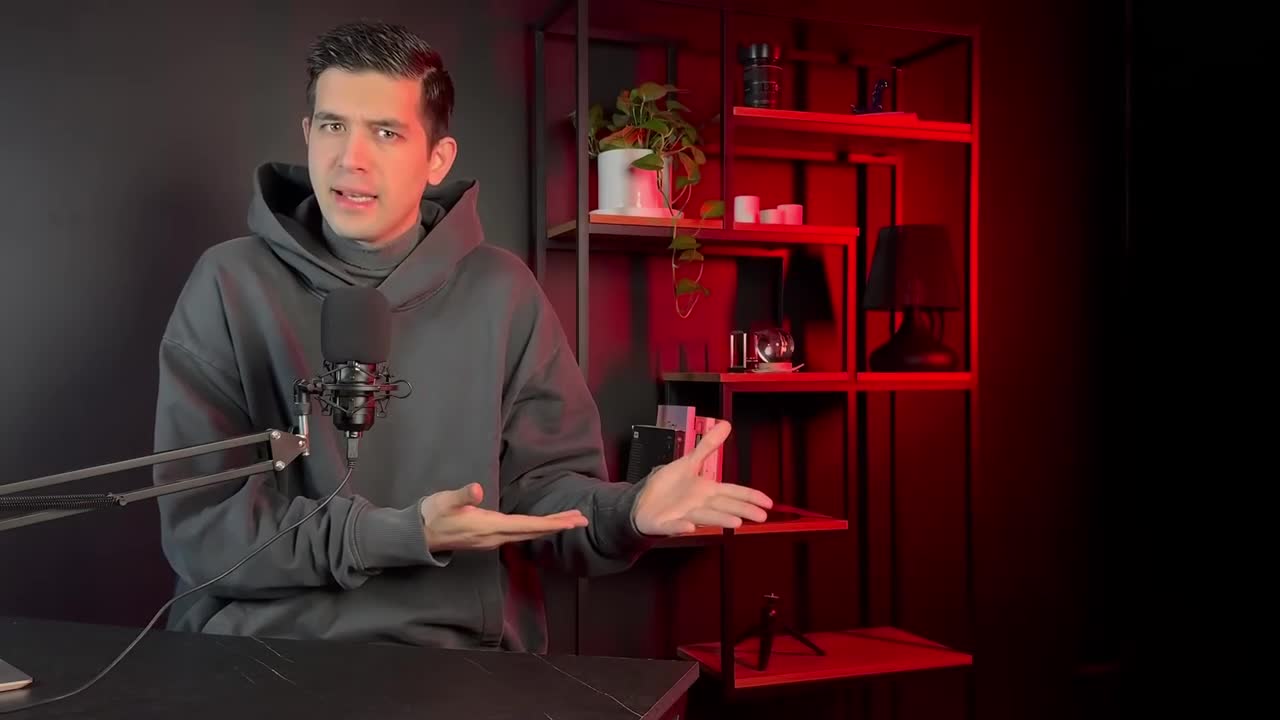
Three two, one yay.
Happy new year.
This year, i'm going to improve my english.
Happy 2006.
New year's resolution improve my english 2012.
Let's improve my english this year.
Improve my english.
Improve my english.
Improve my english 2026.
Let's end this.
Do what I say.
Just do it.
And I promise by the end of 2026, you will speak English fluently.
In this video, I'm going to give you a study plan.
That means every day you will have to study for 60 minutes until the end of the year.
Oh no, teacher, that's too much.
I don't have that much time.
Yes, you do.
Don't be lazy.
I've seen a lot of students nag about not having enough time to study, but then they spend two or three hours scrolling on Instagram or TikTok.
If you really want to speak fluently, you have to do this.
And it's not that much, 60 minutes.
Don't be lazy, just do it.
Do it!
I'm going to give you three different plans.
Plan one, plan two, and more importantly, plan three.
And this will be your schedule.
Mondays and Tuesdays, plan one.
Wednesdays, plan two.
Thursdays and Fridays, plan one again, and saturday, plan two and sunday, plan three.
And that's it, guys.
I hope you've enjoyed this lesson.
Let me know in the comments if this worked for you.
See, wait a second.
I haven't told you the plans yet.
There are two sets of skills in english.
We have receptive skills and productive skills.
What are they?
Receptive skills are the skills which involve receiving input, That is, listening when you receive information, or reading where again you read and receive information.
These are receptive skills.
We also have productive produce information.
Like what?
Like speaking and writing.
When you speak, you produce something.
Or when you write, you're producing information from your brain.
These are also called output.
So we have receptive skills and we have productive skills.
Now this will be your plan one.
Start with the receptive skills.
Watch, listen, and read.
Watch what?
Watch YouTube videos, movies, TV series, or TED Talks.
Listen to what?
Listen to podcasts or even music.
Read what?
Read whatever you like.
Read blogs, articles, the news, or probably a book, a storybook, an educational book.
So watch, listen, read.
These are three different sources of input.
You will work on your receptive skills.
How to choose what to watch or read or listen to?
Choose something that you like and you will enjoy because you like it.
Now, this is very important.
If you choose something that you do not like and you force yourself to watching it or to listening to it or to reading it, you're not going to do it until the end of 2026.
If you want to be consistent, you need to enjoy this process.
That means you need to choose the materials that you love.
For example, watch my YouTube videos.
I'm sure you will love them.
Or I'm a big fan of BBC six minute English podcast.
So if I want to do this, I will listen to the podcast of BBC.
And I'm not a big reader.
The only thing I read is Well, I follow the news of Manchester United because I'm a big fan.
So if i want to read, i will read the latest update on manchester united.
See what i'm saying.
Do something that you enjoy, okay.
So, 15 minutes a day, plan one.
Choose something a youtube video, a podcast, a book, a text, whatever.
15 minutes, do it, read it, listen to it or watch it and, as you are doing this, write down or underline new words or phrases that you may see or hear.
Let's say, I am reading a blog article and as I am reading this blog article, I see some new words and phrases such as carry out.
Oh, what does that mean?
Let's underline it or take for granted or come up with.
Huh, what does it mean underline, run into or point out?
These are the five phrases that I underlined as I was reading this blog article.
Or if you're listening to a podcast, see what's new for you, write it down.
That's the first part, 15 minutes.
We have 45 minutes left.
What's next?
Now it is time to make your personal dictionary.
Personal dictionary.
How?
With the words and phrases that you have written down, you're going to look for a simple meaning and an example sentence.
Where?
ChatGPT?
No, a dictionary.
I highly recommend Cambridge Online Dictionary.
Why a dictionary?
Why not AI?
Because if you let AI do the hard work for you in learning, you are not going to learn.
The point is not just to finish the dictionary and put it away.
The point is for your brain to get into the details of making that dictionary.
Use a dictionary like cambridge online dictionary look up a word or a phrase and look for the meaning in an example sentence and write them down.
This will be your personal dictionary for the first task and that will take about 15 minutes.
So 15 minutes of watching, listening and reading, 15 minutes of making the personal dictionary 30 minutes left.
What's next?
Now we're going to switch to productive skills.
You are going to start writing.
Write what?
Write a paragraph about any topic you like.
Write one paragraph.
And in that paragraph, try to use as many of the new words and phrases as you can.
So let's say I have written down the five words and phrases of carry out, take for granted, come up with, run into and point out.
Now I'm going to write a paragraph using all these words and phrases.
Last week, our team had to carry out a new plan.
At first, we ran into some problems, but we didn't take for granted the help we received.
One person came up with a simple idea that solved everything.
In the end, the manager pointed out what we did well and what we could improve.
See, I wrote a simple text using all the five new phrases and that's another 15 minutes.
15 minutes left.
What should I do?
It is time to use technology.
Open chat GPT or Gemini or any other AI tools that you may like.
Copy paste the text that you have written and use this prompt to get feedback.
This is the prompt.
I'm trying to improve my English.
This is a text I have written.
Check for grammar or vocabulary mistakes, explain the mistakes and suggest improvements.
Using this prompt, you will ask for feedback.
Ordinarily in the past, you would have to ask a teacher and pay to a teacher to correct your piece of writing, but now, with ai, you can do it instantly.
So copy paste the text, get the feedback and take note of any possible grammar or vocabulary mistakes you have had.
That is the end of plan one.
60 minutes easy, right.
Start with receptive skills, then the new words and phrases, then a productive skill of writing and finally feedback.
And this is what you're going to do on mondays tuesdays, not wednesdays, but thursdays and fridays, four days a week.
Plan two speak.
Let's go back to this diagram.
See, we have receptive skills and productive skills and in plan one, four days a week, we have focused on the receptive skills and the productive skill of writing.
But how about speaking?
See, we haven't touched speaking yet.
And this is a very important point.
A lot of the students say that I study a lot.
I have studied for years. but I cannot speak fluently.
I understand when you speak.
I understand what others speak.
I understand when I watch a movie.
I understand when I read a book.
But when I want to speak myself, I just can't.
You know why?
Because you've done everything.
You have worked on your receptive skills listening reading, watching a movie and probably have worked on your productive skill of writing, but you've never worked on speaking.
You cannot expect to work on your receptive skills and improve your productive skills.
These are two different things.
You want your productive skills to get better?
Work on the productive skills.
You want your speaking to get better?
You cannot read grammar and then expect to speak fluently.
That's not going to work.
So in plan two, we're going to focus only on speaking two days a week.
But how?
Again, we have four steps.
Each step will be 15 minutes.
Now, what's step one?
It's very easy.
Remember the text you wrote with the new words and phrases in plan one?
Take the same text, and now you're going to read it out loud.
How would that help?
Trust me, it helps.
This is the easiest speaking exercise.
By doing this, you are telling your brain that it is time to shift from only receiving to giving out, to dishing out, to producing.
Yes, you are not directly producing from your brain, you're just reading something, but you're doing this loudly.
That means you are training and warming up your speaking muscles.
See, speaking is a muscle and you need to train it and it can develop muscle memory.
That means the more you speak, the easier it becomes for you to speak, And that's how fluency begins.
So step one, read the text out loudly.
Step two, you're going to read the text out loudly again, but with a different twist.
This time, stand up and imagine in your head that you are presenting this text to an audience.
You're walking in the room, you're looking at different imaginary people and you are presenting the text as if you are reading the text to them.
How does this help?
It helps because now you are working on your presentation skill again.
This is another trick.
You're you're preparing your brain.
Four communicating something to someone else.
Now it's not real life situation, of course.
You never have a piece of paper in real life.
But this is the second step.
It's an exercise, it's an activity to do at home, very easy.
Now step three i want you to memorize that text you have written.
Why would i memorize it?
It's gonna help you a lot.
Let me explain.
There are two ways that memorizing that text will help you.
First one is that when you memorize that text in your head, those words and phrases that were new to you will, little by little, become ingrained in your memory.
That means you will never, ever forget them again, because you are memorizing how those words and phrases are used in context.
That paragraph is a context.
You're memorizing how they are used in that context.
Very important.
And second, more importantly for speaking, is that a lot of the times when we are speaking in English, we are not thinking about grammar.
We're not thinking about the tense.
Wait, wait, wait, wait.
Should I use simple present or present continuous?
Or maybe present perfect?
Okay, how is present perfect?
Subject plus past participle.
What words am I going to put in this structure?
Negative, I have never eaten sushi before.
See, speaking is not like this.
You're not thinking about words, you're not thinking about the grammar.
So what are we doing?
A lot of the times when we speak, we use something called prefabricated sentences.
What a prefabricated sentence is?
A sentence that was produced before.
You're not making the sentence right now.
You have made it before, so it's like you have a database of sentences that you have used before and now, when it comes to speaking, you randomly select and your brain automatically, on autopilot, puts them together.
And many times when you speak, you use those prefabricated sentences that you once made or you once read somewhere or you once heard someone use, and you just make the sentence.
And again, this happens without thinking.
This happens subconsciously.
So memorize that text.
Yes, the chances of being in an exact situation where you would say the exact same sentence may be low, but you may be in another situation and your brain may use some of these sentences.
It's like creating a giant database in your mind.
And then when you have that giant database because your brain is limitless When you have that giant database of sentences, of words and phrases in your head, when you want to speak, your brain will do the rest.
You might say, that's bullshit.
But let me give you one example.
Do you drive a car?
Next time you're driving a car, think about this.
Are you actively thinking about everything as you're driving a car?
Do I need to change gears now?
Am I in one or two?
Should I go to three?
Should I look left?
Right?
Up?
Down?
Oh, clutch first, then gas.
Really slowly?
Oh, look at left, look at right.
Oh, danger.
Are you actively doing this?
Or is your brain on autopilot?
You're just driving and your brain is doing everything.
Driving is not easy.
In fact, ask someone who's learning how to drive for the first time and ask them if They think it's an easy thing to do.
It's not.
For them, it's the most difficult thing.
Sometimes, some of them may even say that it's impossible to drive.
But if you've been driving for three or four years now, or even more, your brain is on autopilot.
You don't even think about what you're doing.
It's just happening all by itself.
Okay, I've talked too much.
Enough.
Speaking is similar to driving.
In the beginning, it's very difficult, but little by little, you will get the hang of it.
Your brain will switch to autopilot.
Talk so much and see, as i'm talking to you, i'm not thinking about what tense to use or what words to use and how to put them together.
I'm just talking to you and my brain is handling this automatically.
How, through years and years and years of practice.
And finally, step four, speak to an imaginary friend.
I mean, a better alternative is to speak to a real friend or to speak to a group of friends who are also trying to improve their English.
But it's not always easy to find someone who wants to improve their English and who is at the same level as you are and who wants to spend time with you to practice.
So it's better to do it alone.
How?
Imagine somebody sitting next to you talk about an imaginary subject using those words and phrases probably and that was plan two that you will use wednesdays saturdays okay so far we've worked on plan one receptive skills and the productive skill of writing and test two the productive skill of speaking so we've covered all the skills now receptive and productive everything is done so what should we do on sundays nothing no you have to do something that is probably even more important than all other days think about 2020 or 2021 or 2025 do you remember your new year's resolution mine last year was to go to the gym at least for half an hour every day did i go to the gym well i paid for a gym membership but i think i went only twice or three times why because I never held myself accountable.
I never tracked my progress and I never kept myself motivated.
It's the beginning of 2026 and you guys are all super motivated.
But as the year passes and we go from January to February March April May June July, that level of motivation diminishes.
You need to bring it up again.
How?
Every Sunday, this is what you're going to do.
Very easy, probably 10 minutes.
You're going to reflect on your progress during that week and answer three questions.
What did you do well?
What could you have done differently?
What are you going to do next week?
By asking these three simple questions, you are trying to keep that motivation high and to keep yourself accountable, to stick to the plan, to stay consistent.
And that's it, guys.
I hope you've enjoyed this lesson.
During 2026, I'm going to post one video every week.
And of course, a couple of short videos during the week but one video every week.
I want you to follow every single video until the end of the year and I will remind you in some of my videos about this plan that we made together right now.
Let's promise that you will stick to the plan and by the end of 2026, I guarantee you'll speak fluently.
To make your job easier, I have created a PDF file of a sample notebook that can be helpful for you to use these three plans plan one, two and three.
So go ahead, download this PDF, print it out, use it until the end of 2026.
I wish you all the best.
See you soon.
Bye.