You're listening to BrainsOn, where we're serious about beingcurious.
Brains On is supported on part by a grant from the National ScienceFoundation.
Is this thingon?Testing,testing, checkone,two.
Oh,perfect. HeyMark. You excited to watch theeclipse?
Hey Molly andAmina. I'm almostready.
I just need to give one of my famous speechesfirst.
The one about how you should always carry a bag of salsa in yourjeans?
Or the one about how back hair should have its own stylingproducts?
No, not the pocket salsa or body hair gelspeeches.
My other famousspeech.
The patented MarkJ. Sanchez peptalk.
This one's for themoon.
A pep talk for themoon?Yeah, youknow, an eclipse is a big moment for themoon.
It's the star of theshow.
Not the little rulestar.
That's thesun. But an eclipse is like the moon's bigperformance.
And I don't want it to get stage fright and run away at the lastminute.
Mark, I'm pretty sure the moon has never run away from the sun during aneclipse.
Andthat,Molly, is proof my speech iswork.
Now, if you'll excuseme.
Heymoon. It's your old pal Markagain.
I know it's a lot of pressure to have all eyes onyou.
I once played tree number three and anoff,off,off,off,off, off Broadway production of The Wizard ofOz.
So believeme, I getit. But I know you can dothis.
You are the moon for Pete'ssake.
You like thenight. You make thetides.
You're the reason we believe inwerewolves.
Did a cow jump over thesun?
No, it didnot. It jumped overyou, myfriend.
Because you're the star of theshow.
Again, notliterally. You're just a giant spacerock.
But you're the best-durned giant space rock outthere.
Now, go block thatsun. Show them what you're madeof.
Which isn'tcheese, despite what I was told as akid.
Gomoon.Bravo,Mark.Yeah, the moon must feel so pumped up rightnow.
Thankyou. Thankyou, thankyou.
Just doing mypart. But that really took it out ofme.
I could use asnack. Chips and bucketsalso,anyone?
You're listening to Brains on from APMStudios.
I'm MollyBloom, and I'm here with myco-host, Amina fromOrlando,Florida.
Hi,Amina.Hi,Molly.Today, we're talking about one of the most sensational celestial events to grace ourskies, a total solareclipse.
Here in NorthAmerica, we have eclipsefever.
That's because on April8th, a total solar eclipse will be visible on a path all the way from Mexico across the Central United States to the east coast ofCanada.
The rest of North America will get a glimpse of a partialeclipse.
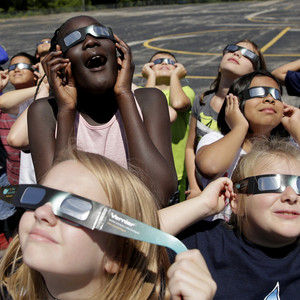
And just in case you don't listen to the end of thisepisode, we need to say rightnow, do not look at the solar eclipse without special eye protection and know your regular sunglasses won't cutit.
More on thatlater. Justremember.
No,no, stare at thesun.
Now doit.So,Amina, what are your plans for April8th?
What are you going todo?
So, the thingis, I have a dance competition the weekend right before theeclipse.
And the competition is here inFlorida.
So, if we do decide to go to the solareclipse, we'll have to leave on Sunday to go to somewhere where we can viewit.
Like the total solareclipse?
Yes. Would you watch the partial one from Floridapotentially?
Yeah,probably. The last time there was a solar eclipse was2017.
And I was in Minnesota and I saw a partial solareclipse, but it was still supercool.
So, I would say even if you're not in the path oftotality, it is still worth it to get a pinhole or some eclipse glasses and check itout.
It's verycool.Amina, have you ever seen a solar eclipsebefore?
I saw a partialone. It was really cool because I got to see it both through the pinhole viewer and the eclipseglasses.
Verycool.So, just in case people don't know like what is it like to look at it through thepinhole?
Basically, it's like a little crescent of light on theground.
It kind of looks a little bit like a crescentmoon.
Verycool. And then when you look at it through the eclipseglasses, how is itdifferent?
Well, through the eclipseglasses, everything except for the sun is pitchblack.
It's reallycool.Also, thesun, it's orange-ish through the eclipse glasses that weused.
It'scool.So, I know a two-year family often likes to look up at cool celestial events that havehappened.
Sometimes you guys gocamping,right?
So, you can seethem?Yes.
Prettyrecently, we went on a camping trip to Sarasota so that we could view a total lunareclipse.
It was veryfun. It lasted like...it lasted a fewhours.
We were around to like 11 to maybe 3AM.
Yeah.Oh, and we saw a turtle weighing hereggs.
A seaturtle?Yes.Oh, that's socool.
During the lunareclipse?
Yes.Whoa, that's reallymagical.
That'samazing.So, what causes anyeclipse?
Spoileralert, this awe-inspiring astronomical phenomenon actually happens because of themoon.
The Earth is alwaysspinning.
Like someone spinning a basketball on theirfinger.
It takes about a month for the moon to make one lap around ourplanet.
During a total solareclipse, the moon passes right between the sun and theEarth.
For a fewminutes, theEarth,moon, and sun are perfectlyaligned.
There's actually a cool astronomy word forthis.
Sysigy spelledS-Y-Z-Y-G-Y.
Sysigy such a greatword.
When thishappens, the moon completely blocks the light from the sun and casts a shadow on theEarth.
A total solar eclipse happens about once every year and ahalf.
But lots of them are only visible from very remote places onEarth, like the middle of theocean.
A lot of our planet is covered byoceans, so that makessense.
So, being able to see a total solar eclipse where we live is a pretty specialevent.
Okay, so maybe you'rethinking.
The eclipse is just ashadow,boring,yawn, whocares?
Well, I would argue that all shadows are supercool.
You mean like how the shifting sizes and angles of these diaphanous forms remind us of our own physical heft in the inexorable march oftime?
Yes, and shadowpuppets!
I learned how to make a pretty convincing swan the otherday.
Thattoo, and the eclipse is the most spectacular shadow of themall.
A solar eclipse starts outslow, hopefully on a clear sunny day where there are no clouds to get in theway.
And I will say again that you definitely should not be looking at the eclipse without special eyeprotection.
More on that in abit. It starts as a nice bigcircle.
Then, as the moon starts to move in front of thesun, a small bite is taken out ofit.
After this firstnibble, the moon starts to cover more and more of the sun until all that's left is a thin littlecrescent.
It can take more than an hour to reach thispoint.
Bynow, the sky is prettydark, and then things start to happenfaster.
As the moon slips in front of thesun, a few spots of sunlight peek around its mooneyedges.
These are called Bailey'sBeads.
Basically, we're catching glimpse of sunlight shining through the moon'smountains,valleys, andcraters.
Then, there's a bright flash of light along the edge of themoon.
Astronomers call this the Diamond Ringeffect, and a few secondslater, totalitybegins.
Totality is the special name for when the sun has been completely covered by themoon.
The sky gets dark like it'stwilight.
When thathappens, you can see the outer layer of the sun'satmosphere.
It looks like glowing wisps of light coming off the dark circle where the sun used tobe.
Once darkness falls during theeclipse, you might notice animals acting like it'snighttime.
Crickets sometimes startchirping, birds return to theirnests, and even honeybees might fly back to theirhives.
But the darkness won't lastlong.
The total solar eclipse only lasts a couple of minutes before the sun starts to peek outagain.
First, a sliver of the sun will bevisible.
Then, as the moon moves out of the sun'sway, the sky getslighter.
Untileventually, the sun is revealedagain.
If you won't be in North America on April 8th for the solareclipse, there are plenty more comingup.
In2026,Greenland,Iceland, and Spain will get thetreat.
2027 brings the phenomenon toMorocco,Spain,Libya, SaudiArabia,Algeria,Egypt,Yemen, andSomalia.
And in2028, it'll be Australia and New Zealand'sturn.
And if you happen to be in any of these places during aneclipse,remember...
No,no, stare at thesun, now doit!
Brain,brain,brain, the wholeworld.
Humans have been fascinated by solar eclipses for thousands ofyears.
And also a little bit afraid ofthem.
Which makessense, if you think aboutit, before we understood the science behind solareclipses, it felt like the sun was randomly going dark in the middle of theday.
One way humans master their fear of the unknown is by studyingthings.
And that's just what Chinese and Greek astronomersdid, starting as early as 4,000 yearsago.
They recorded the movements of theSun,Moon,planets, andstars, and tracked when solar eclipseshappened.
By about 2,000 yearsago, these astronomers had recorded enough information to start predicting when future solar eclipses wouldoccur.
Another way humans handle fear of the unknown is by creating and tellingstories.
And for avery,very, very longtime, humans have shared stories that explain why solar eclipseshappen.
Forexample, people in ancient China thought an eclipse was caused by a dragon eating theSun.
Vikings in Scandinavia believed it was two wolves that swallow theSun.
And some communities in South America said it was apuma.
Indigenous tribes in the United States have a long tradition of studying theSun,Moon, andstars.
And I had the chance to chat with Nancy Mary Boy abouteclipses.
She's Navajo andCherokee, and also an Indigenous scienceexpert.
Every community and every tribe has their own perceptions of theeclipse.
Navos feel that any eclipse is a badomen.
And not all tribesdo, but Cherokee does so toNavajo.
There's a very traditional protocol youfollow.
So you go in your house and everything wouldstop.
And you'd go in there and you'd sit there for the whole time of theeclipse.
And you wouldn't be veryquiet, veryreverent.
You wouldn't eatanything.
You wouldn't drinkanything.
You sing certain songs that traditionally about theeclipse.
You just talk in very quiet voices and you wait itout.
A lot of tribes think of theuniverse, the Earth and thesky, worlds as needing to be inbalance.
And when something out of the traditionalorder, the process of the universe happens like aneclipse, that eclipse is disrupting the order ofnature.
And so that's why a lot of tribes want to make sure the eclipse is corrected and the Sun is outagain.
So they have their different ways of behaving to ensure that willhappen.
All over theworld, there are many differentpeople, differentsocieties, differenttribes.
And everybody sees the sky in a differentway.
And it depends on where you are on the Earth and thesociety, the community you livein.
But there's not just one size fitsall.
There's many different stories that aretold.
And the more youknow, the more enriches you're understanding of thesky.
There's so much to learn from indigenous knowledge about the nightsky.
And we have lots of links in the show notes and on ourwebsite.
That'sbrainson.org. Allright,Amina, before we learn more about the solareclipse, it's time forthe...
Mystery SoundAmina, are you ready to hear the mysterysound?
Yes.Okay, here itis. What do youthink?
It kind of sounds like I am not100% sure if this iscorrect.
But I listen to a lot of ASMR videos and it kind of sounds like waxcracking.
Oh,interesting. Now can you tell us what ASMR videos are just in case people don'tknow?
ASMR is this thing where people will take anobject, put it really close to a microphone and make some kind of satisfying sound withit.
Yeah, it's called ASMR because sometimes it sort of triggers this thing in your ear where it feels good to listen toit.
And we actually have an episode about slime where we talked about what ASMRis.
So if people areinterested, you can go find that slimeepisode.
Okay, so your guess is waxcracking.
Yes. Allright, well we're going to hear it again after thecredits.
Get another chance to guess and hear theanswer.
So stickaround. Hifriends, are you planning on watching theeclipse?
We would love to see your photos showing how you safely watch this awesomephenomenon.
Send them to us at brainson.org slashcontact.
While you'rethere, you can send us mysterysounds,drawings, andquestions.
Like thisone. How do parents mimic other sounds orcreatures?
Again, that's brainson.org slashcontact.
And keeplistening. It'sbrainson.
You're listening tobrainson.
I'mAmina. And I'mMolly.
Today we're talking about one of the most astonishing jaw-dropping astronomical events in ourskies, the total solareclipse.
This phenomenon happens when theEarth,Moon, and Sun are perfectlyaligned.
As the moon passes between the Sun and theEarth, it blocks our view of theSun.
Depending on where youlive, you might see a partialeclipse.
That's when the Moon blocks part of theSun.
Or you could see a total eclipse where it completely covers theSun.
For a shorttime, the sky darkens and day turnstonight.
But no matterwhat, you cannot stare at the sky during aneclipse.
Nope, noway. Please don't really don't doit.
No,no,no, stare at theSun.
No, doit. Here to explain isDr.
RalphChu. He's an eye doctor and astronomer from the University of Waterloo inCanada.
And he says brightlight, like the light from theSun, can seriously damage oureyes.
The problem with looking at the Sun is that it's just too much light entering theeye.
It just overwhelms the photoreceptors at the back of theeye.
Photoreceptors are a special kind of cell in our eyes that help ussee.
Cells are the building blocks of all livingthings.
And when these photoreceptors cells in your eyes get overwhelmed with too muchlight, they start to breakdown.
That can damage your eyes and even affect yourvision.
If you burn yourfinger, you'll know it's burned because it'llhurt.
But Ralph says if you look at a solar eclipse without special eyeprotection, you can damage your eyes without even knowingit.
The problem is there are no pain receptors at the back of theeye.
You don't feel it and you go tosleep.
Everything'sfine. You wake up next morning and all of a sudden you realize you can't see the face in themirror.
You can't see the face of the person across the table atbreakfast.
And you've got this big blurspotinstead.
You might bethinking,OK, I'll just turn my sunglasses to protect myeyes.
Problemsolved.Wrong.
Unfortunately, regular sunglasses don't block enough light to make it safe to look at thesun.
Normal sunglasses block 75 to90% of visiblelight.
That might sound like alot, but there's so much light coming from the sun that you need to block out99.9996% of it to keep your eyessafe.
That's practically all ofit.
So wearing sunglasses isn't safe during aneclipse.
To watch a solar eclipsesafely, you'll need to wear special eclipse view glasses that can block out that muchlight.
You can order them online or maybe get them from your local sciencemuseum.
Since these glasses block out so muchlight, remember you can't really do anything in them besides look at the solareclipse.
Don't try to walk while wearingthem.
You won't get veryfar. Ralph says to remember to put your eclipse glasses on first and then look at thesun, not the other wayaround.
And once you have your eclipse glasseson, you'll be able to safely watch one of the coolest events in our solarsystem.
Ralph says it's a very special thing to be able to see a solareclipse.
He's seen 29 of them in hislife.
I was 12 years old when I first saw my firsteclipse.
Back in the1960s, it was totallyunexpected, but it was a life altering eventform.
He says you could also look at the eclipse through a telescope fitted with a special solarlens, or you could make a pinhole projector that lets you look at itindirectly.
We have instructions on how to do that on ourwebsite,brainson.org.
But even if you don't have eye protection that will let you look directly at theeclipse, you can just go outside and look at the rest of the world aroundyou.
Ralph says there's some cool stuff that willhappen.
When it's close tototality, there tends to be a little bit of a breeze that sets up because the shadow of the moon causes the air to cooldown.
Just watch what happens to the birds and the flowers around you during the eclipse as it getsdark.
There are some plants where the flowers will close up thatnight.
You'll see this happening as the eclipse proceeds and it getsdarker.
The other thing is that the crescent being sonarrow.
All of a sudden you'd start getting effects on how you see things around yourworld, because in that zone of totality you've got thisvery, very thin light source illuminating theworld.
You get different appearances to the sharpness of the edges and what shadows there are look reallyweird.
So get out there and observe what'shappening.
Butremember... A solar eclipse happens in the moon passes between the sun and the earth blocking our view of thesun.
If you're in NorthAmerica, you'll have a chance to see a total of partial solar eclipse on April8th.
There are more coming up that will be visible in other parts of theworld.
But no matterwhat, you cannot stare at the sky during a solareclipse.
Do not stare at thesun. Don't doit.
That's it for this episode ofGrainson.
This episode was written by Molly Bloom in ShailaFarzone.
We had production help from Rosie Dupont in a goldfield.
AaronWoldeslasi, NicoGonzalez-Wisler, RubyGethry, and MarkSanchez.
We had editing help from SandinTotten.
This episode was sound designed by Rachel Breeze and we had engineering help from Alex Simpson and LawrenceBexler.
Beth Roman is our executiveproducer.
The executive is in charge of APMstudios, our Chandra Havati and JoanneGriffith.
Special thanks to RebeccaBenjamin.
We have a lot of work to do with theshow.
We have a lot of work to do with theshow.
We have a lot of work to do with theshow.
We have a lot of work to do with theshow.
We have a lot of work to do with theshow.
We have animated versions of some of your favoriteepisodes.
Or head to brainzon.org where you can send usquestions, mysterysounds, anddrawings.
Okay, newthoughts. What do youthink?
Imean, it sounds like the thing that I saidbefore, but also it kind of sounds like somebody crumbling a plastic waterbottle.
Ooh, very niceguess. Are you ready for theanswer?
Yes.Okay, here itis.Hello, my name is Kyu and this is the sound of me joining the Rubik'scube.
A Rubik'scube, do you know what thatis?
I should knowthat.Oh, do you play withthem?
Yeah, I know how to solvethem.
I watched a YouTube video aboutit.
Socool. I don't know how to solvethem.
That is verycool.Yeah, Imean, I think you were not that far off like the plastic crinkling of the water bottle sounds a lot like mixing up a Rubik'scube.
Yeah. So how fast can you solveit?
My fastest time is like 48seconds, Ithink, in the highforties.
Amina, that isincredible.
Holycow, soimpressed.
Now it's time for the brain's honorrole.
These are the incredible kids who keep the show going with theirquestions,ideas, mysterysounds,drawings, and highfives.
Arene from RedwoodCity,California, Chelsea fromWinston-Salem, NorthCarolina, Ava fromMelbourne,Australia, Hugo fromMaputo,Mozambique, Ethan from SanAntonio,Texas, Ellie fromWesterville,Ohio, Sophie fromPleasanton,California, Emma and Ben fromCrownsville,Maryland, Carter and Avery fromCanada, Staten from NewBrauffles,Texas, Laura fromMontclair, NewJersey, Dixia fromVancouver, Hailey from NorthCarolina, Emma and Elliott fromSpringfield,Missouri, Cora fromSarasota,Florida, Mary fromTukesbury,Massachusetts, Leo fromMesa,Arizona, Turner fromBrooklyn, NewYork, even Zoe fromCromwell, NewZealand, Hazel fromPinocca,Alberta, Isabelle fromMaplewood, NewJersey, Graham fromFolsom,California, Adelaide fromChicago, Farrah and Ford fromGreenwich,Connecticut, Corley and Myel fromRichardson,Texas, Sawyer fromLinwood,Washington, Charlotte fromBare,Delaware, Madeline fromRedmond,Washington, Avery and Alex fromVancouver, Avi and Akiva fromWoodmere, NewYork, Posey from HuntingtonBeach,California, Olivia fromRigby,Idaho, Harper fromHattiesburg,Mississippi, Bianca fromAsheville, NorthCarolina, Erickson fromAlpharetta,Georgia, Mila from GrandsPass,Oregon, Lena fromSterling,Virginia, Titus fromThailand, Edward fromLondon, Deegan fromCahoe, NewYork, Riley fromDerby,Kansas, Ashwin fromWashington,DC, Theo fromScarce,Dale, NewYork, Tasha and Jay fromCorolla,India, Teddy fromSt.
Louis, Shafali fromArts,Lee, NewYork, Celeste fromAlameda,California, Aurelia fromPortland,Oregon, Robbie fromPortland,Oregon, Jacob fromPerth,Australia,Gene, Charlie and Betsy fromHelena,Montana, Alex and Theo from CapeTown, SouthAfrica, Luca fromPrankin,Switzerland, Zachary fromGeneva,Switzerland, Luna fromPaya,Hawaii, Cyrus and Charlie from Salt LakeCity, and Mila from Bali andIndonesia.
We'll be back next week with an episode all about how medicine knows where to go in our bodies to stop thepain.