Discussion keeps the world turning.
This is Round Table.
You're listening to Round Table, I'm Steve, joined today by Yushan and Nyo Honglin.
Coming up, okay, follow me, close your eyes, everyone.
Imagine it's Friday afternoon around 2 p .m. or so your boss comes to you and says, you are free to go home!
Dobby is free! Apparently your boss is a ghost!
Well it sounds pretty good right?
Well here's what's happening.
Several Chinese cities are testing out the idea to see how it goes.
Who knows, maybe you listening are living in one of those cities right now.
We'll discuss it. After that, it's your chance to have your voice heard on Roundtable.
Heart to heart is coming up.
Our podcast listeners that is you can find us at Roundtable China on Apple Podcast and don't forget we want to hear from you as well, an email is great but a voice note is great, great.
Send those our way with your thoughts on any of the issues that we discuss on the show here's how you get in touch RoundtablePodcast at QQ .com once again roundtablepodcast at QQ .com and now Several Chinese cities are pioneering a two and a half day weekend policy allowing employees to leave work early on Fridays.
This bold experiment in work -life balance offers potential benefits for well -being and productivity.
Yes, but its execution is not the easiest thing to do.
There are a lot of challenges there.
The rationale behind the policy reflects evolving attitudes toward labor efficiency and also personal time, but practical hurdles emerge, don't they?
How can industries adapt operating hours?
And then, what about salaries?
Do we adjust those accordingly?
Public reactions, they range from optimism – woo hoo, it's going to happen for me – to skepticism, this is never going to happen here, with many seeking clarity on the issue.
There's a lot to unpack here because we have questions like early dismissal, can we apply that uniformly all across the board for all industries and all companies or will flexibility vary by employer.
What's going on here, where is this happening in the country?
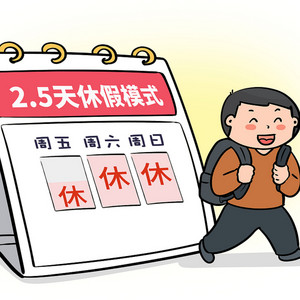
It's happening in Myanyang City in southwestern China's Sichuan province and it was announced that this is a trailing of a 4 .5 day flexible work system, and this includes encouraging people that fit the conditions to implement a 2 .5 -day weekend model and combining Friday afternoon with the weekend, that's what's going on, and this announcement has gained significant public attention and become a trendy topic now.
It has gained significant public attention.
I mean, imagining it I just feel like it's real, you know, at least to hear in Beijing with a fast -paced working and mode, it's hard for me to imagine this going on in a way that's, you know, combining half a day with the weekend.
We'll get to our personal feelings on the issue a little bit later, but the whole concept of the two and a half day weekend, it's not new right?
In fact, this was introduced for us about a decade or so ago.
Yeah. The whole concept, it's not entirely new, let's say the state council office first proposed encouraging flexible working hours, and that was back in 2015, to promote tourism investment and consumption.
And ever since then, well, over 10 provinces and cities that includes, well, here goes a long list. The Hebei province in northern China, Zhejiang, Anhui and Jiangsu provinces in eastern China.
There's Jiangxi Province in Central China and also Gansu and Shaanxi in North Western China.
These provinces, they have all introduced similar policies that's related to the 2 .5 day weekend model and that's often linked to the stimulating consumption locally.
So who gets to take time off then?
Like Yuxin said, it's encouraged, it's advised, it's not mandatory.
so the flexible weekend policy mainly applies to government officials, enterprises, and public institutions, and social organizations, public service departments such as government service, public hospitals, public schools, and emergency response departments are currently not included, which makes sense!
Yeah, I was going to say public hospitals!
They're not included.
What happens if you get sick at 4pm on a Friday?
And that was partly what I was thinking about seeing this, because people are easy to be double standard. And I enjoy definitely having half day off on Friday afternoon.
But in those afternoons, when I go out shopping, when I go run my errands, when I realize, huh, everybody else is enjoying their sweet time as well, I might be a bit annoyed.
Yeah, I want to come back to that point you made about shopping in just a few minutes.
Another question about this, is this year -round?
Is this all every month of the year, every Friday of the year?
Well, it's not really year -round also.
That's one thing. Most cities that have already put this policy into practice, they have chosen to do so just during the summer.
Yeah, during summer times.
For example, there's the In Shangri -La city in Jiangxi province in central China, Beautiful place.
yeah that's a beautiful place and imagine people there only spending their June 1 to August 31 each year and having an extra say half a day off.
that's 12 Friday. during that specific time i know right it's just um during summertime so that there is bigger consumption and you know better travel opportunities but outside of that time you get to work on how you normally work.
I'm terrible at math, but do you see how quickly I did that math when we're talking about getting off work?
You're not terrible.
You've got the question of the math in our first topic really fast, too.
So, okay. So that's the details.
Those are the details on the topic.
Why then, why implement this new policy?
What's the reason behind it?
Well, like I kind of briefly mentioned earlier, this is, this whole move, especially the new one that's happening in Mian Yang in Sichuan province, is for boosting consumption.
That's exactly what I was going to say when you said, oh go out shopping on a Friday afternoon.
Yeah, the boost to the economy through consumption.
And it's also to just improve residence consumption capacity and market vitality as well.
You just allow people to walk out and of course people will want to feel some leisure time and shop around.
And this plan it also includes seven core actions and 29 specific measures that's covering various aspects such as income, education, housing, events, night economy, and also holiday as well.
So that's all, it seems like it's benefiting the local people.
So the reason I said I wanted to come back to that point talking about boosting consumption, is because when people have more time on a Friday afternoon, you said yourself, Ngo Honglin, you'll go out and do some shopping, put some money back into the economy, right?
I'm thinking too, that the tourism industry would benefit from this, because two and a half day weekend means you get out on the road, 2pm, 3pm on Friday, it would encourage people to go out and travel more, I would think.
Previously we've had the talk about a spring break or a autumn break for kids.
It's only three or at most five days plus national holidays and it was also encouraged for different schools to find out different time to give kids that three or five days because we do not want to make problems or make the traffic let's say preferences for these people not existing by enrolling a national holiday for a spring break and that's the same thing I'm glad to see that different cities are experimenting this 2 .5 weekend policy in different period of time so the traffic peak hours or peak days could be a void if people want to conduct short, distant travel.
Yeah and I think what you're talking about here is that when you all of a sudden call it a national holiday, something or other, traffic is going to be very, very, very bad at that time.
But if you leave it up to individual provinces for example, who are doing things at different times of the year, maybe June 1st to August 31st I think is what you mentioned before, maybe even fall time would be a good time for another province.
That would help alleviate some of those issues.
So from the economic side of things sure promoting tourism, traveling, boosting consumption but then there's the side too we can make a strong argument that this is a creating more of a balance between work and life when you get a half day off on Friday.
Isn't that nice? The idea of what it's called WLB, the work -life balance, has been so popular online lately.
And according to the experts, it's happening as well, as Professor Yang Hai -yong, Director of the Institute of Social Development at Southwestern University of Finance and Economics, he said that the more advanced a society becomes, the stronger the desire for work life balance.
And he also stated that in the past, workers they actually a fault for a 10 hour workday.
And nowadays the eight hour workday has become the norm with all the technology and the technological advancements that we have. Working hours nowadays, they are only expected to become shorter in the future.
And let's hope is going to be the future.
Okay. Not only that, in fact, in 2022, in the United Kingdom, They conducted an experiment of 61 enterprises and over 2 ,900 employees to work for four days and rest for three days.
And it turns out all of the enterprises have seen positive results in their revenue and people, employees are happier, they leave their job later and they're healthier.
And the burnout situation is being curbed, partly.
And in 2023, there has been another article published by a naming named How Do 24 Hour Movement Behaviors Change During and After Vacation and it's a cohort study.
And that study also suggests that having longer rest, longer weekends would help people solve the problems of burnout and actually improve the efficiency of their working.
Yeah I mean, other countries have done this.
There was a story from NPR in 2021 that talked about the UAE, the United Arab Emirates.
They announced their big changes to their work schedule.
They transitioned to a four and a half day work week, with weekends to consist of Friday afternoon, Sunday, Saturday and Sunday, which is what we're talking about here.
That was really significant for a couple of different reasons because from NPR it likely made the UAE the first nation to formalize a work week shorter than five days and it also brought the country more in line with perhaps international work schedules, so that was quite a big move.
But let's get to it.
How do we implement this?
This has to be very, very, very difficult.
Exactly. From the employee's side, it looks like a good news, but from the employer's side, from the management's side, that's going to be an issue on how or in which way or Through what kind of manner can I allow all of my employees to do that?
So a lot of the times, this is primarily an encouraging or advocating policy for the employers.
It's not mandatory for all of them to implement it immediately or just following the whole system.
And implementation, they rely heavily on employers' willingness which is often low due to cost concerns.
For example, just imagine one factory manager that's, you know, stopping a production line for half a day.
And according to one real case, that could actually lead to lost a lot of orders for them.
Implementing flexible work systems, they can also decrease management and increase management power and also increase communication costs for the managing team as well.
Sure, yes. So for them, it's complicated.
Yeah, they could lose business, simply speaking, right?
Also, I would think, I would think, correct me if I'm wrong, but if employees at companies here in China say, okay, we can go home Friday afternoon at 2 p .m., that's awesome, but that means I have to stay Thursday night until 9 p .m. So would that be a problem too, they have to make up these working hours somewhere else during the week, do you think?
It could happen. and depending on different industries, depending on the habit of each and every employee.
Because before the show, we briefly discussed this topic, and my feeling is that I could not be able to enjoy that because I cannot finish what I need to do within four and a half days, and I want to finish what I need to do.
And the thing is, we stated that the efficiency of employee would be improved because of the policy, but you still need a little time to adjust. You need better working habit and better working structure so that you can improve your efficiency and enjoy the days off.
It takes time and a little bit of process.
Yeah, I mean, it's something that just people aren't used to it.
So it's going to take a period of adjustment.
All right. So how are people feeling about this in China or just about their vacations in general here?
Well, many Chinese people we still believe that reducing work hour or working hour rather is an inevitable trend.
It is going to happen in the future, but it's not through a one size fit all kind of approach like the policy like how it's presumably going to be implemented.
And also Professor Yang kind of specified this too that reducing working hours is an inevitable trend as society advances and the economy develops.
So as we gradually move on to or like a better better and well -organized working Force, we would imagine that this is going to happen that there will be less working hours but the the thing with the implement the Thing with the implementation must be grounded in real -world conditions in order to avoid Yeah, you know the one -size -fit -all approach Yeah, because the one -size -fits -all approach is just not I mean in a vacuum great But it's just not gonna happen right?
It's just not practical.
Alright, so tell us then I said I'd come back to this How do you feel about it?
Do you want this or do you not want it?
If it means that I need to overwork on another day in order to get to rest on half of Friday then Really not sure for some cases if there's a trip There's a trip plan then sure I can try but I still I don't feel it's really that necessary and in some cases?
I don't think so, not for me.
And for those of you who find five working days is not even enough for you, try doing some other things to improve your mental health, try sit down less or stop sitting for 29 hours every day.
It means that you stand up, you walk around a little bit and also sleep four percent more every day.
It means 21 minutes of sleeping, eating more, sleeping every day, it would increase your efficiency and also make you happier and healthier mentally.
I am not happy. I need to sleep 4 % more.
That's so analytical isn't it?
Does it work? Does it not?
I think it depends not only region to region, not only industry to industry or even company to company.
I think it matters on an individual basis.
Some people might love it.
It might work for them.
Maybe others not so much. but an interesting topic, there's no doubt about that.
You're listening to Round Table, and coming up next, Round Table's Heart to Heart.
You ask. We answer.
Round Table, Heart to Heart.
It is time for Round Table's Heart to Heart, and today, we have a question and a comment from Liz.
Hello, Round Table.
I'm Liz. little. I'm very glad to send this voice message to you.
Recently, I often listen to Roundtable podcasts in each morning.
I think this is a very good way to remain my sensitivity with English.
Another way is that make me to stay familiar with English, because I major in English, but now I'm a four -time mother.
I think maybe in the future I still need to use this proficiency, so thank you guys for creating such a very good program.
It benefits so many people.
Recently I just found myself a very highly sensitive person.
It may be afraid in the psychological field.
I'm very interested in this phrase.
I want to know more about being highly sensitive.
I hope that in the future the Roundtable can talk more on this topic.
Thank you. We're gonna talk more on that topic right now, Liz, thank you very much for your kind words about the show, and thank you for your voice message too.
highly sensitive person or HSP Liz is feeling that way these days what what does it mean well a highly sensitive person is someone who possesses sensory and emotional information that's more deeply and intensely than average person and it it's not a disorder or an issue or anything it's just a recognized personality trait found in about fifteen to twenty percent of the population Oh, interesting.
So about 1 in 5 people has a highly sensitive—or is a highly sensitive person?
Do we have any highly sensitive people in here?
Hand raising. Hand raising?
Yeah, me too. I would think.
Uh -oh. Three. Is it a good—?
I think it comes with advantages and it comes with disadvantages.
Why do you define yourself, Nghonglin, as a highly sensitive person?
There are multiple reasons, for instance, I feel that I am very - very sensitive of people's facial expressions.
The way they talk, I would sense their feelings and when I'm with another person who is also highly sensitive, we sometimes apologize to each other about the things that other people do not even notice that has happened in the conversation.
You would do very well in Canada.
We are a nation of constantly apologizing people.
Or in the UK. Yeah, there too.
What about you, Yishun?
You said you're a highly sensitive person.
Well, yeah. And one quota, I would think, that fits all highly sensitive people are just overthinking.
Overthinking all the time, overthinking as a way to live.
You start to get triggered and think about, oh, did I just say that too loud?
Oh, I'm sorry I got angry.
Was that wrong? Was I meant to do that?
You start this whole world with yourself all the time and self reflecting all the time so that's one iconic feature I'll say.
Over analyzing overthinking.
I think there are advantages and disadvantages, and by the way Liz because I am a highly sensitive person in your voice I sensed that you were slightly concerned perhaps about feeling overly sensitive these days, but I think it comes with advantages and disadvantages.
is I'm a highly sensitive person, it means I'm quite, I believe, intuitive with other people's feelings.
I can tell when they're upset or when they're not.
You read the room better?
You can read the room better and that has a lot of advantages in relationships with people, right?
But at the same time, the problem that I have with being too sensitive is that I will misinterpret a message which my brain perceives to be negative, when in fact there's no negative meaning behind the message at all.
And I do that a lot with text messages and it drives me crazy, whenever I see a text message, I just, for some reason, I just assume it's a negative and that drives me up the wall.
And my tiny little tip here is that people are sensitive, but they're more sensitive in certain aspects.
So if you feel like you are taking a toll because you're super sensitive, figure out what bothers you more.
For me, sounds bothers me quite a lot.
That is why I bring my noise -reconciling headphones all the time so it helps me.
Oh, very good tip. So we could just all walk around with headphones and ignore the universe.
Liz, thank you so much for your message.
And that will do it for today's Roundtable.
Thank you to Niu Honglin and Yuxian for joining the show.
Thank you to you, as always, for sharing your time with us.
I'm Steve, and we will see you next time.