Hi, I'm very happy today because I have a huge announcement.
A new course is now available to help you with your pronunciation.
And it's for all levels.
Visit pronunciationcourse.com and get it now for a special price.
I repeat, pronunciationcourse.com.
And now, enjoy today's episode.
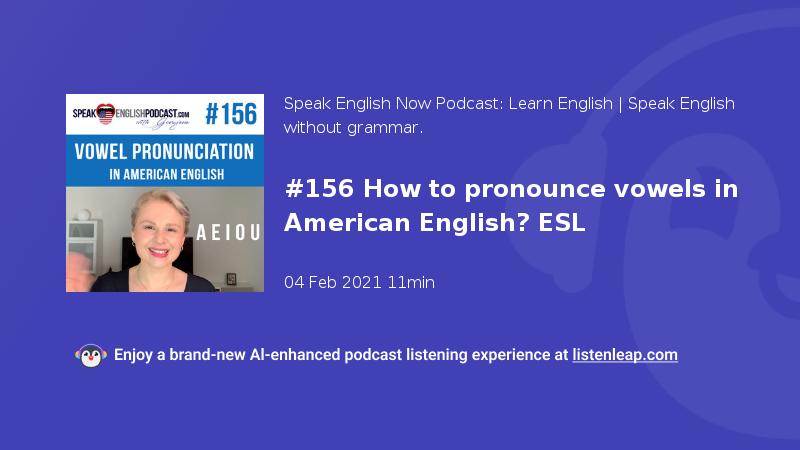
Today we will talk about how to pronounce vowels in English.
And with a fun point of view story, you will improve your grammar.
The truth is that vowels in English always represent a particular difficulty for many students.
But don't worry, because there's a self-evident reason why this happens.
It turns out that in English we have six vowel letters, represented by letters A E I, O and U, and 15 vowel sounds.
15 vowel sounds?
Yes.
You see, that's the real problem.
In English We don't read vowels as they are written, simply because the same letter can be pronounced in different ways.
For example, we can pronounce vowel A in seven different ways.
Amazing, right?
We divide vowel sounds into three different categories.
Long vowels.
We pronounce the long vowels the same as the letter.
These are the long vowel sounds in American English.
A, E, I, O, U. Examples.
Short vowels have the most common sound for a single vowel spelling.
Cat, bed, sit, top, sun.
I will give you some examples with the remaining vowel sounds.
Put Soon Dog Join Down Okay, let's continue.
I want to talk about the schwa sound.
What is schwa?
The schwa sound is the most common vowel in English.
We find this sound in almost all words with more than a syllable.
Examples, doctor, about, the, center.
Schwa replaces any vowel in English if the vowel is unstressed.
It also appears in words consisting of only one syllable, a, the, of.
Let's see some examples with schwa.
For this episode, you will need to read the transcript simultaneously as you listen to it.
So go to speakenglishpodcast.com to get the transcript.
Here I will give several examples where you can see how schwa replaces the other vowels in English.
Okay, let's start.
Banana summer.
Animal pronunciation support.
Let's continue.
I will start by giving you seven examples of different ways to pronounce vowel a.
This exercise will help you understand the different ways you can pronounce vowels in English.
But don't get intimidated.
I will give you further instructions.
But for now make sure you have the transcript and that you listen carefully to the different examples.
Father End Air Amazing Tall, Private Again.
Let's continue with vowel E, Red Evening Resume Eleven.
Let's see some different ways you can pronounce the vowel I in English.
Idle Sister, kiwi, cousin.
Let's see how many ways we can pronounce the vowel O in English.
Hot, hello, to, opposite.
Now you will learn how to pronounce the vowel U seven different ways.
Son Cute Tuesday.
Build Bury Church Focus.
As you can see, there are multiple ways to pronounce vowels in English.
But don't worry, you don't have to memorize anything.
The reason I created this lesson was to make you realize how important it is to listen, listen and listen to obtain English fluency.
However, I do have some tips that will help you improve your pronunciation.
Read the transcript as you listen to my podcast or my premium courses.
Try the shadowing technique.
While you listen to the audio, imitate the narrator.
It may be challenging, but it's fun.
This technique requires a lot of concentration, so leave this part for when you have listened to the content several times.
Practice vowels with tongue twisters.
I have an episode dedicated to tongue twisters for vowels.
Go to speakenglishpodcast.com slash podcast and look for episode 87.
Okay, let's move on to the next section.
I'll tell you a short story more than one time.
Every time I'll change a grammar point.
For example, I can change the tense or the person.
This way you will intuitively notice the changes.
Okay, let's start.
Last summer, I went to visit the United States to practice my English pronunciation.
I made a lot of friends.
However, I wasn't entirely comfortable.
I was afraid of making a terrible mistake when speaking.
I definitely didn't want to get in trouble or offend anyone.
So I didn't talk much.
But one day, someone asked me what I did for a living back home.
I said I was a lawyer.
All the people around me started smiling a lot, and I couldn't understand why.
Later, they explained to me that I pronounced the word lawyer as liar.
Let's listen to the same story in the third person.
Last summer, Lisa went to visit the United States to practice her English pronunciation.
She made a lot of friends.
However, Lisa wasn't really comfortable.
She was afraid of making a terrible mistake when speaking.
Lisa didn't want to get in trouble or offend anyone.
So Lisa didn't talk much.
But one day, someone asked her what she did for a living back home.
Lisa said she was a lawyer.
All the people around her started smiling a lot, and she couldn't understand why.
Later, they explained to her that she pronounced the word lawyer as liar.
Okay, it's the end of this short lesson.
As you can see, just by changing a point of view of the story, you can learn grammar intuitively.
This is one of the techniques that I use in my premium courses.
I recommend you take a look at speakenglishpodcast.com slash courses.
Okay.
This is the end of this episode.
Remember to listen to it several times.
It will help you with your English.
A new course is now available to help you with your pronunciation.
And it's for all levels.
Visit pronunciationcourse.com and get it now for a special price.
I repeat, pronunciationcourse.com.