Nordstrom brings you the season's most wanted brands.
Skims, mango, free people, and Princess Polly. all under $100.
From trending sneakers to beauty must-haves, we've curated the styles you'll wear on repeat this spring.
Free shipping, free returns, and in-store pickup make it easier than ever.
Shop now in stores and at Nordstrom.com.
This episode is brought to you by State Farm.
You might say all kinds of stuff when things go wrong, but these are the words you really need to remember.
Like a good neighbor, State Farm is there.
They've got options to fit your unique insurance needs, meaning you can talk to your agent to choose the coverage you need, have coverage options to protect the things you value most.
File a claim right on the State Farm mobile app and even reach a real person when you need to talk to someone.
Like a good neighbor, State Farm is there.
Let's be real, you chose this English lesson today because you are sick and tired of using the same old boring words to describe things.
And you want to know exactly how native English speakers use adjectives in a way that feel natural and will make you sound comfortable speaking.
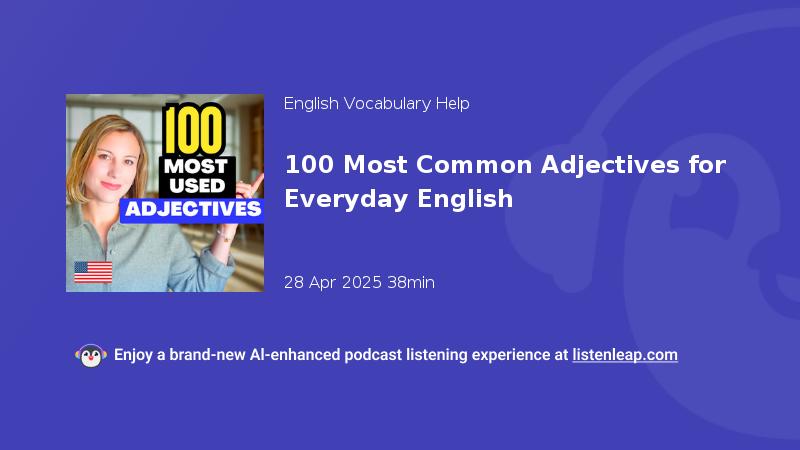
In today's lesson, I have a monster list of adjectives over a hundred that will help you replace your boring, simple adjectives. with either more formal ones or more native or more natural ones that we can just use in our everyday conversations.
If you want to learn more about this list, make sure to use the link below and visit English with Kayla.com.
I'm gonna go over each emotion or feeling or kind of what we're describing here.
And I'm gonna give you lots of different alternatives over 100.
So get ready, let's get started. Native English speakers say I'm happy, but we also have so many other ways to describe our happy feelings.
For instance, we say people are cheerful when they're in a good mood.
She's so cheerful. You're always so cheerful.
You're so cheerful today. Swings are in a very happy, good mood.
We generally use this term when we're just describing someone who's pretty positive in life all the time.
When we're talking about special events or even performances or songs or movies, we can use the word Joyful.
Joyful. full of joy. That was such a joyful song that we listened to.
You know, it just provided a lot of happy feelings.
So joyful is useful when we're describing special events that make us happy.
Another great adjective to describe someone who is generally always happy and pretty optimistic.
They're not always saying negative things.
They're usually seeing the best in everything. is we say that they are very upbeat, or we can say, I want to listen to some upbeat music, something more upbeat.
Upbeat means more happy, more optimistic, more like life is good when we listen to it. more calm word for saying someone is happy and satisfying is to say they are content.
Look how content they are. This means that they're happy, but they're not like joyful or crazy. reading their book or maybe a child's just very content playing with their toy.
It means they're happy, but they're just very calmly happy as well.
So maybe somebody asks you, are you bored?
Because I know I'm completely content. I'm just going to read a book and get some things done.
This means I'm happy I'm satisfied. I don't need anything else.
Now, when you want to say that you are very, very happy, I would say the best adjective to use is thrilled.
We were thrilled to hear the news. your excitement and happiness to someone else, especially when you're saying, you know, you did something good or I'm happy about what you did or I'm happy for you.
I'm thrilled. I'm thrilled to hear your good. news.
So it's a great way to express an extreme amount of happiness.
Yeah. We're going to transition from our happy phrases to our sad phrases, a way that we can describe either weather or mood as, you know, sad and dark.
It is gloomy. It's kind of a gloomy mood today.
The weather is just so gloomy. Typically, when we describe gloomy weather, you know, we're talking about...
Stormy, we're talking about cloudy, dark, no sunshine.
And when we say that it's gloomy out, it's typically seen as a negative thing.
Some people like... The cloudy weather, they like green storms.
But if you don't, you would say the weather is so gloomy today.
It's such gloomy news. It's bad. Nothing good's gonna happen when you describe it as gloomy.
A really casual way just to say that you're sad is to say that you're down.
I've been feeling down all week. Doesn't mean you're in a deep depression, but maybe you just haven't felt a lot of joy.
Maybe it's been gloomy weather. It's been so gloomy.
I've just felt down lately. Just not your normal, happy self.
Now, getting into some more extreme terms of first sadness, maybe you are heartbroken.
Maybe you are heartbroken from a relationship.
This is the most common way. to use this phrase if somebody breaks up with you after dating for a long time, maybe you are heartbroken.
Or maybe there was something that you really wanted, maybe you really wanted your favorite sports team to win the championship and they lose.
You can say, I'm heartbroken. It's something that I really wanted that I didn't get.
It makes you heartbroken. And finally, when you're feeling miserable, It can be really sad, or it can just mean you're really uncomfortable too.
If you're super sick, you can say, oh, I just feel miserable.
And when I feel miserable, I also feel sad.
So sad and uncomfortable kind of mixed together is miserable.
And we use this in extreme circumstances if we're very sad or very sick and uncomfortable.
As a miserable, miserable man. Let's talk about how we can show that we are annoyed.
First we can say that something is irritating. irritating, usually a sound or, you know, something loud is irritating.
Or sometimes it's just, you know, something over time gets annoying.
We say it's getting kind of irritating. This person is getting kind of irritating.
It means after being with them for a long time, they're starting to annoy you.
If someone is really loud all the time, typically we describe a loud person who just does things that aren't We don't find funny and just they do things to get a lot of attention.
We call them obnoxious, obnoxious. That is so obnoxious.
Or if there's a sound that's much louder than it needs to be, you could say my alarm clock is so obnoxious.
That means it's just loud and it doesn't actually need to be that loud or that brighter. you know, that attention getting frustrating.
We say that something is frustrating when it's kind of annoying us, but it's also Stopping our progress or stopping our work.
It's so frustrating when your computer freezes up.
So it's saying like it is annoying, but it's also just like.
It makes you angry because it's blocking your progress or it's not living up to your expectations.
He was obnoxious. You may encounter some stupid people.
I'm sorry to say it, but... The good thing is there's other ways to say stupid because stupid can just come off as plain rude.
So if you want to say that someone has kind of silly or careless behavior, you know they're not. doing something safe or they're, you know, acting like a child.
You can say, oh, that's so foolish. You're so foolish.
Or if you want to say, your own behavior wasn't very smart.
Maybe it was kind of careless. You weren't thinking very well.
I forgot my phone at home. I'm so foolish.
Or it was so foolish of me to make this decision.
It costs a lot of money. It just means, you know, it's kind of dumb.
It didn't have a lot of thought. You could have thought better if you did something that was foolish.
If you ever meet someone that seems like they don't know what's going on, they don't know, you know, what to do or they don't even know, you know, where they're at.
You can say they are so clueless. They are without a clue.
They're clueless. A lot of women say men are completely clueless when it comes to dating or romance, you know.
They just don't get it. They don't understand it at all.
They don't care about it enough. They're clueless.
So you need to be careful with this next adjective.
Sometimes instead of saying stupid, we say someone is slow.
And you always want to make sure that someone doesn't actually have like an intellectual disability that you're using this phrase with.
Because to be honest, that would be really rude and really just nasty to say.
But, you know, sometimes we need to describe people who... to us aren't very smart and it's irritating to us.
They're a little slow. They're not really catching on.
It means they're not thinking very quickly.
We describe them as slow. You know, it's kind of a kinder way than just saying straight up stupid.
I'm really slow when it comes to math. That means, you know, I don't get it very fast and probably not good at it or smart at it.
Another insulting way that we can say that someone is stupid.
We say they are brainless. They're so brainless.
This just means they don't have a brain, and obviously, again, like, you have to be careful with all of these words to cause someone stupid, because in any culture, in any language, it's rude, but here's just another way to say like, ah.
So brainless. I mean, so stupid. I was so brainless yesterday.
I forgot to do whatever it is. means, you know, it wasn't very smart.
I wasn't thinking. It's like, I didn't have a brain.
I was brainless. Okay, thank goodness. Let's move on from saying stupid.
Let's think of some ways to say Smart. So first, the way that someone is good at solving problems and they're very creative, we say they are very clever.
Oh, that was such a clever way to do this.
If someone was playing chess and they made a very good move, you could say that was a very clever move.
It means it was a really good way to solve a problem.
One way that I like to say that someone is smart, you know, they always make good decisions.
They know a lot about a topic. Oh, they're so sharp.
They're always very sharp means they're smart.
And a lot of times we use smart to mean that someone is very quick at thinking of the right answers.
Somebody who's smart and funny at the same time, they're making good jokes. because they're smart.
We call them witty, witty. It means smart and funny.
You make such witty jokes. They're smart and funny.
And then if you're in a formal way wanting to call someone smart, especially if someone is very knowledgeable on a certain topic, maybe their professor.
Maybe they're just an expert of some sort.
They could say, oh, they are just so brilliant.
It's a very, very. Formal and very like good way to call someone intelligent are smart.
They are so brilliant. I have a brilliant plan.
This is another way of saying it's a really good, really smart plan that's going to work.
Yes! Right, witty, attractive? Okay, now let's talk about how we can describe someone as goofy.
Goofy's kind of a weird word. because it doesn't directly translate to every language, and it doesn't just have a simple definition that's one thing.
Think about if someone is drunk, they're probably acting pretty goofy.
It's not normal, kind of clumsy, kind of It doesn't have to be drunk.
You could say, oh, I was being goofy while I was playing with my kids.
It means you're just acting not normal. So one way that we could say this is we could say someone that was acting silly.
And silly is playful or childish. So when I play with my kids, I do a silly voice, you know, when I'm playing. with their little stuffed animals or their little superheroes.
I make a silly voice to kind of make them laugh.
It's playful and it's for my children. If you want to tell someone, you know, start being serious because they're stopping so silly, dorky.
So dorky is a really informal word. It means someone is. kind of awkward, but you know, you love them at the same time.
Normally someone who's like, really into something like dinosaurs, you could say it's really dorky, or they have a passion that isn't necessarily very mainstream, like they're into comic books, you can say, it's kind of dorky, you know.
It's awkward, but they're very normal. They're very fun person.
They're dorky. Another word that's pretty similar to Dorky is quirky.
If you call someone quirky, it means they have a lot of strange interests, and they do a lot of weird things.
Maybe they even dress strange. Maybe they're wearing a bright blue tuxedo.
It's kind of quirky, but you know... They're fine.
It doesn't mean they're mean. It doesn't mean they're bad.
It just means they have an interesting sense of fashion.
They're maybe just have interesting interests, if that makes sense.
English speakers should be able to use is cocky.
If someone is cocky, it means they act like they are just the best person you'll ever meet.
They act like they're so good at everything.
Another word for cocky, cocky is really informal, is to be arrogant.
So again, if you're arrogant, you act like, you know, You just think you're the best person in the world.
They're so arrogant. I can't stand them.
Usually being arrogant or being cocky is seen as a very negative thing.
It's not the same as saying someone is confident.
It's like saying they're overly confident.
If someone has an arrogant attitude or a cocky attitude, they would be very difficult to work with. because they won't recognize when they make a mistake and they think they're just better than everyone.
Another term that we have that means pretty much the same thing. is they are full of themselves.
I mean, they're very just concerned about what they're doing and they don't think about others.
They are just so full of themselves. And then a way that we describe someone that who, you know, they look like they're really happy with what they just did.
Maybe they just did something kind of evil, but they seem kind of happy about it.
Or they get the answer right and, you know, they're looking like, I got the answer right.
We call that smug. They look so smug. Why do you look so smug over there?
It's like you're very happy with yourself, but it's not a positive thing at all to call someone smug.
You look so smug. Arrogant. Reckless. Now, if you want to describe someone as weird or strange, you might just use the noun, they're a weirdo.
It's not a nice thing to call someone a weirdo, but it's valid sometimes.
Another informal word we have for someone who is weird is we say, they're kind of an oddball.
They're an oddball. It's a noun, but it describes them as just being kind of strange.
And oddball isn't necessarily as rude as saying weirdo, but it's, you know, it can't...
It isn't necessarily the nicest thing either.
If you want to say that someone doesn't fit in, they could just say, oh, they're the oddball of the group.
Or, oh, you have this, you're the oddball.
It doesn't always have to be seen as so negative to say that somebody's the oddball or something is the oddball.
It just means it doesn't fit in with the rest of the group.
When I think of an artist, I think of a very eccentric person.
They do a lot of creative and different things.
Maybe they live in a house that's, you know, an interesting color.
Maybe it's bright purple. It's very eccentric.
It's like saying someone is unusual. But again, eccentric isn't always seen as a very negative thing.
If you are eccentric, it just might mean that you don't do things that are a part of the mainstream or just popular.
You do things that you like and that are very creative.
So it's kind of subjective if you call someone eccentric.
It's up to you if you think that that word describes them.
We'll be back. Let's talk about someone who is standoffish.
This is a very informal way of saying that someone is, you know, to themselves.
They like to be alone. I'm really standoffish.
I don't like to be around a lot of people.
Or maybe someone comes to a party, but they didn't seem to talk to a lot of people.
They didn't even really seem to be that comfortable with being there.
You could say, well, they're kind of standoffish at the party.
They were kind of standing off. Another word that we have for this is distant.
You can say they're really distant. That means a person isn't sharing a lot of their feelings or ideas about something.
You know, it's hard to connect with someone who's distant.
If you want to say that someone isn't very friendly or isn't very welcoming, you can say they were cold.
They're kind of cold in our conversation.
That means you got the impression that they didn't really want to talk to you and they didn't want to be friends or friendly at all.
They're very cold. And then if you want to just be simple and direct, you can say they were super unfriendly.
A lot of times we say, you know, dogs are unfriendly.
Like they don't want to be pet. They are actually just kind of dangerous.
They're unfriendly. A good way to say that someone is honest is to say they're truthful.
They're sincere or they're upfront. If someone is truthful, it means they're telling the truth.
That one's pretty straightforward. If someone's sincere, it means, like, you believe that they are actually being honest.
Like they're doing something sincerely, like they're trying to help.
I can tell they were sincerely trying to help.
They were being sincere when they tried to help.
It means like... They weren't doing it just to help themselves.
They were actually trying to be nice and helpful to you.
So being sincere is seen as a really positive.
If you say someone was direct and honest, you can use the word upfront.
They were really upfront. They did not lie.
They were upfront and telling me that they were going to be late.
It means they didn't try to lie. They didn't try to tell you the truth later.
They told you right away. They were upfront that they made a mistake.
So that means they told you they didn't try to lie.
They didn't try to cover it up. They were very direct.
So upfront is a really good adjective here that also means honest.
So our next adjective we're gonna look at is obsessed.
If someone is obsessed with something, we can sometimes say they have an unhealthy obsession or it can just be a normal obsession too.
They're really concentrated on it. They're really focused on it.
Maybe they don't think about a lot of other things.
Maybe they just really like it. If you say they're obsessed with this celebrity, It just means I really, really like them and they talk about them a lot and follow what they do.
Another word that we use for is fixated.
And fixated means you can't think about anything else except for whatever they're fixated on.
So I am fixated on becoming famous, not me, but somebody might be.
Like, all they can think about, all they can talk about.
Or maybe you say, I'm so fixated on this puzzle right now.
I mean, you can't focus on anything else because you just want to get it done.
Another way that we can say this is we're very consumed.
When something takes over our thoughts or takes over our time, we say, ah, we're so consumed by it right now.
I'm so... Consumed by work right now, or I'm so consumed by this movie right now.
It's like I can't do anything else except for this.
And then if you really like a new show or a new book or a new movie, so like any sort of media, you could say you're hooked.
I am hooked. on this show. I can't stop watching it or I'm hooked on this book like I can't stop reading it.
In the United States, a lot of people are like the game of pickleball.
They are hooked on pickleball. It means I really like it and it's now the main sport that they play.
Okay, another adjective we need to be careful with is saying someone is crazy.
Now crazy can be seen as like somebody actually having a mental condition or just being like they do a lot of weird things like they're really excited or.
You know, crazy can mean a lot of things.
So another way that we say that somebody is crazy, or we can say an animal is crazy, we say they are nuts.
It's like... It's humorous to say someone is nuts.
It's trying to be funny. You want to go skydiving?
You are nuts. That means... You have to be making a weird, crazy decision if you want to go skydiving.
You're nuts. If you want to say that something is kind of crazy and unpredictable, You might say it was wild.
The party last night was wild. If you go to a wild party, you know, there'd be people dancing everywhere, really loud music, ton of people.
Maybe even a light show, it would be a wild party.
It'd be very loud as well. And then if something is out of control, like children, for instance, instead of saying the children were crazy, Yeah, you can say they were out of control.
I mean, you could not manage them because they had so much energy or so much enthusiasm.
Are you guys nuts? And then a little bit. up from crazy if someone is psycho.
It's a negative way to say that like their mind doesn't make regular decision.
So again, it can literally mean someone has a mental condition, but oftentimes we're saying someone is psycho and more of a casual way just to mean like.
We don't know how they think. They think in really weird ways.
So if you have a friend and they're dog, like barks all the time and runs around and tears up the furniture, you could say their dog is psycho. cycle.
It just means they're crazy, but really crazy.
Another really new kind of slang word is we say someone is unhinged.
That was an unhinged decision. It just means crazy.
And this is used pretty informally at the slang term to say like crazy and.
They usually mean someone is acting in a very negative way, like they're just being too much.
They're unhinged. And finally, again, if you want to cut. suggests that somebody is not mentally sane.
We use the word deranged. They are so deranged.
It means they're crazy and they're making bad decisions.
They are deranged. Okay, we need some new ways to describe things.
So we're going to talk about when you're describing something as good.
You can say it's good. It's great, which is kind of a step up.
It's excellent, which is really good. And then two words I want to focus on are saying something is solid and dependable.
These words are kind of interchangeable.
If you say that something is very solid or dependable, it means you can always rely on it.
It's very trustworthy. Even if it's not like perfect, you can rely on it.
It's good. Excellent. Now when we're saying something is bad, we can say it's awful or terrible.
These would mean really bad. Like that music is terrible.
That music is awful. These are extreme ways of saying something is bad.
If you want to describe something that's more unpleasant, either in the smell or the taste, you say it's gross.
That is gross. Or maybe you just don't like snakes or spiders or things like that.
You could say, oh, those are so gross. It just gives you a bad feeling.
Maybe somebody eats leftovers out of the fridge that have been there for more than a week.
He could say, oh, that is so gross. You are going to get sick.
So maybe they taste okay, but they're not going to be good for your stomach.
They're going to have some bacteria and it is gross to you.
And then finally, if you just have a strong emotion that something is very bad, you can use the word horrible.
So for instance, if there's a car accident and people are hurt, you could say there was a horrible car accident.
This is a strong emotional word. Horrible.
A fresh start. Whatever it may be, Peloton is here to get you through life's biggest moments, with workouts the challenge and motivation that keeps you coming back.
Peloton's tread and all-access membership helps you set your targets, track your progress, and get stronger, making your fitness goals a reality.
Find your push. Find your power. Peloton.
Visit one peloton.com. At Capelli University, you can learn at your own pace with our FlexPath learning format.
Take one or two courses at a time and complete as many as you can in a 12-week billing session.
With FlexPath, you can even finish the bachelor's degree you started in 22 months for $20,000.
A different future is closer than you think.
With Capella University, learn more at Capella.edu, fastest 25% of students, cost varies by pace, transfer credits, and other factors.
Please apply. We're going to go with some adjectives that can say something is strange or weird.
So again, we're not really talking about people as much here as just describing things as strange or weird.
Sometimes if we just want to say, you know, we don't know why something happened or we weren't expecting for something to happen, we might just say with a neutral tone, oh, that's strange.
Oh, that's strange. I don't know why they didn't, you know, do a thing that they were supposed to.
Like, you're not like getting upset or anything.
You just, you need to figure out why it happened.
Oh, that's strange. I don't know why this didn't work.
That's strange. I don't know why you didn't get my text message.
It's very neutral to say something is strange.
It just means you need to figure it out or you don't know why.
Now, if you want to, you know... be a little bit more strong than just saying something is strange, you would say that's bizarre.
So you can use this in the same way, just you're saying it's stronger.
Like, oh, that's so bizarre. My phone isn't working.
So you don't know why your phone isn't working.
And you're really surprised that it's not working.
It's bizarre. Or if you see a movie and you didn't really understand the movie, you thought it was just, you know, kind of a strange story, but like, Things didn't make sense.
You could say that movie was so bizarre.
And then when something is a bit more rare or not typical, a more formal way to say strange or bizarre is just to say, oh, that's really unusual.
That's unusual. It's a bit more formal in this way if we say something is unusual.
It's unusual for it to snow in the middle of the spring.
It's bizarre, totally bizarre. A slightly more polite way of saying something is weird is to say it's odd.
Oh, those shoes are a little odd. Oh, that's a little bit odd.
That's a bit odd thing of to say, you know, it just is like a polite way to say strange.
If you don't want to be rude, but you want to say, you know, you're not really like sure about something, and it's strange to you because you've never been there before, you've never tasted it before, you could just say it's unfamiliar.
Oh, it's really unfamiliar. I haven't been here before.
So it just means you're not familiar with it.
You don't know a lot about it. I'm unfamiliar with that.
Instead of saying it's strange, you could say I'm unfamiliar with it.
And then a slang word that means strange. but it's a bit more polite, you know, is to say that something is off.
It was a little off instead of saying it was strange.
It just means like, It wasn't what I thought it was going to be.
My friend was a little off yesterday. That means maybe they weren't as... happy or as social as usual.
They're a little off, or if you, you know, didn't feel like yourself the day before, maybe you felt sad and depressed, you could say, ah, that was a little off yesterday.
It's a polite way of saying strange or sad or unusual.
Here are some other great ways as describing something as perfect.
You can say it's ideal, it's flawless, or it's spot on.
If you want to say that somebody has made the correct guess, and it's like a perfect guess, or they made a prediction about what was gonna happen, you could say their prediction was spot on.
If you want to describe a person's outfit as being perfect, you can say, oh, your outfit is flawless.
Or your music is flawless. Your answers are flawless. means they're perfect, there's no errors.
And then if you wanna say that something is specific in a certain scenario or it's specifically for a certain purpose, You can say it's ideal.
It is ideal to take a vacation in the middle of winter, or that's an ideal place to take a vacation.
It means it's a perfect place. If you want to say that something is flawed, you can of course say it's imperfect.
It's kind of imperfect. It's not a perfect solution.
It's pretty imperfect. You can say that something is faulty or broken.
If something is faulty, it means it does not work all of the time, or it just doesn't work perfectly.
Oftentimes when we buy something and it's really cheap, you might say, uh, it's kind of faulty.
Like it doesn't work. It doesn't work perfectly.
Finally, if we describe something as versatile or versatile, it means it works in a lot of different situations.
A lot of times, instead of saying versatile, we say it's flexible.
My schedule is flexible. It means it's very open.
I can make it work in different ways. I have a lot of time.
That's my own. I don't have to go to a job and be there.
Maybe I can work from home. I'm really flexible.
Or if you want to say, you know, oh, when do you want to go get dinner?
I'm flexible. This means like I can pretty much meet any time or I can make any time work.
A more formal way of saying that someone is flexible is to say they are adaptable.
It means they can work in a lot of different environments or under conditions of any sort.
And then if you want to say that somebody is versatile because they can do a lot of different things very well, We use all around there, all around a good worker.
I mean, they do a lot of different things very well.
Flexible hours. Now we're going to do some rapid fire ways that you can say pretty or beautiful.
So there's There's pretty, there's beautiful, attractive, or stunning.
And I would say stunning is the most extreme of these words here.
You know, if someone is incredibly beautiful.
They look beautiful, we say stunning, or if we're in a place with a beautiful view of a sunset, the stunning sunset, it's a stunning view.
You look beautiful. Beautiful. For ugly, we can say unattractive.
We don't find it attractive. We say it's unattractive.
You can say hideous to mean very ugly. Or if you want to say, you know, someone just looks very maybe tired, worn out, or messy, you could say up.
I look rough today or my car is rough. It's really dirty on the inside.
So it just means like overall kind of messy and just not looking good at the moment.
It's rough. Aren't you very unattractive?
When we're talking about a house being ugly, we can also use run down.
This just means like things are old and need to be repaired.
We can say it's shabby. Again, meaning just kind of old and.
Nothing looks new. If you say that something is dilapidated, it means it's completely falling apart.
The roof is dilapidated. It means the roof is falling off, basically.
And then when we're describing a house or a building or whatever it might be, we might want to say it's very smooth.
Ooh, that's a very smooth house. I mean, it's nice.
It's pretty. It's sleek. And when we want to say that something has a very modern and stylish design, using this word sleek is very, very useful.
Or you can even describe someone's outfit as sleek.
That outfit is so sleek. It just means it's very stylish.
It's on trend. It looks very clean. So another word to say that something is either shiny or just actually just looks very good, very clean.
Very well designed as we say it's polished right?
Alpha is so polished today or you can literally describe someone's presentation as polished or the way that they act or the way that they speak is very polished.
It means they don't make a lot of mistakes and they speak very well.
When we talk about being messy, we talk about being disorganized, we talk about being sloppy, making lots of mistakes.
We can also talk about being chaotic or cluttered.
When things are chaotic, it means there's no organization to it.
It's just whatever or cluttered means there's stuff everywhere.
You can't find a clean part of the table because there's so much junk everywhere if it's cluttered.
Most people do not like a house. Sloppy.
Sloppy. Let's talk about describing uncomfortable things.
The most common thing that American English speakers like myself say, when they feel uncomfortable about a situation, they just don't feel you know, very comfortable in a social situation as we say, it was awkward.
It was an awkward conversation. That means we just didn't feel that comfortable talking to the person.
We didn't connect with them very well. It was just awkward.
Another thing, if you feel like there's about to be an argument or some sort of conflict, we say it's kind of tense.
It was kind of a tense conversation. It felt like we were going to get into a fight.
You didn't get into a fight, but it felt like you were going to.
It was tense. Feelings were tense. Or if you feel like you can't trust someone just because of the way they're speaking, they're not saying anything directly, but you just feel like something is, you know? a reason to not trust them because it was kind of uneasy.
The conversation gave me an uneasy feeling.
Ugh, it was kind of uneasy about what he said.
Just feels off. It feels kind of awkward.
It feels like you can't trust the person.
Awkward. It is awkward. Let's talk about some ways that we can describe our reactions and our experiences.
If something is exciting, there are some better words that we can use in English to describe it.
We can say that something is thrilling. It was thrilling to go on the roller coaster.
It just means very exciting. You didn't know it was going to happen.
If you are at an event and you can feel the excitement around.
You could say it was electrifying, especially a sporting event where the audience is very excited about what's happening.
You could say the audience was electrifying.
The crowd was electrifying. It just means very exciting, full of energy.
And then if you get a feeling after doing something like, You're very proud of yourself, you're very excited, you're overjoyed, you can say you were exhilarated, or you could say something is exhilarating.
Hiking up this mountain was exhilarating.
Now some adjectives that are gonna mean the complete opposite here, we're talking about things that are boring, you can use dull.
Dull is kind of a polite way to say that something was boring and it was a bit dull. just means, you know, there wasn't a lot of exciting things happening.
My day was kind of dull, but that's okay.
If you want to describe someone with little emotion, you could say they were very flat.
It was kind of flat like there was no exciting emotions at all.
If you want to talk about a conversation or a performance flat is the way that you would describe it.
If there was no emotion and it was boring.
And finally, the most neutral way that we say something was boring, it's like not a negative way to say something was boring, it's just kind of like...
It was fine. We say it was uneventful. My day, it was uneventful.
It doesn't mean that it was boring in a bad way.
It just means like. nothing exciting or dramatic happened.
It was just as usual, uneventful. Okay, a great adjective in English to use is mind-blowing.
It's like, you can't believe it. It's so good.
You've never seen anything like it. Another way to say it was mind-blowing is to say it was astonishing.
If you see someone and you just can't believe how talented they are and you went to a concert, And you say, oh, her singing was astonishing.
Her singing was mind-blowing. These are very dramatic ways to complement how good it was.
You could also use the word unbelievable.
Her singing was unbelievable. It was so good that you almost couldn't believe it.
Or we can use unbelievable in a bad way too.
We could say, oh, the weather was unbelievable.
It was so bad. It was raining the whole time.
And then finally, if you want to describe something that was so impressive, that you don't even have words to describe it.
You could say it was jaw dropping, jaw dropping is like.
My jaw dropped, I'm speechless, it's so good.
This is astonishing! Okay, we need some more ways to say that something is awful. terrible growth.
So just things that make you feel disgusting.
Disgusting is the word. If you describe something as disgusting, it's very unpleasant, so like a smell was disgusting.
The taste was disgusting. Oftentimes when you're a kid and you have to take medicine, the taste is so bad.
You call it disgusting, disgusting. And then if you want to take it up a notch and say something is really disgusting, you can't even put it in your mouth or you can't even smell it or look at it.
You could say it is repulsive. The smell was repulsive.
It means really, really, really gross. And then oftentimes, if we say something is disgusting, we could say it's nasty.
Or if it's very dirty, you could say, oh, the bathroom was so nasty.
It just means very dirty. We didn't want to touch things in there.
There are some really great ways to say that things are complicated, complicated.
If things are complicated, they're hard to understand.
Or you could say, they're tricky, they're tricky.
When something requires a lot of skill or a lot of thought, you could say it's tricky.
The puzzle was tricky. You can say that something was complex instead of just saying, you know, it's a simple problem.
We say it's complex. Again, this means there's a lot of different parts to a problem that we have to solve.
And then finally, if you want to say that there are a lot of different things that you need to understand in order to solve a problem or understand something completely is you could say it's really layered or if a movie is very complicated you could say oh the plot was very layered there's a lot of things going on.
You stuck with me for a hundred adjectives and I am so...
I have a free PDF that you can download to learn even more with me that's linked in this lesson.
And if you want to learn more about these adjectives that were specifically in this lesson, make sure to visit Englishwithkaila.com.
I'll leave that link below as well. Check out another English lesson because I want to help you update your adjectives and idioms and just your natural everyday English.
I'll put two new lessons on screen. Thank you guys so much for watching and I'll see you in the next one.
Goodbye!