When we see the facial expressions, when we see the lips and the jaw movement, the brain is capable of making connections that are based not just on what you hear, but also what you see.
And when you make those connections, it's easier for you to understand.
You're listening to the Influency Podcast.
I'm Hadar, your host, a pronunciation expert, fluency coach, and a proud non -native speaker.
With over 16 years of experience teaching, I am here to share with you all my secrets on how to show up in English clearly, with confidence, and freedom.
On this podcast, I'll provide step -by -step strategies, lessons, stories, and practical tips to keep you inspired and motivated on your English journey.
Are you ready? Let's do it!
If you work in a global company or you're a part of a remote team, you know that using video calls is one of the best ways to stay on track and connect with your team.
However, However, as a non -native speaker of English, I bet that you have experienced the frustration of trying to understand the other side on Zoom, especially when the video is turned off.
Because first of all, understanding other speakers, whether they're native speakers or non -native speakers on a call and not in real life is immediately a little bit more challenging because the voice is not being delivered exactly like it would if you were in the same room.
Sometimes there's background noise.
Sometimes there's a lot going on.
So you have to invest more energy into understanding others.
Let's not forget to mention that you need to invest more energy into understanding other people if it's not in your first language.
That's even more so the case when you don't have someone's video.
Now I know that in corporate settings and in companies, people don't always like to turn on their videos.
Sometimes people will really resent it and don't want to turn on their videos.
I can tell you from a personal perspective, when I train people and when I teach people it's so important for me to see them and not just to hear them or to know that they're there because when I see them I can see their responses I feel like it's more it's more of an interaction and it's not just me
speaking and I believe it's so important just so you know if you're the type of person who likes to keep their camera off just know that it affects the interaction and the communication.
Having said that, sometimes it's not possible and that is also okay.
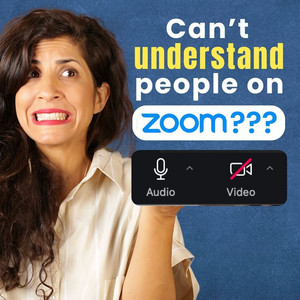
So, in this video, I wanted to give you some tips and strategies to help you understand the people on the other side on a Zoom call or Google Hangout or Teams, whatever it is that you're using in your company, when the camera is off so that you don't feel the disadvantage because you're a non -native
speaker. So, the first thing I want to talk about is why it's harder to understand people when you don't have a video.
So, like I said, the voice is not fully projected when it's delivered on a platform like Zoom or even your phone.
So, you need to invest more energy in understanding.
When you have a video, sometimes the way we analyze a language is not just by what we hear it's also by what we see.
So when we see the facial expressions, when we see the lips and the jaw movement, the brain is capable of making connections that are based not just on what you hear, but also what you see.
And when you make those connections, it's easier for you to understand.
That and also the human connection, and you feel like you're actually speaking to someone and you feel more engaged, that is also really helpful for you to understand others.
So this is why it's hard and it's a valid, valid reason.
So let's say you go into a meeting and you know that the people that you're going to be in the meeting with, they usually don't like to turn their camera on.
And let's say they're not your clients, but maybe your colleagues that you work with.
Maybe it's your manager or someone that you meet with regularly and you might feel comfortable sharing with them how you feel and what you need.
I really recommend for you to communicate your needs.
And ahead of time, say, hey, just so you know, I would appreciate it if we could have our cameras turned on for the meeting.
For me, it's a lot easier to understand and interact when I see the video as well.
So you can say something very, very simple, very appreciative.
Also saying something like, if that's not possible for you, I completely understand.
I just wanted to communicate that ahead of time.
If I were the one on the other side reading this and turning the camera on would not be a problem, I would be very, very happy to make it easier for the other person to connect with me and to understand me.
So I think there is no issue whatsoever if you're honest and open about it.
And whatever they choose to do is fine, but you know that you communicated your needs to create better circumstances for yourself in the meeting.
If people cannot turn their camera on, that's perfectly fine and you need to be respectful of their decision as long as you communicated what you needed.
That's it. That's all you can do.
And if that's the case, let me give you a few tips on how to manage it and how to improve your listening abilities when the video is turned off.
First, make sure that there is no background noise because that could be really distracting and that could prevent you from understanding the speaker.
Second, get a really good headset and make sure that it's connected when you listen to the person.
Third, leave time for clarification and ask the person to repeat themselves when needed, okay?
Don't be shy to ask someone to repeat and don't be afraid of asking someone to speak slower if needed because again, both of you in the meeting or whoever is in the meeting would like for it to be fully understood and well communicated, right?
And every person needs to do their best.
Another thing that you can do, you can turn on the captions.
Sometimes you have live captions on Zoom or other apps.
So that could be helpful if you see the words written while you listen to the other person.
Another thing that you can do is to record the meeting and then come back to it and listen to it again so that you can clarify things that were not clear.
This is a really good practice anyway.
So don't feel like you're doing all this extra work just because you know you couldn't see the other person it's okay.
It's treated like a listening exercise and doing that type of work will help you understand them in the future even more.
Now something that really helps me is to take notes so whenever the other person is saying I just write down keywords that I hear and I write notes or interpretation of things as I understand them and I write it on a piece of paper and then I come back to it and I fill in the gaps.
So even if you don't understand everything, everything, once you write down all the key words or the key topics that were discussed, it's going to make it easier for you.
And yes, like sometimes we need to work harder as non -native speakers, especially when communicating with native speakers who are not aware of this challenge.
But it doesn't mean that you can't do a really good job.
It doesn't mean that you're not good enough.
Okay? It is what it is and you just need to do something that will help you do your work, say what you need to say, ask the right questions and you know, just enjoy communicating, enjoy speaking.
Now if this is something that happens regularly, what you could do outside of the zoom call is really train yourself to listen to people without captions, without subtitles.
So radio, podcasts, just the audio of videos without looking at the video, and then just trying to understand different speakers, different rhythms, people speaking at different pace.
So you actually train yourself to listen to people without seeing them speaking.
Because again, that is a skill in and of itself and you can improve that and then when you go into a meeting without seeing someone or when you go into a phone conversation where you definitely cannot have a video in front of you then what you do outside of the conversation is going to be valuable and helpful
for you to succeed in the conversation once you're in it but if you don't do the work outside it's going to be really hard to succeed in those situations because then you're just like in this survival mode of just like, I just need to understand it right now and you can't improve when this is your only
experience listening to English without video or without seeing the person.
I'm going to link some more videos and resources in the description for you to use if you want to improve your listening in English and like I said, the most important thing is to communicate and enjoy and you need to do everything you can to make it possible for you and to enjoy communicating in English.
I hope this was helpful.
If you have any other questions or thoughts or experiences or stories that you'd like to share, please share them in the comments below.
If you're listening to this on the podcast, you can send me a message on Instagram.
I'm at hadar .accentsway.
All right, beautiful people have a great, great day and I will see you next week on zoom.
I mean in the next video, bye.