This is the Global News Podcast from the BBC World Service.
Hi, I'm Ankur Desai, and on Monday the 29th of December, these are our main stories.
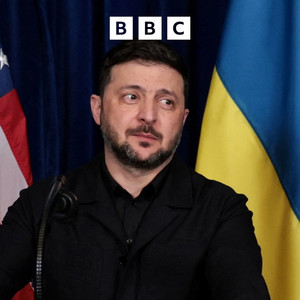
The president of Ukraine, Volodymyr Zelensky, says the United States has offered security guarantees against Russia lasting 15 years, but he would like them to last a lot longer.
Elsewhere, Taiwan has put its forces on high alert after China began a live-fire rehearsal of a blockade of the island.
And after these protests in India last week, India's Supreme Court stops the suspension of the life sentence given to a former regional BJP legislator for raping a 17-year-old girl.
Also coming up in this podcast.
We hear from the man who disarmed a gunman on Bondi Beach in Sydney after 15 people died when two men opened fire at a Hanukkah gathering at the famous beach location in mid-December.
And football superstar Cristiano Ronaldo is still enjoying playing.
He says, and he won't stop until he's scored a thousand career goals.
We begin with our top story and the ongoing efforts to find a peace deal between Russia and Ukraine.
The US says an agreement is getting a lot closer.
Moscow says negotiations are at a final stage.
And Ukraine's President Zelensky described recent meetings with Donald Trump as great.
So a lot of optimism then, but it doesn't seem to have reached the streets of Kiev just yet.
That's according to these Ukrainians.
Unfortunately, the talks won't have an effect.
They're good for the people to understand what's going on, but I don't think the war will end soon.
And yet we have to wait for the deal to be reached.
Even after a deal, Russia could attack Ukraine.
Trump is an unpredictable person.
He changes his mind as the wind blows, but we have very high hopes because we want the war to end.
My husband has been fighting for four years and I want peace and victory.
So just what are the sticking points?
Well, speaking a few hours ago, President Zelensky said the main unresolved issues in the 20-point peace plan were control over Ukraine's eastern Donbass region and the Russian-occupied Zaporizhzhia nuclear power plant.
He says he wants any plan to end the war with Russia to be signed by Ukraine Russia, Europe and the United States.
And he said it should be put to a referendum in Ukraine.
Well, our correspondent in Kyiv is Abdul Jalil Abdul Rasulov.
And he told me more about President Zelensky's comments.
He has outlined some of the details of what has come out from the meeting with Donald Trump.
President Zelensky says that the security guarantees have been 100 agreed and they're pretty much ready.
He says that the US offers those guarantees for 15 years and Kyiv wants them to be in place for much longer, for at least 30 years.
And President Zelensky says that Ukraine has been at war for nearly 15 years.
And if you look at the annexation of Crimea, which happened in 2014, that means Ukraine is effectively at war for 12 years.
And therefore Zelensky says that those security guarantees must be in place for a much longer period.
And there are some other details that he mentioned about these guarantees.
So there will be a monitoring mechanism.
And he mentioned that there will be presence of partners.
Does that mean boots on the ground?
It is not clear.
But earlier there were discussions about sending European military contingents to Ukraine as part of those security guarantees.
Now Moscow is adamant that any presence of foreign military troops on the territory of Ukraine will not be accepted and will be treated as a legal target by their forces.
But the main issue, the issue of the territory has not been resolved.
And that was the main objective for President Zelensky's meeting with Donald Trump.
And that issue hasn't been resolved because Russia does not want to have any, even a temporary ceasefire agreements to allow a referendum.
And the compromise that the US offered to resolve this issue of territory involves creation of this demilitarized zone or, as they called it, a free economic zone.
But in order to do that, Ukraine says they need a referendum, so that the people of Ukraine can decide.
But without a ceasefire, it will not be possible.
OK, so can the US president convince Vladimir Putin to compromise on a deal?
And Kremlin says they will be having a conversation soon.
The general impression here in Ukraine is that Donald Trump is too favorable to Russia, because those things that he said during the press conference yesterday were met here with a lot of skepticism, but also with anger frankly, because when he says that Russia wants Ukraine to succeed, or when he said that he understands why Russia is not willing to accept even a temporary ceasefire,
Of course, that was met with the confusion here in Ukraine.
And for many people here, it's a sign that Donald Trump is too favorable to Russia.
But that means he is not the person who can deliver peace in Ukraine.
Abdul Jalil Abdul Rasul of reporting from Kyiv.
It's a show of strength on a massive scale.
That was footage from Chinese state television showing missiles being fired and military aircraft taking off, as the government simulates a blockade of Taiwan.
You can hear the announcement of the drill's codename Justice Mission 2025.
Shi Yi from the Chinese People's Liberation Army said they were sending a stern warning to separatist forces.
Put simply, China says it owns the island.
The Taiwanese government disagrees.
The war games have come after the largest ever U.S. arms sales to Taiwan.
In a press conference, Taiwan's defence ministry described the war games as unacceptable, saying it had detected 89 Chinese military aircraft and 28 vessels near the island.
I spoke to our China correspondent Stephen McDonald for more details.
So what we have are these huge war games going on, and in the same way that they have in years gone by, it's all around Taiwan.
So we've got these five zones, we know there's five zones because maps have been released.
And what they're doing is practicing blockading Taiwan.
So I guess it's a practice of a precursor to an attack.
But then also, at some point, it would enable an invasion of Taiwan.
So this is also practicing for that attack.
Now, Taiwan has already been tense.
This comes two weeks after the US had its biggest ever arms sale to Taiwan.
And before that the Japanese prime minister said that she couldn't rule out Japanese involvement if the People's Liberation Army tried to take Taiwan by force.
Now, this was an answer to a hypothetical question, but nevertheless, it upset Beijing.
And so now it's kind of trying to, I guess, show its authority again by flexing its muscles in such a significant way with the Air Force, with the Navy, with the rocket force.
I suppose what the view is, is that it would deter others from getting involved.
What about the impact then on Taiwan and the Taiwanese response?
Well, you know, it's funny.
In Taiwan.
These drills for the average people there seem to be a bit like sort of water off a duck's back.
They're used to it now, and you might expect that it might drive them nuts.
I mean, for example, the government in Taiwan has said that this is going to affect commercial aviation, that it's not safe for commercial aviation.
Over the next two days, it might disrupt flights.
And you've got this propaganda from the People's Liberation Army, for example.
They've released these images in conjunction with the drills, with these shields which have got the Great Wall of China on them, with a message that anyone who confronts this shield, ie the People's Liberation Army, will be annihilated.
So blood-curdling threats.
And yet, I mean after years and years of this, of a combination of threats and statements from the Chinese government.
Most people in Taiwan, according to opinion polls, according to the election results we've seen they don't want to unify with mainland China.
They would prefer to have their independent judiciary, their free courts, their democratic elections.
And so, despite all the bluster from Beijing, it doesn't seem like it's had any impact in terms of convincing the vast majority of people in there that their lives would be better if they were to unify with mainland China.
What can we expect next in terms of either a retaliation or a response from either side, really?
Well, we've had the government in Taipei straightaway criticising these drills, saying that they're potentially in breach of international law because of the disruptions to commercial aviation.
In China, I think, again, for ordinary people, they're kind of used to these drills.
Now we've seen them.
And although they're getting bigger, it's kind of the same.
And then in a couple of days' time, when the shooting's over...
Things will go back to normal in inverted commas.
And yet it is increasing the pressure, though.
As I said earlier, there has been a lot of tension around the Taiwan issue.
And no doubt having big war games like this, it'll only increase that pressure.
Now to India, where a decision by the High Court in Delhi last week to suspend a life sentence given to a former regional BJP legislator for rape was met with big protests.
Kuldeep Sengar was sentenced to life in 2019 after being found guilty of luring the 17-year-old girl to his home and then attacking her.
Demonstrators outside Delhi's High Court voiced their anger over the turnaround.
Well, now the Supreme Court has stepped in to hold the suspension of the man's sentence.
Our South Asia specialist Ambarasan Ethirajan told me more about the case.
This was one of the high profile rape cases in India at that time, between 2017 and 2019, when the details started emerging.
So this former legislator, an MLA from Uttar Pradesh state, from the governing BJP party.
And he was convicted of raping a 17-year-old girl.
And later on, her family also went through very difficult times.
Her father was beaten by a group of men after she filed this complaint.
And then he died in custody while he was being held by police on a trumped-up charge.
And later on, she also met with a road accident in which two of her aunts got killed.
So this triggered outrage across the country how someone influential can behave this way.
And Kuldeep Singh Sengar, the former MLA, he was given a life term for this.
And also, he was given a tenure for culpable homicide and the subsequent case.
So when the Delhi High Court last week gave him bail and suspended his life sentence, that triggered outrage across the country.
How?
This was one of those cases which clearly saw what went wrong to this woman, how she and her family suffered.
And the court went through all the details and gave this verdict.
So that triggered the protest, which you heard a short while ago.
What was it put on hold in the first place then?
The high court judgment was about a technical detail about whether it is an aggravated assault.
And if someone like a public servant commits aggravated assault, then it qualifies for a stricter punishment.
Now, whether he can be called a public servant or not at that time, that was the technical detail.
The governing BJP in 2019 expelled him before the original verdict came.
It also shows how people can manipulate the judicial process or the system, and also how people in power can wield their influence.
And that is why this triggered such an outrage in India, like people have been protesting and in social media, everywhere people have been raising questions.
So the Supreme Court now says that it will look at, it will hear the case now.
Ambarasan Ethirajan reporting.
Next, Israel's announcement last week that it will formally recognise Somalia's breakaway region Somaliland as an independent state has been condemned by regional blocs and neighbouring countries.
The United Nations Security Council will gather later to debate the issue.
The question of Somaliland's independence from Somalia has long divided the region.
While the territory declared its sovereignty in the 1990s, it is not recognised by Mogadishu or any other world government apart from Israel.
Israel's decision sparked protests in Somalia's capital last night, with hundreds of people taken to the streets.
Protesters waved the light blue flag of Somalia and some people held posters saying Somalia will not be an alternative homeland to Palestine.
This is in reference to rumours that Israel plans to resettle Palestinians from Gaza in Somalia.
But in Somaliland this weekend people rejoiced in Israel's recognition of the territory in its self-declared capital of Har Hisa.
Here's Somalia's Minister of Information, Dawood Awais.
It was really unfortunate to see this declaration by Israel, which to us, is like an open or blatant attack against the sovereignty of the Federal Republic of Somalia.
And it is a decision that will put the region into a total chaos.
Somalia is one united country that cannot be divided.
And if there is anything to do with our internal affairs, we have our constitutional framework, we have our legal framework and we have our own mechanism.
That means that we will not allow any external factor to have any say into our own internal affairs.
So this was a blatant aggression or blatant attack. against the sovereignty of Somalia.
So that is how we describe the decision by the Israelis.
And it's not something that the Somali government and the people of Somalia will allow.
Well, what's the view in Somaliland?
Osman Dube used to represent Somaliland in the federal government in Mogadishu.
Somaliland got a new route, bilateral agreement or bilateral recognition.
And then the Israel, the state of Israel, become the first nation recognized Somaliland, which is a new era.
That means for Somaliland people, I think you have seen how they celebrate it, how they like it.
Because of 34 years, Somaliland people were seeking to get recognition.
And they were just so keen to get that one.
And the first nation become state of Israel.
That's why they become It's so joyful, extremely happy.
And it means everything.
Osman Dube speaking to the BBC.
Still to come on this podcast, we follow the bird poachers of Beijing.
Eventually, we hear footsteps.
He's there, he's there, he's there.
Go, go, go, he's there.
There?
Yeah, yeah, he's there.
Police across China have launched a three-year crackdown on the illegal trade in wild birds.
More than a year has passed since the ousting of Syria's longtime dictator, Bashar al-Assad.
But huge challenges remain for a country that has been shattered by almost 14 years of war.
During the conflict, about six million Syrians fled the country.
More than half a million have now returned home from neighboring Turkey.
It took in more than anyone else.
With the number of Syrians rising to 35 million at its peak, causing political tension and, on occasion, xenophobic attacks.
Syrians in Turkey have temporary protection, not refugee status, but President Erdogan has insisted no Syrian will ever be forced to leave.
The decision to return home or not is a complicated one, as our senior international correspondent, Ola Geren, reports from the Turkish border city of Gaziantep.
It's a cold, grey morning.
We're at the border, at a crossing into Syria.
I can see the hills of Syria just in front of me through the gates.
The people going through this border gate are going home to visit.
They have Turkish nationality so they can come and go.
Can I ask you to tell me your name and how long you've been here in Turkey?
My name is Mahmoud Sattouf and my wife is Suad Halal.
We are living in Turkey for about 14 years.
And we were very happy in Turkey because they are very good people.
Do you think you will go back to live in Syria?
We are going to return to our country because we love our country.
It is our country in general.
We say in English, east, west, home is best.
I'm standing by a stone wall in the shadow of an ancient castle which watches over Gaziantep.
I've come here to meet a 32-year-old Syrian woman, Aya Mustafa.
She fled here with her family from the Syrian city of Aleppo when she was just 18 years old.
Every hour, every day we spoke about this point.
We were talking about how we can return to Syria.
But it's still a big decision.
For me, for example, I have my grandmother with me.
I have one, my disabled sister.
And we are a big family.
Almost we are 10 members in the same house.
At least we need the basic needs, as electricity, water, work, to have our income.
Do you think a day will come when you can go back?
Sure, we believe that day will come soon, but it will take time.
I've just come into a small Syrian coffee shop.
Customers are starting to arrive for a morning coffee.
Mohammed is working here in the coffee shop.
He's 26 and he's been here since 2014.
Are you planning to go back to Syria, Mohammed?
No, up to now, because the situation here is not stable now.
So right now we are staying here.
The relatives who are there, or even the friends who come back, advise him not to come.
All along this street there are Syrian businesses selling everything from gold to spices.
Some of those who fled here have managed to make a living, but they've always faced a lot of restrictions.
Syrians are not supposed to move from the cities where they are first registered.
They need permission to do that.
It's always been hard to get a work permit.
Officially they are still free to remain here.
But people tell me beneath the surface there is pressure to make them go.
Ola Gerin reporting.
Now to a discovery that transports us back to the reign of King David I of Scotland.
He was on the throne in the first half of the 12th century.
And it was during his reign that the first coins being used in Scotland were actually minted in the country.
Prior to that time, they were made outside.
The earliest such coin has now been acquired by the National Museum of Scotland, prompting the headline Saved for the Nation After 900 Years.
It was actually discovered nearly two years ago by a metal detectorist in woods in central Scotland.
My colleague Julian Warwicker has been hearing more from a senior curator of medieval archaeology and history at National Museum Scotland, Dr Alice Blackwell.
This is a really tremendous discovery for Scotland and for our understanding of the early Scottish Kingdom.
It's the first coin struck within Scotland at a proper Scottish mint that's known to have survived.
So it was found by a metal detectorist about 10 miles south of Edinburgh.
And we were lucky enough to be allocated this really, really nationally significant object.
You, I'm told, have held it.
You've felt it.
What's this coin like?
I have, yeah.
Like coins of this period, it's a very thin silver disc.
Coins of this date were made by striking a thin flan of silver against a die with a hammer.
So it's very thin in order for the image to come across.
So it's very thin, it's very small, it's very beautiful.
It's slightly worn and a little bit bent, as is not surprising given its age.
Presumably it was buried in this one place where it was found for all of its lifespan, was it?
Yes, I mean, it shows a little bit of wear.
So I think the coin was probably used for a little bit.
It will have been struck in the late 1130s.
So it's really amongst the earliest Scottish coins produced.
And there's a little bit of wear, suggests it's been used a little bit before it was lost.
It was found by itself.
It wasn't found with any other objects or any other coins.
So it doesn't seem to have been deliberately buried.
It was probably just a simple casual stray loss.
And you can see the word Edinburgh on it, can you?
And you can see the image of the king of the day, David I?
That's right.
So on one side, there's an image of a portrait of King David and it names him.
And on the other side there's a cross-faced design and there's an inscription which reads Edinburgh, which is the name of the mint, and Erebald, which is the name of the moneyer, the person that was in charge of minting coins at that mint.
You mentioned the man with the metal detector.
He is now £15,000, the equivalent of $20,000 better off as a result of this discovery, isn't he?
That's right.
So the system in Scotland means that anything of any historical or archaeological interest or value can be claimed in order to be saved for the nation.
Finders are paid a reward to the tune of the market value of whatever the object is.
And this is a very rare early Scottish coin, but a unique example of this type.
So it's not surprising that it had a very high valuation.
Next we're on the trail of bird poachers in Beijing.
Police across China are cracking down on the illegal wild bird trade in a bid to bring back songbirds to the skies above the country.
Around the world, birds migrate to warmer climates for winter.
But in China, poachers mount deadly nets on bamboo poles to catch and sell the birds for profit.
Around half of all wild birds caught in China are endangered species.
A China correspondent, Laura Bicker, followed dedicated conservationists who patrol the fields of Beijing during the peak bird migration season.
Silva Gu's eyes scan the horizon for any signs of life in the darkness as we drive towards a large stretch of grassland.
Tonight, like most during the winter migration season, he's hunting the bird poachers of Beijing.
In the skies above us, millions of birds are migrating south for winter.
October in China is the equivalent of rush hour as they head to Australia, New Zealand or even Africa.
As well as navigating through storms and evading predators, they must also avoid the poachers' nets.
OK, where are they?
He's been working with the police, so the police have been nearby in the hope that they would catch the poachers.
Eventually, we hear footsteps.
He's there, he's there, he's there, run.
Go, go, go, he's there.
Yeah, yeah, he's there.
Silva, who's in his 30s, fit and slim, chases the poacher for around two kilometres before calling the police.
He tells them not to move and searches him.
He finds dozens of videos of small birds on the poacher's phone.
They would sell for hundreds of dollars, more than many farmers make in a month.
He was targeting the Siberian ruby-throat and blue-throat.
This is the season for them.
They fetch high prices.
But today, he was unlucky.
China is home to more than 1,500 different bird species, about 13% of the global total.
And although there are wildlife laws in place, Silva told us, the fines to punish poachers do not outweigh the financial benefits of catching and selling the birds.
He believes many of the poachers and buyers don't even understand why this is a crime.
They lack ecological awareness, like how many birds die because of the poaching and the impact it has on bird populations.
Once adults' values are formed, they're really hard to change.
Maybe they can't be changed in a lifetime.
On a long low wall alongside the Liangshui River in Beijing, a trader in an old military-style uniform sucks on his long wooden pipe.
He has several small cages with tiny birds twittering away inside.
Keeping beautiful songbirds is a tradition dating back centuries in China, a symbol of elegance and wealth that some older households still cling to.
But as dealers try to sell the birds in a nearby park, the police turn up.
It's part of a countrywide crackdown on wildlife crime.
Silva is encouraged, but he hopes for a more sweeping generational change in China.
As more years pass and more young people's awareness improves, and if everyone works together, I think there is hope.
I just love them.
I want to protect them.
He's determined to continue patrolling each night to try to free caged birds and bring their song back to the skies above the city.
Laura Becker reporting.
The man who disarmed a gunman on Bondi Beach in Sydney has said his only thought was trying to stop more innocent people from dying.
Fifteen people died when two men opened fire at a Hanukkah gathering at the famous beach location in mid-December.
The attack could have cost more lives if not for the actions of Ahmed Al Ahmed, a Sydney shop owner, born and raised in Syria.
He managed to tackle one of the gunmen from behind, wrestling a long-arm gun from him.
He was shot several times in the shoulder and has required at least three operations.
He's been speaking to the BBC's US partner CBS News.
Mr Al-Akhmed explained how he felt at the time.
My target was just to take the gun from him and to stop him from killing me a human being's life and not killing innocent people.
I know I saved lots of people's lives, innocent kids and women and all this, and men.
I know I saved lots, but I feel sorry still for the lost.
I jumped in his back, hit him.
And hold him with my right hand and start saying to warn him, drop your gun.
Stop doing what you're doing.
And it's come all in fast.
And emotionally, I'm doing something.
I feel something, a power in my body, my brain.
And you want to see people crying, killed in front of me.
I don't want to see blood, i don't want to hear he's gone.
I don't want to see people screaming and bugging.
You know, asking help help, and that's my soul asked me to do that and everything in my heart and my brain, everything it's worth, you know, just to manage and to save the people.
Life To the world of football or soccer.
And there are a few people who haven't heard of Cristiano Ronaldo, the Portuguese superstar who, at the age of 40, is still defying the years and still scoring goals.
In the face of continued speculation about when he'll hang up his boots, he said that he's still enjoying playing and won't stop until he's scored a thousand professional goals and is not far off that magical milestone, as Alice Adderley reports.
The former Manchester United and Real Madrid star, who now plays for a Saudi Arabian side.
Al Nasser, has faced regular questions about his retirement.
In July, he signed a new two-year deal with the club, taking him to beyond his 42nd birthday.
But in November he said he planned to retire soon and that next year's World Cup in America, Mexico and Canada would be his last.
But at the Globe Soccer Awards in Dubai on Sunday, where he won best Middle East player for the second time, he said his passion for the game remained undimmed.
I want to carry on.
You know what my goal is.
I want to win more trophies and I want to reach the number that you all know.
And I will reach that number for sure, if no injuries, inshallah.
And...
And it's great.
So thank you very much.
Have a good night and happy new year.
Ronaldo has scored 956 goals in his career so far and has achieved 13 goals in 14 appearances this season for Al Nasser, who are four points clear at the top of the Saudi Pro League table.
As he said, provided he doesn't get injured, his target looks entirely achievable.
And that's all from us for now, but there will be a new edition of the Global News Podcast later.
If you want to comment on this episode or the topics covered in it, you can send us an email.
The address is globalpodcast at bbccouk and you can also find us on X at BBC World Service and you can use the hashtag Global News Pod.
This edition was mixed by Chris Hansen and the producer was Adrian White.
The editor is Karen Martin and I'm Ankur Desai.
Until next time, goodbye.