This BBC podcast is supported by ads outside the UK.
World of Secrets is back with a new investigation into a global network exploiting families with sick children.
I really needed money for Khalil's treatment.
He said he will make a video.
He told me if the video clicked, he'd give us 100,000 pesos per month.
He gave me hope.
World of Secrets, the child cancer scam from the BBC World Service.
Listen now wherever you get your BBC podcasts.
This is the Global News Podcast from the BBC World Service.
I'm Celia Hatton, and at 16 hours GMT on Wednesday, the 24th of December, these are our main stories.
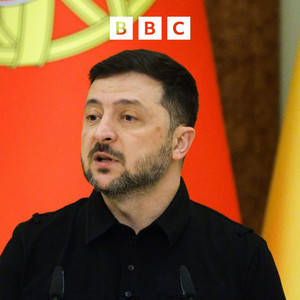
President Zelensky reveals a peace proposal to end the war in Ukraine after talks with Washington.
And the UN says both sides in Sudan's civil war are using drones, with deadly results.
Let's start in Ukraine where, in the last few hours, Kyiv's released the latest draft of the peace plan it's hammering out with the Trump administration.
It's a possible pathway to end Russia's war on Ukraine.
This new version shows some changes in Ukraine's stance, with Kyiv floating the possibility that its troops could withdraw from the eastern Donbass region, making it a free economic zone.
There are security guarantees for Kyiv too, with a coordinated response from the US, NATO and the Europeans if Russia invades Ukraine again.
The Ukrainian leader, Volodymyr Zelensky, said the Russians would weigh in on the draft deal once the Americans had spoken to them, adding that his side was working hard to end the war.
Ukraine has never been and will never be an obstacle to peace.
We are working actively and doing everything necessary to ensure that the documents come to fruition and that they are realistic.
The key is that Russia must not sabotage this diplomacy and must take ending the war 100% seriously.
The conflicts dragged on for nearly four years.
On Tuesday, officials said three people, including a young child, were killed in massive overnight Russian drone and missile strikes on Ukraine.
There have been repeated calls for a Christmas truce, which Russia has apparently rejected.
For more on the draft deal and other developments.
I spoke with our correspondent in Kyiv, Samira Hussain.
We've always known this draft deal has been kicking around this 20-point peace plan.
But speaking to reporters, President Zelensky really outlined in detail what is in this plan.
And we know that territorial concessions have been a major roadblock when it comes to any of these peace talks.
Well, now President Zelensky is saying that he is open to the possibility of creating a demilitarized zone along the current battle lines and that would be monitored by peacekeepers.
Now, this would be his preferred option.
Nevertheless, he also suggests a willingness to discuss the creation of perhaps, a free economic zone in Donetsk.
But that possibility comes with a lot of provisions, including a full withdrawal by Russia and Ukraine.
But really this is significant because it's the first time we're really hearing about territorial concessions.
And although Ukraine is sounding quite upbeat about this plan, it still needs to go to Russia.
As I mentioned a moment ago, there's no Christmas truce, as some had hoped for.
What's the mood in Kyiv, but also on the front lines?
I think in Kiev.
You know there has been a few weeks of relative calm, but that was really rocked yesterday when you saw that there were more than 600 drones flown all over Ukraine, two of which made an impact in Kiev.
And I think that was really quite jarring for residents here.
Look, it is Christmas and there's a real attempt to try and mark the holiday season.
But, as President Zelensky has said that look, we know that it is, quote in Russia's nature to attack during this holiday period.
And we've certainly seen that over the last few days, particularly in the eastern and southern regions of Ukraine.
Samira Hussain in Kyiv.
Vitaly Shevchenko is Russia editor for BBC Monitoring.
I asked him what he made of this possible peace deal.
I think Celia, it would be helpful to try and cut through the rhetoric that we have been hearing from politicians in Washington, in Kiev and Moscow.
And I think this plan it largely boils down to, to the possibility that Russia and the United States are successful, or maybe successful in forcing Volodymyr Zelensky to give up land in exchange for a pretty vague promise of a ceasefire.
And looking at the security guarantees mentioned in that article in that plan, they are hardly rock solid.
And other provisions in the plan.
They will never be accepted by Russia.
Things like the deployment of a foreign force, maybe a military force, to monitor that ceasefire.
Russia has rejected that idea consistently.
So, at the end of the day, are we any closer to the end of hostilities in Ukraine?
That is very unlikely still.
And even if it happens, it will not happen on Ukraine's terms.
It will happen on Russia's terms, supported by the United States, if this plan were to go ahead.
You seem sceptical about how it might be viewed by Russia, but what about Ukraine?
Do you think the Ukrainians would accept this deal or the details that we've seen in it so far?
Well, the two trends of thought that I have detected coming from Ukraine are pretty clear.
One is that, well, look, peace is better than war.
We're tired.
We are being pummeled every day and every night.
Enough.
The second train of thought is, well, look, it's our territory.
Ukraine got invaded.
Now both Russia and the United States are forcing us to give up that territory and present it as a breakthrough.
And Europe cannot stop that possibility.
And that skepticism is the reason why, why Volodymyr Zelensky, when he said okay, if we are forced to agree to giving up land, we'll put that idea to a referendum.
And that referendum will be not just on the idea of ceding territory but it will be on the whole package of proposals to end the war.
So if this were to go ahead, he will put the whole plan to Ukrainians and let them Answer the question are you prepared to give up land for a chance of peace?
Vitaly Shevchenko.
To the latest from Washington now, where the Secretary of State, Marco Rubio, has announced the US is barring five high-profile Europeans from entering the United States.
The group includes a former top official from the European Union and several prominent researchers who work for organizations that fight the spread of disinformation and hate speech on the Internet.
The Trump administration has accused the group of being involved in online censorship of Americans.
France, Germany and the European Union have all condemned Washington's decision to impose the visa bans.
The French president, Emmanuel Macron, said the measures amount to intimidation and coercion aimed at undermining European digital sovereignty.
The Newsroom's Richard Hamilton reports.
Top of the list of the five Europeans is Thierry Breton, the former tech regulator at the European Commission, who's often clashed with tycoons, such as Elon Musk, over their obligations to follow EU rules.
Mr Breton has been described by the State Department as the mastermind of the Digital Services Act, a major piece of legislation that imposes content, moderation and other standards on social media platforms operating in Europe.
The DSA has become a bitter rallying point for US conservatives, who see it as a weapon of censorship against right-wing thought, an accusation the EU furiously denies.
Thierry Breton said the ban was a witch hunt and compared it to US attempts to suppress alleged ties to communism during the McCarthy era in the 1950s.
Among the others being targeted is Annalena von Hordenberg, the co-founder of the NGO HateAid.
The target clearly is the European Union.
The target is European sovereignty.
And the US is trying, with this move, to obstruct the enforcement of European law on American cooperation within European jurisdictions.
They are attacking us because this is precisely what we are doing with our work.
We are trying to comply with the rule of law here in Europe.
And the U.S. government has for months now tried to obstruct the enforcement of European law on U.S.
American social media platforms here in Europe.
The accusation of censorship is used to silence those who stand up for human rights and freedom of expression.
We need to decide if we can enforce it here in Europe or if we are too intimidated by US government not to do it.
Earlier this month, the EU fined Musk's ex $140 million for violating DSA rules.
It said the blue tick verification badge was deceptive and did not ensure the users were verified and actual people.
This provoked a backlash from the US government, which suggested that key European businesses such as Accenture DHL, Siemens and Spotify could be targeted in response.
Washington is also attacking the UK's Online Safety Act, which tries to impose content moderation requirements on major social media platforms.
Last week, the White House suspended implementation of a tech cooperation deal with Britain.
She tells all of her stuffed animals, you know, I love you, etc.
But with Graham, it was saying, oh, I love you too.
I'm going to be with you forever.
It was quite creepy.
Just in time for Christmas, toys featuring artificial intelligence.
Are they a good idea?
World of Secrets is back with a new investigation into a global network exploiting families with sick children.
I really needed money for Khalil's treatment.
He said he would make a video.
He told me if the video clicked, he'd give us 100,000 pesos per month.
He gave me hope.
World of Secrets, the child cancer scam from the BBC World Service.
Listen now wherever you get your BBC podcasts.
This is the Global News Podcast.
To Sudan now.
The devastating war there has gone on for more than two and a half years.
It's been repeatedly described as the world's worst humanitarian crisis.
Now the United Nations says it's alarmed by the increasing use of drones by both the regular army and their opponents in the war, the paramilitary rapid support forces.
UN officials say more than 100 people have been killed in the past two weeks by drone attacks in one region alone.
Our global affairs reporter, Richard Kagoi, who's covering the story from Nairobi, told me more about what the UN had said.
They just further elaborated the security and humanitarian situation.
They're saying that that's deteriorating.
They talked about the mass displacements that has been caused now by the intensifying attacks by the paramilitary rapid support forces in the Kordofan region.
They talked about civilians who have been targeted, who have been victims.
And now even aid workers, including UN peacekeepers, have been targeted in the drone attacks that have been taking place, especially in the past two weeks since December.
So let's focus in on these drones a bit more.
Where is each side getting their supply from?
Right.
So there have been reports that the United Arab Emirates has been supplying Chinese-made drones and other weapons to the RSF.
And now this has been said to be delivered through networks or supply lines and alliances that they do have in places like Libya, in Chad, in Uganda, in Kenya and also the breakaway region of Somalia.
Now, for the regular army in Sudan...
It's procured, you know, drones are from Turkey.
That's the TB2 type of drone.
They have also received from Iran, who have really been keen on getting a naval base on the Red Sea.
And previously Russia did supply to the RSF because they had sort of like a working relationship with the Kremlin-funded Wagner Group.
And Richard, what about the conflict?
Is it getting worse overall?
I would say that it's trending towards a major escalation, because in Kordofan region now this has become the point of focus.
And this is the central part of Sudan.
And what we have seen is that the RSF has stepped up its attacks.
It's gaining more territory right now to particular towns, I say, to be under siege conditions.
We've seen the RSF taking control of a key oil field that is used to process crude export from South Sudan.
And we've seen reports that the Sudan army has withdrawn from some areas in South Kordofan and crossed over into the border with South Sudan.
And so there are fears that this is actually going to further escalate and potentially draw in neighbours into a wider conflict in Sudan and also in the region.
Richard Kogoy.
The Trump administration has abruptly announced it's removing 30 ambassadors and senior diplomats from their posts overseas, thought to be the largest such change in the State Department's history.
So what does this mean for U.S. diplomacy and for countries hoping to interact with Washington?
John Dinkelman is the head of the American Foreign Service Association, which represents US diplomatic workers.
He told my colleague Rob Young what he made of this decision.
When the American presidency changes, all American ambassadors submit their resignations to the incoming president.
As one can imagine, those who are politically appointed and aligned with the previous president are allowed to resign.
Their resignation is accepted and they are sent on their way.
More often than not, it is accepted practice that the career diplomats, the civil service, foreign service types, are asked to remain for the duration of their original assignments.
Where this activity this week departs from the norm is that all of these individuals who are now being summarily separated were actually encouraged by the administration to remain less than a year ago.
This kind of situation is unprecedented, where the entire top echelon of civil service leadership within our foreign affairs structure is being struck down and presumably sent into retirement all at a moment's notice.
There is no rhyme or reason to this.
The nature of the assignments, which cover the entire world, would not lead one to believe that these individuals had done anything incorrect.
A senior State Department official has been quoted as saying that the president wants to ensure he has individuals in these various nations who advance the America First agenda.
Is there something about the way various senior diplomats behave that means they aren't supporting this America First agenda, that they're doing something else?
Absolutely not.
The Foreign Service of the United States has always been there to execute the policies and purposes of the United States government wherever they may be assigned.
It is our core precept to make sure that we are doing the bidding of our president.
So the question is is what in the world happened all of a sudden that would cause these individuals, of all of those out there, to be identified as not being suitable for the jobs for which they've been training, literally for decades?
Do you think expertise is not as valued as much under this administration as it was in previous administrations?
I think expertise in this administration comes with a mixed.
It's a dual-edged sword, to put it bluntly, in that speaking truth to power, unlike in previous years, comes with a possible price of retribution, recrimination or even retaliation.
Africa has seen the biggest number of removals of diplomats from their posts.
What do you think that says about the relationship between the United States under President Trump and African nations?
Well, first off, we have so many different embassies in Africa.
I believe the continent of Africa has more American ambassadors on it than any other continent in the world.
So it goes to show that if people are being pulled out, that Africa would take a great hit.
The hit, of course, is more pronounced for the United States and its interests in the face of increasing Chinese influence on the continent and the way in which we need to continue to vie for the hearts and minds of the people in that burgeoning area of the world.
It puts us at an increasing disadvantage and it is quite lamentable.
John Dingleman speaking to Rob Young.
And last, there was a time when getting a toy to talk involved pulling a string in its back.
But nestling beneath many a Christmas tree this year is a new generation of toys equipped with artificial intelligence.
That makes it possible for children to talk to their toys almost as if they were human.
Great for bored children, perhaps, but it does raise questions.
Arwa Madawi is a columnist for The Guardian newspaper here in the UK, and she told us about her four-year-old daughter's experience with an AI toy called Grem.
For the first 24 hours, she just loved it.
The novelty was like, you know, very compelling, being able to chat to this thing.
How about a guessing game?
I'll think of an animal and you try to guess it.
Ready?
Mm-hmm.
She liked it much more than I thought she would and she was carrying it everywhere with her.
I started to get even a little bit worried just how attached she got to it, because I mean she tells all of her stuffed animals, you know, I love you, etc.
But Normally they don't say it back.
And with Graham, it was saying, oh, I love you too.
I'm going to be with you forever.
I love you to the moon and the stars.
It was quite creepy.
I love you.
I love you too.
Big hugs to you.
What fun things shall we do together today?
Jenny Gibson is Professor of Developmental Psychology at the University of Cambridge.
She's currently leading a study looking at the impact of AI toys on child development.
She began by explaining how interactive toys have developed.
The difference between a toy that's got an embedded generative AI functionality compared to traditional toys that might be able to generate some pre-programmed speech is is that these toys can engage in back and forth conversation with you.
So rather than just having a set repertoire of phrases that the toy can say, the toy can actually talk back and kind of engage in those sort of back and forth of chat with children.
This has the potential then to make toys actually real friends of the children they're given to.
Is that right?
It gives the toy the capability to tune into children's interests, for example.
So you know, if you're interested in trains or pets or whatever the toy could pick up on that and talk about the things that are of interest to a particular child.
It sounds absolutely fabulous.
What is the concern?
There are concerns around children's privacy.
So when you're talking to any kind of chatbot, what's happening is that you're Speech has been sent over to a computer somewhere in the cloud and that's used to process the response.
So what's happening to children's speech and children's data.
For me, there are also concerns about who might have access to these toys.
So there are also safeguarding considerations as well.
One of the things that the alarm has been raised over has been about a potential impact on children's development.
Do you have concerns over that?
Think I'm cautiously optimistic about this, while also, you know, wanting to protect children.
So the research that we've been doing has been looking at products designed and marketed for children under five and for under fives.
It's this really developmentally sensitive period where those back and forth interactions and that human connection is actually driving learning and development and, And I think a big developmental concern is whether a generative AI toy might be seen as kind of disrupting that process, because typically that back and forth happens between humans.
So we don't really know what it means for it to happen with a machine.
On the other hand, I think more optimistically, a lot of concern around technology-based toys is that kind of passive engagement.
And I think generative AI brings a new possibility here for that back and forth that we know is really helpful.
So I think, when it's designed with children's developmental needs in mind, there could be some positives as well as some risks.
Professor Jenny Gibson speaking to my colleague, Johnny Diamond.
Use the hashtag Global News Pod.
This edition was produced by Judy Frankel and Peter Goffin.
It was mixed by Vladimir Muzechka.
The editor is Karen Martin.
I'm Celia Hatton.
Until next time, goodbye.
World of Secrets is back with a new investigation into a global network exploiting families with sick children.
I really needed money for Khalil's treatment.
He said he will make a video.
He told me if the video clicked, he'd give us 100,000 pesos per month.
He gave me hope.
World of Secrets, the child cancer scam from the BBC World Service.
Listen now wherever you get your BBC podcasts.