Compassion is not something you do for other people.
That's a great side effect.
Compassion is something you do for yourself.
It changes the way you function and show up in the world.
So the best selling author and host the number one health and wellness podcast on purpose with Jay Shetty.
Hey everyone, welcome back to the number one health podcast in the world.
Thanks to each and every one of you that come back every week to listen, learn and grow.
And you know that I love introducing you to thinkers leaders, people who can inspire you to change your daily habits and make shifts, small shifts that make big differences in your daily lives.
Now, today I'm talking to a guest who's already been on the podcast before.
He's a favorite here.
I know you enjoy listening to him.
And some of the videos that we've done together when I've been speaking on his platform and he's been here, have gone absolutely viral.
So I know you're excited for this one.
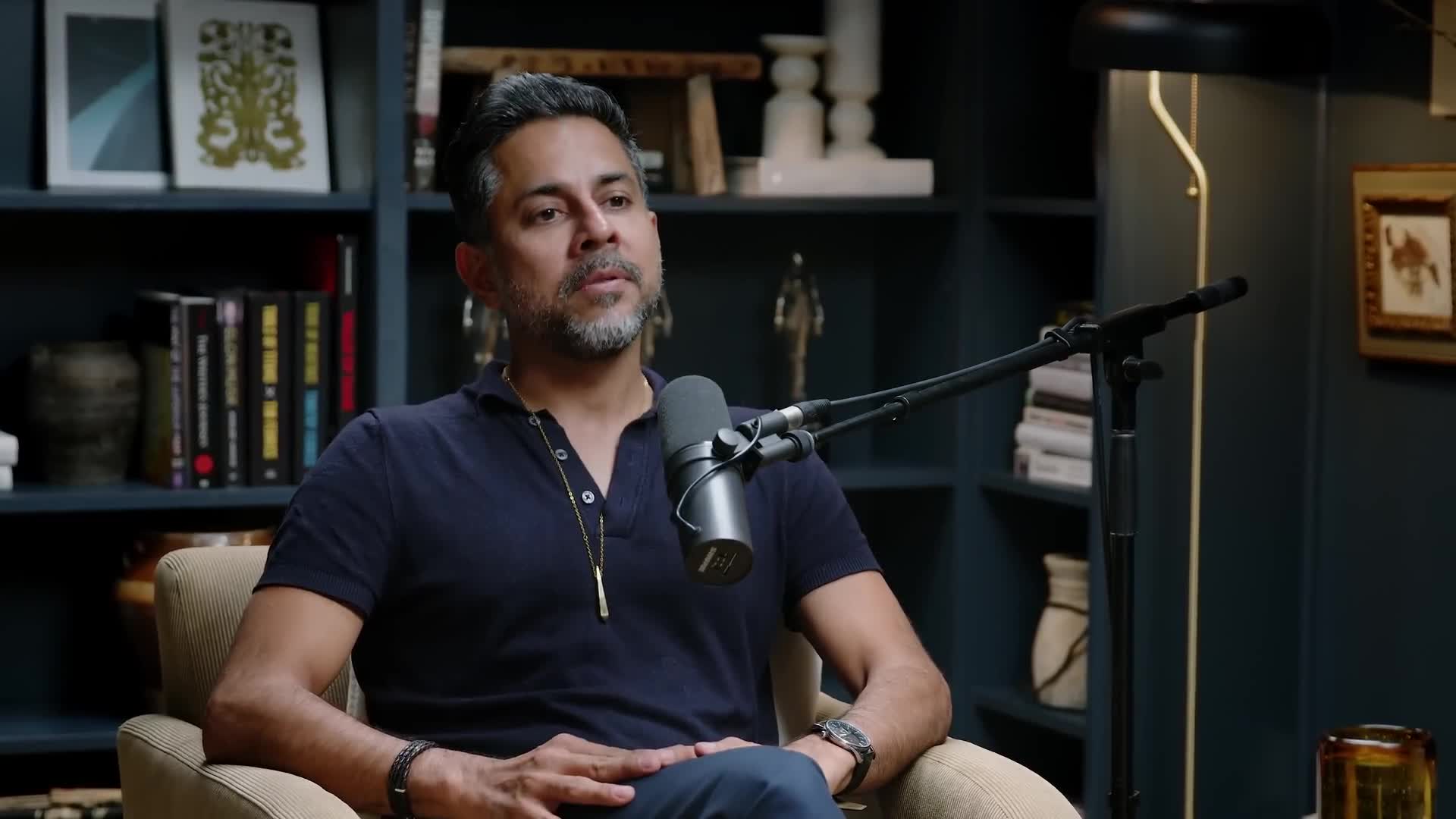
I'm talking about the one and only Vishen Lakhiani.
Now, Vishen created Mindvalley, one of the world's most powerful life transformation platforms.
That now has a following of 20 million people across 195 countries.
And today we're talking about his brand new book called The Six Phase Meditation Method.
And for those of you who want to know how much I love and endorse this book and this human, I have a testimonial right on the back of the book.
This book is a practice.
It's not just a book that you'll read.
It's not just a book that will sit on your shelf.
It's a book that you will actually implement that will shift the way you think about meditation and the way you think.
Welcome to the podcast, Vishen Lakhiani.
Vishen.
Thank you, Jay.
Such an honor to be back here.
I love the new podcast setup.
I love your new place.
This is amazing.
I love seeing you grow and grow and grow.
Well, it's such an honor because I've had so much fun with you at multiple Mindvalley events, whether we were in Italy Sardinia, whether we were in LA, where we did so many events together.
I mean, I think the community that you've cultivated at Mindvalley is so special.
Yeah.
And the people there are so special.
And whenever I'm there, I feel so much love.
I feel so much joy, genuine sincerity to grow, and my community here loves you too, and can i can?
I appreciate you for one thing, and many people don't know this about you, and maybe you don't know this about you as well, but when i first met you in 2018 in sardinia, you were speaking at one of my events.
I was not on Instagram.
I was not on social media at all.
I felt I was too old.
I didn't know.
I felt imposter syndrome.
I felt I don't know anything.
I felt I'm too old.
And you were the person who convinced me to get on Instagram.
I didn't know that.
You didn't know that.
But before then, I used Instagram just to share.
I used Instagram as a gratitude wall.
I would share pictures of things I was grateful for, never for an audience.
And you showed me that it was possible.
My Instagram blew up.
It's now like 800,000 people at Vision.
And now I use it to curate this community and to talk about my discoveries and personal growth.
But you were the person who inspired me to get on.
Oh, thank you, man.
I had no idea.
That's beautiful.
I'm happier for the world that you did get on.
My first inspirational Instagram post happened one week after we spoke.
And you don't even remember this, but we spoke over dinner.
Yeah, I remember.
I've remembered all our meetings.
But I think what you've done with Mindvalley, what you've done with your work has been incredible.
Today I want to dive into parts of this book, but I want to dive into it with your experience, because
I think everyone can remember or has a distinct memory of their first meditation experience.
What was your first meditation experience ever?
Do you remember it?
Like the first time you were ever introduced to any form of meditation?
So the first time it happened to me, I was 14 years old.
I was a young kid in Malaysia and I decided to try a form of meditation that I learned from a book called The Silva Method, a really old 1960s, 1970s book.
Back then, I was 14, so it must have been like 1990.
There was no internet in Malaysia.
We had four television channels.
So, really to pass the time by, all I did was I would browse all of the books in my father's bookshelf.
And I discovered this book called The Silver Method.
Now, the book captivated me because it spoke about how the mind can heal the body.
What was happening to me back then is I was having a really horrible skin problem.
My face was covered in acne.
I had very little confidence.
I considered myself ugly.
I had difficulty making friends at school.
Even if I liked a girl, I had no confidence to even talk to her.
And so when I read in this book that the mind can heal the skin, I was game on.
I want to figure this out.
So I tried practicing.
Nothing happened.
I continued practicing.
Nothing happened.
And there was very little results.
But I read and reread and reread that book over and over and over and over again.
Then I started picking other books from Bob Proctor, from Wayne Dyer.
I started reading these books.
It became a passion.
And slowly, things began to click and one day, applying the silver method at this point i was 17 years old things had finally started clicking.
I began to understand.
It's not just about hoping and wanting your skin to heal.
There was a process, there was a method, there was a psychology.
When it clicked, in five weeks i completely healed my skin.
Five years of skin disease healed in five weeks.
Today, science talk about this as a thing.
It's called psychodermatology how your mind influences your skin.
But that was my first evidence that we can use our minds to influence our bodies.
Now, the next thing I did was I decided to see, can I use my mind to accomplish a really big goal?
For me, that was qualifying for the US Open Taekwondo Championships.
Taekwondo is Korean karate.
I was really into it.
And I managed to qualify my first ever trip to the United States, which was my dream land.
Since I was like a kid, I wanted to go to America.
My first ever trip was to the U.S.
Open to represent my country.
It was in Colorado Springs in 1993.
My first time I fell in love with America, but it became because I visualized that in my mind.
And that was my beginning, the beginning of my fascination with the human mind that would later lead to me starting Mindvalley and writing this book.
That's amazing.
I love that story for so many reasons.
A, because, well, let me just break this down for everyone.
You had an intention that was very clear.
Even if it was to save your skin or to impress a girl, or whatever it was, you were clear of why you wanted to meditate.
The second thing was you were happy to read the book again and again and again.
And I think that takes a lot of resilience, because most of us, when we try something once and it doesn't work, we give up.
And the third thing is you didn't just test on something small.
Once you saw a small result, you were like, well, does this apply to something bigger?
And I think those three lessons in and of themselves are so powerful.
What has changed in the benefits to you of meditation today?
At that time, it was solving your skin.
It was getting focused around the taekwondo championships.
How do you view meditation?
Like, what is its use in your life today?
Because I feel like so many people keep telling us to meditate.
And there's so many benefits, but for you personally, what's the reason?
So I grew up in a Hindu family in Malaysia.
Meditation was never what I was thought.
The style of Hinduism I was thought was very dogmatic.
You had prayers, you had chants, you had mantras.
And I found it, oh God, so boring and irritating.
I hated being dragged to temple to listen to a priest speak in Sanskrit, a language I didn't even understand.
So when I was 19, I gave up Hinduism.
I decided the religion was not for me.
I read a quote by Gandhi that said I'm a Hindu and I'm a Muslim and I'm a Christian and I'm a Jew and I'm a Buddhist.
And I thought, that's it.
I want to study and unite ideas from all of these different spiritual practices.
And so that was my beginning.
I got obsessed with spirituality.
I started reading books by Esther Hicks, by Neil Donald Walsh, and I became particularly captivated by the spirituality that was emerging from the United States, from everyone, from Paramahansa Yogananda, who was an Indian who crossed over over here, to Neil Donald Walsh, to especially Jose Silva.
Now, a lot of them spoke about spirituality.
What made Jose Silva's work different was that he broke it down into actionable steps.
And that's what fascinated me most.
So a lot of people spoke about meditation, about sitting still, about going within.
Jose Silva would teach the method.
You're going to do this method to reduce your brainwave frequency to the alpha level.
This method to get it down to the theta level.
This method of positioning your eyes to activate alpha frequency in your brain.
This method to reprogram your subconscious.
This method to manifest a goal.
This method to do healing.
And that structured approach captivated me.
Now, we call that active meditation.
That's the word Jose Silva used.
Osho used the same word, active meditation.
This means it's different from passive meditation, which was more the meditation from Hinduism, from Eastern cultures, where you focus on your breath or you go within.
And there's a usefulness in that.
But what I loved about active meditation is in the words of Jose Silva You use it to solve problems.
You do not push your problems away.
You turn your problems into a project.
You have skin disease?
You're going to heal it.
You need to achieve a business goal?
You're going to make it happen.
And you would apply different tools to solve these problems.
Now, when I was in Silicon Valley, I applied the Silva method and it completely transformed my career.
I was able to hold down two jobs.
I got promotion after promotion after promotion.
At the age of 26, I was vice president of a boomingcom and I was meditating using the Silva method and other practices I would combine with it.
And one day I certainly had a calling.
I realized that meditation was the most powerful thing I'd learned in life.
It was the reason why I was successful at my career.
Yet, my university degree, for which I paid almost a quarter million dollars for, taught me jack.
It wasn't really helping me.
So I decided I wanted to do something that could help the world.
I decided to quit and become a meditation teacher.
Now, as I started becoming a meditation teacher, as I started compiling all of these methods, I needed something for myself.
And I look at meditation as a tool.
So a lot of people say, all right, meditation is a form of self-awareness, of prayer.
Yes, yes, yes.
But meditation is also a tool.
The point of meditation, in the words of the great teacher Emily Fletcher, is not to get good at meditation.
It is to get good at life.
And so I use two different types of tools.
Now, let's think about our home.
We have coffee makers and we have electric drills.
We use a coffee maker every single day or a tea kettle every single day to put ourselves in a good state to start our morning.
An electric drill is a power tool.
You don't use it every day.
You use it when you have a problem, when you have to drill a hole in a wall or threaten someone.
I guess
So in meditation, the style that I teach, there are two types.
You would use a power tool like the Silva Method, which now sits on Mindvalley, for a really tactical problem.
For example, healing, right?
The Silva Method has been proven by Dr O Carl Simonton as a very effective form of imagery therapy for accelerating healing.
You're sick, you want to do it.
If you are suddenly feeling like you have a migraine, you want to use it to help reduce your migraine.
The sixth phase is what I developed as, not the electric drill, but the coffee maker, something you use every single day.
Even if your life is amazing, you use it every single day because it helps put you in a peak state for work, for happiness, for human connection.
And it puts you in this beautiful state where it almost feels as if the universe has your back.
Like you have you know, the Tinkerbell fairy following you around, blessing everything you do and making your life magical.
This is how I view meditation.
It's an active approach to tackle the most complex problems in life, but also as a daily approach, to put you in peak states of humanness.
This is why I love talking to you, because I love that explanation.
And I think that that breakdown of how meditation can be used differently for different challenges is fantastic.
And I love the analogy with the tea kettle.
We'll go with and the drill, because I do think you're right that we've made meditation.
What you just said is about becoming good at meditation, which is absolutely irrelevant to life.
And with the six phase method.
What I love about it is that you have the same thing that you loved about how the silver method taught it.
You've figured out your own method that people can take.
Now in this book, when you talk about this is where I want to get into some of this and everyone who's watching and listening back at home or wherever you are.
I'm only going to be giving you a tip of the iceberg, but I want to give you this insight because my hope and goal and intention is that you will go and order the book right now, while we're having this conversation, to really dive deep into it.
But I want to give you just enough to recognize how practical it is.
So you talk about how we need to start with the circle of love and compassion.
When I hear the word compassion and I think when a lot of people do compassion feels like a tall order because I feel like it's been removed.
I think before compassion, we think of criticism.
We think of complaining.
We think of comparing.
Those are more natural thoughts.
Can you talk to me about how you had this epiphany that compassion was a beginning, when often our beginning place is criticism, complaining or comparison?
So compassion is not something you do for other people.
That's a great side effect.
Compassion is something you do for yourself.
It changes the way you function and show up in the world.
So there's a lot of science right now on compassion practices that derive from zen roshi, buddhism or even from the hartman institute, For example.
The HeartMed Institute found that if you just close your eyes and you see the face of someone you love, you see their eyes, you see their nose.
You feel that love for them.
You feel it in your heart area.
It changes your heart resonance.
And your heart resonance is a biomarker of health.
In short, giving love to someone else instantly physiologically changes the quality heartbeat that you're having and puts it in a better state that shows that your body is in a healthy mode.
Heart resonance correlates with health.
And I found this fascinating.
That is how we start the sixth phase.
Then we move to a more advanced compassion practice where we extend love across the world.
We start with our family, our neighborhood, our city, our country, and then globally.
Now, why is this important?
Compassion is like a muscle.
You can train it.
And when you train it, you become more loving.
If you think about all the great saints and sages and mystic compassion and love was a key part of who they are.
Whether it's Yogananda or Jesus, it was compassion and love.
But this is how it shows up in your world, right?
So i remember after the pandemic i went for breakfast with a friend.
All the restaurants had been closed for three months and finally that weekend everything opens, and so we are waiting in line for around 20 40 minutes to get in.
Finally we get in.
It's really busy, so they can only see this at the bar and all i'm craving is coffee, eggs and some and a side of avocado.
So i order my coffee and 20 minutes later the waitress hasn't brought the coffee.
The waitress is carrying around.
There's a lot of people over there, she's wearing a mask And she left the coffee on the bar and I can see it.
And it's 20 minutes.
I can't get her attention.
Finally, she brings me the coffee, just puts it down, doesn't even say anything.
And it's gone cold.
So I have to order another coffee.
That other coffee comes 10 minutes later.
Then my omelet comes 40 minutes later.
They forgot the avocado and all of this chaos.
Now, at the end of that, As I was tipping the waitress, I still had a smile on my face and I gave a tip worth 50 of the entire bill.
So my friend looked at me and goes, what are you doing?
Like, the service here was horrible.
She doesn't deserve 50%.
And I said, really?
Well, I thought she did.
And I explained it to my friend yesterday.
I said, look, it's all how we see it.
To me, I'm just happy to be here, to be able to eat outdoors again.
It doesn't matter we had to wait 20 minutes in line.
It was just nice being able to step into a restaurant after three months.
That waitress, she's been running around with a mask on herself for, gosh, maybe 12 hours.
Look at the line.
She's not even getting a break.
And probably for the last three months, she didn't have a job.
She was probably worried about how to put food on the table.
And that's why I gave her a 50% tip.
I don't care if my coffee was cold or my avocado came late.
That didn't even register for me.
Rather, I was in a state of appreciation, of love, of awe at the humanity around me, even if it was a little bit messy.
Compassion had put me in that zone.
When you see someone else, even if it seems like what they did is wrong to you, you look at them with a sense of empathy, with a sense of understanding.
And it is that understanding that changes and reframes your definition of the world.
So I'm not saying do compassion so you become a better tipper.
I'm saying do compassion, because the world becomes a more beautiful alive, connected place and your life becomes more peaceful.
Now, the side effect is everyone you come in contact with, you bring happiness into their lives.
And the world needs that today.
What I love about that example is that it shows something in a personal way that we all experience.
And it's so fascinating because I've been experimenting with something similar in a professional setting.
So a lot of people would say oh yeah, you can do that with a waiter or a waitress at a store, but then what about someone in your workplace?
And I realized that if you go... hard on people and people experience this.
I think we've all had experience of it.
We've all had bosses who are hard on us.
And I found that when my bosses were hard with me, it closed me off.
It didn't open me up.
Whereas if someone checked in with me and said, Hey Jay, you look like you're struggling a bit.
Is everything okay at home?
Like, is your family okay?
Like, how are things going?
You don't have to tell me, but if you feel like telling me, let me know.
That allowed me to have a safe space and want to deliver more for that person, as opposed to if that person came up to me and goes.
I'm not really happy with your performance right now.
Like hearing that from someone didn't open someone up.
And so even your same approach in a professional setting still works and applies that when you approach someone, or someone approaches you and just says hey, I can tell that you're dealing with a few issues or something must be going on.
Do you feel like telling me?
I think that compassion is such a superpower and it's so underestimated.
Where did we lose that?
Where did we go wrong?
I think we underestimate it because for the longest time in society we thought kindness is associated with weakness.
Strength, power, even to put power over someone else was a sign of strength.
But today we know that's not true.
There was a Gallup study done on 10 million employees.
And they found that the employees who loved their jobs more, who were most engaged, who were most productive, who had one of the highest correlations with revenue growth answered yes to the following question.
My supervisor or someone at work cared about me as a person.
And that's compassion.
Now, I remember a funny story about you, Jay.
Yeah, please.
About me?
Yeah, yeah, yeah.
That shows how compassionate you are.
So I want to share this with the audience.
We were having dinner at Mindvalley's festival, A-Fest.
This was that festival in Ibiza.
And you disappeared to use the restroom.
Oh, yeah.
And then we never saw you for two hours.
So imagine you're having dinner with someone.
There are about six people in the dinner table.
And that person goes, I have to go use the restroom.
Two hours later, he hasn't come back.
And so you're thinking, gosh, what a jerk.
If he was bought by my company, he should have just said, Vishen, I'm going to go to sleep.
He had to make that restroom excuse.
So I was mildly annoyed by you.
And then I realized what happened.
Jay went to use the restroom.
And as you were coming out of the restroom, one by one, people were coming out to take photos with you or ask you for advice.
And you stood there for almost two hours talking to everyone, taking photos, giving them the advice they needed.
And then you were so tired, you went to sleep.
That's compassion.
And see, you may have done that almost just organically, but I never forget that.
And that put you at hero status in my mind.
No, well, I honestly have to say it's because you attract the best people.
The culture and community of the quality of individual that comes to Mindvalley events is really special.
And I know so many A-Festers in my personal life as well, like Erwin, who's one of my closest friends, Erwin Valencia E And it's like he's been an A.
I think.
He's like I don't know how many A-Fests he's been to, maybe like nine or something.
I don't know.
He's been to a lot.
I think he's the health director for the New York Knicks.
Yeah, absolutely.
Absolutely.
He's the director of training and conditioning at the Knicks.
And it's just like, he's the embodiment of everything we're talking about in a beautiful way.
And I think I did that because of the quality of the people you attract.
But I appreciate you remembering these things.
Obviously, meditation gives you a good memory too.
So I say that because compassion today, kindness is the ultimate flex.
I remember 15 years ago when people wanted to sell you stuff on the internet.
Do this to make money, do this to build a business.
They would post with their Lamborghini or their car.
Today, nobody gives a damn.
Today, the stuff that we share on Instagram are very often inspirational stories people doing kind acts, people saving animals, people doing great things for kids.
Compassion is the flex in today's society.
What is the difference between a technique and a pure intention?
In the sense of we know each other well and I know that you've meditated for God knows how many years now and I know how much study you've done and how many incredible people use this method, like so many celebrities and athletes use this method.
What have you found to be the difference between someone who uses compassion as a technique to get what they want or to present themselves a certain way, versus what is the difference in result and practice in someone who's doing it from a pure place?
I'm just fascinated.
Absolutely.
Okay.
So the technique is not compassion.
The technique is the circle of compassion, which is the specific exercise we do, inspired by Zen Roshi, Buddhism and the HeartMath Institute, to expand and open your heart.
So that is the technique.
The compassion itself is a quality of being.
So the sixth phase is six specific techniques that layer on top of each other, that open up six different aspects of your being which I believe are really important for you to show up in the world not just as a good human being, but to crush it at work to hit your goals, to get things done, and to do it from this state of just absolute bliss and equanimity.
The point is you're making is that you can't even use compassion for lower means or lower requirements, because that's not compassion.
That's fake kindness, right?
You're doing something to get something.
But the technique that we are doing actually trains your brain to understand how deeply connected you are.
If you do this, you automatically become nicer.
So yeah, you're talking about the actual change in consciousness and like transforming your character, as opposed to like what we're saying, like I'm talking about marketing versus meaning, like the idea of like oh, I can market this stuff versus this actually makes sense.
There was one thing specific I wanted to ask you.
You talk about happiness and gratitude.
I wanted to ask you your take on after all these years.
You've helped so many teachers share their work.
You've helped so many.
That's one of the most special things about you.
That I appreciate about you is that you're not just presenting what you know.
You're supporting the work of so many other incredible people.
And you've supported mine too.
You've supported me too in such a deep and beautiful way.
And what I'm intrigued by though is, out of all the reading you've done, all the studying you've done, what is happiness?
Is happiness in your eyes still a goal?
Is it a pursuit?
Is it a byproduct?
What is happiness?
Because I feel like we still don't know.
We still hear people talking about, I just want to be happy.
Well, my goal is to be happy.
What's Vishen's take on that?
So happiness is not the goal at all.
In fact, happiness is not even what we care about.
What we're looking at is a concept called blisscipline.
Blisscipline is not being happy.
It's not forcing yourself to be happy.
Look, I am a person who can be prone to depression.
It's actually in my DNA, right?
You can measure these things now with DNA.
And I've been in depression in my life.
I'm also a person who is prone to melancholy.
Melancholy is when I want to, when it typically happens when it's raining.
I want to sit by the fire, listen to sad music and just be by myself.
And I like that.
I'm not happy.
Neither am I sad or depressed.
I'm just melancholy.
And it's a beautiful feeling.
And we all feel that sometimes.
If you've ever seen the Pixar movie Inside Out, it shows that sadness can be a superpower.
You can be sad when you miss someone.
You can be sad when you're grieving.
There's a beautiful quote from the Disney show WandaVision.
What is grief but love persisting?
The goal isn't to push away sadness.
Rather, the goal is this, is to remember this.
When we are showing up with people, when we are showing up at work, the thing that matters is the concept of discipline.
And that is having the discipline to ensure that you are nurturing your positive emotions.
Now, positive emotions doesn't mean you're fake happy.
Positive emotions mean that even if you're sad, you can observe it.
Like I love that quote, what is grief but love persisting?
Because if you're grieving someone, that's a beautiful emotion.
You can grieve someone who has left your life, but you're not beating yourself out of it.
So you're still in a way blissful.
Now, why is this important?
There's a study called PQ.
And there's a book about it by Shijat Shamin.
And PQ means positivity quotient.
It's your ratio of Good thoughts versus overall thoughts.
Now what they find is that the higher your PQ, the better you function at your job.
The better you function at your work.
We spend 70% of our waking hours on our work.
And so if we can practice discipline and elevate our PQ, we get more done.
We are happier as we work.
The quality of our work is better.
But you know, the studies on PQ fascinate me.
They found that the number one thing that determines how well a team functions is their PQ is what is the ratio of positive emotions within the team and between the members of this team?
And so if we can train for blisscipline, if we can put ourselves in these blissful states, we simply do better.
Now, one of the most beautiful things I read was in the book Titan.
It's the biography of John D. Rockefeller.
He was the richest man who ever lived.
And at the age of 83, John D Rockefeller wrote a beautiful poem that illustrates this idea of discipline.
He said, I was early thought to work as well as play.
My life has been one long happy holiday, full of work, full of play.
And I left the worry along the way and God was good to me every day.
And that's really what we're talking about.
Now, the richest man in the world could pen that.
Imagine what this quality, what this essence can do for you.
It's amazing, isn't it, how what we read or what we think about become the scripts of our life.
And I feel just as you're quoting people that have inspired you.
I feel like, for me, half the thoughts in my head are things I've absorbed and held onto that then create my story and my script.
I didn't know what you just said about you.
That's actually such interesting news to me.
I don't think we've ever spoken about that.
I loved how you talked about how melancholy isn't happiness or isn't sadness, but you enjoy that feeling.
I feel the same way about solitude, of spending time alone.
Like I often look forward to spending time alone.
I try and make time to spend alone.
I'll often choose being alone as opposed to doing something else.
And that's not because I'm happy or ecstatic about it or I'm not sad about it.
It just brings me joy.
But what I didn't know about you was this bend you said towards depression or depressive thoughts.
And I want to go there.
What has been the most depressing state that you've been in, that the six-phase meditation method and other methods that you practice and even teach today have helped you out of.
What has been that point?
So first you got to understand phase one compassion, phase two gratitude, phase three, forgiveness.
All of these qualities have been scientifically proven to lower risk of depression and lower situations where you're feeling anxious or panicked.
But I have gone through depression in my life.
I have gone moments where I was profoundly sad.
That hasn't happened much in the past decade or so.
And part of the reason is because of the sick space.
But it doesn't mean that I don't get sad.
All of us are going to go through troubles in life.
I miss people.
Yesterday I was sad because it was my son's birthday.
He turned 15 and I couldn't be with him because I was doing a big event in LA and my son lives in Estonia, in Europe.
And there's nothing wrong with being sad about that.
Right.
But through that sadness I left him.
I think one of the most beautiful voicemails I've ever left my son about how much I love him.
So you can channel sadness into love, into compassion, into vulnerability and help you connect with yourself and other people.
Yeah, how do you stop sadness from developing into guilt?
Because I find that you could have easily gone the other way.
You could have been like, all right, I'm sad that I'm not with my son on my birthday.
I'm a terrible dad, which I know you're not, but you could say I'm a terrible dad, and people do feel this way.
I'm a terrible dad.
I care more about my work by my actions than I do about my son.
Someone could, I'm saying could think of this story.
They could think I should have flown back.
I should have been there.
So these are the things that I hear from parents all the time.
Exactly right.
So this past four weeks, I'm on a four week book tour right now.
This is the longest I've been away from my kids.
So I get that.
And I've never been traveled this much away from them because of that guilt.
But I realized that was silly.
I know that I'm deeply connected to my children.
I've learned since then that it's not about being with them all the time.
It's about when you're with them, how do you feel with them and how do you make them feel?
But how do I overcome that guilt?
Well, that's where phase three comes in.
Guilt is one of the lowest human emotions, guilt and shame.
From a consciousness vibration point of view, if you look at the Hawking scale right at the bottom guilt and shame.
You don't want to get there.
Phase three is about healing from guilt and shame.
So when you practice forgiveness and in the sixth phase we teach you a eight step forgiveness protocol that you stick right in.
You forgive yourself for mistakes you've made in the past.
You forgive yourself for things that you may feel shameful for or guilty for.
But you also learn to heal and forgive the acts of others.
It turns out, if you want to develop the brainwave of a monk, so they've actually measured the brainwave states of monks and you're a monk.
So I bet you fall there as well.
So monks have high left right brain coherence.
That means your left and right brain are kind of vibing at the same level and high alpha amplitude.
So they found this in Zen Roshi monks who have spent 20 to 40 years in meditation.
So at the BioCybernaut Institute in Vancouver, where they mapped the brainwave states of monks, they found that these were the two qualities that you want to create.
But how do you get that?
Well, forgiveness.
Forgiveness, and forgiving people who hurt you, as well as forgiving mistakes that you made in the past, is the number one hack to get you in that level.
This is why forgiveness is phase three, because I've seen miracles happen through the practice of forgiveness.
Forgiveness has been proven to not just improve back pain, increase your heart health, improve the quality of your sleep, reduce depression and anxiousness.
A study showed that it improves your vertical jump.
Another study in Israel showed that it improves your endurance.
And for people who believe in manifesting, it's quite possible, because I've heard this from many spiritual teachers it increases your rate of manifesting.
That's why forgiveness is phase three.
Because I practice forgiveness in a very rapid way every day, so each phase takes about two minutes of practice.
I don't experience guilt.
I don't experience shame.
It doesn't mean I've never made mistakes.
I just don't beat myself up over it, because you understand that we're all humans.
I love that principle and I'd say that that applies to marriage, that applies to work, it applies to ourselves.
That idea.
I always talk about how one of the things that's helped me and my wife massively in our marriage is that we're both wired to forgive overnight.
And I have never met many, I'm like that with 99% of people I meet.
I've been like that for a long time, but my wife's like that too.
And that's really helped, because then I don't wake up in the morning and look at her and go oh God, she's still judging me for the mistake I made last night.
We've both moved on.
And so mirroring that habit is really powerful.
But the two ends of the spectrum are narcissism of letting go of all mistakes, which I know.
That's not what you're recommending.
And then the other thing, like you're saying, is self-sabotage and beating yourself up forever.
And you have these two polar opposites.
And I think people get so scared that they're doing one or the other that they kind of avoid it.
What is the process to get to the forgiveness you're talking about, where you can allow yourself to move on?
So narcissism is self-love without love for others.
That's why we start with compassion.
When you start with compassion, you are training your love for others.
When we come to gratitude and forgiveness, you're actually training your love for yourself.
In the gratitude phase you don't just express gratitude for three things in your work or three things in your personal life.
You express gratitude for what you love about yourself.
And that's because why shouldn't we?
The world doesn't tell us to love ourselves.
Since we are kids, our education system, the people around us point out our flaws.
Most people don't have a problem with self-love.
They have a problem with self-pity, self-loathing, with not enough self-love.
Now, when you come to the forgiveness stage, you further amplify your love for yourself.
But remember, you're doing these phases after you express love for everyone else.
Compassion first, then gratitude and forgiveness.
And this is how you avoid narcissistic tendencies.
I think it's become more and more challenging, because I think the rise of narcissistic personalities and the challenge that people are experiencing in their relationships is just on such a high.
I feel like it's one of the most talked about things right now and i guess that also stems from that feeling of like we never got a chance to love each other.
So almost now we're going in that direction with step four a vision for the future.
This step is, for some people, a hard step because the future is usually a place of anxiety.
Right, for most people, the future is a place of uncertainty, of anxiety.
Obviously you've done these three steps to remove anxiety et cetera.
That's where it's a perfect buildup.
I've heard so many versions of what a good vision for the future is.
Some people say you should know exactly what you want.
Some people say you should have an overall vision.
What is the six-phase version of the vision?
So when you finish phase three and you move to phase four, you're moving to a different essence of being.
My last book was called The Buddha and the Badass, and that title came from an essay by the great philosopher ken wilbur, and that essay was called egolessness, and it starts like this the great spiritual sages and saints of the world, from moses to jesus to padmasambhava, were not feeble-minded milptoes.
They were movers and shakers who rattled the world with the force of their ego.
They instigated massive social revolutions that lasted generations, from bullwhips in the temple to subduing entire continents.
Now what Ken Wilber was saying is that the great spiritual teachers were not just focused on the now.
They were focused on the future.
Jesus wanted to build a legacy.
Buddha preached because Buddha wanted to change the institutions of that time, the way the rich and the poor were.
Moses wanted to free his people.
Muhammad wanted to conquer and spread Islam to the world.
Paramahansa Yogananda came to America to spread the wisdom of India.
All of these people had a vision for a future they wanted to create.
And that's really important.
Mother Teresa wanted to feed millions of people.
So if you really want to practice your spiritualness, you can't just be sitting on your meditation cushion.
You got to have a vision for the future.
That's what phase four is about.
Now, to answer your question, how much should you be specific?
How much should you be unspecific?
Well, it depends on what you're manifesting.
So now we can get into a little bit deeper spiritual ideas.
My friend, Marie Diamond, who is a brilliant spiritual teacher from Belgium and someone I train with.
Marie says that what we manifest in the world comes from three different parts of our being.
There is our intention which is what we desire but that's only one third.
Then there is our destiny which is what our soul wants to experience.
That's one third.
And then the third piece is the energy of the world around us.
Our home.
You know, the Chinese call this feng shui.
The people, group consciousness, our culture, our society.
It's all three of these.
So if you think of manifesting, you're a car going down a highway.
Okay, that's your life.
All of us have a destiny.
And a spiritual teacher explained this to me.
He said, Vishen, you can't go for the exit ramp.
You are on one highway.
Your highway is to spread consciousness through education.
You can't go on that exit ramp and go into a different direction.
That's your highway.
And I've noticed this about my life.
Every adventure I've tried outside this zone of spreading wisdom and consciousness fails.
It just becomes unnecessarily hard.
If I stick on my highway, I go super fast.
So that highway is the destiny.
Within that highway, you can change lanes.
That's your intention.
You can change lanes.
You can go faster, you can go slower, you can go left, you can go right.
And then there's the quality of the traffic.
Is it stuck?
Is the traffic moving easily?
Is the traffic congested?
That's the group consciousness around you.
So that's just an analogy to understand this.
So when you're manifesting, all three of these pieces are coming together.
Now in the sixth phase, if you go deeper into the wisdom of how it's designed, the protocol is designed to take all three of these into account.
But in phase four, what you're doing is you're playing with intention.
Intention, but also leaving things behind. open for the universe to bring you for example if you want to meet your soulmate you don't want to get super specific because what if your soulmate is in a different age or a different body type than what you think you want michael beckwith the spiritual teacher calls this mature versus immature wanting Immature wanting is, oh, I only want to be with someone who is tall and blonde and blue-eyed.
That's what maybe society or what you read in a magazine influenced you.
Mature wanting is knowing that your soulmate may come to you in many different forms and it's going to be an essence, an energy that's going to spark that love in you.
Likewise when it comes to our mission, our vision, sometimes we don't know what the universe has set forth for us.
And so when you are practicing phase four, the important thing that we ask people to keep in mind is to focus on the what and the why, but to park aside the how, the when and the who.
So that's advice from Esther Hicks.
The what and the why.
Don't worry about the when.
When is it going to come?
Who is going to bring me or who's going to be my soulmate or who's going to give me that job?
And the how.
How am I going to get that?
How am I going to meet that person?
SSAs, all of that adds resistance to that which we seek to manifest.
The what and the why add forward momentum.
So you focus on that.
I love that.
Yeah, I've always realized that you'll get to where you want in life, just not in the way you imagined it.
Yeah.
And the problem is we have this projection and imagination of how the path should look.
Right.
Not why we want it or where we're going.
Right.
And our paths change.
We pierce different circles of purpose.
You were once a monk.
And then you became a storyteller.
And then now you have this incredible podcast.
And now you're launching a tea company.
You've pierced different circles of purpose with your purpose to help the world getting bigger and bigger each time.
And all of us are going to go through that.
We are not one thing.
Yeah, and I love that idea because I think for me...
When we create and associate with identities early in our lives, it becomes harder and harder to shake them.
So I became a monk from age around 21, 22 for three years.
And that was a young time to create a very distinct, specific identity.
And shaking it off took a lot of effort.
To allow myself to keep the parts that were still me, but then to accept the new parts that were parts that maybe I'd negated or neglected, and to re-become and to evolve took so much effort.
And even now, I find allowing yourself to become new things is probably one of the biggest challenges in the world, because most of us are like oh, I've always been an accountant.
I've always been a lawyer.
I've always been a doctor.
And usually we just use our job titles to define it.
And I was actually having this conversation with one of my team members earlier today.
She was saying that before she worked with us, she had never worked on a book or a book tour, and we're working on mine right now.
And I was like, that's what I love about it.
I don't care that you haven't done that.
I'm interested in how you think and how you approach problems.
And I'm intrigued by the fact that you don't know the rules of this industry.
That excites me.
How can people find the courage and strength to become new things and not feel held back by old things?
One of the most powerful practices I've found is the Lifebook protocol.
And we talk about it in the book.
So Lifebook is a goal-setting protocol by John and Missy Butcher.
In the spirit of openness, Mindvalley acquired the company, the majority stake in the company.
We're now merging it with Mindvalley because I felt it's the best goal-setting system in the world.
And we wanted to integrate it with our education platform.
Now in Lifebook.
One of the exercises you do is you look at your life from 12 different buckets right.
Your emotional life is one bucket.
Your financial life is one bucket.
Your character is one bucket.
And already, if you think about that, you find that most people tend to focus on just a few limiting buckets.
They focus on goals for finance, goals for relationships, goals for work.
But are we setting goals for the emotions we want to experience on a day-to-day basis and emotional mastery?
Are we setting goals for the character, how we want to show up as a man or woman in the world?
Lifebook makes you go deep.
You really have to think about it.
And at the end, you end up with a 100-page vision for your life.
Now, within that 100-page vision, there are going to be things which are going to be unclear.
And that's when the magic happens.
So I remember when I was doing Lifebook in 2010, there was a particular category of the 12 categories called Quality of Life.
And this is really where you put down your lifestyle, your home.
And so I put down some really crazy things because they push you to dream big.
I was on a speaker there and I said, I want to be speaking on stages around the world.
I want a vacation in five star resorts around the world.
I want inspiring friends.
I want to go on trips with inspiring friends.
I put down even some really like bold things.
I want to win an Emmy or a Grammy or an Academy Award, whatever.
What happened is 10 months after doing LifeBooks, I certainly had this weird impulse.
It came from my soul.
Back then I was running a dot-com.
I'd started the dot-com.
I'd raised $2 million in venture capital money.
It wasn't Mindvalley.
It was more like an e-commerce play, like a Groupon clone for Southeast Asia, and i was feeling so dissatisfied i realized i'd been chasing an immature wanting.
I'd been chasing all of that stuff i was reading about in tech publications and thinking i wanted to be one of those entrepreneurs, but it wasn't for me, and so i gave up my shares, i quit thatcom and then i needed to do something.
This was 2010 and i thought i want to learn surfing.
Whatever could get 250 people to join me in a beach in costa rica, put on a little festival where we can all study surfing, maybe have some personal growth talks and maybe really have some great bonding events at night.
That random idea became a festival called AFEST, A-F-E-S-T.
That first festival sold out.
It blew up.
Then it continued growing and growing and growing and within two years, everything i put in my life book came true.
All of a sudden, i was speaking on stage.
All of a sudden, i had all of these amazing people lisa nichols, chip conley all coming and speaking on stage with me.
I had the inspiring friends.
All of a sudden, i was staying in these five-star resorts around the world.
Hotels were giving me the presidential suite because i was bringing 250 people to their, their property in costa rica and mexico.
And the craziest thing was this
I put down I wanted to win an Emmy.
Well, Nick Nanton, a film producer, came to one of our A-Fest.
He turned it into a documentary called Live Your Quest, and it won an Emmy.
It won an Emmy.
And I was the producer.
And so all of these crazy goals came true.
Nowhere did I put, I want to invent a festival.
Rather, I described the life I wanted to lead, the quality of life and the idea came to me.
And there's an important lesson here.
Sometimes you don't want to put down the job.
Your business, your job, your career is nothing more than a vehicle for your growth and the life that you want to lead.
Most people get more clear on the job.
I want to be a lawyer than they do on how they want to grow and the quality of the life they want to lead.
Flip it around.
You got to get really clear on the lifestyle.
How many hours do you want to work?
What do you want to do first thing in the morning?
Who do you want to be with?
How much time do you want to be able to spend with your kids?
Who are your friends?
Where do you want to live?
Get clear on the quality of life.
Get clear on the values you want to have and the ideal job will follow.
Yeah, and i think that that getting clear on the quality of life and then those steps that are there to make sure that you show that priority in a small way, like i find that don't you find that everything that happened in a big way in your life was because at one point it was a small priority?
Like I worked at a big consulting firm and I would use all my vacation that I got to spend time with my spiritual teachers.
This is after I left the monastery.
I would spend all of it.
So I wouldn't take a vacation, because I was like my priority is to still learn, to still grow, to still think like a monk at this point in my life even though I'm not a monk anymore because I was so scared of losing that deep, important part of my life that I was like, all right, all the vacation I get, this is what I'm going to do with it.
And now I'm so grateful that some of them will come live with me here.
Some of them I'll get to travel to.
But it's like, because at that time it was hard to make that a priority.
I had to sacrifice in one sense that this is what I was using my vacation for.
So what I'm interested Vishen, is what defines for you now a good meditation, what is a satisfying meditation?
Because i think this is like a recurring challenge that all meditation and guides guides have is that people are like well, did i do well?
Like did i do good?
Because we only know how to.
We don't, we've forgotten how to experience.
We only know how to evaluate.
That's what i've realized the human mind has diminished in its ability to experience and increased in its ability to evaluate.
And our evaluation is this was either good or this was bad, rather than this was my experience.
So how do you define what a satisfying positive meditation is today?
So I look at the six qualities of the six phase.
And at the end of the day, did these qualities express themselves in my life?
Was I kind and compassionate today?
So at the end of the night you can basically, before going to sleep, you can ask yourself these six questions.
Who did I help today?
That relates to compassion.
The second question is, what was something that truly made me come alive, that made me happy today?
That relates to phase two, which is on gratitude.
The third one is, what have I come to learn?
And come to learn often relates to forgiveness.
Through forgiveness, we often learn.
What is a new vision or a new desire that I saw today that I want to bring into my life?
That comes from phase four, which is vision for the future.
Now phase five is commanding your perfect day.
So what you may ask at phase five is, what was my favorite part of today?
And then the final one, phase six is a blessing.
This is almost like a prayer.
And at the end of the day, you might ask, did I truly feel connected to God, to a higher power?
Did I feel that the universe had my back today?
And if you ask yourself those six questions, you know you had a good six-phase meditation.
So again, that's just the lens I use.
Yeah.
No, I like that.
And I think it's useful to have some sort of measuring stick because we all need to evaluate.
But that's a healthy evaluation.
Yeah.
As opposed to, I think, just saying, was it good or bad?
Right.
It's like irrelevant.
You went in a direction there which I was interested in.
You're saying that the goal of meditation or the work that you've done, you found that life is about growth and the experience and the quality of life that you want.
I think a lot of people define their destiny quite early on in life.
How do you test the parameters of your destiny?
So I think one of the things that I think is a useful tool is to understand the difference between means goals and end goals right,
Very often your destiny.
The stuff that you're meant to be doing is something that you would do if you were not even getting paid for it.
Very often we do the opposite.
Think about the standard American system, right?
So you have people.
So one of the most common jobs that Americans go into is law.
And I'm not dishing on lawyers.
I'm just using this as a really interesting thing because I used to work in the legal industry.
I used to sell software to law firms 20-something years back.
So America is 5% of the world's population, 70% of the world's lawyers.
Why?
Well, maybe it was shows like LA Law or Ellie McBeal in the 1990s that glamorized law.
And so so many Americans go into crazy amounts of study, crazy amounts of debt to become a lawyer, to pass their LSATs, to join a good law firm.
Then they're working crazy hours.
But here's the thing.
If you're a lawyer, you have a 50 statistical chance of suffering from clinical depression.
Wow, it's crazy.
So this large number of americans are going into a job that can make you depressed at an astonishing rate, but they do it why?
Because they are following the herd.
This is a classic example of immature wanting.
You're wanting what everybody else wants, not what could truly resonate with your soul, and so the important thing is to really look at what.
Would you do that, even if you're not being paid, It's something that you would do anyway because it makes you come alive.
And often that is the stepping stone to where your dream career could be.
I was meditating and I wanted to teach meditation.
But I wanted to teach it because I was teaching it to my friends.
I was teaching it to my cousins because I was so excited about it.
I remember a teacher telling me, you're never going to make money with that.
You need to be an engineer.
And I tried becoming an engineer.
I was miserable.
But with meditation, I built a massive, massive, massive company.
I wrote hopefully, my third New York Times bestseller because I was simply, but I never did it for money.
I was doing it because it brought me joy.
And if you look at so many of the most successful people in the world, they took what they did, that brought them joy and they turned it into an incredible career.
And that would be my advice to people.
Absolutely.
Everyone, Vishen Lakhiani, the six-phase meditation method.
Make sure you go and order your copy right now.
The book breaks down how to practice each phase.
I also want you to test it out.
And I want you to tag me and Vishen on Instagram, on TikTok, on Twitter, whatever platform you use.
Tag us and tell us what you learned, what you took away.
What were the practical things that you're going to try?
What was something new about meditation that you haven't learned before?
I love seeing the nuggets of wisdom and the insights that you take away from these episodes.
Vishen, I'm going to ask you if there's anything else that you want to share, that I haven't let you share or that you haven't brought up.
So you can get the book on Amazon.
But if you get the book from mindvalleycom forward, slash the letter six.
There's this crazy bonus that you're going to get.
In fact, even if you buy it from Amazon, you can get the bonus.
Just go to mindvalley.com forward slash the letter six.
Mindvalley has a meditation app with 500 meditations hypnotherapies, ambient sounds from all of these world-class teachers.
You get 500 of those completely free downloadable on your iPhone or your Android phone when you get the book from mindvalleycom forward.
Slash the letter six.
And it's only for this month.
Okay, only for this month.
So that's a great bonus.
Vishen, thank you so much for that.
That's amazing.
I hope that everyone's going to go try and test them out.
Again, please make sure you come back to On Purpose.
I do want you to listen and read.
I'm a big reader.
I'm sure you can get the audiobook as well.
Vishen, you read the audiobook?
Yes, I did.
So make sure you go and grab the audiobook if you're more of a listener.
And thank you for being here on On Purpose.
I hope you go and follow Vishen, connect with all of his work.
Subscribe to mindvalley if you don't already, and we'll see you very, very soon.
Thank you everyone.
If you want even more videos just like this one, make sure you subscribe and click on the boxes over here.
I'm also excited to let you know that you can now get my book think like a monk from thinklikeamonkbookcom.
Check below in the description to make sure you order today.