Discussion keeps the world turning.
This is Roundtable.
You're listening to Roundtable.
I'm Niu Honglin, joined by Steve and Ding Heng.
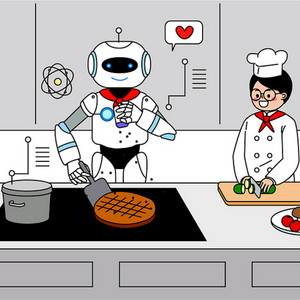
In a bustling kitchen in Beijing, steam rises, pans and pots fly, but no one is speaking, breaking a sweat.
That's because the chef is made of steel.
Across China, robotic cooks are quietly transforming how we eat.
They're fast, consistent, and never need a cigarette break.
But as algorithms take over the wok, new questions sizzle beneath the surface.
What happens to the human touch in cooking?
That pinch of intuition, that sense of warmth, that connection between the cook and the eater.
And Roundtable invites you to find out all about down jackets in the beginning of this winter.
One for 99 yuan, another for 999.
Both claim to keep you warm.
Which one really does?
But now.
Robotic chefs are flipping, frying and sauteing their way across China's kitchens, and they never complain about long hours or bad tips.
But if machines start making our favorite dishes faster and cheaper, will we still crave the chaos and charm of a human chef?
When we talk about robotic chefs, exactly what we're talking about how robotic are they and how much percentage of chef is included in these machines?
Super. robotic to answer the first part of your question.
They are stainless steel machines that are rapidly replacing human cooks in those commercial kitchens and restaurants.
I guess these technologies, alongside artificial intelligence and pre-prepared food dishes packages, they are the new elements in our catering market.
And some of them can cook, not some of them.
I guess virtually all of these robots can cook some classical Chinese dishes like Kung Pao chicken, Mapo tofu or some stir fries like chili fried pork, fried beef and mushroom fried chicken.
There was one.
I mean, we talked about this on Roundtable before when it was really kind of brand brand new at the time, and i think we talked about seven fresh kitchen.
That's the one that's under jd dot com and uh, in that particular space, all the dishes are made by robots and they're very affordable.
They're about 15 to 20 yuan, that's about two to three dollars each, and that includes rice as well.
So that's obviously one of the major selling points here.
Right is that they are very fast in creating their food, but it's also very affordable as well.
And they're not just we mentioned that.
You know the stir fries that they can do, and they can do those, but they can also create stewed dishes or braised dishes.
They can blanch certain vegetables if need be.
They can apply their seasoning when they have to as well.
So yeah, the role of human beings.
And there's a flip side to this coin it shifts to more of a robot operator who doesn't really need to do the complex cooking skills in the kitchen.
So these operators they place the pre-portioned ingredients into designated slots and then the robot takes over from there.
I have personally witnessed one robotic.
I don't think it's a chef, it's a Bristol because that robot makes makes coffee yep, and it's not a robot per se, it's just one hand one, it's an arm and just one arm and making the coffee.
And that's what got me interested in checking out all these robotic chefs.
They're not human, they do not look human.
When you hear the word robot, you think of a human, like robot, android.
Well, those are the humanoid robots, but i mean there are plenty of others too Exactly.
So when I think of the robotic chef, I was a bit curious and I realized there are so many different kinds.
There are the ones that look exactly like a wok.
It's just a wok with a huge spoon in it that can help it fry.
And there's also the huge ones.
The huge one can operate digitally. three, I think at least up to three pods together.
And they can be really, really good.
And like Steve said, the reason that we had talked about it, one, it was really, really new.
At that time, it was not that new.
The concept was not that new.
It's just it only started to be able to cook Chinese dish at that time because previously, for especially what we mentioned, when we say Western kind of dishes, when you do not really need the timing of seasoning, the temperature of the open fire cooking, the dish should be that precise.
When it's mostly just the kind of cold dish salad or you are frying an egg or something, do an egg omelet.
It's not that hard.
So using machines to cook those kind of dishes were relatively easier.
But after years and years of research and development, the robotic chef can now really cook the kind of Chinese dishes that we're we are in love with for thousands of years.
And we even talk about.
That is the atmosphere and the feeling and the taste of the walk of a human being operating in front of the wok, in front well, in the kitchen, and that special kind of freshly made Chinese dish.
And that can also be created by these robotic chefs as well.
And that's one of the really impressive part.
What are some other perks of these robotic chefs?
Well, I think efficiency and lower labor cost that's a very obvious benefit that these business owners, restaurant owners, can reap from this new development.
Cost is a major benefit, because if you want to hire a very experienced human cook, then you probably need to pay this person like more than 10000 yuan, depending on which city.
But here in Beijing, maybe 10,000 yuan is way not enough.
But by comparison, a robot is just one-time investment that is able to run over the long term.
In one case I have read about, thanks to the employment of robots, a restaurant saw its monthly labor costs drop dramatically from the previous level of somewhere between 75000 and 80000 yuan to about the current 19000 yuan.
So the change is that Previously he was hiring a team of five cooks and five helpers in his kitchen.
But now he is just using two operators managing six to seven robots.
Yeah, that's going from like $10,000 a month in labor costs to $2,500 a month.
That's, you know, you're reducing your labor costs by 75%.
And the labor market here in Beijing is also quite interesting.
If you take a look at the average age of, for example, food delivery guys or package delivery guys, their average age is 25 years old.
But for these chefs, no matter what kind of restaurants, their average age is 45 years old.
And less and less young people are willing to choose cooking or choose being a chef as their major, because of the working environment and also a lot of different reasons.
But we are definitely looking at a shortage of really good chefs in the market, especially during, for example, a holiday period and after spring festival.
They have a really huge problem finding out the good chefs they need.
And the chefs would be definitely a key factor to maintain the quality of their product.
So having a possible alternative is definitely a good news for restaurant owners.
You said it in the opening, these robots don't need a break, right?
They can work 24 hours a day.
So if their restaurant is open late at night, then staffing can be a potential problem for a company.
And that just eliminates that problem.
From a business point of view, it's really difficult to see.
I mean, if we're only talking about the money side of things, it's very difficult to see any downsides because you basically eliminate well, not eliminate your training costs, but you heavily reduce your training costs, your ingredients.
You save a lot there too.
Ingredients and seasoning, because they're so exact in with their measurements, the robots.
And humans will sometimes take a little bit more of one seasoning one time and a little bit less the other time.
So they save money there.
And a lot, by the way.
30% they save on seasonings from reduced waste.
You've got your consistent quality, so that's not an issue.
If it were before, your flavors are always exactly the same.
It's scalable, which is a great thing for a business, should it be successful.
It's faster, you have higher profit margins.
So from a business point of view, it's win win win win win win, with very few downsides.
I want to ask both of you do you cook?
Yes uh yeah, yes.
Are you like good chef or the kind that can make sure that your food are edible and won't poison anybody?
Yeah, not killing anyone is usually priority number one for me.
I love to cook for my wife.
We cook for each other sometimes.
And we really enjoy it.
How about you, Ding He?
Yeah, I think cooking is a very enjoyable process as well, especially during the weekend when you got temporarily released from your related pressures.
Temporarily.
You make it sound like prison.
Yes, exactly.
You're out on a weekend.
But it's very enjoyable.
But it's time consuming, to be honest.
Yes, and the reason I'm asking this is to make sure we're on the same page when we talk about the logic and nature and principle in cooking.
That is, for especially Chinese food, it's really important about the temperature.
You need to rise the temperature really, really fast so that the temperature, really nice smell and taste of the ingredient can be um inspired and can be invite out.
But at the same time, especially for vegetable for example, you do not want the cooking time to be too long, you do not want to heat up the material or the ingredient for too long, so the texture would remain good.
And that is the thing.
With robotic chefs, they are able to, in their pot, rise the temperature to up to 300 degrees right in several seconds, so that it can taste really good.
And when we talk about robotic chefs, when we talk about maintaining the same type of quality of the dish, we're not talking about.
They use the exact same, for example, number of stir every time they fry.
We're not talking about.
They use the exact same temperature every pot.
They It's that they mimic the movement of a major, huge level, A chef, and they have different sensors detecting the temperature of the food.
They can know how much more they should eat.
Continue heating up the ingredient and maybe a little more salt they can put inside.
And that consistent is talking about the consistent quality of the dish, which means for business owners they can open their business not only in where they start the business, but to cross the entire country, if not globally.
And that's something very, very important for Chinese food, because Chinese restaurants having problem, especially the franchise restaurants, having problem expanding.
And the problem is that they need the exact same level or same level of consistency of chef all over the place.
I mean, I mentioned that there were almost no downsides from a business point of view, but there is one, and it's kind of the elephant in the room.
There's no humans cooking your food.
And for some people, that is an issue, right?
And business owners, they acknowledge that as well.
Some people might think, oh, it's not worth it.
Even though it is affordable, it's not worth it if it's not a person actually doing it.
So the majority seem to think, though, that it's not an issue at all.
But there are certain people out there that haven't really adjusted to the idea just yet.
Yeah, especially for foodies, for people who enjoy food as a hobby, as a kind of passion.
Like an artistic thing.
Yeah, art.
They will care, oh, how come my chef is not a human, it's a robot.
But I guess for most people they are primarily just concerned about price ingredients freshness, the hygiene condition within the kitchen, et cetera, et cetera.
So it's hard to say whether this is all good, but I think ultimately robots will not entirely take the place of human cooks, because
Because, at the end of the day, in those higher-end restaurants where cooking and access to, Where food is not only sold as just a food but more like an art, as an emotion, as a nostalgia feeling,
Yeah, in those places, I don't think robots will play that significant of a role.
But for those...
Fast food chain, franchise restaurant.
Yeah, robots is a very... profit-driven phenomenon.
That's my argument.
I don't know.
I think it's because you know it's cooked by a robot.
You're judging the robot chef.
But that's my point.
Being a little bit biased.
But that's my point.
That's exactly my point is that people need time to adjust to that.
And there was a competition between a robotic chef and a real, really good, human chef from Hunan province.
They were cooking Hunan cuisine and, And Hunan cuisine is kind of famous for being super spicy to start with, but also you need open fire to really fry the ingredient, to give it the guoqi we talked about, the feeling of freshly made food out of the wok kind of feeling.
And they did three different dishes and all the ingredients are prepared for them.
The robotic required around three minutes, whereas the human chef used around nine minutes.
And they gave both dish to, well, both three pairs to strangers on the street for them to taste.
None of them could really tell the difference. did they choose the robot's food as better?
They thought both of them are similar.
They're really close to each other.
Yeah.
But the thing is, there were nuances in cooking process.
Like, if you cook Kung Pao chicken, you can cook it as like a spicy combined with sweet or combined with Yeah.
So With every cooking process,
There is nuance.
Like, not every dish can be standardized, but robots.
I guess it's more like standardized cooking.
Right, that i agree.
No creativity, no creativity.
But human chef can be the creator and then putting in the algorithm in the robot.
We don't know, but we are here to observe.
You're listening to round table coming up next this as well.
We see that for the kind of down jacket, you always have different choices.
So let's talk about the down jackets.
Don't go away.
Looking for passion.
How about fiery debate?
Want to hear about current events in China from different perspectives?
Then tune in to Roundtable, where East meets West, and understanding is the goal.
It's Roundtable with myself, Niu Honglin, Steve Heatherly, and Ding Heng.
Quick question.
How much do you think is a reasonable price level for a down jacket a decent one, measured in RMB, at least four digits?
Oh, really?
That's my impression.
I just bought one for 360 yuan.
And how was it?
Well, I've only been using it for about two weeks, but I'm satisfied with the product to this point.
Although it hasn't gotten to be fair.
We had a little cold spell here in Beijing, but it went away very quickly.
It's been kind of warm recently, so I'll report back later.
Yes, and here in Beijing, we're already entering the well, I think almost winter kind of period.
And that is why we're discussing different types of down jacket.
Because now here in the Chinese market, especially online market, you can find different types of product.
You can find different even description of the product, different types of filling in the down jacket and also, of course, different price tag.
Yeah.
So here's what you look for if you are looking at a down jacket for this winter.
One.
You have to check The down cluster content and they say that's the most important piece of information to look for on the label or the product details on the page.
It's that down cluster content, which must meet or exceed 50 under the new Chinese national standard consumers standard report, which instructs those to avoid products that use vague or misleading terms like downed cotton.
So have a look for that and make sure that it exceeds 50%.
Also, they recommend this, remain skeptical of deeply discounted prices because a legitimate downed jacket featuring a reasonable amount of filling, that's about 150 grams or about 90% of white down duck, it has a core cost that makes it unlikely to be sold affordably below 300 yuan, which makes my 340 or 50 yuan down jacket purchase still good enough, I hope.
So for your four-digit down jacket, what do you look for?
Or you want a really good one, judging by the price you are preparing for the down jacket.
What are some elements that you look for when you purchase your down jacket?
Well, it's material.
The material, the... Fabric.
Yeah, the down... Filling.
Filling and... The fill power.
Oh, fill power.
But I guess the look on the... Of course, fashion.
That's for, especially for young people, that's a big matter and excel accessories, etc etc.
So i guess um, currently the most commonly reported problem from consumers seems to be that some fraudulent practices involving using single down filaments or feather filaments instead of chewed down clusters.
For example, one person purchased a jacket that is advertised as 90 ducked down for more than 200 yuan, only to find that this jacket is actually filled with low-quality substituted single filaments.
So that's false advertisement already.
Yeah, so you want to make sure what you're buying is real.
That fill power thing that I mentioned before by the thing that they said before was one of the things they say to look for for quality.
Because if you find that on the label of the jacket, the best down jackets tend to have a fill power of about 750.
And anything 900 or higher is quite premium.
Fill power just means the down clusters are larger and they can trap more air with less weight.
Because air is what insulates you in the down jacket.
So... you want to have a higher number there.
So this is what they say on a chart.
$400 to $500 for the Phil Power is cheap and not that good.
$550 to $650, that's the balance between performance and cost.
So for a lot of people who go out and buy their winter down jackets, they should basically look for that fill power number 550 to 650, because that'll be good enough for winter time going out and about and things like that.
When you're outside for a limited period of time, 700 to 800, that's for like skiers and snowboarders, and then 850 to a thousand fill power, you're basically ready to climb mount everest with a coat like that.
Oh, and one more thing which i think is important also look for responsible downsourcing or rds.
That's a certification that down's been procured through methods that prioritize the welfare of the animals and the environment.
Yes.
And for those who are interested in getting one down jacket here in the Chinese market, you can also get a little bit creative and a little bit adventurous, because there are now a lot of different types of fabric that can be used to make the down jacket not the usual ones that are relatively lighter but not that trendy.
I personally have a a down jacket, but the surface of it was made of leather.
And it's really warm.
It's a little bit heavy, but it kept me warm even when I was visiting Iceland.
So it was quite good.
And now there are the ones that you can wear, that can look much more fashionable and can allow you to, like Steve said, walk.
Well, I think some of the material is even waterproof.
Yeah, some of it.
So as long as you do a little bit more research about the table, about the sheet, you get telling you the material of the downfield power.
Yeah.
And then also re-listen to what Steve has said about what to look for.
And keep your eyes peeled.
If waterproof is important to you, make sure you check how waterproof the jacket is, because if not, then the down.
If it's not water resistant, you will look like a drowned rat when that coat gets wet.
Trust me, I've been there on that one.
And that brings us to the end of today's Roundtable.
We'd love to hear your thoughts on today's topics.
Leave us a comment or send us an email to roundtablepodcasts at qq.com.
I'm Niu Honglin with Steve and Ding Heng.
Thank you so much for listening.
Bye.