Grownups, Wondery Plus subscribers can listen to Wow in the World early and ad-free right now.
Join Wondery Plus in the Wondery app or Wondery Kids Plus on Apple Podcasts.
Hey, Wowzer fans, Mindy here.
And before we start the show, I gotta let you know that this November, with a special new episode featuring our friends at Circle Round and Terrestrials on Radiolab for Kids,
And don't miss when Elmo from Sesame Street stops by Wow in the World to make us all belly laugh on November 24th.
Oh, but that's not all, Reg.
On December 1st, we are sharing our 250th episode of Wow in the World with all of you.
We think this one is going to be music to your ears.
Literally.
Did I mention it's a musical?
And if you're a member of the World Organization of Wowzers...
Oh boy, do I have a surprise for you.
You can listen to our 250th episode early with me and other members from around the world on Saturday, November 22nd, at 7 pm.
Eastern.
That's right, we are throwing another listening party.
Join us as we dance along to our new songs.
React to the episode with other members in the chat and more.
Grownups.
If you want your wowzer to join this members-only listening party, you can sign up to become a member today at Tinkercastcom.
Slash wow.
Already a member?
Well, you can find the link and password to join the event when you sign in at Tinkercastcom.
Slash wow.
That's it.
It's going to be a November to remember.
But for now, let's get on with the show.
Woo!
I'm Richard, gonna need the washer.
There we go um.
And now the valve cap, valve valve oh, here it is, i'm just gonna.
There we go, and um oh, i need the float arm.
Do we have, thank you, red low arm and, last but not least, the flapper there.
That should do it.
Okay Reg, you want to do the honors?
Oh, that's right.
You don't have hands.
That's okay.
Here, I'll do it.
By the way, you know that you can use your wing to put the seat down when you're finished using it?
Oh, look at that.
We did it, Reg.
The world's teeniest, tiniest working toilet until he gets a diaper load of this.
Coming!
Hey, Guy Ross.
Oh, hey, Mindy.
I heard a bunch of loud clanging and flushing over here, and I just wanted to make sure that you weren't trapped in your bathroom again.
Oh, yeah.
That was just the sound of me literally flushing out an idea that came to me in the middle of the night.
Oh, yeah?
Well, what's the idea?
Well, the idea was to make the world's teeniest... tiniest working toilet.
Well, that seems like time well spent.
I know!
Want to see it?
As long as you don't try to get me to use it.
What?
No!
This tiny toilet invention isn't intended for human use.
So then, what is it for?
Well, the answer to that question is off the coast of Georgia.
The country or the state?
Oh, the state.
I only follow my curiosity so far.
That's still kind of far to go to for an answer to a simple question, don't you think?
Reggie!
Oh, no.
Oh, no.
Mindy, I... Hey, Reg.
If you're not too busy, we need you to take us to some murky, muddy marshy waters off the coast of Georgia.
Why does everyone keep asking me that?
Georgia, the peach state.
Oh, no, no, no, no, no.
I've got a long list of things I plan to do today.
Fermenting some mung beans, yarn bombing the neighborhood fire hydrants, and then I've got rehearsal with my barbershop quartet.
Your barbershop quartet will be here when you get back.
Now, here, I need you to hold on to my adventure toolbox.
Oof.
And my adventure journal.
Mindy, I... And this gallon of frost.
No, I... What?
Frosting?
In case we get hungry.
And last but not least, this one-of-a-kind, world's teeniest, tiniest working toilet.
Okay, now I want you to be very careful not to drop it.
It's ceramic.
Mindy, I don't have enough hands for all this stuff.
Whoa, whoa, whoa.
It's so...
It has an itsy bitsy toilet seat and a tiny toilet paper roll and everything.
The bowl part is modeled after my own head.
Uh... Oh, come on, Guy Raz.
Let's follow Reggie outside so we can take off.
Wait, why are we going to Georgia again?
To find the answer to your burning question.
Which was what again?
What is this teeny tiny toilet for?
Oh, right.
But do we really need to...
What are you getting us into, Mindy?
Just some of Georgia's finest murky waters.
Now hold on tight, because here we go!
Nice splash landing, Reg.
If I knew we were going for a splash landing, I would have worn my tweed bathing suit.
I'm soaked.
Hey Roz, do me a favor and grab our inflatable flotation devices out of my adventure toolbox over there.
Uh, okay.
Right there.
You got it.
Why are there always cats in this toolbox?
Okay, I think I got them.
Hey, hey, these look just like the ones on airplanes.
Yeah, that's them.
How did you get... Just pull them out and they'll inflate automatically.
Uh, okay.
Much better.
Okay, now we can relax.
Relax?
Where are we, Mindy?
What is this?
Guy Raz, we're in Georgia.
How many times do I have to?
I know we're in Georgia, but what is this murky water we're floating in?
Mosquitoes!
Get away from me!
Get away from me!
Oh, well, these murky waters just happen to be a marshy estuary, Guy Raz.
Of course, an estuary.
A body of water where the river meets the sea.
You are so bright, your mother should call you... Son, I know.
Ha ha ha.
That joke gets funnier every time you interrupt it.
So, why are we floating in this estuary, and why...
Why can't I see my feet?
This water is disgusting.
Shh.
What?
They'll hear you.
Oh.
The crabs, they live here.
I'm standing in crab water?
Well, not just crabs.
We're talking oysters, shrimp, all kinds of fish.
I think I can feel them nipping at my toes, Mindy.
Oh, that means they like you.
It does?
Are you sure?
Yes, of course.
I'm not sure, Guy Raz.
Now lift your foot out of the water and let's see what's clamped onto it.
Aw, they're tiny mud crabs.
Hey there, little fellers.
Get them off me, Mindy.
I'm pretty sure I won't have to, Guy Raz.
What?
Why?
Well, because they're about to become lunch.
Mindy, if you were hungry for crabs, we could have just gone to that little crab shack up the...
Not our lunch, Guy Raz.
What?
Her lunch.
Whose?
Whoa!
She is what we came here for.
The famous blue crab.
Wait.
She is going to eat these little mud crabs pinching onto my feet?
Is she going to eat my feet, too?
No.
But...
She is about half the size of your foot.
And these little mud crabs are only about the size of my thumb.
Wait, wait.
How do you know she's a she?
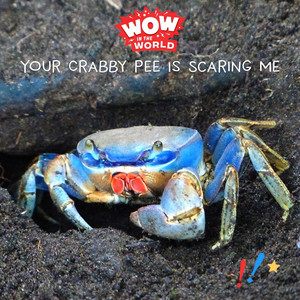
Oh, so see the red tips and the pinchers of her big blue front claws?
Yes.
Well, that's how you know she's a she.
And the blue claws are how you know it's a blue crab?
Exactoritos, Guy Raz.
And can you guess how to tell if a blue crab is a he? by its blue elbow patches?
What?
No, male crabs are known for their crazy dance moves.
Oh, I think I read about this once.
Don't they do these wild leg-waving dance moves to send signals to the females?
Yeah, kind of like what you're doing now.
I'm not dancing or sending signals, Mindy.
I'm treading water with feet full of mud crabs.
But speaking of signals, Guy Raz.
Yes?
There is another way that blue crabs send signals.
And it has nothing to do with dancing.
But it has everything to do with why we're here.
So there is a reason we're floating in this marshy estuary in the middle of nowhere?
Hey, you were the one who asked me what my teeny tiny toilet was for, remember?
That seemed like so long ago.
Well, grab that crab and let's swim to shore.
I'll explain everything when we get there.
Grab that... Ah, Mindy, I think it grabbed me. and don't let her go.
She's swimming faster, Mindy.
She's pulling me.
I'm just along for the ride.
Swim, swim, swim, swim, swim.
Okay.
Air off.
Air off.
And up.
Come on, little boy.
You can do it.
You're almost there.
You did it.
Yay!
Whatever we're here for, Mindy.
This better be good.
Okay, Guy Raz.
Now we need you to pull that teeny tiny toilet out of my adventure toolbox, okay?
You know, Mindy, you could have just done your business here in the water.
I mean, judging by the smell out here, that's what everything else does.
It's not for me, Guy Raz.
It's for Crabby Abby over here.
You dragged me out.
All the way out here so you could put a crab on the toilet?
You wanted to know what it was for, and now I'm about to show you.
From now on, before I ask you a question, I need to brace myself for the answer.
The answer?
You mean the adventure.
Now pull that crab off your... Wait, is she pinching onto your buns?
Well, scientifically speaking, it's called a gluteus maximus.
Well, pull her pinchers off your crab cakes and help me get her onto this tiny toilet.
Come on!
Wait, why are we putting a crab on the toilet, Mindy?
For science, Guy Raz.
For science?
Okay, so here's the deal.
I just read this study that was conducted by these scientists at the Georgia Institute of Technology.
Oh, yeah, Georgia Tech.
And I found it so fascinating that I just had to see or smell it for myself.
Smell it?
Well, what was the study about?
Oh, so it was about blue crab pee.
They found that crabs have blue pee?
No, blue crab pee.
Blue crab pee.
Interesting, because mine is usually yellow.
No, blue.
Crab pee!
I feel like you're just saying the same thing over and over and over again.
Did you accidentally drink some of this murky water, Mindy?
No, it's pee from a blue crab, not a crab's pee that is blue.
Never mind.
The color of its pee is not what's important here.
It's what's inside that counts.
You mean like the chemicals in the blue crab's pee?
Yes!
Winner, winner, crab-like dinner, Guyron!
But now I need to know what color is a blue crab's pee.
Well, when I first read this study, I kind of wanted to know the same thing.
So I called Mark Weisberg, one of the head scientists on the study.
You called a scientist and asked him what color a blue crab's Pee is?
Guy Raz, there is no such thing as a dumb question.
Well, I guess that is what they say.
So what'd he tell you?
He told me that it was a fantastic question and that a blue crab's pee is basically the same color of ours when we've had a lot of water to drink.
So we're talking a pale yellow, like a cream or a flaxseed or maybe daffodil?
Straw.
What?
He said the blue crab pee is the same color as straw.
Huh.
Good to know.
Oh, look, Mindy, she's sitting on your tiny toilet.
The blue crab is on your toilet.
Aw, look at that.
She looks so cute on there.
Come on, Crabby Abby.
Time to go potty.
What is happening?
So while we wait for her to pee on the potty here, I'll tell you about those chemicals in her pee.
Oh, yeah.
Well, what did the researchers discover about them?
First of all, they found more than 600 chemicals in the blue crab's pee or urine, if you want to be scientific.
I do.
And 600 chemicals is really not that big of a deal when you consider that we humans have over 3000 chemicals in our pee.
Wow, I never really counted.
But what is a big deal is that two of these chemicals send invisible danger signals to the blue crab's prey.
Like the tiny mud crabs it wants to eat?
You know it.
Well, how do these chemicals actually work?
First, we should start with the chemicals' names, which are trigonelline and homerine.
Trigonelline and homerine.
Now I know what you're thinking.
Those names sound like delicious pasta dishes.
I was actually not thinking about that.
But you know Mindy, trigonellin just so happens to be a chemical molecule that's also found in coffee beans.
And it's part of what makes coffee smell.
So you can smell the trigonellin in your coffee?
Well, not specifically, but But you would if you were a tiny mud crab and that smell would be the scent of coffee.
Wow, so how does it work?
Okay, when a blue crab eats, its body breaks down the food kind of like how ours does during the digestion process.
You know the time between when we eat our food and when what's left and not used by our bodies comes out the other end.
Yeah, yeah, I got you.
And so during that time, those two chemicals, trigonellin and homarin, are made?
Yep, and when the blue crab goes to pee...
Those two chemicals tell the mud crabs what the blue crab had to eat.
And the warning signals become especially strong if the blue crab's last meal was mud crab.
The smell of fear.
Yep.
And if those mud crabs smell other mud crabs in the blue crab's pee, well let's just say they know they better.
Usain Bolt.
Ah, interesting.
Four alarm pee siren?
Uh-huh.
Hey, by the way, do you think she's peed yet, Mindy?
I'm not going to go check the toilet while she's on it, Guy Raz.
Well, I haven't heard anything yet.
Have you?
Nah.
You smell any pee yet?
You mean, do I smell any fear yet?
No.
Well, maybe you should bring one of those mud crabs up here to sniff out the situation.
Well, that's the thing, Mindy.
What's the thing?
Crabs don't actually have noses.
So how are they supposed to smell anything, much less fear and death in urine?
Oh, well, Dr. Weisberg also mentioned that these crabs are basically walking noses.
Ah well, that makes sense Mindy, because although crabs don't have actual noses, they are able to detect smell or certain chemicals with their antennas or mouths.
Yeah, or even their legs.
Fascinating, isn't it?
Totally.
So how do these scientists find all of this out?
Well, I can tell you.
Yes?
But I'd rather show you.
If Crabby Abby over here will ever go to the bathroom in this tiny toilet.
Maybe we should offer her a treat.
I mean, that always seems to work for you.
Oh, good idea, Guy Raz.
Okay, Abby, if you use this potty, I've got some kelp with your name on it.
Kelp?
That's your idea of a treat?
Hey, kelp is the kale of the sea, Mindy.
She's clearly not interested.
Here, let me try.
Hi, Abby.
For a little pee-pee in this potty here, I'll let you take a dip in this tub of melted butter.
We're in the middle of nowhere, Mindy.
Where did you get a tub of melted butter?
I had it in my pocket.
Hey, Roz.
Crab legs always taste better in melted butter, so I brought it along in case of emergency.
You're going to eat crabby, Abby?
I said in case of emergency.
But she doesn't know that, so I'm going to use this melted butter to scare the pee out of her.
Nothing yet?
Here, let me sing her a song.
Maybe that'll help her to, you know, get things flowing.
Let it go...
Let it go.
Don't hold it in anymore.
Let it go.
Let it go.
Shut the bathroom door.
Huh?
We can't sing the P out of her, Guy Raz.
Maybe we should squeeze it out of her.
What?
Yeah.
Hand me my adventure toolbox.
Oh, no.
I will not sit here while you squeeze the P out of a crab, Mindy.
Oh, yeah?
Well, I will not.
Sit here while you sing the pee out of a crab, Guy Raz.
Oh, yeah?
Oh, yeah.
Let it go.
Let it go.
Don't hold it in anymore.
Boo!
Boo!
Stop booing my song, Mindy.
I'm not booing your song, Guy Raz.
I'm trying to scare the pee out of her, ghost style.
Boo!
Let it go.
Boo!
Let it go.
Boo!
Let it go.
Boo!
Let it go.
Boo!
Is that what I think it is, Mindy?
I was.
She's peeing in the potty.
Yeah, you did it.
Ooh, pee-pee in the potty.
Pee-pee in the potty.
Pee-pee in the potty.
Pee-pee in the potty.
Pee-pee in the potty.
Pee-pee in the potty. she flushed and we needed that pee to re-adact the experiment.
Don't worry, Guy Raz.
This tiny toilet's not connected to any pipes.
Phew!
So the pee's still right where she left it.
Now close the lid and let's get this pee-pee potty back to the lab so I can show you how this experiment was done.
Anything for science, Mindy.
Reggie!
Wow!
Hey, Reg, that was quick.
Now, Reggie, please fly carefully.
I'm holding a toilet full of crab urine.
We'll explain later, Reg.
Okay, let's just hop on here.
Here we go!
Hey, Guy Raz, is all of Crabby Abbey's pee still in that potty?
Uh, yeah, I think so.
I think so, a little bit splashed out when we hit that turbulence, but I think we're pretty good.
Okay well, we better get it back to the lab so I can demonstrate what those researchers at Georgia Tech did in their experiment.
Come on, let's go.
Run, run, run, run, run.
These mud crabs are all over my feet.
Ah, well, maybe you shouldn't run, Guy Raz.
Besides, you're going to spill it.
Oh, right, right.
Walk, walk.
Slow and steady.
Walk, walk, walk.
Okay, back at the lab.
So where do we begin, Mindy?
Well, first, I need you to take those mud crabs and put them in your fish tank over there.
But they'll pinch me.
Come on.
Now what?
Drop the crabs in the tank.
Okay.
You're doing great.
The crabs are in the tank.
Now, once the mud crabs get situated, I'm going to throw in this shrimp.
What?
Where did you get a live shrimp?
My pocket.
Now drop them in.
Okay.
Well, good luck in there, little buddy.
So, what's the purpose of the shrimp, Mindy?
Oh, mud crabs love shrimp, and nothing will stop them from trying to eat it, except for the smell of a blue crab predator in their midst.
Oh, wow.
Look at them going after that shrimp.
They might as well be holding knives and wearing bibs.
Now...
I want you to dump that tiny toilet of blue crab pee into the tank and closely watch what happens.
Okay, easy does it.
It's coming!
Now, watch what happens.
They froze dead in their tracks.
A total duck in cover, almost like they're trying to go undetected.
Yep, they're smelling those two chemicals in the blue crab pee. trigonelline and homerine.
So those researchers were right.
Blue crab urine does contain secret signals that warn their prey.
Pretty cool, huh?
They work almost like disaster warning alarms.
Silent warning alarms.
Exact Doritos.
So think of it like this.
To us humans, trigonelline would be like a blaring car alarm and homerine would be like a bright flashing light.
Both different, but both trying to warn you about coming danger so that you can stay safe.
Gives these mud crabs a good head start if they want to swim for their lives.
Yeah, but if our food could run away every time it smelled us coming, we'd starve.
So is there anything the blue crab can do to stop these secret pee signals?
Nope.
Well, can't they hold it until after they eat their mud crab dinner?
Nope.
Can't hold it.
I can barely hold it.
Well, what about...
Peeing in designated spots, like underwater bathroom stalls, far and away from their lunch.
Guy Raz, when you're a crab, the entire underwater world is your toilet.
Well, then how are blue crabs not starving to death?
Well, I mean, I'm sure some do.
But the smart and savvy blue crabs know that pee... floats downstream.
Aha!
So they swim upstream to hunt their unsuspecting prey.
You got it.
Wow.
But I'm still wondering why did these researchers at Georgia Tech want to learn about the bathroom habits of blue crabs?
Well, so in a crab-eat-crab world or really any predator-prey situation, pee chemistry like this can really affect the balance of whole entire ecosystems.
Oh, yeah?
Well, how so?
So you've heard of the food chain, right?
Oh, yeah.
It's basically the order in which different living things eat.
Yeah, so starting with plants and ending with animals.
For example, a grasshopper eats grass.
Yeah.
And then a frog eats the grasshopper.
Okay.
And a snake eats the frog.
Go on.
And an eagle eats the snake.
Oh, okay, I got it.
And in this case, mud crabs eat the oysters and the blue crabs eat the mud crabs.
But nature has given mud crabs the superpower to bite, basically eavesdrop on their predator's pee right.
Yep.
And when the pee starts to flow downstream, it acts as a silent alarm warning the mud crabs to get out of Dodge.
And when they do, they stop looking for their own food, which in most cases would be oysters.
Yep.
And crazy as it sounds, These secret silent pee signals might actually be nature's way of protecting oyster populations.
So essentially, what you're saying Mindy, is that this blue crab pee works as a natural repellent to keep mud crabs from eating all the oysters.
That's exactly what I'm saying.
Without the blue crab pee, mud crabs might see these waters as an all-you-can-eat oyster buffet.
And this must be especially big news to oyster farmers who are trying to preserve or save large oyster populations.
Oh, yeah.
Speaking of which... me how these researchers are hoping to use this new information.
OK, how are these researchers hoping to use this new information?
Well, I'm so glad you asked, Guy Raz.
Now that they know what these chemicals are and how powerful they can be to the entire underwater ecosystem, The hope is that scientists can recreate this blue crab pea and then use it to help save other oyster habitats or at least control their predators, who are on a mission to eat them.
Fake blue crab pea to scare off the crabs and keep them from eating all their oyster livestock.
That's brilliant.
Yeah, and believe it or not, this is really nothing new.
I mean, some farmers on land have been doing this for a long time, using fake pee to do things like scare away coyotes and wild foxes.
You know, this reminds me, Mindy.
You can actually buy certain kinds of animal pee on the internet.
What?
Guy Raz, I just got an idea.
Oh, no.
Do you think that maybe I could sell my pee?
Nope.
Oh on, it's not like the worst idea i've ever let it go.
Let it go, don't hold it in anymore.
Wow in the world, we'll be right back.
Grown-ups, this message is for you.
Hey grown-ups, it's mindy and guy ross here from wow in the world.
Mindy and i have some, We'll be right back.
Our Wow in the World toys help your wowzer learn about their world through play.
Plus, you can hear exclusive audio content from me and Guy Raz to help your wowzer discover even more wows.
Grownups.
Give the gift of wow and wonder this holiday season with our latest Wow in the World toys designed with your curious wowzer in mind.
You can shop our Wow in the World toys at Tinkercast.com slash toys.
That's Tinkercast.com slash toys.
Hi, thanks for calling Wow in the World.
After the beep, get ready to record.
Hi, Mindy and Guy Roz.
I'm Miles from Plainfield Indiana, and my Wow in the World is that anybody standing on the equator is going 1000 miles per hour.
Hi, Mindy and Guy Roz.
I'm Hannah, and I'm 11 years old.
Hi, Mindy and Guy Roz.
I'm Mimi, and I'm six years old.
We're from Wellesley, Massachusetts, and our wow is that wombats poop huge.
Bye, Mindy and Guy Raz.
We love your show.
Hello, Mindy and Guy Raz.
My name is Liam.
I'm from Minneapolis Minnesota, and my wow is that the Statue of Liberty was made in Paris and taken apart and moved to New York City.
My name is Riley, and I am from Asheville, North Carolina.
And my wow in the world, hiccuping is actually good for you.
It releases extra air in your stomach that you don't need.
Hi, Mindy and Guy Raz.
I love your show.
Hi, I'm Nick from Powell, Ohio, and I'm 10.
And my wow in the world is Benjamin Franklin's last words were in French and the nurse didn't understand.
So today we don't know his last words.
I love your show.
Goodbye, Mindy and Guy Raz.
My name is Shreve Lamont, and I am 8 years old, and I live in Hinesburg, Vermont.
And my wow in the world is that lions are more likely to attack humans than tigers.
Love your show.
Hi, Mindy and Guy Raz.
My name is Marianne, and I am 8 years old.
I live in Houston Texas, and my wow in the world is that there are more stars in the universe than grains of sand in all the Earth's deserts and beaches.
Bye, Mindy and Guy Raz.
I love your show and my wow in the world is marine iguanas keep their eggs warm and ready for hatching in the mouths of volcanoes, risking their lives to put them there bye.
I love your show.
I listen to it every night.
End of messages.
Hey, everyone.
So much for joining us this week on wow in the world and if you want to keep the conversation going, check out some of the questions we posted on this episode at our website, wow in the worldcom and grown-ups.
There you can find more details on how your kids can become part of the world organization of wowsers.
Lots of cool perks, exclusive t-shirts, autographed pictures of us and a bunch of other cool stuff wowintheworldcom.
Our show is produced by Jed Anderson.
Say hello, Jed!
Yo!
With help from Thomas Van Kalken, Chelsea Erson, and Jessica Bode.
Meredith Halpern-Ranzer is the big boss.
Our theme song was composed and performed by The Pop-Ups.
You can find more of their awesome all-ages music at thepopups.com.
And parents and teachers.
If you want to send us an email, our address is hello at wowintheworldcom.
Grownups, you can also find us on Facebook, Twitter, and Instagram at WowInTheWorld.
And if you want to be featured at the end of the show, call us up and tell us your wow in the world.
Our phone number is 1-888-7-WOW-WOW.
That's 1-888-7-WOW-WOW.
And parents.
If you want to upload any photos or videos or messages to us, please visit wowintheworldcom and find a link where you can do just that.
And if you haven't already done so, please subscribe on Apple Podcasts, or however you get your podcasts.
Leave us a few stars and a review and be sure to tell a friend about the show.
Until next time, keep on wowing.
Wow in the world.
Made by Tinkercast.
Grownups, if you like Wow in the World, you can listen early and ad-free right now on Wondery Plus.
Join Wondery Plus in the Wondery app or on Wondery Kids Plus on Apple Podcasts.
Prime members can listen ad-free on Amazon Music.
And before you go, tell us about yourself by filling out a short survey at wondery.com slash survey.