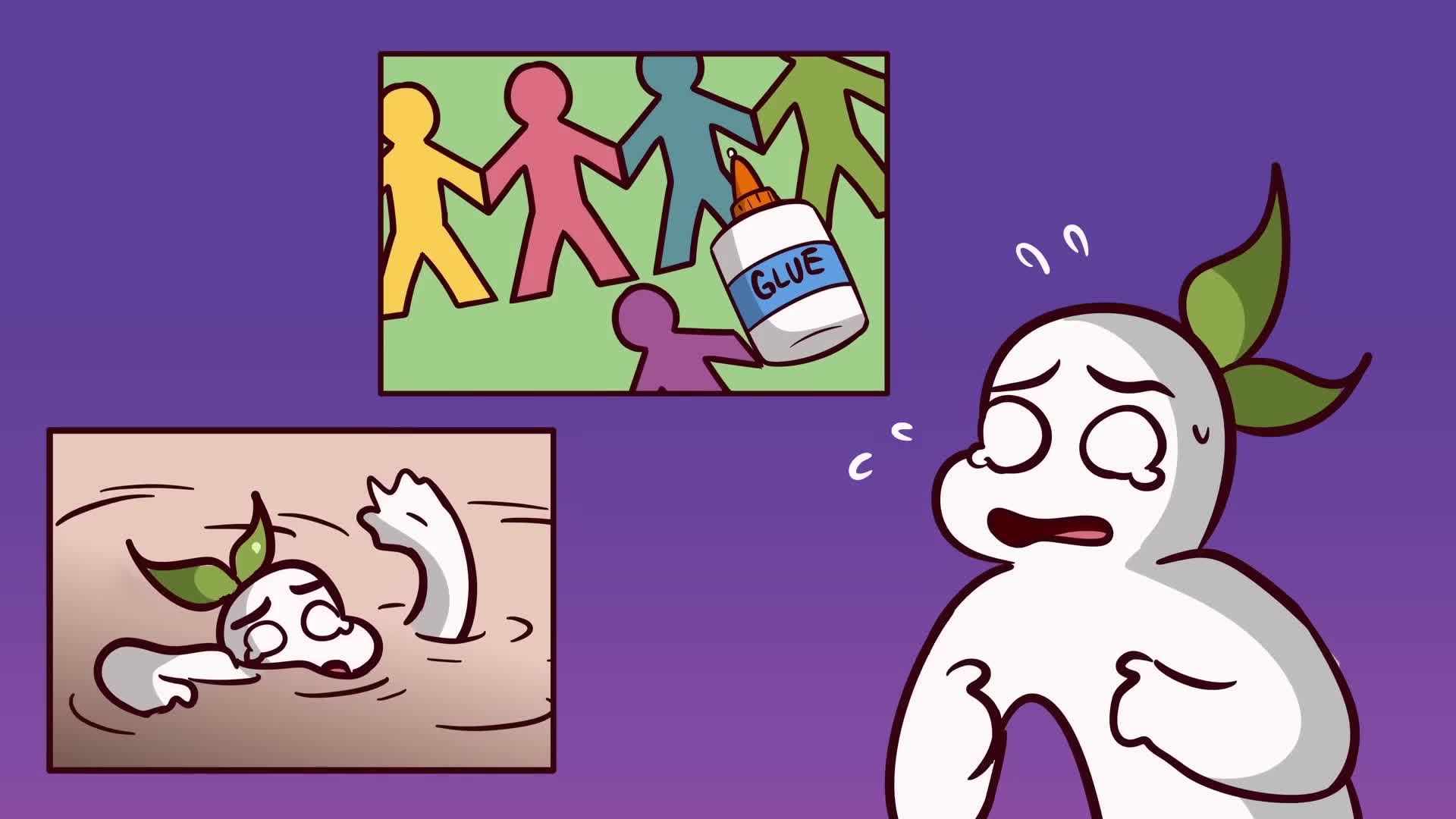
There's a specific kind of exhaustion that doesn't come from doing too much, but from being too much for too many people.
The one everyone can count on.
The one they turn to when things go wrong.
The one they all depend on.
And it feels good to be needed at first.
But slowly something shifts.
You start realizing you're not just helping people, you're holding them together.
And no one seems to notice that you're falling apart.
If that sounds like you, you're not alone, and that's exactly why videos like this exist.
To help you understand yourself more clearly, put words to experiences you may have carried quietly or alone, and remind you that your needs too are valid and worth honoring.
So let's talk about how to handle being everyone's support system without burning yourself out emotionally.
When you're everyone's support system, you're not just giving advice or lending a helping hand.
You are co-regulating their nervous systems.
This means that when they panic, you steady them.
When they overthink, you ground them.
When they're overwhelmed, you absorb the intensity.
The only problem is that regulating other people takes energy.
Real, biological energy.
Your body is constantly monitoring, soothing, adjusting.
So, even if you're just listening, you leave the conversation drained because your nervous system was working the entire time.
Ever had an absolutely horrible day, egregious.
And still, when you were asked how you are, you said, I'm fine.
Maybe actually you were overwhelmed, exhausted, breaking down.
But when someone asks how you are, you forced a smile and said, yeah, I'm good.
And the conversation moved on.
If you're used to handling things alone, this probably sounds familiar.
You don't vent dramatically.
You don't fall apart in front of people.
You cry alone in your room.
You process internally.
And you compose yourself.
So from the outside, you do look fine, like you've got it all together.
But the problem is, the more composed you appear, the less people think to check in on you.
It's not because they don't care.
They don't know that you need it.
Maybe you were the calm one in a chaotic environment, the one who didn't make things harder, the one who could handle it.
And without realizing it, your nervous system adapted.
You became highly attuned to subtle emotional shifts in their tone, their body language, even the silence between their words.
You learned how to stay steady, soften yourself, and make space for others.
Psychologists sometimes call this fawning.
It can be a stress response where, instead of fight, flight or freeze, you try to please and appease people, to avoid conflict and danger.
But there is a hidden cost to living this way.
When your nervous system is constantly monitoring the emotional climate around you, it never fully powers down.
Part of you is always alert, always sensing, always ready to jump into action when things go wrong.
And that means never really catching a break.
The hardest boundaries are with family.
Imagine you finally make plans for yourself.
Something you've been looking forward to for a while now.
And then your phone rings.
A parent needs help.
Or a sibling has a problem.
Something urgent.
Again.
And immediately, you feel that internal conflict.
Because with family, it's never just a request.
It feels like a responsibility.
Family systems assign roles over time, and yours was probably the responsible one, the fixer.
And once everyone gets used to you being that person, saying no doesn't really feel like setting a boundary.
It feels like being selfish.
Psychologists call this homeostasis.
The system's tendency to maintain emotional balance by keeping everyone in their familiar roles.
So when you start to say no, even gently, even if you have the right to it, disrupts the entire system.
People may react with surprise, guilt, pressure.
Not necessarily because they want to control you, but because the family is trying to return to what feels normal, familiar.
But the pattern doesn't stop with family.
It spreads to friends.
Psychology teaches us that behaviors are hard to unlearn and social roles don't simply describe what we do, but shape who we believe we are.
So if you grew up being everyone else's support system, believing consciously or unconsciously that this is how you should act to be loved, you carry that same role into your friendships too.
You become the one people vent to, the therapist friend, the glue of the group holding everyone together because it feels familiar, and you know how to be that person.
But if you're always the steady ground, you rarely get to collapse.
You never get to be the one who can say, I don't know.
I can't.
I need help.
And it's a strange kind of loneliness being the one your friends always talk to about their problems, but not feeling like you can do the same.
You're deeply involved in their lives, but parts of you remain completely unseen.
If you relate to most of what we've talked about so far, you're probably the type to fall in love and then stay in it for the long haul.
Eager to prove your commitment.
You are dependable, trustworthy and generous with your time and effort.
You show up fully, you listen, you support.
But sometimes you give so much, so quickly that you burn out before you even realize what's happening.
And other times, it goes the opposite way.
The relationship lasts, but you slowly disappear inside it.
You become their stability and their safe place, but somewhere along the way you stop asking for the same in return.
Either way, your relationships tend to stop feeling like a mutual connection and more like emotional labor.
So what do you do without becoming the cold one?
This is the fear, right?
If I stop being available, if I say no, if I pull back, will I become selfish?
Will people stop loving me?
Will I stop recognizing myself?
No, because healthy boundaries don't turn you into a cold person.
They help you take care of yourself too, and remind you that you are allowed to be someone with needs, not just someone who meets everyone else's.
You don't have to stop supporting people.
You just have to do it in a way that's still fair and healthy for you.
Right now, your nervous system might be used to responding immediately, fixing quickly, absorbing everything before it escalates.
The goal is to create space between the request and your response.
Instead of saying yes automatically, try saying, Let me check and get back to you.
That one sentence changes a lot.
It gives your nervous system time to ask a different question.
Not, how do I fix this, but do I actually have the capacity for this right now?
Being supportive is about being honest enough that when you do say yes, it comes from care, not exhaustion, resentment or obligation.
Being supportive isn't always about just saying yes.
So pause before agreeing.
Notice your body.
Is it tightening?
Is it tired?
Practice saying things like, I really care about you, but I can't tonight.
Or, I can do that for 10 minutes, but then I have to go.
Or I need to reschedule.
I need some time for myself right now.
And something surprising happens when you start doing this.
The people who truly care about you will understand and adjust.
And they won't lose respect for you.
They'll gain a more honest version of you.
And for the first time, support stops flowing only in one direction.
If you recognized yourself in several of these, it likely means you're emotionally intelligent, considerate of others and reliable in ways that most people aren't.
And that is something to respect.
But being the strong one doesn't mean having to suffer in silence.
When was the last time someone supported you?
If the answer feels unclear, that's a sign that you may have been giving more than you've allowed yourself to receive.
So what would it look like to stop being everyone's support system for a moment and start letting yourself be supported too?
Share your thoughts in the comments.
And if this resonated, please like and subscribe for more insightful content.
Thank you for watching and we'll see you soon.