Here we go.
Here's my first food from the air ever.
It feels so science fiction.
I mean, the fact that it actually was created literally from air, I can't even imagine.
So I'm going to get out a knife here.
I am pretty excited.
So I need a knife and a plate.
And I have some bread.
Yes, you heard that right.
Nikki and I were about to taste food that was literally created out of thin air.
And it wasn't imaginary.
It was real.
Real, spreadable, meltable, edible butter made from air.
Right now, you're all probably wondering, what in the world are you talking about?
And we are going to answer that question this episode of Gastropod.
You are indeed listening to Gastropod.
We're not science fiction.
We're the podcast that looks at food through the lens of science and history.
I'm Cynthia Graber.
And I am Nicola Twilley.
And this episode?
Can we really bypass plants and animals and just get all our nourishment from the same stuff we breathe?
And why on earth would we want to?
This episode is supported in part by the Alfred P Sloan Foundation for the Public Understanding of Science, Technology and Economics.
Gastropod is part of the Vox Media Podcast Network in partnership with Eater.
Support for this episode comes in part from Vitamix.
Quick kitchen history lesson.
Electric blenders, first introduced in 1922, were invented to make milkshakes.
What followed was iconic Americana the era of teenagers in checkered floor, soda fountains and drugstores jiving to jukeboxes, slurping shared milkshakes through two straws.
In the late 1930s, Vitamix began promoting their new blenders for use beyond making milkshakes.
Soon, electric blenders found their way into kitchens across the country, where they've been essential cooking tools ever since.
Vitamix reimagined the blender as a powerful, versatile tool, ideal for making soups, nut butters, marinades and, of course, delicious nostalgic milkshakes.
Vitamix's trusted versatility blends together culture, science and history right on your countertop.
Only the essential at Vitamix.com.
Amazon has everything for everyone on your list.
Like your teenage son, who has sprouted the sorriest excuse for a mustache you have ever seen.
Get him an electric razor.
And with Amazon early holiday deals, you'll save big.
Okay, before we get to the future, we need to make a brief stop in the past, where the future was being invented, to meet a Frenchman named Marcelin.
Marcelin Berthelot was a renowned chemist from the 19th century.
His claim to fame really was synthetic chemistry.
Synthetic chemistry being combining elements to make new compounds, versus analytical chemistry, which is taking apart compounds to get to their elements.
Bill Gergy is a science writer and he told us that Marcelin's research wasn't about creating food from air exactly, but it set the stage for that because he had the idea that we didn't need plants to create food.
This was a really radical idea.
Most of everything we eat comes from plants originally.
So if you think about every calorie you've ever eaten, it really all starts with kind of photons coming from the sun and that form of energy getting transformed into food molecules through agriculture.
Kathleen Alexander is co-founder and CEO of a food from air company called Savor.
And so to kind of really have humans thinking about like, do we need this agricultural paradigm to make food?
That didn't really get started until we started understanding.
You know how to think about molecules.
Which was in the 1800s when chemistry as a science emerged.
And one of the first things these new chemists did was figure out what food was made of.
So food really is, you know, we think of like carbohydrates and proteins and lipids, right?
Fats, you can throw in vitamins and minerals.
And those are probably like the five sort of basic categories to simplify.
But I mean, carbohydrates are what the name says.
They are carbon, hydrogen, and oxygen.
And that's it.
From carbon hydrogen and oxygen we get sugars, you know, like glucose and fructose and sucrose.
And we get starches, which are sort of long chains of those sugars.
The same is true for protein.
If you just add one extra element, nitrogen.
It's made of these amino acids that are carbon, hydrogen, oxygen and nitrogen.
And that's it.
And lipids are fats.
Those are same thing as carbohydrates, carbon, hydrogen and oxygen.
The chemistry is a bit different, so they're insoluble in water.
But that's it.
I'm going to repeat this because it's kind of mind blowing.
All food at its core, from fish to bread to oranges, the so-called macronutrients that are the basis of these foods fats proteins, carbs.
They're all made up of carbon, hydrogen, oxygen, and nitrogen.
Like Bill says, that is literally it.
But at the time, in the 1800s, a lot of leading chemists thought there was something else in organic living matter, some kind of vital spark or force, something we humans couldn't make.
Marcelin Bertelot didn't agree with that point of view.
He argued that if we combined the molecules from non-living stuff in the right ratio, well then we could make something that was chemically identical to organic living matter.
And he was a real advocate for synthetic chemistry and believed that synthetic chemistry was going to replace the entire food chain.
Marcela created all sorts of useful things in the lab from chemicals, not from air.
But he even was able to create fat in his lab.
The fat in our diets comes from living things.
It comes from plants or from animals.
This didn't.
That said, it wasn't food, not the way he'd imagined it.
But he'd done what a lot of people thought was impossible.
And so he was really sanguine, after having so much success on the notion that it would just be a matter of time, and not much time before all foods were manufactured from these basic elements.
Of course, there were a ton of skeptics at the time.
But there really was this rising tide of optimism about the future of chemistry and where it was all going.
And it really started right around that time.
Marcelin died in the early 1900s.
Obviously, his vision hadn't been implemented by that time.
And his son, Daniel, was also a scientist.
He was determined to realize his father's dream of creating food directly from chemicals.
But Daniel figured, you know, plants already know how to do this.
Maybe I can steal their secrets and then cut them out of the process.
Nobody understood photosynthesis at the time.
Today, we know that this is a complicated process that plants have evolved.
But Daniel thought it was super straightforward.
He thought plants just absorbed sunlight and gases and bam, they created food.
I mean, that was really it.
And so he had this very sort of simplistic and almost romantic vision of what it was that happened in the photosynthetic process.
Daniel set up his research laboratory in a park just southwest of Paris.
It was called the Garden of Wonders.
He had lots of plants growing in glass containers and pipes filled with different gases.
But probably the coolest thing that he had was these glass tanks inside the buildings where he set up ultraviolet lights.
The tanks didn't have any plants in them, and they didn't look like much was going on.
They just looked empty.
But he was pumping oxygen, nitrogen hydrogen and carbon dioxide into the glass tanks, then shining ultraviolet lights on them to mimic the sun, and waiting for the magic to happen.
And his vision of that magic and what that magic would look like.
He sort of predicted that the starches would spontaneously develop in the air and fall to the tank bottom like snow, and you know that it would be shoveled up and those would be the starches that could be turned into, you know, into food.
Super cool.
And it totally didn't work because Daniel didn't realize that plants have a whole set of chemical reactions going on inside their leaves that turn the energy from light into chemical energy and then use that energy to break apart carbon dioxide and water into their elements and then combine them with other things like minerals to build something we can eat.
Danielle might have gotten this wrong, but he wasn't at total loss as a scientist.
He did synthesize a compound called formamide that was later used to create important drugs.
Formamide is a precursor for amino acids, which are the building blocks of protein.
And it's also a precursor for sugars.
And if you heat formamide, it can break down into the precursors for fatty acids.
Daniel didn't actually get to amino acids or sugars, at least as far as we know.
But still that's not nothing, though it's a long way and a bunch of chemical reactions away from anything even resembling the building blocks of food.
And soon after this milestone, Daniel died.
So that was that.
But the science of using chemistry to build molecules people needed kept going.
In the 1930s, German scientists were able to create margarine using chemicals from coal.
Of course coal is kind of decomposed plant material.
But turning coal into chemicals that you can combine into fat is very different from pressing olives for their oil or having a cow eat grass and then turn that into milk that we use to make butter.
Also in the 30s, and also in Germany, scientists figured out how to make an amino acid by combining industrially produced chemicals.
This amino acid was used in animal feed, but it wasn't exactly a steak or a bean or anything you could recognize and eat and fulfill your body's need for protein.
This was all happening when Germany was gearing up for war and expecting food shortages.
And then there were all sorts of shortages during the war.
But afterwards, something dramatic changed, and that's the expansion of industrial agriculture.
We've talked about this before on the show, but all that production of weaponry and heavy machinery and explosives, some of it got repurposed to make fertilizer and pesticides and tractors.
Meanwhile, researchers focused on boosting crop yields and efficiency, and we had what is known as the Green Revolution.
One of the things that really took off right around the time that these types of processes were being developed was agricultural seed oil production.
It tends to be kind of lower in capital costs, right?
We don't oftentimes pay any cost associated with clearing land or removing forests.
And so there's kind of less opportunity of a barrier to scaling up, For example, vegetable oil production globally.
What all this meant was that you didn't need synthetic lipids like the ones the Germans had been developing.
It was cheaper and easier to just go out and rip up rainforests and plant palm and soy fields.
Yay, capitalism.
But while we were busy building this brave new world, we were also dreaming of traveling to other worlds.
During the Apollo missions, during the early, early missions that were just sometimes hours or days food was taken with them.
You know, and in the very early stages, it was like pasty food.
So it was not even good tasting food.
It was more about the nutrition.
Montse Roman is a former administrator at NASA.
Then, as we started evolving towards the era where we were flying astronauts for about two weeks, we started sending
Food that was in packages, right?
But it was more like real food, but dehydrated.
You know, you would take it in your mission and put the water in.
While NASA was figuring out how to feed those early astronauts with delicious treats like freeze-dried ice cream, they also started thinking about what space travelers might need on a longer journey, like maybe to Mars.
It might sound appealing to eat astronaut ice cream for months on end, or maybe not.
But either way, it's not an option because you simply can't carry enough of it in your space rocket.
Folks at NASA quickly realized that if humans are ever going to settle in outer space, we would need to figure out how to make food where we're going, rather than take it with us.
So researchers started wondering whether they could use exhaled carbon dioxide and feed that to a friendly microbe and have that microbe reproduce and ultimately sacrifice itself to yield edible protein-rich cells for dinner.
This was kind of a thought experiment at the time, based on some research NASA had been doing with bacteria, but it didn't really go anywhere because the technologies needed for the whole process just weren't there yet.
But a lot has changed in the past 60 years or so.
I think a big turning point was the CO2 capture technologies.
If we didn't have that, it would be almost unthinkable to be able to do this.
Colin Tim is a scientist at Johns Hopkins Applied Physics Laboratory.
And his point is that today, the big breakthrough is that we have at least feasible ways of capturing carbon dioxide from the air.
We are using technologies developed in the energy industry where they're trying to recapture CO2, reduce pollution, so that companies can remain compliant and not pollute the world.
We want to take those same technologies and use it to produce things like food.
Collins Lab is working with the government, with DARPA.
That's the Defense Advanced Research Projects Agency.
DARPA wants to be able to make food from air for soldiers traveling into remote regions.
They've got all their, you know, trucks moving with them, their supplies.
But one thing that they are dependent upon is having food brought into them fresh food at some regular basis.
That slows them down.
That means they can't be as agile in the field.
They need technologies that allow them to disconnect from that supply chain of trucks coming in to their field.
Forward position.
Figuring out how to feed the military in the field has often led to innovations that then end up feeding the rest of us.
That's how canning was invented.
NASA may have let this slide for a few decades, but they're back on the food from air.
Science beat now too.
And it is kind of something needed anyway.
You know, we need to process the CO2 that the crew is breathing out during a mission inside a can.
Basically, it's a can, a closed can.
So we have to take that CO2 and do something with it.
So why not try to use it for food?
If you don't do anything with it, carbon dioxide levels would build up in a space habitat and become a problem.
But guess where else that's happening?
Yes, right here on our own precious planet Earth, where our food system has many other problems associated with it too.
So the CO2 levels are really increasing and the kind of agricultural land area is diminishing and we are cutting more rainforests to get more fields.
Joao Pekka-Picken is chief scientific officer and co-founder of Solar Foods.
His company and Kathleen's company were both founded out of a desire to help improve the situation for everyone right here on Earth.
My co-founder at one point was like up in an airplane looking out the window and just kind of marveling at the extent to which we have subdivided like 50, it turns out of the habitable land on this planet to produce food.
And I think it really begs the question of Is it necessary for humans to consume planet Earth in order to feed ourselves?
And the possibility of kind of being able to feed ourselves with much fewer resources is actually very compelling, I would say.
So, whether you're in space, on the battlefield or just a regular human, the motivation to make food from air is definitely there.
But you need more than motivation to actually make it work.
Monsi said that when she was launching this project she talked to a NASA expert who said turning carbon dioxide from the air into useful, maybe even edible, stuff was one of the hardest challenges he could even imagine.
And we were like, that doesn't sound that difficult.
And he goes, no, no, no, trust us.
You know, this is not going to be easy.
Colin never thought it was going to be a snap.
It's a very hard problem and it was a convergence of a lot of technologies and a lot of experts working on their part of the problem.
We had to bring in people who could build and understand the CO2 capture system.
Then we had to bring in the engineers who understood how to turn that CO2 into the small molecule products that microbes could eat.
And then we had to bring in the experts that understood how to engineer microbes such that when they ate those small molecule products, it would produce glucose.
This was Colin's big plan to bypass photosynthesis.
Grab the gases you need from the air press.
Gang a friendly microbe into service and bingo glucose is served.
But man cannot live on glucose alone.
So what happens next to make that sweet microbial sugar into actual food?
That's coming up after the break.
No matter how savvy you are, predicting the market's future feels like palm reading, an invisible hand.
And until science can crack the mysteries of fortune telling, there's NetSuite by Oracle.
NetSuite by Oracle is a top rated AI cloud ERP bringing accounting, financial management, inventory and HR into one fluid platform.
One unified business management suite gives you the visibility and control you need to make quick decisions.
With real time insights and forecasting, you're peering into the future with actionable data.
When you're closing the books in days, not weeks, you're spending less time looking backwards and more time on what's next.
Whether your company is earning millions or even hundreds of millions, NetSuite helps you respond to immediate challenges and seize your biggest opportunities.
Download the CFO's Guide to AI and Machine Learning for free at netsuite.com slash gastropod.
That's netsuite.com slash gastropod, netsuite.com slash gastropod.
Throughout human history, in homes and restaurants in every corner of the planet, kitchens have always been full of noises.
Okay, so long before the buzz of the fridge and the whir of the Vitamix, the story of kitchen noise started with the sound of fire.
Its crackle has been part of the essential kitchen soundtrack for over 1.5 million years.
With the Stone Age came essential kitchen tools like the mortar and pestle, rolling pin, the knife and even the humble spoon.
Skip ahead a bit, and we have the modern kitchen.
Following the Industrial Revolution of the 1850s, electricity brought a whole concert of beeps and buzzes.
First there was a dishwasher in the late 1800s, the garbage disposal in the 1920s, the electric blender in the 1930s and the microwave shortly after that.
But all these sounds from across kitchen history the clank of the mortar and pestle, the buzz of the Vitamix, the click of the stove form the course of experimentation, nourishment and love that fill the kitchen up.
Kitchen noise is nothing short of the sound of joy.
Dinner is served.
Vitamix knows your blender is one of your kitchen's essential noisemakers.
Its whirring is the sound of making your family's famous hummus the creamiest strawberry smoothie, or that perfect summer pesto to enjoy around a crowded, noisy table.
Add a little more joy to your kitchen and shop only the essential.
Like the new Vitamix Ascent X5 at Vitamix.com.
Morning, Zoe.
Jeff Bridges, why are you still living above our garage?
I want to be in a T-Mobile commercial like you.
Teach me, Saldana.
I couldn't possibly.
At T-Mobile, get the new iPhone 17 Pro on them.
It's designed to be the most powerful iPhone yet and has the ultimate pro camera system.
Impressive.
Let me try.
At T-Mobile, you can save up to 20% versus the other big guys.
You heard them.
T-Mobile is the best place to get the new iPhone 17 Pro on us, with eligible trade-in in any condition.
Check them out to see how much you can save versus the other big guys at T-Mobile.com.
And this is one of the two major methods scientists can use for turning air into something edible.
They can grab gases and find the right microbes that can thrive off those gases to produce something edible for us.
Like the NASA vision from the 60s.
Or method number two.
They can go back to Marcelin Berthelot's big idea and just grab gases, extract the elements they need and make food using pure chemistry.
No life forms required.
Scientists today are tackling this challenge using both of these approaches.
Colin and Joao Peca are using the microbe approach.
And while we said that carbon capture technology was critical to making this feasible, so is genetic sequencing technology.
That's how both teams can quickly search through the microbes, discard the ones that won't work and find just the right microbes for the job.
Colin's also been using genetic engineering to help him on this microbial adventure, and that's something where we've made a lot of progress in the past decades.
Colin's brief from DARPA was very specific.
They wanted something that would work at the front lines.
In other words, the whole machinery to grab the gases and turn them into microbe food and then turn that into human food.
It had to be small.
Yeah, so we envision a system that could mount on like a truck.
It sits on the back of a pickup truck.
It's got an air processing system that pulls in hundreds of meters cubed of air per day, that scrubs out all the carbon dioxide and captures that carbon dioxide.
And for that technology.
While you'd usually think of starting in a lab, making something small as a trial and then scaling it up, Colin had to ask researchers who've worked on carbon capture systems for power plants to do the exact opposite for him.
And we asked them, hey, we know that you're used to building systems for plants.
Can you make us something that would fit on the back of a truck and feed into a bioreactor?
They developed novel catalysts, novel reactions such that they could do that for us.
Which is great.
So now Colin has carbon from the carbon dioxide in air.
But most microbes can't eat just plain carbon.
You have to use chemical reactions to put those carbon molecules together into stuff they can eat.
So you can get things like formate, acetate, propionate molecules that by themselves we as humans can't consume.
We need to upgrade those molecules into something more complex.
And it turns out that microbes are a really good way to do that.
The microbes feed on things like acetate and create things like glucose.
But these aren't food-safe microbes.
We can't eat them.
So Colin and his colleagues have selected a whole extra team of microbes to eat what the first microbes have excreted.
This second team of microbes.
They're food-grade and they're engineered to contribute the right ratios of carbohydrates, proteins and fats.
But still, at this point, Colin's microbe feast is nutrient-rich, but it's not exactly food.
His ultimate goal was to make a yogurt-like substance.
So he recruited a couple more microbes.
So we have selected a different set of microbes that produce gelling agents.
Xanthan gum is something you can find in your grocery store today.
That's a microbial product that we were able to produce as well.
And then lastly, in order to have something that really resembles a yogurt, it's got to have the right flavor profile.
So we engineered microbes that could produce molecules like vanillin that give them that vanilla-like flavor.
Ultimately, that allows us to produce a yogurt material that has a vanilla flavor.
And drumroll, this project has actually worked.
They've made about half of like a container of single-serve yogurts.
Yes, we made about 100 grams of the product already on the project.
And we use that as a kind of a show and tell for here's what food from air looks like.
DARPA rules say that this yogurt material is not actually approved for human consumption yet.
So Colin couldn't tell us anything about the flavor.
But he was pretty excited about the texture.
Oh, absolutely.
You could scoop it up with your finger and it'd have the little flip of texturized material that you're looking for in something that you would call a yogurt, right?
This is genuinely impressive, and everything that went into that yogurt, other than the microbes, came from the air.
But this particular air food is not ready for the battlefield just yet.
So our project was all about demonstrating the prototype.
It took us about six months to get that 100 grams of product from those air materials.
Obviously, that would speed up once they got beyond the prototype and into regular production.
But Colin estimates that making yogurt material from air on the battlefield is at least a decade away.
Of course, he's taking a very purist approach.
All the raw ingredients that the microbes use have to come directly from the air, and the result has to be edible without any further processing.
Joao Pekka has taken a different approach, and his has worked too.
In fact, Solar Foods already has a commercial facility that's using microbes to make food from gas in the atmosphere.
It was the first of its kind.
But it's a much more pared-down type of food.
So essentially, the main raw materials are electricity and CO2.
And from these raw materials, we make protein-rich powder as a food ingredient.
For this slimmed-down, scaled-up process, Joapeca only uses one microbe.
We call it SOF1.
So it's S-O-F-1.
Like Solar Food 1.
Joapeca's idea is that just the microbe itself is the final product and it's an ingredient that can be used in food.
It's not like what Colin wants to create, which is a mix of microbes and microbe excretions that are blended together to create a food, a yogurt that you can just grab a spoon and take a bite.
It doesn't need any further processing.
And because Yoapeca wanted to use just one microbe to eat air and then get eaten itself as part of a food, that microbe had to be pretty special.
He told us that, to be sure Sophie wouldn't be harmful to humans, she had to be the type of microbe that doesn't use chemicals to harm other microbes around her, because if she did, that could also make her toxic to us.
So basically for us, we kind of wanted to find or kind of needed to find a pacifist microorganism.
When Joa Pekka and his co-founder started Solar Foods in 2017, they went out looking for this special pacifist microbe, and they found Sophie in the sediment of a Finnish bog.
But then they needed to get Sophie's food.
She needed hydrogen, oxygen, and carbon.
So we use electricity to split water into hydrogen and oxygen.
So that's the way we get hydrogen and oxygen and then CO2.
So we have in our demonstration factory, we have a direct air capture.
So it captures CO2 from air.
Being completely honest, not all the carbon that Sophie eats comes from the air, because capturing carbon from the air makes that carbon very expensive.
Because while the technology exists, it is still very much in the prototype phase right now.
I mean, it is still the most expensive CO2 to capture it from. from air.
So we are doing that for demonstration to test how the technology works.
Joa-Pekka told us that right now, most of Sophie's carbon intake comes from the carbon dioxide released when you make lime, a common agricultural product that's used to boost soil productivity.
This would normally be released into the air from the factory as pollution, but instead Solar Foods captures it for Sophie's dinner.
And it also turns out that Sophie needs more than just carbon, hydrogen, and oxygen to survive.
She also needs trace elements, zinc, cobalt, potassium.
As we said, Joapeca isn't a purist, so he buys the minerals from a supplier and adds them to the mix too.
And then, once Sophie is fed and happy and has grown and multiplied into many, many Sophies, she's nearly ready to be eaten.
But first, she has to die.
So we have a pasteurization step.
And yeah, sorry to say, so then we kill the organism.
At that point, they separate out all the microbes from the solution they've been living in.
They dry the whole mess out.
And then you have this powder.
It's an edible powder made entirely of dead microbes.
So it happens to be a vibrant yellow color.
So this yellow color comes from carotenoids.
As well as the carotenoids.
The powder is about three quarters protein with just a little fiber and fats.
It might sound futuristic to create an edible protein-rich microbe-based powder, but actually this type of food has a long history.
We told you in our Mexico City episode that the Aztecs used to scoop out bright green algae called spirulina and dry it for food.
This is also super high protein and it's also dried dead microbes.
Same concept.
And just like dry plain spirulina powder.
The taste of Sophie just by itself is not much to write home about.
So as a dry powder, well, it is very dry powder.
It has a bit of like a corn puff taste.
I mean, there's maybe a little bit of carrot taste and then maybe a bit umamic.
Slightly like a corn puff, slightly carrot-y and lightly umami sounds okay, but it's not so appetizing just on its own.
So what the solar chef does in their test kitchen is mix the powder into things.
So for me, nice examples have been ice cream and then also in pasta.
Basically in vegan ice cream, it gives kind of firmness to the texture.
And then in pasta, also in fresh pasta, it then replaces egg yolk.
So again, it gives kind of more texture.
It's more moldable.
Because it's a new kind of food, Solar has had to get approval from food regulatory agencies in all the different countries it wants to sell in, which means having to jump through a lot of hoops to prove Sophie is safe to eat.
Joa Pekka told us that was the hardest part of the whole thing.
But they've succeeded, so now Sophie is on its way to a supermarket shelf near you.
So in Singapore, we have had some sales of ice cream.
So these have been by Japanese company Ajinomoto.
And in US, we are in process with our partners to bring products to the market.
In the US.
They're focusing on so-called health and nutrition products like protein powders, protein bars, protein mix-ins, those types of things.
These kinds of products are already on the market.
Right now, they use animal or plant protein, and there's already a market for them.
So this is a good way to get a foothold and some income, which could help them expand.
It's kind of amazing.
This was NASA's vision in the 1960s, and here it is, finally for sale.
At least in Singapore.
We figured Yoa Pekka must be feeling super proud and excited.
Feelings.
I'm a Finnish man.
I don't have feelings or I don't express feelings.
That said, he did find a way to kind of cautiously express a slightly positive emotion.
Yeah, so nice, but still acknowledging that there is still so much work to be done.
So that kind of from the initial discovery, it is maybe, I don't know, 10, 20 percent.
So that it just gets steeper and steeper, the hill itself.
Ain't that true, buddy.
About basically everything.
But meanwhile, although we at Gastropod love microbes.
Okay, yes, you can have another drink.
We should raise a glass to Yoapeca and Colin's successes for sure.
But it turns out you don't actually need a microbe to make food from the air.
That story coming up after the break.
A few years ago, this researcher was trying to get people to relax by sitting in a silent room for 15 minutes.
But they hated it.
People would rather listen to sounds of people vomiting nails on a chalkboard, et cetera, rather than simply sit in silence.
I got obsessed with this experiment.
So I decided to make a whole series for Unexplainable about the way our brain processes sound like tinnitus.
It's like you're just trapped.
There's nothing else to do, like no way to escape it.
Or what audio illusions show us about how hearing works.
It just seemed that the world had just turned upside down.
Or how astronomers are making new discoveries by listening to space.
I thought those sounds were bothersome.
And at that moment, everything transformed into beauty.
The Sound Barrier from Unexplainable.
A four-part series about the limits of hearing and the ways we can break through.
Follow Unexplainable for new episodes every Monday and Wednesday.
We all have it.
In the body.
Men want more.
Women also want more.
You know what I'm talking about.
Testosterone.
Today on Today Explained, the hormone of which ladies and germs cannot get enough.
Everyone's on T. Should they be?
Stay turnt.
Weekday afternoons, wherever you get your podcasts.
Let's bring that bass back.
CNN is a big, important cable news channel.
It's also in trouble because cable TV is in trouble, So is selling streaming subscriptions to CNN for 7 a month a solution?
Yes, says CNN CEO Mark Thompson.
Something like 80 million Americans are in households who've cut the cord.
Of those, our market research suggests that 18 million of them they'd be very interested in receiving and paying for CNN as a standalone subscription.
I'm Peter Kafka, the host of Channels.
You can hear my interview with CNN's Mark Thompson now, wherever you listen to your favorite podcasts.
As we said, if you're thinking about how to make food from air, there are two basic ways to go about it.
Do you want to use the machinery of organic chemistry or do you want to use the machinery of biology?
Chemistry is how the Bertolo's father and son thought we should make food from air and chemo.
Chemistry is how the very first synthetic food substances were made.
Margarine from coal and a couple of amino acids from various industrial chemicals.
We told you about those amino acids.
They're the building blocks of protein, and the protein we eat contains 20 of them.
We need lots of different ones.
So just eating an amino acid isn't complete, not like eating protein.
But, and here's where it gets intriguing...
You can't actually build most of those amino acids using pure chemistry, because of whether they're left-handed or right-handed.
This is a weird thing in chemistry where it turns out that many molecules, their structure isn't symmetrical.
That means they can have what's called a left-handed orientation or they can have a right-handed orientation, and that difference affects how they behave and even whether we can digest them.
Some molecules don't have this problem.
Like there's one amino acid called glycine, where there is no left and right-handed form, and so it's easy to synthesize using just chemistry, and we do that in industry.
We do it easily, and we make boatloads of it.
But like we said, glycine isn't dinner on its own.
It's a single amino acid, not protein, and it's certainly not food.
Whereas a microbe can make digestible protein and sugar and whatever else, and it naturally only makes the version of a molecule we want.
So
Why would anyone want to use just chemistry?
Well, it turns out there are benefits.
When you use biology, when you use microbes, they need certain conditions to survive and thrive.
They need the right temperature, the right pressure and, most importantly, these microbes need a medium to live in, usually a water-based one.
And it actually takes a lot of energy to smush all the gases into water, that is, to dissolve them.
That's what Colin and Joao Pekka have to do to give their microbes gas slash food.
You don't have to bother with that if you're just making food from chemical reactions.
So it can be faster, cheaper, and more energy efficient.
But then how do you get around the left and right version problem that a lot of molecules have?
Well, Mansi told us that one company that NASA worked with figured out an entirely new solution.
So, on this one in particular, this company, Air Company actually developed a way of using CO2 to make a molecule of sugar, in this case.
Like we said, astronauts in space are already breathing out a lot of CO2.
It's a waste product.
And NASA wanted to see whether anyone could come up with a way to turn this waste product into something useful.
Air Company wanted to make sugar.
They wanted to make glucose.
They first turned carbon dioxide and hydrogen into methanol.
Methanol isn't sugar, so they needed a few more reactions.
It went from methanol to formaldehyde.
That's not edible.
Then they made sugars that are toxic, and then they could turn those into glucose.
And this was all chemistry.
All the glucose in nature is right-handed.
If you synthesize left-handed glucose in the lab, it tastes sweet, but no living organism can digest it.
Plus apparently, it has a laxative effect.
The chemical reaction Air Company was using would normally produce a mix of left- and right-handed glucose molecules, but all those left-handed ones are not good to eat.
So their big breakthrough was to develop a special enzyme to add to that final chemical reaction that made it so.
Only the right-handed glucose was produced.
Amazing.
But glucose wasn't going to be enough to feed astronauts on a long-haul flight.
So Air Company's original idea was to take that glucose and feed it to...
Yes, microbes.
Yeast in this case, which, you know, it's pretty easy to do.
And then from there make food, make the components of a powder that can be nutritious and can potentially have some taste, that can be part of something that might look like a protein shake perhaps.
There's still a lot of steps between the chemical reactions and the protein shake and, as Monsey said, a microbe would still be involved somewhere along the line.
But Air Company did successfully produce glucose from the air without any microbe helpers.
NASA cares about glucose for space missions, but sugar is pretty cheap today here on planet Earth.
So now what Air Company is doing is they've tweaked their chemistry to take gas from the air and make something to help us fly through the air.
Right now they're using a process very similar to do fuels for airplanes and perhaps even on Mars.
You know, rockets and such.
So food is kind of on the back burner for Air Company at the moment.
But it turns out there's another edible product whose molecules don't have a left and right problem, which makes them perfect for creating using chemistry.
With fats.
There are actually many fats, including the ones we make at Savor, that don't have any symmetry at all.
Kathleen's company, Savor, uses the same raw ingredients as everyone else.
Carbon, hydrogen, and oxygen.
They get the hydrogen and oxygen from water.
In the future, they could get carbon from carbon dioxide in the air.
But for right now, they get it directly from emission sources like cement plants and power plants.
Then they do a couple of chemical reactions to transform those raw ingredients into paraffin wax.
That's a very energy-dense substance.
It's also very useful in its own right, with the exception that it is not fuel for your body.
Converting it into fuel for our bodies takes another round of chemical processes.
They basically add oxygen to the wax and that turns it into a fatty acid.
And fatty acids are the building blocks of fats that we eat.
At that point they have to add some glycerol, which they buy, and that binds those fatty acids together into an edible fat.
And so that's kind of where we start is this very pure fat without any water in it.
And then to get it to behave like a butter, you have to emulsify it into this like very creamy buttery thing.
Notice how Kathleen calls it a creamy buttery thing.
That's because it's not actually butter.
The name that you will see is MLCT oil, medium long chain triglycerides.
And so what that is indicating is that there's this mixture of medium chain fatty acids and long chain fatty acids that are present in our butter.
And those then, are going to get metabolized in your body, just exactly like those fatty acids already get metabolized in the foods that you eat.
MLCT oil is just a type of oil.
You can even buy this in supplement stores today.
But when Saver thought about what to do with their MLCT oil, how to create a food that people can cook with, they decided to create a stick of butter.
We were very intentional in deciding to make butter first as the kind of fat we wanted to share externally, because it's one that people already have some expectations around.
They already kind of know what to think about butter.
They do indeed.
I think about it with great affection.
Butter holds a special place in my heart for its sheer delightful butteriness.
So how do you make MLCT oil compete with that?
So the kind of neat fat, as we like to call it, has the very neutral flavor.
There's kind of like hints of creaminess, but compared to a butter it's actually very light in flavor.
So they add some flavorings to the final product to make it a little more butter-like.
To get those grassy notes, for instance, they add a little rosemary and thyme oil.
And we straight up spoon this air butter into our mouths.
It's actually like...
It's creamy.
It's a little bit salty.
It's a little grassy.
Yeah, I get that rosemary.
I mean, it's good.
We did have regular butter butter out to compare it to, of course.
I do actually love butter.
The butter definitely has that like a dairy thing going on.
The butter is A better and B definitely.
It's got a more.
I would say cheesy note almost, which I guess is your dairy.
It's like salty, savory, and it's a tiny bit of a different melt too.
Like the butter is creamier and the air butter is a little moussier, if that makes sense.
We spread the air butter on bread to test that out and it spread well too.
I'm not gonna lie, I love butter, but the air butter is quite good.
I've tasted a lot of vegan butter's And they're OK.
This as a non-dairy but still sort of dairy butter is actually quite delicious.
Kathleen told us that savers started out with butter, but they're not limited to butter.
They can tweak the fatty acid structure to create fats with all sorts of different properties.
We, for example, you know, make liquid oils.
We make fry oils.
We've made, you know, beef tallow equivalents and lard equivalents.
And we could differentiate that from a beef tallow that's like a little bit earlier melting, like a corn-fed beef tallow or like a grass-fed beef tallow, is like a little waxier or a little harder.
And they're partnering with chefs to test out these different fats.
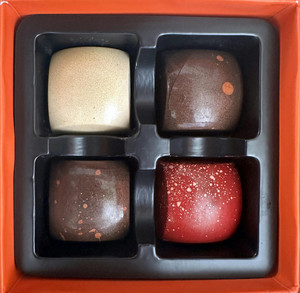
They sent us a box of four bonbons that were totally vegan.
The ganache inside is usually made with cream, but the dairy fat in these was Saver's air-made variety.
Amazing mouthfeel, totally delicious.
Beautiful piece of chocolate.
I don't know.
I don't have anything to complain about.
It's really good.
It's a little chocolate with a ganache center that tastes exactly like a chocolate with a ganache center.
Yeah.
I mean, the texture is like perfect.
10 out of 10 no notes on that.
As we said, Savor can make a variety of fats, but right now they can only make the saturated kind.
These are like animal fats and palm oil and coconut oil.
That's because these fats don't have the left and right-handed issue.
You absolutely can make unsaturated fatty acids.
You can make omega-3 fatty acids.
Those actually start getting you into that thing we talked about at the beginning.
You know how some molecules have left and right handed versions.
That's an issue with the omega-3 fatty acids.
At which point you need something like Air Company's special enzyme to make sure you only get the version you want.
So that is more complicated and definitely something for down the line.
But even so, just making saturated fat, that gives Savor both a huge market and an opportunity to have a really important environmental impact.
So our commercial and scale-up focus has really been on...
You see us talking the most about animal fats and tropical oils, because that's where the agricultural footprint is the largest for fats and oils.
And so our goal is about how do we shrink the footprint that we produce food for humans on and land being the literal version of that, but then also emissions and water and biodiversity loss.
And so palm oil fits into that equation.
Animal fats fit into that equation.
And those fats make up a lot of our industrial fat.
They're used in all kinds of processed foods, from ice cream to chocolate bars to packaged cookies.
Those customers are really important for us getting to impact and getting to scale.
Like if we want to make it so that we don't, you know, deforest like one more single acre of tropical rainforest.
Right.
Like those are the partners that we have to get on board.
So we are kind of first commercial facility is targeted to be able to compete directly on cost with companies milk, fat or cocoa butter.
So these are kind of higher priced, but still commodity fats and oils.
The idea is, if Savor can compete on price with milk fat and cocoa butter and get those clients, they can use that investment to scale and become less expensive, at which point they hope to be able to compete with palm oil, which is even cheaper.
While it might be a great idea to eat fewer of the kind of processed foods that contain these oils, in reality we're eating more of them.
We've talked about how incredibly destructive palm oil is on a previous episode, so replacing that in our food system has a lot of potential.
Overall, making food from air has a lot of potential benefits.
Clearly, in niche situations like outer space or the battlefield, it could be key to survival.
But for the rest of us it's an industrial solution that could make our industrial food supply more sustainable.
Kathleen and some academic colleagues recently published a paper in a peer-reviewed scientific journal trying to quantify some of these potential environmental wins.
One benefit is in terms of greenhouse gas emissions.
Making savers.
Fat does take electricity to power all those processes, and how their air fat compares to say, palm oil depends on whether they use renewable energy or not.
But for savers fat, the greenhouse gas emissions are already pretty much the same or lower than palm oil, even if they're just using electricity from the US grid.
If they can make saver using renewable energy and pull more carbon dioxide out of the air as one of their ingredients, then the emissions for each stick of butter could be negative.
When it comes to the land use question the issue that caught her co-founder's eye when he was looking out of the airplane the savings are dramatic.
It only takes about 2 of agricultural land to make a calorie of savor, as compared to a calorie of palm oil, which could lead to thousands and thousands and thousands of acres of forests being hopefully protected or rewilded.
But, as we've said, if you're using gases from the air to feed a microbe, to make something like Yoapeca's solar powder, that process of dissolving all the gases into the water your microbe lives in is very, very energy intensive.
So indeed, electricity is our main ingredient.
Well, it basically comes from the grid.
And that is, of course, the main input into our process.
In a different paper analyzing the benefits and challenges of this new technology, the authors say that if the entire electrical grid all over the world was used to feed protein-rich microbes like Sophie, all of that energy would only produce about half the calories that humanity needs.
Obviously, we wouldn't do that.
And also, we don't get all of our calories from protein.
But this gives you a sense that it would take a lot of energy to make this work.
Not only is it something we would never do, but it's also not even something we're close to being able to do.
Joapeca told us that his pilot plant can only make about 1,000 pounds of protein powder per day.
That's not nothing.
The company calculates it would take 50,000 hens to produce the same amount of egg protein.
But it's only enough protein for roughly 5,000 people at our current consumption levels.
It also means he's not at the scale where he can compete on the market yet.
Solar's protein powder is still niche and in development.
They need to eventually have a factory that can put out about 3,000 tons a year to be competitive.
Because it basically then enables us to be there in the whey protein price point, maybe even a little less.
Of course, for now, Yoapeca and Kathleen are still at very early days.
They're still getting approval to sell their products and their factories are still pilot plants.
But they are planning to grow.
We are scaling up.
You know, we've made it through our first regulatory approval.
We are in some restaurants and, you know, have these early commercial partners.
It's not necessarily going to be in the super near future, but they both think that you'll be able to find these food from air products in your grocery store someday.
Joapeca hopes his pathway forward will be like the company Korn.
They make vegan patties out of a fungus.
We here at Gastropod love them.
I've been thinking about it and kind of looking into their path.
The path of corn has been long.
They started looking for their fungus in the 1960s.
They found it in 1967, and then corn products didn't go on sale in supermarkets until all the way in 1985, nearly two decades later.
So that is, in my view, that is a realistic scenario for solar foods.
Okay, so maybe you shouldn't be anxiously checking their website to see when they're going to be showing up at a store near you.
This technology isn't as out there as it seems.
I don't know.
It's crazy.
But like everything that is in the early stages is, you know, it looks crazy and ridiculous.
And I think it's going to get there.
I know it's going to get there and it's going to be part of the buffet of choices that people will have to feed themselves.
The other thing that's important to remember is that buffet.
Because, even in a couple of decades' time, when your Oreos are made with savor rather than palm oil and your protein bar contains solar powder rather than whey, it's not like you'll be dining exclusively on food made from air.
Unlike Marcelin Daniel Berthelot, nobody today thinks food made from air will be all of the food we'll ever eat.
We actually think that agriculture is a very you know, is like going to be part of how we feed humans for a long time.
Like we don't have a way of making you a tomato and we don't want to live in a world that doesn't have tomatoes.
Two quick, exciting things for you listeners.
One, we have some new t-shirts for sale.
Just to let you know, this is not a fundraiser for the show.
This is just something you've all asked for so you can show your love around town.
You can find them at gastropod.dashery.com or on our website, gastropod.com.
Be sure to check out the different fit and style options for each t-shirt to make sure to get the best one for you.
And the second thing, we want your questions.
We're making another of our favorite Ask Gastropod episodes, and they are fueled by the things you want to know.
So email us at contact at gastropod.com with questions.
Whatever you're wondering about.
Thanks this episode to Bill Gergy Kathleen, Alexander Joao Pekka-Picken, Colin Tim and Montse Roman.
You can find links to their companies and research at our website, gastropod.com.
And thanks as always to our amazing producer, Claudia Geib.
We'll be back in a couple of weeks with yet another glorious episode for your listening delight.
Till then.