Aaliyah, wake up.
Joy, what are you doing?
It's 4 a.m.
The world waits for no one.
Carpe diem.
Good morning, good morning, good morning to you.
Ah.
I'm not a morning person.
Well, we have a full day of chores on the Forever Ago Ranch, and I don't want to waste a second.
We have chickens to pluck, lambs to shear, milk that needs to be milked.
Milking milk?
Don't think too much about it.
Do you hear that?
Is that music coming from the porch?
I can't hear anything.
I think you're imagining things.
I swear I heard a guitar.
Let's explore.
Give me a decor, give me a home where the G-Corp buffalo roam.
You were right, Aaliyah.
Hey there, friend.
What you doing?
Hey, y'all.
I'm Wally Tartan.
Rhymes with Dolly Parton.
I just got this guitar here.
Now I got to learn how to play it.
And this here is my dog, Nellie.
Woof, I guess.
Hey, Wally.
Nice to meet you.
You must be a real cowboy.
You've got the big rimmed hat, the shiny boots, and the vest with all the frills.
And they all match.
Stylin', Wally.
Oh, and what a cute puppy.
Heya, puppy.
Come here, Nellie.
Um, I will not.
Nellie, come.
No.
Ah, I see I've got my work cut out for me.
Nellie, come.
Come.
Make me.
Yeah, she's a bit stubborn.
It helps if you give her a reason to come over.
Oh, I know.
Nellie, if you come here, I'll give you lots of snuggles and cuddles.
Ugh, I'm not really a touchy-feely dog, so sorry.
How about a treat?
That's what I'm talking about.
Here I come.
Whoa, how did you do that?
I always carry a filet mignon steak in my pocket, just in case.
So tender.
Tastes like pocket.
Wow, I guess I'm a city girl.
To be honest, I never really lived on a farm.
I don't know the first thing about it.
Well, it seems like I have my work cut out for me.
Joy?
Aaliyah?
Come!
Welcome to Forever Ago, where we explore the before.
I'm Joy Dolo.
And I'm Aaliyah.
And today we're on the Forever Ago ranch, rustling up some history.
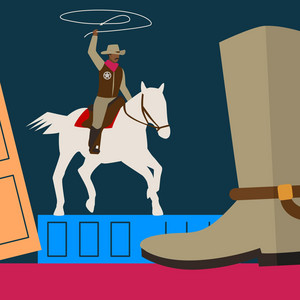
We're going to talk about the forgotten black cowboys of the Wild West.
These were rough and tough riders who explored the frontier and became the stuff of legend.
Yeah, back then, about one in four cowboys was Black.
The Wild West was full of people of color.
There were Chinese immigrants building railways and Native Americans who had lived all over the plains for thousands of years.
There were also the OG Mexican cowboys called vaqueros.
So how come we rarely see people of color in the American history of the Wild West?
Oh, wait a second.
Before we hightail into it, Aaliyah, I got a few questions for you.
What do you think about when you hear the term cowboy?
When I hear the term cowboy, I think of, like, Woody from Toy Story.
Absolutely.
He's like the best cowboy, right?
He's like the leader of the pack.
Yes.
I think of Woody and I also think of like, somebody who's like in the desert with a horse and who's riding and has a country accent.
Okay, so cowboys, we have Woody, Toy Story.
Have you ever been on a farm?
No, actually, I've never been on a farm.
But I feel like when I think of farms, I think of like the smell of the zoo.
Yeah.
And how would you describe that smell?
It's like manure.
Because in the Nashville Zoo, there's this area where you get to see like goats, llamas, alpacas and that.
That smelled like manure, but like other places, some other places didn't.
So I would think it would smell like manure because there was like Other things there.
It's like all the things that poop outside are there.
Yes.
What about horses?
Have you ever ridden a horse?
When I was little I went to a birthday party with a horse, but I was way too scared and I was like Mommy, oh my hand.
So I didn't really do it.
But I've been on a horse, and they're so soft and gentle.
My in-laws have a bunch of farmland up in Canada and one of them owns a bunch of horses, so we always go over there and say hi to them.
And every time I walk up to one, I'm like, I'm terrified.
I don't want to feed it.
You are bigger than the biggest thing I've ever seen.
They're kind of like dinosaurs that neigh.
Oh my gosh, yes.
Well, Aaliyah, we better get our day started.
We have a whole list of chores.
There you two are.
How about we saddle up some horses and head out to pasture?
Wally, is there another way to head out to pasture?
I got you, Joy.
I found some old scooters we can use.
I put ears on the handlebars, so it's like a horse, but safer.
All right.
Grab your scooters.
Hi-ho, scooter!
Away!
Hey!
Wow, look at that view.
Mountains as far as I can see.
And the grass is so green and hilly.
I want to roll down it.
I think I swallowed a bug.
Next on our list is to round up these horses.
They are so big, so horsey.
I'm not scared, you're scared.
I'm not scared.
Can we use our scooters?
Why don't we get some inspiration from hearing the tale of one of the greatest black horse trainers in history, Nate Love?
First, we need to go back to a different time.
A dangerous time when covered wagons carried families through the Western United States.
A delicious time when food wasn't kept in a fridge, but in an icebox.
Literally a box with one giant block of ice.
A rough and tumble time with no phones or computers.
And the fastest way to get mail was through the Pony Express.
Which was a guy riding a horse as fast as he could and then passing off mail to the next rider.
And even though they were riding real fast, it still took about 10 days.
Ma, it's here.
It's here.
A letter.
Quick, everyone gather around.
What's it say, sweetheart?
It says, I'd love to talk to you about your horse's extended warranty.
This was the American frontier in the 1800s.
You're rootin' tootin' right about that.
The American West offered folks a chance to farm their own land, herd their own cattle and create their own opportunities.
And there were a ton of black people in the American West.
Most had been moved out there as slaves and worked on the land with horses and cows.
Slavery was a horrible time for African people and their descendants.
They were forced to work for free farming, cleaning houses, tending to fields or anything they were ordered to do.
But one of the biggest rules was that slaves could not learn to read or write, because then they might start thinking for themselves.
But Nate Love was always a rule breaker.
Nate Love was born into slavery in 1854.
His father taught him to read and write.
And lucky for us, because he was able to write a book about all his adventures.
And we can read all about his life.
You should know, though, that folks say Nate Love's adventures are a bit far-fetched.
He writes about his childhood getting into trouble, sneaking around hunting rabbits and rock battles.
Wait, rock battles?
Is that a music thing?
Not quite.
This is more like a few kids would get together in teams and throw rocks at each other until once I'd quit.
Do not try this at home.
But Love would have to grow up soon.
In 1863, when Love was nine years old, Lincoln delivered the Emancipation Proclamation and declared all slaves in the US were free.
Not long after that, Love's father rented a piece of land from their old slave owner and the family started farming.
But then Love's father passed away.
And after just one year of freedom...
Love became the man of the house and he tried a variety of jobs to care for his family before he found his true talent of breaking horses.
Breaking a horse refers to breaking in a horse.
It's the process of training a horse to wear a saddle, take commands from a rider and, of course, to be ridden.
Woof.
Don't get any ideas.
This little doggie is unbreakable.
Most horses we see these days have already been broken in.
But horses that haven't been trained yet can be very dangerous.
They bunk and stomp and kick.
You can even get hurt if you aren't very skilled.
Love had some friends that offered 10 cents for every horse he could break.
10 cents was a lot of money back then.
Love broke 12 young male horses and suddenly he was making money left and right.
Now he was ready for an even bigger challenge.
Enter the roughest, toughest, horsiest horse to never be tamed.
His name, Black Highwayman.
He was a glamorous horse with an uncertain temper.
And the boys offered Love a huge amount of money to break him.
The most money Love could fathom.
An amount that would make him risk life and limb.
25 cents?
It was just too much money to turn down.
But Love asked to be paid before he rode this daredevil.
The boys put the horse in the stall.
Love climbed on top and held onto its mane.
And then they opened the gate.
And that horse took off faster than a jackrabbit on fire.
Love described himself as a leech, the way he held onto that horse.
Black Highway Man took him over tall fences, across farmyards, and even into another pack of horses.
But Love still held on.
Later, he wrote that it was a choice of breaking the horse or breaking my neck.
And he broke the horse, all for $0.25, which had fallen out of his pocket during the ride.
This wild ride convinced Love that he could ride any horse.
And he'd go on to use this skill to get his big break.
And that's where a guy named Johnson comes in.
You see, Johnson had this really strong, beautiful horse.
But that horse was as wild as they come.
So Johnson said anyone that can ride it could have it.
After taming Black Highwayman, Love thought this would be a piece of cake.
So he decided to give it a shot.
And when he climbed up onto that horse, he held onto its mane and didn't fall off.
He won that horse.
But he really needed the money.
So he sold it back to Johnson for $50.
That's a lot more than 25 cents.
Yeah.
He was trying to start a new life so he had to get adult stuff like new boots and groceries and a mortgage maybe for a house.
He needed that money.
So Johnson decided that he would make a bet.
Remember, he had just bought that horse back from Love for $50.
But he told him, if you can ride it, you can keep it again.
So what did Love do?
He rode it again and won it again.
And then Love sold it back to him.
Again.
Not sure why Johnson kept buying back that horse, but now Love had 100 enough to head west and start a new life, even though he was only 16 years old.
Love wound up in Kansas and, after showing off his horse riding skills to a band of black cowboys, he was hired on the spot and given the nickname Red River Dick.
He writes about his many adventures in his autobiography winning 200 at a rodeo, fighting Native Americans which is very problematic, but that's a story for another time fighting bad weather and buffalo stampedes.
This mix of danger and freedom is what he wanted.
Love went from being a slave to becoming free from his enslavers and then finally having the freedom to travel the American West.
From his rock battles on a plantation to his days rounding up horses, he was made to be a cowboy.
And he was black.
Nellie, where have you been?
We already went over to love being black.
Well, I missed you saying that.
While you were chatting up Wally, I rounded up all the horses.
I'm a roundup dog.
That's my main job.
Thanks, Nellie.
Good girl.
Let me give you some cuddles and snuggles.
Hold your snuggles there, Joy.
Remember, Nellie isn't a touchy-feely kind of dog.
Yeah, that's correct.
I believe love is a sign of weakness.
I respect your boundaries, Nellie, but I love you.
Woof.
Why don't we hop on our scooters and head out to the barn?
I believe I left a bone there that has your name on it, Nellie.
And someone has to feed the feral cats.
Feral cats?
Yeah, Joy.
How else do you keep mice out of the grain bags?
Listen, y'all.
I'm a city girl.
Mice?
Feral cats?
No, thank you.
Oh, come on.
Don't be a sourpuss.
Wally, Nellie, wait up.
Hi-ho, Scooter, away!
Kitty, kitty, kitty, kitty, kitty, kitty.
Kitty, kitty, kitty, kitty, kitty.
Oofta, this barn smells.
Woof.
That, my friends, is the smell of manure.
Ah, sweet manure.
Poop.
Great.
Yep.
Cow pie is as far as the eye can see.
My favorite.
Speaking of cows, we talked about the great horse trainer Nate Love and his adventures.
But did you know about the cowboy that was famous for kissing cows?
Kissing cows?
Ooh, yuck.
You must be talking about Bill Pickett.
He was an African-American and Cherokee cowboy who was also a movie star.
He was born in Texas in 1870.
Slavery had been abolished five years earlier, so he was allowed to go to school, but he wasn't into it.
Yeah, he left after fifth grade.
Fifth grade, that's when I learned my times tables.
Five times five is 25.
Five times six is 30.
Five times seven is 35.
Pickett left to start his career as a cowboy, and as he was out watching the longhorn steers of Texas, he started noticing how the farm dogs interacted with these huge animals.
When the dog barked up a fuss, the cows would get antsy.
But some dogs would bite on the cow's upper lips and the cow would just freeze.
They'd let the dog lead them to the ground.
So, Pickett thought, maybe I can do what this dog does.
Eventually, he figured out how to tame cows in three easy steps.
First, he'd ride his horse super fast.
Then, he would jump off of it.
Finally, he'd grab the cow's head and bite the upper lip.
Then he'd fall backwards, wrestling the cow to the ground.
Yuck!
Pickett called it bulldogging, and folks would pay good money to see it.
He was able to travel around to different rodeos doing this trick.
Pickett and his brothers even invented their own rodeo show that traveled the world.
He became so famous, Pickett even appeared in silent movies all about bulldogging.
And he was black.
Good dog, Nellie.
So there were black cowboys in films.
Oh, no.
The feral cats.
Y'all can go and get out of here.
I got this.
Come on, Aaliyah.
We'll get back to the movies in a bit.
While they round up those cats, maybe we should play a round of...
This is the game where we try to figure out what order things came in history.
Today's items are cowboy-themed, obviously.
We've got ranch dressing, the Stetson cowboy hat, aka your classic 10-gallon hat and the mechanical bull.
Okay Aaliyah, which do you think came first, which came second and which was most recent in history?
Well, that's confusing.
Ranch.
Ranch.
Ranch dressing?
Do you know those like hats, those like big 10-gallon hats?
Have you seen those before in cartoons?
10-gallon?
Yeah, they're like you know, like you have the brim, the outer layer of the hat, and then like the middle part, that's like super high.
Oh.
Yeah, yeah.
They call that a 10-gallon hat or the Stetson cowboy hat.
That kind of reminds me a little bit of one of the Looney Tunes.
Exactly, yeah.
I feel like the 10-gallon hat would be because, like, I feel like it's been around for so long.
Yeah?
I don't know why I just feel like it, because when I think of like cowboy, I think of like a while ago.
But I'm not sure.
Yeah, yeah, I think that's a solid guess.
I'll take that.
Yeah.
I think it's the 10-gallon hats and then the ranch dressing.
Oh, the ranch dressing.
Okay.
All right.
So why do you think ranch dressing?
Because I feel like ranch dressing would be.
I don't know if it said 18-something or 19-something.
You know how it says, like, we've been making this since this yada, yada, yada.
Yeah, yeah, I do.
I've seen that before on other, like, food items.
Yeah.
I just feel like that's it.
And then the electric bowl things.
The mechanical bull?
Yes.
Those are so intense.
I've seen them, like, go on full level.
Like, I would get dizzy and fall off.
I would never do it because I've never broken a bone in my life and I don't plan on trying to do that now.
Oh, me either.
No mechanical bulls for us.
No.
But you're right.
You said something interesting about, like, electricity.
So I wonder, however it's run, that it would probably be the most recent in history if it needed that right.
Yeah.
Yeah.
I think those are fabulous guesses.
So we have the 10-gallon hat as the oldest.
Next up is ranch dressing.
And the most recent in history is the mechanical bull.
We'll hear the answers at the end of the episode right after the credits.
So keep listening.
Welcome back to Forever Go.
I'm Aaliyah.
And I'm Joy.
Aaliyah, I am exhausted from all these chores.
We did yoga with the pigs.
We challenged a chicken to a duel and lost.
We made sandwiches for the goats, taught the horses horse algebra and combined all the combines into a super combine harvester.
We are going to harvest so hard this year.
Yeah, we're going to eat so much corn.
Woof.
Hey Nellie, what is it?
Woof woof.
Timmy fell in the well?
Woof.
Did you eat my homework?
No, homework has too much fiber.
No, I'm barking because we're almost done with chores for the day.
Thank goodness.
I wasn't sure I could last another minute.
I respect all farmers.
This is hard work.
Don't worry.
I'll help you finish.
Like I always say, to have a friend, a dog must be one.
That's very insightful, Nellie.
Thanks.
It's one of my favorite quotes by the Lone Ranger.
Oh, yeah.
The Lone Ranger was a super popular old TV show in the 1950s and 60s.
The title character was a cowboy who fought outlaws in the American West.
He always wore a mask, but he was also known for going in disguise and arresting outlaws.
The Lone Ranger was created for the radio first in the 1930s, and the show was an instant hit.
By 1939, 20 million Americans were tuning in every week to listen to his adventures.
And he went on adventures with his Native American friend, Tonto.
He rode a horse named Silver and had a catchphrase, Hi-ho, Silver, away!
As cool as this guy is, we're getting a bit off topic.
Today's episode is about black cowboys.
Actually, it's perfectly on topic, Joy, because the Lone Ranger sounds a lot like Bass Reeves.
You're right, Aaliyah.
Bass Reeves was the most famous Black deputy of the West.
Reeves was also born into slavery, but wasn't there long.
He escaped during the Civil War and lived with Native Americans.
He was among them so long he learned several of their languages.
But in the late 1800s, there was a problem, and it was in Oklahoma.
The US government was removing Native Americans from their homes and forcing them to move to the central US.
This area was also home to freed slaves, white settlers, and outlaws.
We call it Oklahoma today, but back then, they called it Indian Territory.
And this area had its own police that only handled cases involving Native Americans.
So the police in Indian Territory had no official power over non-Native Americans.
And this area was huge.
It covered thousands and thousands of miles.
These things made Indian Territory a great place for outlaws to hide out, and it could be very dangerous there.
But Bass Reeves was on the case.
Reeves was working as a farmer when the government hired him, along with 200 other deputies, to go arrest outlaws hiding out in Indian Territory.
He couldn't read or write, so he would memorize the pictures and signatures of the outlaw he was looking for.
Reeves was 6'2, a big guy with a giant handlebar mustache, so he added a little razzmatazz to the job and he used some unconventional tactics.
Like when he was hunting down criminals.
He would dress up like a regular person, down on their luck or another outlaw.
Like an actor.
In one of Reeve's adventures, he put on ripped up clothes with bullet holes in his hat.
Then he walked 30 miles to an outlaw's house.
Please.
I'm so hungry.
So thirsty.
Oh, you poor thing.
Come on in.
This woman gave him a place to rest until her sons came home.
Mama, we're home.
We spent all day breaking the law and we're hungry.
We need some grub ASAP.
After a big meal, the outlaws fell asleep.
And while they slept, Reeves handcuffed them.
When the outlaws woke up, they were well-rested and arrested.
Reeves brought them to jail.
Ah, come on, Mr. Reeves.
I haven't even had my griddled corn cakes and coffee yet.
Sorry, outlaw.
The only thing you'll be eating is pie.
Justice pie.
Reeves was really good at his job.
Most deputies brought in two or three outlaws at a time.
He brought in a dozen.
He arrested over 3,000 people during his career.
And he was known for being fair.
He arrested anyone who broke the law.
He arrested white people for attacking black folks and even brought his own son to jail.
Sometimes his adventures sound like movies, which is why some people argue that the Lone Ranger television show was based on the real life of this black cowboy.
Bass Reeves was a Texan.
The Lone Ranger was a Texan.
Bass Reeves worked in disguise.
The Lone Ranger worked in disguise.
Bass Reeves worked side by side with Native Americans.
The Lone Ranger had a psychic, Tonto.
Even if we'll never know for sure if Reeves was the inspiration here, we do know that Black people and Black history in the West have been erased over time.
A lot of early movies didn't feature real Black actors.
Instead, white people would dress up as Black people wearing dark makeup.
We call that Blackface.
Other movies made the old Southern life of slavery and Black people serving white people seem romantic like Gone with the Wind.
This makes it seem like Black people were not brave, courageous, daring, or adventurous.
It erases the idea that we were humans living in the American West and that we were heroes, too.
And the more that films told this story, the more people began to imagine the Old West without us.
But some people are working to change that story and show that Black people have always been cowboys.
People like the Compton Cowboys.
Compton is a city near Los Angeles, California.
The Compton Cowboys are a group of black horse riders that teach young people how to ride horses.
They help empower inner city kids and combat negative stereotypes.
Then there's the Sisters with Horses Saddle Club.
In Charlotte, North Carolina.
They share the love of horseback riding with other people of color in their community.
And there are black cowboys still in the rodeo, too.
Every year the Bill Pickett Invitational Rodeo travels all around the country showcasing black cowboys and cowgirls.
And in music, people of color are embracing the genre of country.
Lil Nas X hit song, Old Town Road, topped the charts in 2018 and was labeled Country Rap.
A Black husband and wife duo named The War and Treaty were nominated for the Best Duo at CMT Country Music Awards.
The world of Black cowboys is finally starting to get the attention it deserves.
Hey, y'all.
Speaking of attention, there's some chores needing yours.
Specifically, a whole load of manure that needs shoveling.
You coming?
Quick, Joy.
Get the scooters.
I think we've had enough farming for one day.
Agreed.
That's all you, Wally.
I need an iced frappuccino.
Later.
Night Love.
Bill Pickett and Bass Reeves are just a few examples of the many Black cowboys of the Western frontier.
These Black men redefined freedom.
After the Civil War, they used their knowledge of the West and their many, many talents to create a new story for themselves.
Whether they were training horses, kissing cows or arresting bandits, they had incredible adventures.
And their stories should live on.
They lived during a time when it was really hard to be a black man.
They conquered their own fears and became legends.
And I have to say, I admire them.
One day on the farm and my dogs are barking.
Put your feet up, Joy.
Enjoy your frappuccino.
Oh no, it's the rare cat.
They found us.
Run!
Hi-ho, Scooter!
Away!
This episode was written by me, Joy Dolo, with production help from Molly Bloom, Anna Goldfield, Rosie DuPont, Ruby Guthrie, Anna Wagle and Nico Gonzalez-Whistler.
Our editors are Shayla Farzan and Sandin Totten.
Sound design by Rachel Breeze.
Theme music by Mark Sanchez.
Beth Perlman is our executive producer.
We had engineering help from Derek Ramirez and Anna Haverman.
The executives in charge of APM Studios are Chandra Kavadi, Joanne Griffith, and Alex Schaffert.
Have a topic that you really want to know the history of?
Send it to us at foreverago.org slash contact.
Okay, Aaliyah, ready to hear the answers for First Things First?
I was born ready, Joy.
Let's do this.
Great.
Okay, so just a reminder the oldest thing was the 10-gallon hat, the second was ranch dressing and the third was mechanical bulls.
Hi-ho answers, away!
Oh my goodness.
Okay.
I'm scared now.
No, no, you were actually the very first one.
You were right.
The first, the oldest thing is the 10-gallon hat or the Stetson cowboy hat.
That was from the 1860s.
So this dude, John B. Stetson, was born in 1830 in New Jersey, where his father was a hat maker.
He worked in his father's shop learning how to make hats and eventually he decided to move out west.
And, according to legend, Stetson invented the hat while on a hunting trip, as he was showing his buddies how he could make cloth out of fur without tanning it.
Tanning essentially means it's how animal hides are preserved so they can be used in clothing.
It's time-consuming, messy, and smelly.
It's a whole process.
Ew.
Now, in 1865, Stetson headed back east and started his own hat-making company in Philadelphia.
He later decided to create a felt hat based on his experiences in the American West, which he called the Boss of the Plains.
The Boss of the Plains should have their own song.
So you were right about the hat.
Good job.
You're super smart.
Thank you.
Now, second, you said ranch dressing and that wasn't right.
Second up, and it's okay, but it's okay.
Next up was mechanical bulls.
So that was invented in the 1930s.
And so I guess a mechanical bull, also known as a bucking machine, is a device that replicates the sensation of riding a bucking animal like a rodeo bull.
Like kind of what we were talking about.
It seemed kind of scary, right?
Sometimes there's just a saddle that moves, but usually it's just a fake bull that riders sit on.
Mechanical bulls can be ridden at different speeds and intensities from gentle spinning for beginners.
I would like that.
To full on rocking and jumping for rodeo experts.
I would not like that.
Yeah, I think if it was higher than medium, I would have Whiplash.
Yeah, yeah, me too.
And last but certainly not least is Rant Dressing, which was from the early 1950s.
Whoa.
Wow.
Yeah.
The original recipe for ranch dressing was created by a plumber named Steve Henson while he was working as a construction worker in Alaska.
It was really hard to find fresh ingredients there.
Oh, so he came up with a recipe for a ranch dressing around 1950.
A few years later, Steve and his wife moved to California and bought a ranch which they named wait for it Hidden Valley.
Whoa.
Totally worth the wait, right?
He served his dressing to guests at the ranch and it quickly became so popular that he started selling it to a local restaurant.
And by the late 1950s Steve was selling his special Hidden Valley Ranch dressing as a dry mix by mail for 75 cents a packet, and every room in his house was devoted to the business.
Eventually, the dressing business totally overtook any business from the ranch itself.
That's nuts!
I know.
I mean before you explained it, my brain was like okay, how are you a plumber, construction worker and you're worried about ranchers?
He's like a jack of all trades.
He was a construction person and he had a ranch and he was making sauce.
He's basically the men version of Barbie because he has so many jobs.
Yeah.
He's ranch dressing Barbie.
We'll be back next week with an episode all about the history of The Weeknd.
Thanks for listening.