
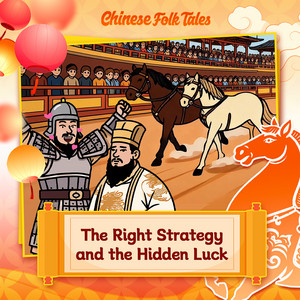
[Strategic Wisdom and the Fluidity of Fate: Lessons from Ancient Horse Tales]-[Year of the Horse Special | The Right Strategy and the Hidden Luck]
📋 Summary
Strategic Intelligence and the Nature of Fortune
This podcast episode delves into two foundational stories from Chinese history, utilizing the metaphor of horse-related events to illustrate profound insights into strategic thinking and the unpredictable cycles of life. By analyzing the tales of Tian Ji and the Frontier Old Man (Sai Weng), we can extract timeless wisdom applicable to modern challenges.
The Art of Strategic Sacrifice: Tian Ji’s Horse Race
The first narrative focuses on Tian Ji, a high-ranking general in ancient China who struggled with a recurring defeat in horse racing. His predicament was a classic case of resource disparity: his opponent possessed horses that were "slightly better in every category"—top, mid, and lower tier.
Redefining the Rules of Engagement
Tian Ji’s consultant, the brilliant military strategist Sun Bin (a descendant of the legendary Sun Zi), identified that the general was losing because he was "matching the best with the best." Sun Bin’s intervention proves that when one cannot compete in strength across all fronts, one must become the "strategic architect of our own fate."
The Mechanics of the Win
Sun Bin orchestrated a counter-intuitive strategy that prioritized long-term victory over immediate parity:
- Round One: He pitted Tian Ji’s slowest horse against the competitor’s fastest, resulting in a "deliberate crushing loss."
- Round Two: Tian Ji’s best horse faced the competitor’s second-best, securing a "solid win."
- Round Three: Tian Ji’s second-best horse outperformed the competitor’s slowest, yielding another win.
By sacrificing a "small battle" in the first round, Tian Ji secured the overall victory. This serves as a powerful reminder that "winning the big game" often requires the ability to see the "whole board" rather than focusing solely on the immediate sprint. It teaches us that resourcefulness and "smart thinking" can overcome even the most daunting objective disadvantages.
The Fluidity of Fate: The Story of Sai Weng
The second tale shifts from the tactical to the philosophical, introducing the Frontier Old Man (Sai Weng). His story addresses the human tendency to label events as strictly "good" or "bad" luck, proposing instead that life is a "suspenseful mystery box."
Misfortune as a Blessing in Disguise
The narrative follows a cycle of events:
- The Loss: Sai Weng’s horse runs away. Neighbors lament his "bad luck," but he remains composed, questioning if the loss might actually be a "good thing."
- The Gain: The horse returns with a magnificent steed. Neighbors celebrate the "incredible luck," but Sai Weng warns that this gift might bring trouble.
- The Consequence: Sai Weng’s son breaks his leg while riding the new horse. Neighbors pity him, but he remains unfazed.
- The Ultimate Outcome: War breaks out, and the son is spared from the draft due to his injury.
This story illustrates that "misfortune may be a blessing in disguise." It challenges us to maintain an "open and calm mind" when faced with life’s turbulence.
Conclusion: Integrating Strategic Wisdom
The synthesis of these two stories provides a dual-layered approach to navigating life. From Tian Ji, we learn the value of being a strategic architect—actively changing the situation of the race when the odds are stacked against us. From Sai Weng, we learn the value of patience and perspective—recognizing that "good things can turn bad" and "bad things can also turn good."
Ultimately, wisdom lies in knowing when to intervene with calculated strategy and when to trust that "the race isn't over yet." Life is an adventure full of unknowns, and by avoiding being "overjoyed or upset by temporary gains or losses," we can better navigate the unpredictable flow of fate.
Deep Learning with ListenLeap


