Grownups, Wondery Plus subscribers can listen to Wow in the World early and ad-free right now.
Join Wondery Plus in the Wondery app or Wondery Kids Plus on Apple Podcasts.
Hey, Wowzer fans, Mindy here.
And before we start the show, I gotta let you know that this November, with a special new episode featuring our friends at Circle Round and Terrestrials on Radiolab for Kids,
And don't miss when Elmo from Sesame Street stops by Wow in the World to make us all belly laugh on November 24th.
Oh, but that's not all, Reg.
On December 1st, we are sharing our 250th episode of Wow in the World with all of you.
We think this one is going to be music to your ears.
Literally.
Did I mention it's a musical?
And if you're a member of the World Organization of Wowzers...
Oh boy, do I have a surprise for you.
You can listen to our 250th episode early with me and other members from around the world on Saturday, November 22nd, at 7pm Eastern.
That's right, we are throwing another listening party.
Join us as we dance along to our new songs.
React to the episode with other members in the chat and more.
Grownups.
If you want your wowzer to join this members-only listening party, you can sign up to become a member today at Tinkercastcom.
Slash wow.
Already a member?
Well, you can find the link and password to join the event when you sign in at Tinkercastcom.
Slash wow.
That's it.
It's going to be a November to remember.
But for now, let's get on with the show.
Woo!
I don't know what you've been told, but we're in a golden age.
So many discoveries that are jumping off the page.
Ah, what a lovely day for a Beach trip.
The sun is out, my 70 SPF sunscreen is on, and Mindy is nowhere to be seen.
Where is she?
We said to meet here at 10 o'clock.
Okay, Reggie, hand me that bucket and shovel, please.
No, Reggie, not that bucket and shovel.
The other one.
The one that looks like a goldfish.
No, the other one that looks like a goldfish.
Hey, Chief Horse, you're served.
You sure you're ready for this, old man?
Oh, yeah, dude.
I was born ready.
Well, watch out, Fingerling, because here comes the smack attack.
Oh, Chief Horse.
I told you to watch out.
Well, I'm sure Mindy will show up soon.
In the meantime, I think it's about time I got started on my book.
A History of Elbow Patches and Their Uses.
I don't know if there's such a thing as the perfect beach read, but I think this one comes pretty close.
Let's see here.
Chapter 1.
Elbow Patches and the Pharaohs.
Wow.
What in the... appeared in mid-air!
What?
My sandcastle!
Fine.
Our sandcastle, whatever!
I'm soaked!
My book!
I made it!
Mindy! in the wow machine.
You completely soaked my book.
Oh, sorry, Guy Raz.
I'm still trying to get the hang of those water landings.
I can see that.
But now that I'm here, we can get going.
Get going?
Get going where?
To the nursery, Guy Raz.
Why'd you think I asked you to meet me at the beach?
Uh, I thought we were having a nice, relaxing day on the beach.
You mean just sitting around in the sun doing nothing?
Yeah.
I was building a sandcastle.
Reggie, you are not lead architect.
Yeah, like I said, sitting around doing nothing.
Well, why did you bring us all to the beach then, Mindy?
Oh, I brought you to the beach for science.
For science?
Yeah.
I'm not getting it, Mindy.
You don't have to get it, Guy Raz.
All you have to do is trust me completely and get into the wow machine.
But... Now, come on, Guy Raz.
Anything for science?
Ah.
Anything for science.
Yay!
Who else is in?
Oh, me!
Me, me, me, me!
I want to come!
Okay, Reggie and Dennis are in.
Come on, get in the wow machine.
Hooray!
Wow machine!
Wow machine!
Wow machine!
Thomas Fingerling?
Grandma G-Force?
You want to come?
Well, I gotta stay back and teach Fingerling a lesson in volleyball.
What?
You couldn't teach me a lesson if you chose...
I'm sorry.
You were saying what, Fingerling?
Nothing.
Okay, well, uh, try not to get too violent while we're away.
Don't hurt each other or anything.
No promises.
All right, come on, Guy Raz.
Hop on in.
All right.
Okay, everybody got their seatbelts on?
Yep.
Yes.
Great.
Now let me just switch the wow machine into submarine mode here.
Wow.
Oh, no.
Mindy, there's a massive leak in the side of the wow machine.
Don't worry, Guy Raz.
Let me just get out my gum here.
Chewing, chewing, chewing, chewing.
Mindy.
Oh, wow.
There, that should hold it.
Should hold it?
Now, where was I?
Oh, yeah, everyone, hold on to your butts.
We're going down.
Ooh.
So, Mindy, can you remind me again about where we're heading?
We are heading to the nursery, Guy Raz.
Oh, right.
A nursery?
You mean like for babies?
Yep, but not the kind of babies you're thinking of, Dennis.
Oh, really?
What kind of babies am I thinking of?
Uh, baby dentist babies.
Small, pudgy, two arms, two legs.
Those are the babies I was thinking of.
Yeah.
Well, these babies in the nursery that we're going to have eight arms suckers and live at the bottom of the ocean.
What?
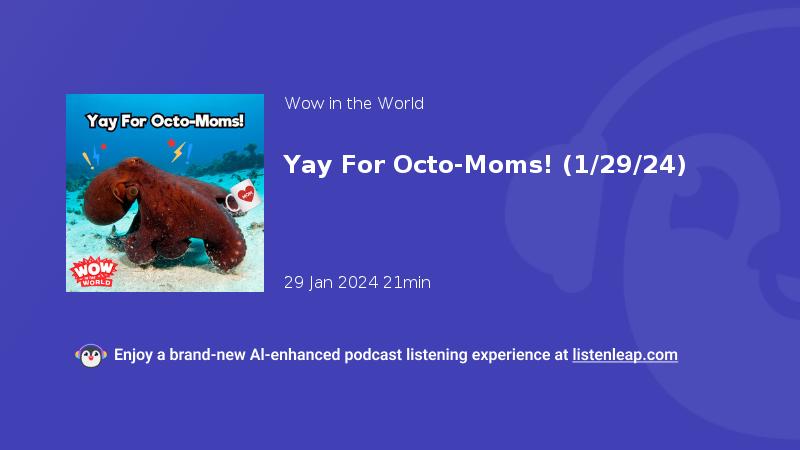
Because the babies in this nursery are octopus babies.
Octopus babies?
Yeah.
It's known as a brooding ground. and it's where mama octopuses go to give birth.
Really?
Yeah, and there are baby octopuses as far as the eye can see.
Scientists estimate that there could be as many as 20,000 octopuses down there.
20,000?
Uh-huh.
Oh, wow.
But what makes this spot on the ocean floor such a hot spot for octomoms?
Well, Guy Raz, it all has to do with the temperature.
The temperature?
Yeah, and we should be getting to just the right depth now for me to show you what I mean.
Let me just roll down the window here.
Huh?
Wait.
Uh-oh.
I can't wet in here.
We just drain the cockpit real quick.
And now where was i?
You were telling us about the water temperature.
Oh right, yeah.
So uh, if we take a look at this here thermometer, we can see that the water is.
Can anyone tell me the temperature of the water?
Uh, I don't know.
I only know how to read Canadian temperatures.
What?
Canadian temperatures, you know.
Celsius.
Oh, got it.
Um, can you read the thermometer, Guy Raz?
All right, let's see here.
Huh.
52 degrees Fahrenheit.
Which is 11 degrees Celsius in Canadian temperatures.
That's right, Dennis.
I don't understand, Mindy.
What's the significance of this water being 52 degrees Fahrenheit?
Well, if we just rewind this thermometer here, What in the?
We can see that the temperature is dropping.
Oh, yeah.
Look at that.
The temperature now reads 35 degrees.
Which is 1.5 degrees Canadian.
Exact Doritos.
The surrounding water is much colder.
But down here, it's pretty nice and warm.
I don't understand, Mindy.
I would have thought that the lower down you go, the further away you get from the sun, the colder it would get.
Well, normally that would be the case, Guy Raz.
But this place? is special.
You see, this part of the ocean floor is heated by underwater volcanoes.
And that hot magma from the volcano running underneath here heats the surrounding water on the sea floor.
You're picking up what I'm putting down, Guy Raz.
And presumably, these octomoms like warmer waters for giving birth.
You tell me.
The octonursery should be right over this ridge.
Whoa!
Oh, yeah.
Mindy, there's thousands of them.
They look like fleshy little soccer balls with long arms and suckers.
I have never seen so many octopuses before.
I think this might be the most octopuses anyone has ever seen.
What do you mean?
Well, when scientists first discovered this brooding ground back in 2018, it was the largest group of octopuses ever recorded.
Wow.
So why are so many of them here?
Well, because the warm water helps to shorten the octopus's gestation time.
Gestation time?
I don't know what time it is at the station.
Oh, boy.
Fine.
I'll guess 5 o'clock.
No, no, no.
Not gestation time, Dennis.
Gestation time.
It means the amount of time that it takes for the octopus baby to hatch out of its egg.
Ah.
Exactly.
And these scientists found that these higher water temperatures were able to cut down the octopus's gestation time by as much as four times.
Whoa, that's so much faster.
No wonder all these octomoms come here.
And so I'm guessing that a shorter gestation time means that their eggs have a higher chance of hatching and being healthy too.
Exactly.
But do you know why?
No.
Why?
Well, it's because of a strange behavior that the octomoms do when they're waiting for their eggs to hatch.
Well, what is it?
What's the behavior, Mindy?
Oh, is it raiding?
Reading?
Yeah, like reading a book.
How is reading a strange behavior, Dennis?
Well, have you ever seen an octopus mom read before?
I guess I haven't.
That's right.
No, it's not reading.
The strange behavior is starving.
Starving?
Yeah, for the entire time that these octopuses are waiting for their eggs to hatch, they won't eat anything.
They just sit around and watch over their eggs, protecting them from predators.
I know that moms are always sacrificing, but that's wild.
No food for the entire time their eggs are gestating?
Yeah, which is usually around four years, but it can be up to eight years.
Eight years with no food?
What?
I can't go eight minutes without food.
Speaking of which, get this here, and...
Dennis, is that a sandwich?
No, it's a hoagie.
Oh, okay.
How can these octopuses go eight years without food?
Well, they can't.
What do you mean?
Well, most of these octomoms don't make it through this breeding process.
They make the ultimate sacrifice for their babies.
They die?
Yeah, and they use their bodies to protect their eggs from predators.
Oh!
That's pretty gruesome, Mindy.
I know, right?
And so I'm guessing the shorter they're able to make their gestation period, the longer they're able to stay alive to protect their eggs.
You got it.
Now it makes sense why there are so many octopuses here.
Warm water means less time for your eggs to hatch, and less time for your eggs to hatch means more chances for your octobabies to survive.
Exactly.
Over there!
What is it, Dennis?
That octo-egg is octo-hatching!
Where?
Just there!
Oh, wow!
Mindy, see if you can get a bit closer.
You got it, Captain.
Turning, turning, turning, turning.
Oh, oh, just there, Mindy.
Easy easy, easy debating.
Octopus translator.
Octopus translator, it's happening, it's happening.
Oh sorry sorry, sorry.
Wow in the world, we'll be right.
This message is for you.
Hey, grownups.
It's Mindy and Guy Raz here from Wow in the World.
Mindy and I have some brand new Wow in the World toys out in the world just in time for the holidays.
Made for the kids who love science and for the ones who don't yet.
From our 100 experiments, that Wow kit to the telescope and astronomy kit.
Our Wow in the World toys help your wowzer learn about their world through play.
Play?
You can hear exclusive audio content from me and Guy Raz to help your wowzer discover even more wows.
Grownups.
Give the gift of wow and wonder this holiday season with our latest Wow in the World toys designed with your curious wowzer in mind.
You can shop our Wow in the World toys at Tinkercast.com slash toys.
That's Tinkercast.com slash toys.
Hi, my name is Taylor.
I live in Camas Washington, and my wow in the world is that octopuses can change the texture of their skin to camouflage.
Hi, Mindy and Guy Raz.
My name is Hannah, and I live in Brooklyn, New York.
My wow is that a chameleon has a third eye.
Say hi to Reggie for me.
Hi, my name is Keza.
I live in San Antonio, Texas, and I'm nine years old.
My wow in my world is that a cloud can weigh around a million tons.
Hi, I'm Indian Guy Roz.
My name is Marcus.
I live in Los Angeles California, and my wow in the world is that there are more stars in our universe than grains of sand on Earth.
Say hi to annoying Guinness Grandma G-Force, and Reggie for me.
Ahoy there!
Oh yeah!
Bye.
I love your show.
Hi, Wow in the World.
My name is Miranda, and I live in Reno, Nevada.
My Wow in the World is that in New Zealand, there are more sheep than people.
Say hello to Dennis for me. pounds of bamboo each day.
Bye-bye.
Hi, my name's Guy Raz.
My name is Vera.
I am nine years old, and I live in San Antonio, Texas.
And my wow in the world is that the human body has around 37 trillion cells.
Say hi to Reggie for me.
Bye.
Hi, my name's Guy.
My name is Tenzin.
Mr. Colorado.
I have a special Wow in the World for Reggie.
Homing pigeons can find their way back to the nest from 1,300 miles away.
Bye.
Love your show.
Woo-hoo-hoo-hoo-hoo!
End of messages.
Wow in the World is written by Mindy Thomas and Tom Van Kalken with help from me, Guy Raz.
Original sound design and music editing is done by Tyler Thole with help from our supervising producer, Jed Anderson.
You can also hear Jed Anderson in the voices of Dennis Thomas Fingerling, Reggie and many of the other silly characters that you hear on our show.
And Lizzie Freilich can also be heard as some of the silly characters on our show.
Jessica Bode keeps our facts straight as our fact checker and Meredith Halpern-Ranzer powers the wow at Tinkercast.
Our theme song was composed and performed by three-time Grammy nominees, The Pop-Ups.
Find them at thepopupscom.
Special thanks to Kit Ballinger, Rebecca Caban, Dr Natasha Crandall, Kenny Curtis, Kristen Yang, Thuy Mac, Erica Medina, Henry Moskal, Jodi Nussbaum, Ali Paksima, Linda Rothenberg, Steph Sosa, Joanna Weber, Anna Zagorski and all of the other tinkerers at Tinkercast HQ.
And to keep the wow rolling at...
And learn about some of the other amazing podcasts from Tinkercast.
Grownups, you can follow Wow in the World on Facebook, Instagram, and Twitter at Wow in the World.
And our email address is hello at Tinkercast.com.
And if you're a kid with a big wow to share with us, call us at 1-888-7WOW-WOW for a chance to be featured at the end of our show or an upcoming episode of Two.
What's in a Wow?
Thanks again for listening.
We're here every Monday or you can check out Two What's in a Wow every Friday right here in the Wow in the World podcast feed.
And don't forget, we wow on the weekend with Dennis, Saturday and Sunday.
Keep on wowing!
Wow in the World was made by Tinkercast and sent to you by Wondery.