This message comes from NPR sponsor Capella University.
Interested in a quality online education?
Capella is accredited by the Higher Learning Commission.
A different future is closer than you think with Capella University.
Learn more at capella.edu.
True story.
A couple of years ago, American Girl introduced a pair of new historical characters from wait for it 1999.
The dolls' accessories were as Y2K as they could possibly get a tamagotchi, a purple inflatable chair, a portable CD player.
Basically, my 11-year-old life.
I felt so old when I saw that.
Now we're officially a quarter century into the 2000s, and it's our turn to be a little bit nostalgic here on NPR's Pop Culture Happy Hour.
We're going to try to pinpoint the essence of that period when teens ruled the culture.
Viral internet memes first became a thing and everyone was freaking out about stocking up on duct tape.
I'm Aisha Harris, and today we're debating what's the most definitive piece of Y2K pop culture.
This message comes from Apple Pay.
Forget your wallet.
It's all good.
Because, with Apple Pay, you can pay with a simple tap of your iPhone, the wallet you never forget, at millions of places worldwide, including websites, apps and anywhere you see the contactless symbol.
Security is built in with Face ID, so you don't have to worry about your cards getting lost or stolen.
And the best part, you still earn the card rewards, points, and cash back you love.
So say goodbye to the buy fold.
Add your card to Apple Wallet and start paying the Apple way.
Terms apply.
This message comes from Schwab at Schwab.
How you invest is your choice, not theirs.
That's why, when it comes to managing your wealth, Schwab gives you more choices.
You can invest and trade on your own, plus get advice and more comprehensive wealth solutions to help meet your unique needs.
With award-winning service, low costs and transparent advice, you can manage your wealth your way at Schwab.
Visit Schwab.com to learn more.
This message comes from NPR sponsor Capella University.
Sometimes it takes a different approach to pursue your goals.
Capella is an online university accredited by the Higher Learning Commission.
That means you can earn your degree from wherever you are and be confident your education is relevant, recognized and respected.
A different future is closer than you think with Capella University.
Learn more about earning a relevant degree.
This message comes from Wise, the app for using money around the globe.
When you manage your money with Wise, you'll always get the mid-market exchange rate with no hidden fees.
Join millions of customers and visit wise.com.
T's and C's apply.
Joining me today is Christina Tucker.
She's the co-host of the podcast, Wait, Is This a Date?
Hello, Christina.
Hello, hello.
Thrilled to be here.
Thrilled to have you here.
Also with us is culture writer, Margaret H. Wilson.
Hello, Margaret.
Hi, Aisha.
Delighted to be here.
It's so lovely to have you.
And making their Pop Culture Happy Hour debut.
I am so excited.
Is the host of the podcast, Pop Pantheon DJ Louis XIV.
Welcome to the show, Louis.
Ayesha, this is a true honor.
Thank you so much for having me.
It's so great to have you here.
So we're here to argue for the piece of culture that we think best captures the spirit of Y2K.
And for our purposes, we're going to be defining the Y2K era as being bookended by two very arbitrary but monumental cultural moments the international launch of the Tamagotchi in May of 1997 and the shutdown of Napster in 2001.
So whatever we chose had to fall within that time period.
Christina, I'm going to start with you.
Tell us what is your pick?
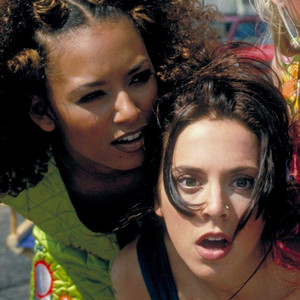
Folks, it's spice world.
It's the movie spice world.
I consider doing the album spice world.
But when I thought about the film spice world, there were some obvious things that made it very Y2K culture to me.
One, the fashions.
Yeah.
The fashions are extremely of the Y2K era in a way that I find so comforting and takes me simply right back to being an 11-year-old once again.
The notion of girl power, huge for Y2K.
I don't know what we had happening in the culture, something that I'd love to bring back maybe.
But for me, the most definitive thing that makes this Y2K culture is the way the paparazzi are obsessed with stalking those girls.
And to me, that spooky man is like one of the horsemen of like the apocalypse.
Right.
And then like right on his heels is, you know, we've got Perez Hilton coming down the line.
You know, Dumois is coming later.
I think the way they talk about privacy and what we demand from celebrities as people, it was just like a shockingly prescient way of thinking about what pop culture would become.
And for me that makes it fascinating, very definitive of Y2K culture, because Y2K and paparazzi culture, baby tight as heck.
I mean, that was also, 97 was the same year as the death of Princess Diana, right?
And that had its own paparazzi storyline.
Yeah.
Christina, look, I love this.
I named my first book after a Spice Girls song.
This is very dear to me.
I'm curious, Louis and Margaret, how do we feel about this?
Does this feel like an apt pick?
Does it feel Y2K enough?
It's such a strong pick, this is such a good pick, like I'm actually sort of kicking myself that I didn't think of it.
To be honest with you, like I have so many core memories tied to this, like Definitely as a queer person, as a queer man, Spice World and my pick also are points of like, deep conflict manifesting themselves, because I wanted to love the Spice Girls openly but I couldn't because of maybe, what that meant.
And I remember trying to find like roundabout ways to like see this movie without like letting too much on.
Yeah.
A lot of psychological fraughtness.
I don't know if it's Y2K to be like a certain version of closetedness.
No, it is.
Oh, it's definitely Y2K.
And also, I would say this sort of like glossy, almost naive, bright-eyed optimism of the teen pop movement and how teens were represented.
I mean, the Spice Girls themselves were not teens, but they were geared towards that culture.
And in some ways, I think calcified or...
Or the precursors to like the teen pop explosion that would happen a couple of years later.
A hundred percent.
And that particular sort of teen milieu I feel like is so Y2K to me in the most quintessential way.
I feel like the Spice Girls taught us to love Europop again.
As a country, we lost our way.
As a country we like, only wanted something that had like aesthetic grit to it, that like thought how much we were going to enjoy listening to it.
And the Spice Girls swooped in and they were like what if it was just fun to listen to and you could dance to it all the time?
Right.
And for a heady moment, we were like, yes.
Well, it's like the timeframe that you all have presented of like 97 to 2001, is really interesting in sort of like the pop musical trajectory, because you're sort of like dealing with the exact moment where there's sort of this like retrenchment towards pure pop, sort of.
Yeah.
Frivolous pop after sort of this dominant period for gangster rap, for grunge, for these more sort of like cred-driven, raucous ideals of centralized pop music and back towards something that sort of celebrated artifice, celebrated lightness.
Celebrated again like, I think, a certain European sensibility that tracks through also the American teen pop of that moment, via Max Martin and all these Swedish men.
So yeah, I think that's a really quintessentially Y2K thing too as well.
This sort of like version of pop music.
Especially the Spice World album was such a disco-inflected piece of work.
It was like a look back to 20 years prior, so it was like that weird moment.
And then, of course, in that same period, you have VH1 launching its I Love the 70s and I Love the 80s.
It's both of its time, but also it's like a complete rewind and a remix.
Right.
It's like a postmodernism version of pop music in a way.
And that's what you could also say about a lot of this teen pop music that was essentially being like I'm going to take this from disco.
I'm going to take this from rock.
I'm going to take this from reggae, whatever it is, and sort of like take the stickiest parts of everything and like just blast them out to a thousand.
Great.
Yeah, absolutely.
I also think it's crucial to remember that Spice World includes aliens.
That's also very Y2K culture.
Deeply Y2K to be like, what's happening in space?
And like what's going on up there and the future, like a very specific sort of glossy version of like what the future could look like.
Maybe I feel like in the last seven or eight years.
That's when, like Y2K fashion is starting to become cool again among actual young people.
And I remember just how chilling it was the first time that I saw Y2K as a descriptor on a secondhand site and the way it was like they were presenting the clothing that I had been traumatized by.
Right, as a teenager, and they were presenting it like low rise jeans.
Right, they were presenting it like no person who had been personally victimized by it was ever going to encounter it.
It was like an archaeological find.
It's like from nowhere we bring back butterfly clips.
And I was like, no, they come back from somewhere.
Well, it was my understanding that when I was 11 years old and wearing bell bottoms, that everyone who lived through that already was like why are you doing this again?
Right.
I finally understood how everyone who was young in the 70s felt about my Delia's catalogs.
Right?
Yep.
What was also interesting about the Spice Girls versus some other like members of this Boom.
Right.
Was that they presented a version of quote unquote diversity that, like I feel like wasn't that common.
Like, I mean, you had a person of color in the group, their body types.
I mean, like now we look back at it and we're like, those are five skinny women.
Like, you know, given how messed up our body standards were.
Sporty was so sporty.
Yes, she was sporty.
She's kind of square, right?
Right.
And also when you contrast them with the Brittneys and Christina's, you know, who had this very particular version of sort of like ultra thinness and all that kind of stuff.
Like the Spice Girls were kind of like this be yourself, like be different, be outside the norm.
That was what girl power was in a way.
Yeah, it was like here's five versions that you can be pick one right exactly exactly which was more than a lot of our pop culture at that time was selling us.
You know yeah, this is true, this is true.
Well, it's sort of taking the actual like challenge and complexity of the early 90s and like fully commercializing it, right.
And defanging it.
And being like, yeah, be yourself in a sexy way.
Yeah, be yourself in a sexy way.
Be you, as long as it's hot.
Yes, yes, right.
I mean, Christina, that is a very worthy pick for most definitive.
That is Spice World, the movie, of course, which came out in 1997.
And now we're going to move to Margaret's Pick.
And we've got another movie here.
Yes.
And there's so many movies you could have chosen from this era.
I am so excited to hear.
You're so excited to hear why I chose this one?
Seriously.
Yes.
Yes, I am.
I started seventh grade in 1997.
So I feel like that gives me a frame of reference where like this is like peak teen years.
And this is also, I feel, the apex of the second wave of teen movie culture.
We have like John Hughes as our first wave.
Or, like, maybe Gidget is our first wave.
Then we have John Hughes.
Right?
And then we have Y2K.
And there are so many movies in this period I could have talked about.
Obviously, Josie and the Pussycats was in the conversation.
But I already talked about them on the fictional band episode.
And I do have to have, like...
More than one personality trait.
I can't just talk about them all the time.
But 10 Things I Hate About You, Bring It On, even She's All That.
There are so many incredible teen movies.
Why did I pick... this medium terrible one, get over it.
Which if you've never heard of it, don't be surprised.
It's because I think if something achieves escape velocity from its time period, I think it gets recontextualized and we incorporate it into our own aesthetics now.
I couldn't pick Bring It On, because Bring It On is already being made in part of our time, because it's in the Thank You Next video by Ariana Grande.
But if you find something that stayed trapped in the amber of its period, Right.
Like you can extract the DNA and like you could make Y2K again with the blood and Of Get Over It.
Okay, so remind us all what Get Over It is about.
So Get Over It is part of the proud Y2K tradition of retelling Shakespeare plays as teen movies.
Of course.
In this case, it is- That was a movement.
Yeah, a huge movement.
Bring it back.
A Midsummer Night's Dream.
A boy gets dumped by the girl he wants to be with at the beginning of it and he ends up with a different girl by the end.
The different girl is Kirsten Dunst.
The boy is Ben Foster.
We have Mila Kunis up in the mix.
We have a lot of people, but we also have figures who, who exist basically in this time period and have never come back again.
Like, the opening credits are, for some reason, vitamin C. Vitamin C. With a marching band.
Yeah, that sounds right.
That is Y2K.
That is Y2K.
You know what else is Y2K?
Ben Foster's best friend slash sidekick.
One of them is Colin Hanks, right?
Y2K, absolutely.
Nepo Baby and New Generation.
And two, the other one, Sisqo.
Sisqo.
Sisqo of the thong song.
The outward credits are a duet between Sisqo and Vitamin C, And if that's not Y2K, I don't know what is.
However, the most Y2K thing about this is this is one of those classic teen dramas where they're like in a play, but then their lives are also mirroring the play.
So there's a lot of Shakespearean nonsense.
But the most Y2K thing is.
The theater teacher who is running.
This musical version of A Midsummer Night's Dream is played by Martin Short.
And I am going to send a picture in the chat because I just think it's really important for you to see how Martin Short is costumed.
For the listeners at home, we have Martin Short.
He has the classic. straight up in the front styling of male hairstyle with frosted tips.
Frosted tips.
Frosted tips.
Those are frosty.
Frosty frosted tips.
He is tanning bed tanned, a crispy orange.
He's Mark McGrath.
He has Mark McGrath sideburns.
Those like skinny ones that are like really, really sharp at the bottom.
Very shaped.
Yeah.
And he has a soul patch.
The man is wearing not one, but two studded leather cuffs on his wrist.
And he has a shirt that has a sort of psychedelic fiery leaf print on it that is made out of some kind of absolutely egregious polyester with those huge lapels.
And what is important about this image is not even at the height of Y2K mania presently.
Not even now would anyone choose to dress like this.
This is not the part of Y2K that you're excited to show off to other people.
This is what it was really like when you were in it.
That is why I chose Get Over It, because I'm not over what this time did to me.
And I want other people to understand it better.
The crusade that you're on.
I mean, Sisko in and of himself makes this such a great pick to me.
In some ways, I'm like, is the thong song the ultimate Y2K moment?
I'm literally sitting here thinking, it might be.
I honestly considered it.
I did consider it.
The thug song.
But no, when you open the DVD case for this and you have to open a DVD case because you can still smell Gap Dream just emanates out.
CK1 hits you right in the face.
I love it.
Love it.
Okay, Margaret, that is...
That is a great pick.
That was the movie Get Over It.
And now we're going to throw to you, Louis.
Louis, what is your pick?
Okay.
Well, I'm going to come in on a unique angle and I'm going to say a word that you know may not be everyone's favorite, but I feel like should be mentioned in this conversation, which is 9-11.
Ooh.
Yeah.
Not everyone's favorite.
I'm sorry to bring up 9-11 in the chat.
Yes, I mean, that was part of our cutoff for this experiment.
That feels like the end of an era.
In a way.
Yeah, right.
That's the end of Y2K to me.
And it's sort of that loss of innocence, right?
And I think that like that is the end of whatever this moment is for Y2K. culture, for our world.
And so when I was thinking about this, I was like what is sort of emblematic of that particular brand, of sort of like pop macro naivete?
Mm-hmm.
We all know that.
That could easily also be on this list.
But I think that Oops, I Did It Again captures the things that sort of are emblematic to me about Y2K, aesthetically and specifically as it's framed through that sort of naivete, this sort of like futurism with this glossy edge, this sort of knowingly artificial futurism.
Like in the video, Britney is in some sort of like space age something.
Mars lander, what's happening up there?
And she was hot, too.
I mean, let me tell you.
I mean, she is at the peak of her very specific version of sort of like I'm an innocent teen, but also I am beckoning you sexuals.
Not a girl, not yet a woman.
That is 100% correct.
And what that sort of represents to me is this sort of techno-optimism, right?
Like that we were in this moment of like the future is here.
Like that's the thing about the turn of the millennium that was such a big deal.
It's like we're in the future.
Like we have arrived in 2001.
Whoa, like the word 2000 in and of itself was like this kind of mind blowing idea.
And I think this video really captures that sort of like oh my God, the forward march of technology, like the internet, like whatever it was.
I feel like that version, that sort of like almost like completely surface level, like not grappling with any of the danger of this, just thinking about like the fun of technology.
Right.
Like, I feel like that's a big part of that.
Doesn't it look cool?
Yes, exactly.
I think that's what we did.
I think we were all like, yeah, doesn't tech look cool?
And now we're kind of like, wait, what?
I think palette wise, both as a song and a video, it really represents like what Y2K was about.
Like bright, iridescent silvers, like hot pinks blues, like Britney's in that obviously like super Super red.
Latex.
Latex jumpsuit.
Plastic latex jumpsuit.
I think latex is Y2K culture.
Yeah.
A hundred percent.
Latex and also her body.
Her body's very clearly shown in that outfit and that body is the Y2K in some ways the emblematic Y2K female ideal body.
Britney was that for so many people.
Oops, I did it again.
When I think about like what sort of Swedish pop mastermind Max Martin was doing at that time.
God bless him.
God bless him.
But Max Martin's music was sort of this like post-genre, post-modern ideal of like what pop could be.
Like there were no boundaries.
It kind of gets into the techno-futurism part of the whole thing, where it's like we're not beholden to tradition.
We're not beholden to boundaries.
We're making R&B music, but with like this white girl in the front.
Like, you know, roots don't matter.
Like history doesn't matter.
We're back to Y2K, combine everything.
Everything's gotta be two things.
It even has a Titanic reference.
Like, come on now.
Yeah.
Right, exactly.
And the video has a literal Titanic reference in it, like for like no apparent real reason except to just sort of say, like what if there was a Titanic reference on this?
But it all serves this idea of, like you know, shameless capitalism, in a way, like we're not here to talk about roots, we're not here to talk about history, we're here to think about anything besides, like what will grab and sell?
Yeah, so if that means, like you know, a wah-wah funk bass line and big electronic guitars from arena rock, and it means, like you know, calling from black musical traditions with really no black people involved, or like respect for where any of this is coming from, like it didn't matter, and like let's throw the Titanic reference in like we have flames, we have keyboard slams, there's nothing that can't be in this.
Right like, there's no boundaries, there's no history, we're in the future, we're in this spaceship of some sort yeah, and Titanic's here also.
You know, utopian dreams right, like and I think that that's why I bring up 9-11, because I think that that in some ways, in relief, highlights the sort of foundational elements of this moment which were that, like there was this naivete and to me, Brittany miss, you know I'm not that innocent, but like you know, you are that, you know, that kind of dichotomy.
She embodies that very clearly to me and especially in this video.
I mean, even to your point about capitalism, this is like peak teen pop explosion, right?
Like it was the year 2000.
You had Millennium, Backstreet Boys had just come out the year before, smashed records.
And then you know You have No Strings Attached.
Celebrity, the NSYNC album that came out in 2000 2001.
So it was just kind of like this moment where it crested and then it went away.
Not very new, but it felt like a different version of that because it was the very early internet version of that.
Oh, man.
I mean, this is a great pick.
I mean, all of these have been excellent picks.
I think we're definitely touching on a lot of ways, both different and the same, that the culture was kind of aligned aesthetically.
And like, that's really well represented by the Titanic reference.
Yeah, totally.
Because it's not like, she's like.
Oh, you brought me the heart of the ocean from the movie Titanic directed by James Cameron.
Yeah.
Heart of the ocean.
Everyone knows what that is.
Everyone knows what it looks like because everyone's seen that movie.
Yeah.
Everyone still knows what that looks like.
Totally.
Because this is sort of the last time we had a monoculture, this mono.
Yes, for sure.
Absolutely.
So I think that that's just an important sort of like element of this that then begins to fracture.
I mean the Napster thing is powerful because the minute people start being able to download music and choose their own adventures musically, that's part of the dissolving of this whole thing.
Yeah, absolutely.
Well, great pick, Lily.
You went with Oops, I Did It Again, the video for Britney Spears.
And now we're going to go to my pick, from Britney to arguably, one of her mothers, one of her forebears, her pop forebears.
Sure.
I chose a Janet Jackson song.
Um, as I already hinted, I went in the kind of the complete opposite direction of Margaret in terms of how I thought about this, which is like I wanted to figure out what kind of both lived in this space, where it was forward thinking and really predicted the way that we interact, and what also felt like very much you know of the moment and of that time.
And so I chose a deep cut Janet Jackson song called Empty from her fantastic, very forward thinking album The Velvet Rope.
And I just want to start by saying the opening of this song sounds like this.
One, two, one.
So anyone who's listening to this, who's probably under the age of like I don't know 25 30, you might not know what that sound is, but that is a sound of your modem booting and having to connect your phone.
Like your phone line was connected to the internet.
And if you were on the internet, you couldn't also use the phone.
It was very much... a point of contention in many households, including mine.
And your parents were like, get off the internet.
That alone.
This song came out in 1997.
The album came out in 1997.
And so the internet existed, chat rooms existed, but it was still very, very nascent.
It was still very, very early in that time.
And That sound alone to me is very Y2K.
But then the concept of this song is internet connection with someone you've never met in real life.
And This is like specifically more about love than it is about necessarily like friendship.
It's like a very lusting and very yearning song.
But also this can apply to, you know, any sort of relationship.
So here's one of the verses which will tell you everything, if you can understand, because I love Janet, but sometimes her enunciation.
But here we go.
So tell me, please, am I wasting my time?
Your face is discreet.
I know that extra words would be like posts and you said the verbs.
We never met.
The way she sings, we've never met.
Oh my goodness.
Because the song is like, it's a discovery, right?
It's like, I've never felt this way before.
I've never connected with someone without having met them before. is this a new way to love?
Girls, you don't know.
I met my partner slash husband, whatever I'm calling him now.
I met him on the internet some couple decades later after this album came out, but It happened.
And the way that this song predicts online dating, but also just how.
Now this is how so many people interact.
And Catfish came out of people finding love on the internet and being scammed.
This idea of connection and the way she talks about it and the way she frames it, as This is very exciting and fun, but it's also kind of depressing and leaves me empty.
I feel empty.
And she keeps saying, I feel empty.
That just hits.
Especially in a post-COVID world.
You see all these studies about younger people Gen Z, Gen Alpha who like don't know how to communicate in real life because they only connect on the internet.
Look, Tumblr had some great moments, great connections.
LiveJournal was my thing back in the day.
I had a lot of people I never met who I was like, oh, I know you on LJ.
Like, what's your handle?
It's just to me.
I don't know if you can get more Y2K than talking about how we connect over the internet.
And how the internet has warped our sense of belonging, our sense of understanding, our sense of, just like having internet personalities that are different from perhaps, the way we are in real life.
And the song is just a freaking bop.
Janet wrote it with Jimmy Jam and Terry Lewis and her then husband at the time, Rene Elizondo Jr.
Like it's just, like it sounds very 2000s.
It does.
It also just kind of comes in that same mix of that era of RB especially, but also pop, like NSYNC had Digital Get Down.
I was literally thinking about Digital Get Down.
Just you and me, baby.
The entire Fanmail TLC album is like, you can draw that line.
It has an entire internet, robot-y voice interludes and things about connecting with fans.
I just think it's both...
It was part of a musical moment and led to more songs and more musical culture happening in that vein in a very Y2K way.
But also, almost all of it can apply just as much to the present day as it did then.
Yeah, I think that's what's really interesting for me about it is like thinking about her in 97, thinking like but I feel empty, even having all of these connections when I think like digital get down for me is like oh, this is like sexy and fun.
Like there's no negative, you know, you're 20,000 miles away, but I can see you.
And like, there's excitement there.
And here I love in this one that she's like this is interesting and new and fun, but it's not doing anything for me.
And I think that is really interesting that it took us this long to get to where she's kind of at right now.
Well, leave it to Janet's like ultra sensitivity to capture something more nuanced in a moment that was often about sort of like maximalist overload.
I think that, like this song is unique in that way, because Janet was at this moment of like creative zenith.
This album is perhaps like maybe my all-time favorite album, but also one of the most influential.
It's one of the best albums.
It is one of the best albums of all time period and this is maybe the best song on the record.
So incredible pick.
Of everything that we've spoken about maybe this entire day, I feel like as much as this sounds...
Y2K, I think you hear this song in contemporary music so clearly.
The innovation that was going on here is something that is very directly referenced by so many artists today.
And what do you even call this?
It's R&B.
It's electronic music.
It's pop.
It's avant-garde.
It's mainstream.
It's sexy.
It's sad.
It contains so many multitudes.
It's so layered.
I'm feeling emotional just thinking back at somebody at the dawn of this moment looking out over the horizon and wondering about what this is going to mean for us.
And like how dark it is for all of us sitting here, like knowing what it's manifested, and like how bad things have become because of all of this stuff.
And just like thinking about her sheer like prescience and brilliance in that moment.
But also the naivete that we were talking about earlier.
Like she is grappling with this in layered ways but she can't possibly really know what's coming.
You know what I mean?
And just sort of that sense of wonder.
You know what I mean.
I feel like we live in a moment that feels like we don't have a lot of wonder and like I feel like, even in all of her fears and anxieties that she expresses on this song, there's still that sense of like possibilities, of what could be maybe good, maybe bad.
She doesn't really know.
And there's something sort of sad to me about thinking back on that moment and like what the song encapsulates in that way.
Woo!
Y2K!
Yeah.
Woo!
Y2K!
Woo!
Also, everyone, like, listen to The Velvet Rope because, wow.
Like, any excuse to listen to that album.
Absolutely.
Well, we want to know what you think is the most definitive piece of Y2K pop culture.
Find us at Facebook.com slash PCHH.
And that brings us to the end of our show.
Margaret H. Wilson, Christina Tucker, DJ Louie the 14th, thanks so much for being here.
You did not leave me empty.
I feel full and fulfilled.
Same, same.
Girl power.
And let's just say Y2K was better.
Hear, hear.
This episode was produced by Carly Rubin, Janae Morris and Mike Katzeff and edited by our showrunner, Jessica Reedy.
Hello, Come In provides our theme music.
Thanks so much for listening to Pop Culture Happy Hour from NPR.
I'm Ayesha Harris, and we'll see you all next time.
This message comes from Warby Parker.
What makes a great pair of glasses at Warby Parker?
It's all the invisible extras without the extra cost, like free adjustments for life.
Find your pair at Warby Parker dot com or visit one of their hundreds of stores around the country.
This message comes from NPR sponsor Oracle.
In business, they say you can have better, cheaper or faster, but you only get to pick two.
What if you could have all three at the same time?
Oracle Cloud Infrastructure is the blazing fast platform for your infrastructure database, application development and AI needs.
With OCI, you can run any workload in a high availability, consistently high performance environment and spend less than you would with other clouds.
To try OCI for free with zero commitment, go to oracle.com slash NPR.
This message comes from Warby Parker.
What makes a great pair of glasses at Warby Parker?
It's all the invisible extras without the extra cost, like free adjustments for life.
Find your pair at warbyparker.com or visit one of their hundreds of stores around the country.