Discussion keeps...
Hello, everybody.
Welcome to Roundtable's special series China Horizons, where we go to different places in China, conduct direct interviews, enjoying the firsthand experiences, and provide authentic perspectives.
And here we are today in a whole new place.
This place is very special.
It's with diversity, it's with natural beauty, and it's with a lot of opportunities.
We are in Xinjiang Uyghur Autonomous Region.
Hello from Xinjiang.
Hello.
Hi.
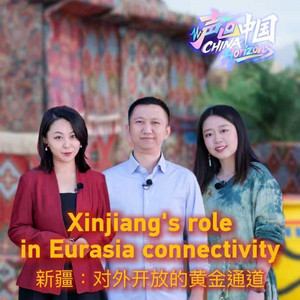
Today I'm with Lai Ming and Yushan, and we are on again a very special location.
It's quite unique.
I've never been here, but nowadays tourists can also come up here, enjoy the decoration with authentic Xinjiang style.
We are on a rooftop of a building, and the building is in Xinjiang International Bazaar.
Bazaar, yeah.
We are actually on the rooftop overlooking the bazaar.
It's a vantage point.
People need to pay to get access here, to take photos and to enjoy the view, to see the beautiful skies and the people bustling around in the, which is a giant fair or a market where people sell all kinds of stuff.
And also what's unique about this place is not only are commodities at play here.
People also put on shows and performances.
So it really is a business and cultural destination for tourists and shoppers alike.
Yeah, this Grand Bazaar was established back in 2003.
So in the past, say two decades, it's been experiencing just vast development itself and nowadays it's been attracting just tourists from all around the world.
Like i remember seeing no english signs before, but nowadays, as we walk around it, there are bilingual, if not trilingual, like language signs, all over the place, all over the shop.
How many are we talking about before as in more than two decades ago?
Because I would personally consider Xinjiang as a second hometown, given that over 60 years ago, my grandparents they became the first batch of the workers who came from various provinces all across China and came to Xinjiang, right here in Wurunqi, to help develop local infrastructures.
So they were both workers from over 60 years ago.
Basically, my family has a very long lasting connection to the place and just passion for this place because this is where my father and aunts were given birth to and this is where they feel like home the most.
So for me, I feel like this place gives me this kind of connection to this very diverse local culture.
But in the meantime, it just inspires me every single time I come back to Xinjiang.
And you were here often in your childhood?
I would say, yeah, quite often.
I spent quite some time here back in 2003 just doing primary school and also visiting areas such as the International Grand Bazaar.
And one thing that remain the same throughout time is that it's always crowded.
How crowded it was back in 20 years ago is just, if not more crowded right now here.
Because I ask around. local staff said that for the international grand bazaar these days now they welcome tourists around 110 000 every day and during peak season august i guess august is the peak season to travel here in xinjiang and during that time the number can reach to around 200 000 per day so i would dare to say that more and more people are coming to the international grand bazaar yes and it's getting very crowded we are recording this at around 11 a.m local time beijing time actually local time is beijing time although there is a time difference of about two hours if you judge it by the time the sun sets uh in different parts in beijing and in room key but what i'm saying is this is very early in the morning and already we see a lot of people downstairs crowding in into the space and they're shopping and taking photos and it's a very very busy part of the city and you see people selling naans which is a very famous snack and it's like a flat bread kind of pizza without the toppings but with some fillings a different kind of pizza so it's a very busy part and people are crowding in here now like Yushan said it's been built in 2003 which means the buildings the architectures are not historical, but there was Islamic style, the outside decoration of different buildings, there's even a central tower at the Grand Bazaar, you can go up there, climb all seven stairs, enjoying the inner painting on the wall while you're walking, because guess what, you're only walking, you cannot take elevators, no elevators provided, but you can go up there, enjoying the views, see the entire Grand Bazaar which is quite big and busy and beautiful and well deserve to be explored.
Yeah.
If you've never been to Xinjiang before, geographically it's on the northwestern side of China.
So, typically speaking, it has a little bit of what we call time difference, where people get up a bit later and go to bed a bit later.
That's why we still don't hear much of the music now, because right now it's still rather early for local people here.
In a few hours time, let's say, this whole place of the International Grand Bazaar is going to be filled with music and people dancing and just the local instruments playing, drums playing all the time.
So that's the real background of this place, the background music of this place.
Right now we have the advantage of borrowing the morning, say a little bit of quietness, to just present to you how the Grand Bazaar is like and what the general atmosphere, information about it.
For those of you who are not that familiar with Xinjiang Uyghur autonomous region, this is quite a special and important place here in China.
It covers land area of around one sixth of the entire land area in China.
And it has, when I say diversity, they didn't choose the word lightly.
It has all the 56 ethnic groups that China has.
You can find all of those ethnic groups here in Urumqi.
Oh, maybe not in Urumqi itself, but in Xinjiang throughout the region.
And that means here in the Grand Bazaar.
You get to also enjoy all kinds of ethnic groups, character-fulfilled kind of products and special products, which is very interesting to do.
So this place for Yushan is like her second home, as she just described to us, since she was here often in her childhood.
But for us, New Holy and I, this place looks familiar as well.
I remember a few years back when I was here in Xinjiang for the first time.
I came here to the Grand Bazaar, and it is a very, very welcoming place.
I was immediately stricken by the hospitality of the local business women and men.
When was that?
When I said women, because that was very Around the year, 2013 or through 2015, I can't remember put an exact date to it.
So when I said the business, women first before men, that was because my first impression about the place was the warmness and the cordiality that one specific businesswoman showed me.
I was looking, I was shopping around, looking at scarves made of wool.
Wool is a very local specialty here.
So I was looking for a scarf and this one businesswoman was so warm, he called me son.
In Chinese Mandarin, he said .
For those of you who are not familiar with the language, it's not something we say in daily life to strangers.
I know how it is in English.
An older man might address a friendly young man and say son or young lad.
Not our thing.
We don't call anybody without that special connection.
So I was I was stunned.
So you're ready to be so close to me in order to complete this business.
And at the end of the day, she really convinced me to buy a couple of scarves.
So that was my first impression.
I know, I get it.
When I was in Xinjiang in around 2020 it was just the after pandemic period of time the tourism was definitely not as vibrant.
Yet i stayed here for around 40 days.
I went to the north part of the region, which is famous for its beautiful natural environment and landscape.
We enjoyed the snow-capped mountains.
We enjoy the beautiful lakes.
The lakes are with different colors.
Even within the same lake, you get to see different layer of the water in different color.
I didn't get to the bottom of the science there, but I enjoy the view quite so much.
And along the side, the river side, you get to also enjoy a little bit of horseback riding, which was my first time I learned horseback riding.
When I say learned, I mean I was able to balance myself on the horseback without falling.
Doesn't mean I can gallop with the horse.
Remarkable technique.
No, it's not something I can do just yet, but I enjoyed the experience a lot and also we traveled to the southern part of the region which, in my opinion, is characterized by the warmth and friendly and hospitality of the people, because in the southern part you get to meet more people in different ethnic groups and because many of them, especially the elder generation I'm not really sure about your elder lady who called you son, But for my experience, the elder generation here in Xinjiang, here in the autonomous region, many of them are still more familiar with their mother tongue.
They do not speak Mandarin that fluently.
So you couldn't tell if they were addressing you as daughter?
I have no idea.
Maybe they were.
Maybe they were.
But what I know was that, as a young journalist, I was eager to communicate with them, failing to communicate with them, eager to take some pictures of them, asking oh can I take a picture of you in your very beautifully decorated little yard that is full of different flowers and ethnic characteristics?
Can I do that?
And they would say something like oh, it's a kind of shy decline, but they will always, always smile very sweetly to my camera after they say no, don't take a picture of me because I'm shy.
It's the kind of hospitality.
They're being modest, but they enjoy taking pictures and being appreciated.
Yes, and that was a very lovely experience.
So when they address you as son, accepted with grace.
Which is why I still have two scarves made of wool at home.
Uyghur people or local Xinjiang ethnic groups, they don't have social anxiety.
They don't know what that term means.
If you approach me, you're a stranger or not.
I'm going to show you the warmest, the best that I have as a host.
They have a very strong sense of this is my home and I'm hosting a friend.
So there's no like, how do I approach you?
How do I socialize with you?
That's not how they impress us when we try to visit their homes.
It's just, oh, I've got a friend visiting, so I'm going to host them.
I want to ask Lai Ming this because for me, When I arrived this time, my feeling was a little bit different.
To start with, I've been here.
I stayed here for 40 days.
I thought I'm, you know, very much familiar.
I know the place.
But when I land in the airport, I thought, I have no idea what this airport is.
What is happening?
It's a new airport.
And then I realized it's a new airport.
It's huge.
It's with a lot of different brands.
You can shop here.
You see people. from around the world coming here for tourism, for business.
And it's very metropolitan kind of feeling here in Warumaki.
And uniquely metropolitan, because I was stricken by the view of young girls dancing in the airport.
You don't get that a lot in the other parts of the country, or in fact, in other parts of the world.
Maybe Hawaii, something I can imagine, but I haven't seen anything like that.
And after that, on our first day here, we also went to a place that is famous for being a favorite location for local people as well as tourists and also some exchange groups to go and tour a little bit, take pictures, Instagrammable pictures.
And that was also a new place.
And after consulting a little bit with the local people, I found out it's a place that's only been introduced since 2021.
Yeah.
And lately, I think, more and more cultural facilities within that area is gradually starting to operate and opening up to the general public to attend, like I think just last year or was it earlier this year, the library was opened and also the day before we visited the Urumqi Museum, like the local museum based in the city of Urumqi, where there's a lot of just very beautiful and delicate cultural relics that's excavated there.
I believe this museum is part of the new cultural center that's based in Urumqi locally.
When I first approached this site, all of our team members were lost because it's just so vast and also the architecture style is just so modern that you can easily believe that this is a site in shanghai instead of far west here in urumqi, in xinjiang.
So that's just how modern and fast developing this city is becoming nowadays is just transforming various sites of itself into this cultural living room and just developing these multifunctional areas for people to better enjoy local life.
Yes, in 2023 alone, it welcomed a total of 15 million visitors and launched themed exhibitions, including the Belt and Road print exhibition and while also offer free entry to several of its venues.
When you go there, you can buy a ticket and enjoy the exhibition on display.
You can also just walk around, walk your dog or walk your kid, or just have a nice family time and take some family photos very modern, very different in a good way.
So there's cultural destinations, there's shopping places that you can hang out.
Another thing that you are bound to discover is that there are different calibers and grades of raisins.
To my surprise last time I came here and noticed that at the Grand Bazaar they have different grades for raisins.
They call them grandpa of raisin.
And grandpa of grandpa of raisins or grandma of raisins.
They indicate different types, different colors and different grades of grapes of raisins.
And that's really utterly different from what we commonly know in other parts of the country.
And this is also a demonstration of the advanced level of the fruit industry here in Xinjiang.
Honeydew melons grapes, pears we call it the whole ton of different types of fruits because of the abundant sunlight, the temperature difference between daytime and nighttime, making sure the fruits are extra sweet with different varieties.
And it's also the hometown of singing and dancing of a lot.
If it's the hometown of all 56 ethnic groups here in China, it must be hometown of all ethnic groups' authentic music.
It makes a lot of sense.
And for those of you who again, are not that familiar with Xinjiang, another quite interesting thing is that its land border stretches for more than 5700 kilometers, which also combines with the fact that it shares the frontiers with eight nations, meaning that people can interact and engage and have exchanges with other people living in these countries as well.
Just yesterday we were at the campus of the Xinjiang University and I overheard a teacher speaking to an overseas student in Russian.
That goes to show how versatile and skilled they are in terms of language skills and also the ability to communicate with people from different countries and cultures.
These kind of interactions and interchanges does not just happen these years, because the transportation is better, the infrastructure is better.
Those factors do need to be taken into consideration a little bit later.
But this kind of connection, because of its geographical location, because of its vital role along the Silk Road, the interaction with other civilizations, with the kind of development, the kind of results happening in rather inner area in China, has always happened.
And like Yushan said, we went to a museum the other day and we've seen a lot of different proofs.
We learned a lot about these kinds of exchanges and cultural exchanges happening in Xinjiang.
Yeah.
One item that I was so shocked to discover is the fact that they were able to excavate such a piece of fabric that has Chinese well ancient Chinese characters embroidered onto it.
And it was discovered in the city of He Tian here in Xinjiang Uyghur Autonomous Region.
But the linkage between Han culture of the local Xinjiang culture was already happening.
It was a piece of artifact all the way back in Western Han Dynasty.
That's some 2,200 years ago.
Yeah, this is just further proving that, over 2000 years ago, there's already such cultural exchanges between central China and the western side of the country.
One other interesting discovery is that there is such weaver machines that's all made by wood, that's also presented in the museum.
But the fact that this machine, as well as its parts, were excavated in southwest China's Sichuan province, for the proof that it's not only the products that were already being exchanged back then, but also the skills and also the kind of like the marketing of products was already so well established back then, so that archaeologists can just find them underneath the very soil of Xinjiang, and proving how deep of a connection we've already had all the way back in 2000 years ago.
That was quite impressive because it takes only a ship to have all the goods transport.
Well, maybe a camel to transport all the few camels, transport the goods.
But if you want to transport the technology, definitely personnel would have to come and maybe some research would have to be conducted to suit the local situation.
So that's quite impressive.
Still, I also had an experience in a museum.
I saw a very beautiful picture of Tang Dynasty ladies.
You get to tell they're Tang Dynasty ladies, because of their dressing, their costumes, as well as their makeup style.
Yet that piece of art was was found in Turpan here in Xinjiang.
So that also shows the kind of people-to-people exchanges.
And what's also quite funny was during the same period of time, not only you get to see all these different types of Tang Dynasty style living habits, as well as dressing, coming to Xinjiang, but also in Xi'an, for example, in other parts of China.
We also are introduced to all these different music instruments that were originated here in Xinjiang.
So these kind of exchanges go definitely both ways.
Yeah, it's still continuing.
And one, it's really interesting you mentioned Tang Dynasty because I think it's also around the same period of time. that a lot of, say, local people here in Xinjiang back then, over 1,000 years ago, they traveled all the way through the ancient Silk Road and land in the back then Chang'an, which is today's Xi'an, I believe, in central Shaanxi Province. they just stay here and become part of the local culture and civilian, and they even try to bring forth their own cooking, culinary culture and music to the local people.
That's why nowadays there are a lot of novels and historical fantasies describing just how vibrant the culture back then in Chang'an, where people just from all different backgrounds just dance and sing together.
And it's just not only Han culture alone in Chang'an, but you can just find a very diverse kind of communication between people.
The funny thing is, my feeling was that during Tang Dynasty you can feel that people are a little bit more open.
And I think that openness is also introduced from Xinjiang, where it's definitely affected.
Because here, when you're in a place that is with more diverse cultures, that is common to the kind of activities from outside of the region itself.
They are more open, they are more tolerant, they are welcoming diversity in much deeper ways.
Tang Dynasty was a very prosperous period of time in ancient Chinese history and we can't really tell whether it was the confidence in the power or in the strength of the nation that drove the communication or the openness to the outside world, or if it was the openness to the outside world that really helped the country to prosper back in the time.
But we can tell that now we are again at a time in history when China is a prosperous country and we do see that confidence exuding from the locals and then from Chinese people to that curiosity and that willingness to get to know about different cultures and that willingness to reach out to countries outside and to communicate and to enrich our lives, to bring our commodities to the rest of the world.
So we see that and that's what I get from traveling to this particular part of the region.
Well, we've talked about Xinjiang in history.
We've talked about how the eagerness to communicate, to exchange, to embrace diversified cultures is in its genes.
Yes, it's a factor.
It's not, at least for Xinjiang's case.
It's not the decisive factor, but it's definitely helping the region to be more effective in communicating with the outside world.
We've been to Xizang autonomous region in our series, in our China Horizon series.
And then at that time we talked about Xizang, because of its geological distinctiveness is really high.
Well, it's high altitude.
It's hard to reach to the heart of the region.
So at that time my feeling was in order to bring all the highways, the railways, to Xizang from, for example xining, which is the bordering uh province yes, it's already quite difficult.
It's you're linking these regions and it's hard to do and it's just through no man's land exactly, overcoming permafrost and all kinds of engineering challenges, and that's already a huge challenge and a huge achievement for today.
If you consider the center of the country and the west of the country, definitely it's a relatively remote area.
It's one sixth of the land area in China, but the population is about 26 million, so slightly more than the city of Shanghai.
It's a very sparsely populated area, for a good reason, because there's a lot of desert.
There's a lot of areas that are not inhabitable to humans.
As such, there's a lot of challenges to go through as well.
Yet when we are here talking about the story of transportation, we tweak the storyline just a little bit.
Instead of talking about how hard it is and how amazing it is to have the link between the relatively inner part of the country, the center part of the country, to the west part, we talk about how convenient it is already become, how not only are we linking the roads from Beijing to Xinjiang, we are also seeing that inside Xinjiang there are already a lot of very high quality highways and expressways, helping people communicating or commuting within the region.
One good example that I can raise is that, back in say, over a decade ago, traveling from Beijing to Urumqi via train will take at least three days.
That's something I learned when I was very young that Xinjiang is so far away as in you have to live on the train, slipper train and endure the very chaotic interior environment on the train and land in three days after you board the train.
But nowadays, with more airlines opening over the years, At least two days ago when we flew to Wulunqi, it only took like less than four hours by air.
So that's just how fast developing the transportation is becoming in linking Xinjiang, in this particular case Wulunqi, especially with the outside cities and just better promote the commutes for people inside and outside of Xinjiang to travel between different destinations.
Now the region has more than 9000 kilometers in railway and among them more than 700 kilometers of high-speed railway, and major cities, prefectures and regions, 80 of them, 80 of the counties in the region they are connected by railways.
And also in terms of highways, the mileage has reached 12,400 kilometers.
And about 90% of the counties, they're connected with superhighways.
And that is why the idea, the concept of a one hour living circle, three hour living circle, five hour living circle among different cities is possible here in Xinjiang.
That's what they're doing.
They're trying to figure out better ways to bring up people's living standard.
They allow people to live in their original hometown but also work in a relatively bigger city.
They allow people to live in Turpan, which is not far away from Urumqi.
If you're driving you can spend around three hours driving to Urumqi or spend one hour on train to Urumqi to do your business or to travel, and it's just quite convenient.
You know, over 50 ish years ago my grandpa used to be the driver of his factory where the first generation of the zfm truck was the primary say transportation means.
Back then he used to drive the trucks and go across different major cities in relatively north into central xinjiang to deliver goods, because back then goods were kind of scarce and people just enjoy the products locally but rarely do they communicate between cities.
So that's why my grandpa and his truck teams were given the assignment to just load say, watermelons from Urumqi to nearby places, to get pears and vegetables from Urumqi to nearby regions.
And according to him back then it used to take over one day to two days to drive from Urumqi to Kashgar.
At the speed average speed of 80 kilometers per hour, which is not bad at all.
The speed is fine.
The only reason back then it took so long to travel between these two cities is nearly because of the road status, because it's all like mountainous roads.
There were barely roads, sometimes you just drive on dry sands.
That looks like roads because too many say horse carriages, where trucks have been already paid, were rather drove through to make it into a road.
That's just how say, limited the transportation back then were like, but nowadays, according to some resources I found I think it only takes like around one day to drive from Urumqi to Kashgar, given that we break through mountains to build highways, to build just well-paved roads for cars to drive through.
So it's just very much impressive how the transportation is developing nowadays.
You mentioned something about back in the days.
People have to contend with buying and using locally produced products.
Now i think the the other impression that we get coming to here again is that we are able to buy stuff that we commonly see in Beijing and Shanghai bottled water and makeup, stuff that you have to use for today's show.
So you can find them in convenience stores.
In fact, I feel there's more convenience stores here in Runqi than they are in Beijing.
We complain about the shortage of convenience stores in Beijing, although the locals are working hard to improve it.
But so China is still in the process of building and developing a unified national market.
And we already see some results in our lives.
And we also see results in the kind of fruits that we are able to buy in the rest of the country.
Honeydew melons, grapes and was the almond apricot, right?
Very famous apricot.
White apricot, literally, bai xing.
And then what's the other one?
The ones that will, yes, that will live on the tree instead of white.
In Chinese, I need to look it up, what it means in English.
But suffice to say we in the rest of the country are all pretty much looking forward to products and fruits that are locally produced in Xinjiang.
So that's expanding.
And what's also expanding is the scope of communication.
Xinjiang.
Given its geographical advantage, it is also becoming a gateway for imports from the neighboring countries, from Central Asian countries.
So it's become a distribution center for imports to be brought in and distributed across the country.
And we have to not only thank the high-speed rail as well as the highway, but also the airlines.
From January to May 2025, Xinjiang Airport Group operated a total of 548 international, domestic and regional routes, an increase of 115 routes compared to the same period last year.
And here in Xinjiang there are 28 airports, which explains why I didn't realize this is a new airport, because there are just so many airports here in Xinjiang.
When I was little, I thought the milestone or an example of showcasing this place is quite advanced is that, instead of driving to everywhere or taking the high-speed rail to everywhere, you fly to everywhere.
I know that's not really the case, but still having so many airports and allowing people to fly not only domestically internationally, but even within the region is quite the advancement.
It is a sparsely populated area, and the distance from one place to the other is so vast, and so it makes sense to have more airports.
And with that kind of convenience in transportation, in communication, we're also looking at more and more tourists coming in here in the Grand Bazaar, for example, and also all around Xinjiang during peak traveling seasons.
I couldn't dare to book a ticket to Xinjiang because it's It's so crowded and it's really hard to book a hotel.
And even though you get to enjoy the conversation with fellow tourists, still that's quite the challenge, quite the competition.
And not only are tourists coming.
Like Lai Ming said, yesterday we went to Xinjiang University And in Xinjiang University there are around 500 exchange students in Xinjiang University, mostly from Central Asian countries, because it's closer, it's neighboring, and many of them even speak Uyghur language.
Some of them all speak Russian and, as Lai Ming said, In the campus, many people also already speak Russian, which is quite impressive.
Yeah, and many of them consider Xinjiang as a stepping stone.
A guy from Kyrgyzstan that we talked to yesterday said that he's chosen Xinjiang University as a place to study the Chinese language.
And when he graduates, he will move on to Beijing to start to study international relationships.
And that's what he hopes to do to pick up the mantle from his father, who also work in the diplomatic circles.
So that makes a lot of sense, because flying from Central Asia to Xinjiang takes about less than two hours, whereas for us to fly from Beijing to Xinjiang is around almost a four-hour flight.
So it makes a lot of sense for them to come here, get familiar with the culture, with the language, and then expand the scope.
And I also learned from yesterday that Xinjiang University is hosting a lot of exchange programs to bring Chinese students from all different ethnic groups outside of China to nearby Central Asian countries, while inviting Central Asian students to Xinjiang University and just learn Chinese and experience the culture.
It's such a nice opportunity for the youth to already have this opportunity of planning their future career and seeing just how people-to-people communication can be forged under such a context, in such an environment.
And I also had the chance to speak with Professor Li Qing from the School of Economics and Management, who explained particularly on this spot and more.
That was a good interview.
He talked a lot about the free trade zone area, the pilot zone here in Xinjiang, as well as the exchange programs that Yushan has mentioned.
I also talked to the teacher there, they said that, like Lai Ming said, it is kind of like a hub.
And not only is Xinjiang serving as a hub.
The exchange students college is also serving like a hub, because for them they provide Chinese lessons, Mandarin lessons.
Exchange students would be able to come to Xinjiang, go to Xinjiang University and familiar themselves with the language, and then they would send the students from their college to the college that the students would major in.
So I met a student who was from Pakistan and he's a doctor here well PhD, studying math in a different college, but he also spent around a year learning the Chinese language.
It's a difficult language.
It's a difficult language.
It takes much, much more than just a year.
But my point was people are finding different ways, smart ways to take advantage of different types of resources.
They also told me that here in Xinjiang University, because of the advancement and also achievements in agricultural product related majors and the technology in agriculture sector, it is one of the hot subjects that are attracting people especially from the Central Asian countries and other regions.
Quite popular major includes biochemical studies and also artificial intelligence studies.
These are all quite in need in their home countries as well.
And also other sectors including, I believe, textile and also manufacturing.
Speaking of agricultural majors, I think I've met a Uyghur girl studying a few years ago, studying in Beijing, majoring just in agricultural studies, simply because of the fact that she comes from I think.
The city is called Aksu, where agriculture is the leading industry locally.
Apples from Aksu.
Yeah, the apples from Aksu are the best.
And also they grew like cotton and other type of just agricultural products.
That's also like delivering to the outside of that city alone.
So for them, this is something natural that they embrace.
And these young people.
They also look for opportunities in major cities all across China and just deepening their learning in order to bring the skills and knowledge back home so that they can better develop their own hometown.
There's great potential in agriculture.
China doesn't develop such an advantage for no good reason.
In China, the per capita arable land is not as rich as in the rest of the country.
So it has to feed once the world's biggest population with that limited supply of arable land.
So we had to work hard.
We had to develop.
We have to advance. in terms of farming technology.
And also given the vast variety of terrain, it makes a lot of sense to pursue an experiment in different aspects.
We often talk about rice grown on desertified land or salty alkaline land.
They were talking about the rice having been grown on such challenging land, and it was a good demonstration of how we have to keep on innovating and developing in terms of agriculture, especially given the challenges brought on by climate change.
I think all countries must consider food security as a priority, and it makes sense for young people to want a career in this regard.
Since we're on the subject of academic research, it's not only in agricultural sector, though it's quite important.
It's happening in all different areas, even as tourists partly tourists, partly people working here in Xinjiang.
We see a lot of different exhibitions, and those exhibitions are held here in Xinjiang and also going outside of the region and outside of the country.
Just in 2024 and 2025.
Within these two years, Xinjiang has conducted the kind of exhibition exchanges with the Central Asian countries for 18 times, making sure that outside of the region the kind of artifacts, the kind of relics that are exhibited in Central Asian countries are brought to Xinjiang so that visitors here in Xinjiang or outside of the region from other parts of the country coming for tourism would be able to enjoy the exhibitions and also people living in the Central Asian countries would enjoy the exhibitions in Xinjiang.
And the direct viewers has surpassed 2.6 million already.
They have also conducted different research teams to each other's countries, to among all these different places for archaeological research.
Another thing that impressed me is technology.
In fact, digital technology.
We've been shopping a lot since we arrived here, buying bottled water and makeup.
And every time we paid without cash, we paid on WeChat, we paid with Alipay.
So that technology is also in place.
Also, given the natural endowment in Xinjiang, it is a place rich in solar energy.
In fact, it's the number one in terms of solar energy resources across China.
And it's also the second place when it comes to wind energy.
So there's a lot of clean energy coming out of the place, on top of the already very rich natural resources in coal, in petroleum and also in natural gas.
So it's a very, very promising place to develop digital technology as well.
When we were in Guizhou, we talked about Dongshu Xisuan, data generated in eastern part of the country being transported and stored in Guizhou.
Here in Xinjiang, there's a term called Yushu Xisuan.
Yu stands for Chongqing municipality, which is also western China, southwestern.
And then so meaning likewise, like kind of like .
So data and computation is coming from Chongqing municipality, being fulfilled and conducted in Xinjiang.
So there's a lot of potential in pursuing green energy and in pursuing digital technology here in the western part of the region.
It's going to be the new development driver.
Yeah, and that's on the more uplifting side of the status here.
On the more day-to-day side I think it was just some of our team members chatting from just yesterday that We took a walk late after say 10, 11 pm and the streets were crowded with people just walking around.
That's partly because of the time difference.
Not only because of the time difference, but also that the streets management team and also the individual shop owners and restaurants, many of them just allow their operating time from say, midday all the way until 12 am, sometimes 4 am.
Yeah, just giving this time span to allow just not only local people but also tourists to enjoy the very bustling night life or evening time here in Xinjiang, because they have so much to offer.
If you are impressed, Imagine how impressed some foreign visitors would be.
Because I chatted with one foreign visitor.
They said that here in Xinjiang, they can use their own credit card.
That really is convenient.
I remember having to call my bank and say, I'm traveling overseas.
Please allow me to use my credit card outside of this country in order for me to be able to buy stuff outside.
And when Lai Ming talks about the data center, he reminds me of a place that I once visited, Karamei.
For Chinese people, common Chinese people.
When you talk about carame, especially in Chinese, you think about oil.
Because it's the place when you harvest the oil, it was famous for it.
Almost the entire city was built with the theme.
I have even visited a Keramei theme park of oil harvesting, showcasing all the equipment and also different level of oil, different types and different way to use it and also different byproduct.
It was the theme of the place.
And now it's changing because we're moving greener.
We're going to the other direction of the development, the sustainable development route.
And Carame because of its nice temperature, just like Guizhou developing itself into a data center as well.
So computing, power, data preserving is also now the new thing for Karamay.
How amazing is that?
We do not have enough time to discuss all the characters of all the different cities.
We are yet to see all the cities.
We are yet to see all the cities.
But one city that I have to mention, especially on today's show, would be Horgos, because that is the city that has been.
Some people would address it as the gate, one of the gates of China.
And there is an actual gate there.
It's the country's gate, because you are taking goods outside of the gate, you're exporting and also you're taking goods from outside world into the country through that gate.
I think the first gate was constructed in the 50s last century.
At that time it was mainly for importing, because we didn't have a lot to export at that period of time.
But that was quite an important place.
It was quite an important port.
It was only five different rooms on the port area.
Yet 80 percent of the goods that are transporting from outside of the country to especially helping the country at that period of time was transported from or through the Horgo's Gate.
And now we're moving to the sixth generation of the Horgo's Gate, where you see different types of goods being transported through the gate, and the famous China-Europe Expressway was also one of the routes was also through Forgo's gate.
And let me guess the physical gate is still there, but I imagine, I'm sure in fact the gate has assumed other forms of existence as well.
Good guessing.
For instance, in digital form.
Because earlier this year, during the China Central Asia Summit, I saw a very interesting report about a new profession here in this part of the country, and that is the chauffeurs of new energy vehicles.
They're so popular in Central Asia.
There's huge demand for them.
There are some drivers who will drive the new energy vehicles across the customs.
I see pictures of them, videos in fact, of them using a car to clear the port and then drive outside of the border to the destination, to the buyers.
So they're car delivery guys.
Chauffeurs.
So in order for that profession to... be more efficient.
The physical gate obviously has to be there, but it's not there to stop people.
It has to go with a complete set of policies or procedures so that when the chauffeurs drive the cars across the borders, he can scan the card and get access.
It's not only for high energy cars.
There are different streamlined process for imports and exports so that previously maybe it takes several days.
Now it's only for one hour.
You can finish the entire paperwork to get your goods in your hand and enjoy them or just, you know, exchange them for some money for your of your industry.
And we've been here for only several days, but it's also not our first time.
So we've also seen observed all sorts of changes.
Where do you see the autonomous region in the future, in five years, ten years?
Do you see this place being a place with more opportunities and potentials, or do you think that it can move to other directions what?
What is your take on the future development of here, of Xinjiang, of Xinjiang, Uyghur autonomous region?
So now, sitting on top of the roof in the grand bazaar, i couldn't help but notice the high-rise buildings surrounding us in the city of Urumqi, and i don't recall having this many tall buildings last time i was here.
So i see great potential in the concentration of population here, also in the congregation of opportunities for Xinjiang autonomous region as a major hub on the Belt and Road, on the Silk Road, modern Silk Road.
So there's plenty of evidence to show that there's a lot more opportunities to be enjoyed, to be exploited um, both in terms of the old-fashioned trade, but also in terms of new technologies, clean energy.
So there's a lot of roles and that the region has can play and there's a lot of areas that it can grow.
So i can see people from across china and also people from across the region coming here and looking for opportunities.
And there's great potential in having a lot of people gathered in one place.
And I think, as Professor Li Qing from Xinjiang University concluded, after the establishment of the Xinjiang Pilot Free Trade Zone back in 2023, Xinjiang in general is attracting more and more global attention, especially in terms of global investments.
If you open your food delivery apps here in Urumqi the city, you can already see a lot of foreign brands.
That's well known and very popular in major cities already staying in Xinjiang and offering their food, their style of snacks, to people here as well.
So yeah, in three to five years times, I would think that there are certainly more and more global brands trying to find their new opportunities on this vast land that we call Xinjiang.
And yeah, it's going to be more prosperous.
And I'm very much looking forward to see.
I agree with both of you.
Xinjiang is going to be the destination for a lot of new business, new opportunities and new things happening.
At the same time, people in Xinjiang might be going out a bit more as well.
I also talked to someone from the pilot free trade zone and they are opening up a new platform allowing more business to be on the platform.
They are providing services for these local businesses who are interested in finding their new customers and clients and maybe a new office in outside of the region and the country, especially in the central asian countries, and for this new platform they are providing services uh, including law related services so they would know what are some local laws and what are some kind regulations they need to prepare for the paperwork, the kind of research, the profile and document they provide for so that they can establish, for example, a another company or a new office in another country.
And also they are providing matchmaking services for a small yes, for small and medium enterprises, and So they can find the enterprises in the upper industrial line of their business as well as the clients in the lower industrial line.
And all that is happening, I think in just several years.
So yes, it's a place that is full of opportunities by itself and also it's providing opportunities and looking for opportunities for its people living here.
And we are very much looking forward to see Xinjiang in a year, in three years and in five years.
And that brings us to the end of today's special series of Roundtable China Horizons.
Thank you so much for spending this lovely one hour with us.
In the following days, we're still here in Xinjiang.
We'll still explore more interesting stories in the autonomous region.
And I'm sure you will also be there.
Thank you so much.
I'm Niu Honglin with Lai Ming and Yu Shan.
We'll see you next time, still in Xinjiang.
Bye-bye.