This BBC podcast is supported by ads outside the UK.
It's American-made, stored on site, and always ready.
Powering homes and businesses with cleaner, reliable energy that doesn't depend on the grid or the weather.
Learn more at propane.com.
Saks Off 5th is your secret to fashion's most wanted deals at up to 70% off.
On the hunt for designer steals that'll turn heads and leave a trail of envy?
Uncover Gucci Valentino Versace, Stuart Weitzman and more, with new arrivals dropping weekly at prices too good to stay confidential.
Luxe layers, statement boots and tailored essentials from Saks Off 5th will put your wardrobe on the most wanted list.
Head to SaksOff5thcom or SaksOff5th store near you for a style lineup you won't want to miss.
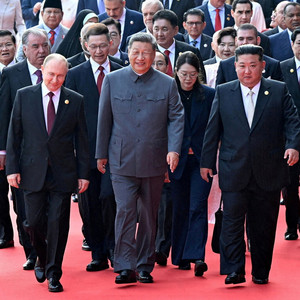
China's president xi jinping held a massive military parade to mark 80 years since the end of world war ii and the country's victory in it.
But it was much more than a parade.
Vladimir putin was there, the leader of russia and north korea's kim jong-un.
It was the first time all three men have met together, and that's a big deal.
But what sort of alliance is this, and how should Western leaders respond?
I'm Celia Hatton.
This is the Global News Podcast on the BBC World Service.
Jean, let's start with you.
What is the moment that made you sit up and really take notice.
That's really stuck in your mind from the events that we've seen in Beijing.
So I'm the BBC's Seoul correspondent, which means I'm based here in Seoul in South Korea, but I cover North and South Korea.
And so for me, watching this parade, the moment I guess that really stood out for me was just right at the beginning, when you had Kim Jong-un walking through Tiananmen Square right at the front with Xi Jinping and Vladimir Putin the three of them together.
Just because you know, this is a leader that has been so isolated and suddenly he seemed almost elevated to the same level of these two major world players.
And just seeing him on that kind of stage and given that prominence by the Chinese, was quite staggering.
Absolutely.
And Olga, your thoughts.
What's the moment that stuck in your mind?
Yeah, I'm Olga Ivshina.
I'm covering everything related to Russia, senior correspondent at BBC Russian Service.
The moment which really stuck with me was actually when Putin was welcomed by Xi Jinping.
And this is the moment which was broadcasted by Russian TV many, many times on repeat afterwards.
It was Mr Putin walking on a red carpet, just fluttering through the barrage of flags of the other countries who were invited by Xi Jinping as well.
And this was exactly the message, both internally and externally, because the West, the Western countries, were talking so much about isolation of Russia sanctions, diplomatic blockade, economical blockade.
But here he is, Mr Putin, walking on the red carpet again, surrounded by countries who are happy to talk to him, who see him not who, at least publicly, perceive him, not as a war criminal, but as a leader of a mighty country who they want to have dealings with.
That's a very powerful message, which Mr. Putin wants to reiterate again and again.
OK, so that was the view from Moscow.
Let's go over to Beijing.
Stephen, you've been in the middle of this all for days now.
What's been a big moment in your mind?
So this is Stephen.
I'm one of the China correspondents based in Beijing.
I've been a reporter in this city for two decades.
So I've seen quite a few of these parades.
It is amazing.
Even though these things happen again and again, they never cease to well make you laugh.
Because?
So this parade?
It's not for ordinary people to go to.
In fact, for several blocks back from the main east-west drag of Beijing, you couldn't get anywhere near it unless you got special permission.
And there's some poor foreigner there somewhere down the road and he can see the vehicles coming through.
He's trying to take some photos with his camera and there are these two plainclothes goons standing in front of him blocking his camera but also filming themselves the parade at the same time.
So they're blocking him while they're filming the parade and the whole thing's being telecast anyway.
It's on television.
Why on earth would you be trying to block this poor bloke from getting a couple of photos?
But it's just the ridiculousness of how things happen in China sometimes.
The word goes out to these more lowly party officials and they just do what they've got to do, no matter how ridiculous it is.
Stephen, you make me laugh.
I mean, you and I have known each other for decades.
I mean, back to when I was a correspondent in Beijing as well.
And I remember, during these moments of these parades, being sort of sequestered blocks and blocks away and having to watch the whole event on TV.
But you could sort of hear the tanks rumbling by and the aircraft going overhead.
I mean, it really was kind of an amazing thing to cover.
I'm a bit jealous that you're doing it from China.
Can I just add one other thing while you mention it?
The funny thing, of course, I've been having practice runs for this.
And so there we are on the weekend.
You're sitting there on a Saturday night and you're flattened.
It's all shaking because the tanks are coming down the road and we stick our heads out the window and they're practicing.
And then you get this knock on the door from the cops.
Don't take photos.
Don't take photos.
But, I mean, goodness knows why because, like I say, it is all going to be on television anyway.
Amazing.
All right.
Well, Mikey, Kay, great to have you here with me.
It's nice to have a face to look at directly.
You have a completely different perspective on this, I would guess.
What is the moment that made you sit up and pay attention when you were watching this spectacle taking place in China's capital?
Yeah, it was pretty remarkable, actually.
I run the BBC News security brief on the channel.
I've got 30 years in counterterrorism counterinsurgency, 10 combat tours, 20 years in the military and then 10 reporting from war zones.
And what I what I really focused on was, yes, there's obviously a big optic in terms of having these three leaders sat watching this parade, which to me tells me there's a evolution happening. of an alliance that's occurring here right under the west nose and it's been happening for some time but the big thing for me was just the sheer volume of military capability that was on display and the bits that really interest me is not necessarily the legacy equipment that they've got but what's new what's out there so for example these these autonomous drones that sit on the wing of manned fast jets, the size of these intercontinental ballistic missiles that now have the capability of reaching the US.
And that's all a statement.
You know, that's all there on purpose.
None of this is by mistake.
And you look at the sheer numbers of the People's Liberation Army in terms of numbers of troops, numbers of tanks, artillery.
You look at the aircraft in the air.
You know Russia Russia, China and North Korea are cementing something here which the West has relied on for a long time in terms of an alliance.
But when it comes to alliances, you can sort of see fragmentations in where the West are now going with NATO, which is which inception was in 1949.
And now we see a strength building an alliance which which isn't going to be good for the West.
It's amazing, right?
We're entering into this new era of military parades, where superpowers like the US and China are putting all their hardware, all their toys, on display for us to see.
What's it like to see those things just literally being paraded in front of our eyes?
Yeah well, I mean, Donald Trump attempted it a few months ago and I think he's probably regretting that now.
When you look at the size and sort of spectacle that China's just put on versus you know what the US did a couple of months ago.
I mean, the UK would never do something like that.
I do think there is sometimes strength in silence.
I don't want to sort of, you know, shock the pigeons at this point because yeah, the volume is significant and it's quite startling.
But when it comes to sort of real analysis on military capability, you've just got to look at the technology inside what you're seeing.
And I think that's where the huge differences occur.
We can come on to that a little bit later.
I want to focus for a moment away from the hardware and onto the men mostly men who were watching this parade, the invited guests.
And three in particular have really caught our attention.
We've got Xi Jinping, the leader of China.
We've got Vladimir Putin, the leader of Russia.
And we've got Kim Jong-un from North Korea.
I just wonder if we can turn to you, Stephen, first, you know, to that end.
I wonder if you can give us a sense of Xi Jinping and how he's seen domestically and also abroad, what he was trying to achieve by hosting this massive global event in front of the TV cameras.
Well, Xi Jinping is interesting in a way in that he's a real mystery man.
I mean, he gives very little away.
People don't know what music he likes, really.
Does he play sport?
Apparently he plays ping pong or something.
I've never seen him do it.
You never see him crack a joke.
Do you know what I mean?
He barely cracks a smile.
He's not given anything away.
But one thing he is, and that's feared, and I think he probably likes that, because when he came in there was this huge anti-corruption crackdown.
He used it to take out all his political enemies.
And so within the party...
You know, man, no one's going to really take it up to him.
And I think part of the criticism of this style of leadership is that he's surrounded by yes men, and they are mostly all men.
Politburo Standing Committee, for example, no women there.
He's appointed his old friends to the Politburo Standing Committee.
The other factions aren't represented there anymore.
So that's kind of what he's like.
As for ordinary people, well, they call him Xi Dada.
It's kind of an affectionate name for him.
I guess in one way you could think of it as like Big Xi, but it's more like Uncle Xi or something like that.
It's kind of affectionate.
While we're talking about it, I should say ordinary Chinese people have some nicknames for the other leaders you're speaking about.
Tell us, please.
Jin Sanpeng is a beauty.
Fatty Kim III, or Kim Fatty III, it should be.
It's a reference to him being the third Kim and, of course, the size of him, etc.
And even you hear Chinese government officials calling him that Jin Sanpeng.
You know, Kim Fatty III.
And for Vladimir Putin, it's Pudadi, which is like calling him Emperor Putin.
He doesn't get it as much as Jin Sanpeng, but everyone calls Kim Jong-un Jin Sanpeng here, from little kids to probably people on the Politburo.
Amazing.
Well, let's turn to hear about Fatih Kim III, for lack of a better term, as some in China might call him.
Jean, take us through the spectacle of Kim Jong-un arriving in Beijing and really what he's been trying to achieve during his time in China.
Well, I think Fatih Kim III is, because of course he is the third in this family dynasty of rulers that ruled North Korea since sort of just a few years after the Second World War.
So it was his grandfather first, then it was his father, and then he took over when he was only 27 years old, because his father died quite unexpectedly.
And so he had to consolidate power really quite quickly.
And it was sort of People talked about whether he was going to be quite a weak leader because he really hadn't been sort of groomed enough.
He hadn't been put in the public eye because his father died so unexpectedly.
But actually he proved himself to be remarkably ruthless and he consolidated power very effectively, purging anybody who would rival him, even his uncle.
And so he has really continued this authoritarian dictatorship that North Korea has, you know, probably one of the most authoritarian countries in the world right, where people are more restricted than anywhere else in the world.
But what we've seen over the last couple of years is him forge this relationship with Vladimir Putin right because he has been supporting Putin's war in Ukraine.
And that really helped him come out of isolation.
Because the COVID years were really really difficult for North Korea because Kim essentially shut all the borders and they were so scared about COVID getting in.
This is such a poor and isolated country with absolutely no medical system that could have coped with it.
And that kind of basically brought the economy to its knees.
So then Putin gave Kim this opportunity to come out of isolation.
The war in Ukraine was like this lottery ticket, essentially for Kim Jong-un, because he was able to start selling Putin these vast amounts of weapons and sending all these soldiers and getting huge amounts of money in return.
But...
Kim never likes to be reliant on one person, and he has become increasingly reliant on this relationship with Vladimir Putin.
And you know, with discussions about the war ending and things, and it's been quite a transactional relationship, albeit a very lucrative one, I think Kim's mind has very much been on.
Well, what happens next?
And so it was very unusual, actually, for him to go to Beijing.
This is the first time we've ever seen him go to an international event like this with many world leaders.
He's only ever really left the country to go and meet leaders like Xi or like Putin one-on-one.
He does this so rarely.
Everything's very controlled.
It's very calculated.
So putting him on a stage, that was a big risk for the North Koreans.
But the calculation, I think, was twofold.
One was because he is aware that he needs to try to repair and rekindle his relationship with China, which has slightly fallen by the wayside because of his relationship with Vladimir Putin, and he is aware that he needs now more economic support from the Chinese.
He needs to keep Xi on side.
Xi obviously wanted him to be there.
The invitation went out and then I think there was a calculation that actually I am sure he would have got assurances in advance.
Stephen can tell me otherwise that he would be given this prominent position, that he would have gone on that basis.
So a chance to really try to establish himself as this kind of powerful statesman alongside Xi, alongside Putin, you know, at the helm of these world leaders gathering in order to send a message to the West, but particularly in the United States, which is North Korea's main adversary, that actually he isn't isolated anymore.
He's in this strong position.
He has the backing of Xi and Putin.
And He's basically buying himself leverage if he is ever to try to negotiate with the West again.
Before we move on Gina, I want to ask you though, about someone that Kim Jong-un brought along with him, you know, with the, with the nod to North Korea's future.
I think she might be the youngest member of an official delegation who's been visiting Beijing this week.
Can you tell me about her?
Yeah, so we were all pretty surprised Celia, when we saw these photos that came out when Kim was getting off the train when it entered Beijing, because his daughter was standing behind him his young daughter.
Now, we don't know how old she is.
We think she might be around about 12.
But he, we think... is grooming her to be his successor.
So he introduced her to the public about three years ago, and we've just seen her grow in stature ever since.
So she first attended this missile launch with him back in 2022.
And ever since, she's gone to more and more high profile events, and she's been given more and more prominent placement next to her father. even in some cases being positioned in these official photographs in front of her father.
So it seems quite clear that he is intending for her to take over, or at least the South Korean intelligence services are saying they think that's their best bet.
And that there was a lot of discussion around why on earth would he be introducing her to the world when she's only 12 years old or younger, when he actually first did it?
But if we look at the way that Kim Jong-un came to power, as I said, which was very rushed, his father died suddenly.
He wasn't really kind of consolidated and built up in this way.
And he very, very quickly died. had to consolidate his power by being very ruthless.
He had an incredibly hard time, we imagine.
And the explanation is that actually he knows how miserable that is.
And he doesn't want that for his eventual successor, his daughter.
He wants to make it a lot easier for her.
So by putting her so much front and centre of his leadership.
Therefore, when she does come to power, nobody is going to question her authority and her legitimacy.
And also because she is a woman, North Korea is a very patriarchal society.
It's never been run by a woman.
Perhaps it needs that bit more time to get used to the idea of a woman leading the country.
So to switch from someone who's just entering onto the global stage.
Olga, now let's turn our attention to a man who's been leading Russia for years now.
I mean, Vladimir Putin's been smiling a lot in Beijing at the moment.
Take us through his motivations and what he's been trying to achieve by his visit to China.
Over these few days, we were discussing it with colleagues.
And it's interesting, you know, just to hear how both internal and external messages for all three leaders China, North Korea and Russia resonate with each other.
Sometimes they are completely identical.
It was interesting for me to see how Xi Jinping was trying to position himself as a world leader, etc.
Mr Putin says exactly that, that he is now a leader of this alternative world world, this alternative to the West reality.
Leader of the global South, the gatherer of the global South.
That's exactly what Mr. Putin was aiming for.
I mean, his ambitions were bigger initially, but he had to, I guess, scale them down a little bit.
What he definitely wants is the new old world order.
So he's not happy with a world order where West prevails.
Many times in his interviews he said that the end of the Soviet Union was, as he said, the greatest geopolitical catastrophe of the 20th century.
So he definitely tries to rebuild it in some shape or form.
And the shape which works now, it seems, is gathering the global South and sort of putting it as a counterbalance to the global West.
And that's exactly what he is trying to project.
In Russian media.
He was being shown as the leader of that gathering, even though he was visiting China.
Of course, Russia wants to show that he's the biggest mastermind behind it.
Maiki Kay, we haven't heard from you in a little while, but you've been hearing this sort of individual assessment of what these leaders are thinking, as they've been in Beijing this week.
But I wonder if you can kind of give us an overall sort of military assessment.
I mean, is there an actual level?
What is the actual level of solidarity between these three nuclear armed dictators, these three countries?
And, for me, a key driver within this evolving alliance are the individual country threat assessments and what they might be facing at the moment.
So, for example, I think the person that is driving this, the country that is driving this reliance at the moment, is Putin and Russia.
Russia has outsourced a significant amount of its drone capability to China.
When you look at how many drones are being utilized on both sides, but particularly Russia against Ukraine over 6000 in the month of July alone.
So that's significant, and that's hurting Ukraine hard.
If you then look at the reliance on Putin, with Kim Kim has provided over 15000 troops who were deployed inside Russia, on the Ukrainian border at the moment, not just troops ballistic missiles, for example, that are being launched on Kyiv.
So that for me is the two key reliance drivers between Putin and Xi.
When it comes to Kim, what is he getting out of this in terms of threat assessment?
Well, there's not a major threat assessment.
You know a real time against North Korea at the moment.
However, this alliance will be able to improve Kim's standing in terms of the way that she and Putin treat him.
So, you know, Kim is providing troops inside Russia.
He'll be able to be able to say to Xi look, we can support you with.
He's got 13 million troops, for example.
He's got a lot of military capability in terms of ballistic missiles.
How good that is, that's another question.
But in terms of volume, that's what Kim can do.
So I think that is the thing that is driving and involving this alliance at the moment are the individual threat assessments.
And when it comes to Xi specifically...
Taiwan is a massive threat assessment because if China wants to be aggressive towards Taiwan, it knows obviously the US military an 870 billion defense budget, 11 aircraft carriers, potential for home basing in Japan and South Korea.
You know, that's going to be a significant problem for Xi.
So I think Xi is now using this relationship to be able to lean on China.
North Korea if he needs to and lean on Putin and Russia if he needs to.
So I think there's a number of components there where this alliance piece is beneficial for all three.
So this alliance, though, I mean, Gene mentioned it earlier.
If you are Donald Trump, sitting in the White House.
I can't believe we haven't mentioned him until now.
But, you know, would you see that apparent alliance as an increased threat?
Do you think that that threat, that risk assessment has really gone up in the minds of Americans and other Western countries, NATO countries?
I mean in the eyes of Donald Trump, who has transactional foreign policy, who's very much taken an isolationist approach in terms of stepping away from NATO.
It may not resonate with them.
But I can tell you it will certainly resonate with the leaders in Europe and the members of NATO outside of the US.
For sure, you know, NATO's inception was in 1949.
And there has been relative global peace, you know, for over 75 years.
The idea that NATO is now being fragmented in terms of Trump's lack of reliance in supporting NATO when it comes to the fight against Russia in Ukraine.
You know, that's that's huge.
And he'll also be looking at, you know, Pete Hegseth is a defense sec and J.D.
Vance have been very aggressive in terms of the posturing on Taiwan.
And so, you know, if I was Donald Trump, if I was J.D.
Vance, if I was Pete Hegseth, I'd be looking at this alliance and it would be playing a huge factor into any military contingency planning on how they might counter any aggression from China on Taiwan.
Because that's going to be a naval sea-based operation primarily.
You know, those 11 aircraft carriers that the US have will be absolutely critical in any countering of military aggression from China in terms of power projection.
You've then got, you know, four bases in Okinawa.
They will be absolutely critical for use by Donald Trump to counter any aggression.
That then is going to pull in Japan.
And so there's all of these counter consequences that you know, if I was, if I was in the cabinet in the US, I would be directing military generals to be working up a lot of counter contingency planning proposals, courses of action that now see not just China entering the aggression, but a reliance of China on North Korea and Russia.
And then that sort of expands the military capability and what the US has to do to counter that in a really significant way.
Gina, I'd like to bring you in here, you know, just to reflect on what Mikey's just been saying.
You know, he referenced Kim Jong-un several times and North Korea's position.
Kim Jong-un has really prioritised growing North Korea's military programme and nuclear programme.
So in 2021, he set out this five-year plan for all the things that he wanted to achieve over the last five years.
And he has prioritised almost completed it.
So he has sort of forged ahead, regardless of all these sanctions on developing very powerful ballistic missiles that can carry nuclear warheads and continuing his building up his stockpile of nuclear warheads.
And so North Korea is in a stronger position militarily, really, than it has ever been.
And yet the sanctions aren't working, because it's now getting this cover from countries like Russia and China, which are, in turn, just allowing it to build its nuclear program even further.
Jean, thank you.
I mean, that brings us to a good point.
As we wrap up, really think about the significance of what we've seen in Beijing.
So if we cast ourselves forward to September 2026, how will things change?
What does the events in Beijing, the meeting of these leaders, this huge military parade, what difference has it really made?
So, Olga, let's start with you in Russia.
I mean, what do you think?
What have we seen?
And what's the significance for Vladimir Putin and for Russia as a whole?
Well, the rule number one of living in Russia or dealing with Russia is never plan too far ahead.
Things don't go upside down.
I mean, you know, if you told me in January 2022 that I would never possibly, would never be able to go back to Russia, I would say oh, come on.
But, you know, that's the reality for me, at least for now.
So this just gives you an example of how unpredictable the things are.
So things can change a lot on the one hand.
On the other hand, some things almost never change or take decades to change.
So I think, first of all, Putin will still be there as he'll still be leader of Russia.
Possibly war can still be going on in some shape or form, because definitely he hasn't achieved nearly as much as he wanted at the moment.
Definitely, Russia will still try to find new ways of evading sanctions, because some sanctions will definitely remain in some shape or form.
And, yeah, Russia will still try.
You know, Russia is... it's a bit like a two-face.
It's a collection of masks.
So there is one mask for internal audience, one mask for external audience.
So Putin will still try to prove domestically that he's a great leader, gathering the global south against the global west.
In the west.
He'll still try to show that he's a leader of a mighty country, even though Russia Russia is not performing that great.
And the troubles inside Russia are slowly, slowly mounting up.
So I think, yeah, that still will be the case.
And definitely there still will be lots of parrots.
In Russia, in China, in North Korea, and quite possibly there will be rotating on those squares, on those parades, together again and again, trying to project these images, because sometimes images are the most powerful weapons they have.
Oh, that's a key thought, isn't it?
The power of images.
All right, Jean, I'm going to throw you next into my Global News Podcast time machine.
Let's fast forward a year.
What's your prediction for the significance of this moment in Beijing?
When we talk about North Korea and the future of North Korea, particularly in terms of the threat that it poses the rest of the world, the question is always is North Korea going to give up its nuclear weapons?
And that is the basis of all the sanctions and all the discussions with the United States and the West over the years.
And here you have, or had, Kim Jong-un standing up there with two nuclear powers, China and Russia, essentially them fighting.
I guess, authorising in their own way his nuclear programme.
These are countries that have in the past been part of all these joint sanctions, right?
They have been part of this team trying to get North Korea to give up its nuclear weapons.
And it's quite clear now that that is not going to happen, that China and Russia see North Korea as a country that has nuclear weapons and they are accepting that.
And they are giving him the cover therefore, to keep on developing the nuclear weapons, because if they're going to do economic deals with him and keep him afloat, then the sanctions become irrelevant.
And of course, these two, China and Russia, they're on the Security Council.
They need to vote for any further sanctions on North Korea.
So with this context, it just...
Now you look at, you know all the questions about well, is Kim going to sit down with Donald Trump again like they did when Trump was president first time and have these discussions?
And we've even had Trump coming out as president saying he really wants to meet Kim Jong-un.
He really wants to talk to him.
But you know honestly on what basis, on what basis now, are Trump and Kim going to sit down together?
It is not going to be on the basis of getting North Korea to give up its nuclear weapons.
So how can Kim agree to sit down with Trump if that's the US position?
And how can the US sit down with Kim Jong-un saying well yeah, we're not going to discuss you giving up your nuclear weapons?
It just seems that now that that cannot happen.
And I hate to make predictions because they also, they say with North Korea, never predict anything.
And, you know, I'm sure Trump and Kim are desperate to meet each other for the optics.
But it just seems now that North Korea has sort of been given the green light by these two major countries to continue its nuclear programme.
And there is no chance in hell it is giving up these nuclear weapons.
Mikey, your chance.
I know we all hate making predictions.
Gene, you're totally right.
But I'm going to force that on to you.
Let's fast forward a year.
I'm going to take Gene's approach, actually, and I'm going to shy away from the prediction.
I think that the key bit for me is what happens between now and in 365 days time.
So I've worked on multiple NATO operations.
And the hard bit about doing that is interoperability across a multinational operation.
So when it comes to communications, secure communications, every country uses different pieces of kit, which makes it really hard to communicate.
If you look at tactics, training and procedures, it's about understanding the way that another country works.
And that takes years.
And I've been on multiple NATO operations where, even now, you have to have significant amount of exercises you know, exercises that are going on in Finland, for example in order for them to be, you know, within sort of the bandwidth of being able to operate together.
So are you saying that these countries need to learn to work together?
Bingo.
Absolutely right.
So, in the next 365 days, what I'm going to be looking for is multinational operations between China, between North Korea, between Russia.
We've already seen...
Chinese naval capability joining Russian capability in the South Japanese Sea.
And I think that that is what we call in the military INW, indicators and warnings.
So I think the next level of this relationship isn't just standing at a parade with the optics, and the whole world are watching it.
It's about now looking how they try and interoperate together in order to counter aggressions say, from the US, when it comes to Taiwan.
That's a key indicator and warning for me that I'll be looking for.
Okay, so that's what you're going to be watching for.
Stephen, let's go back to you in Beijing.
I mean, China has been hosting this whole event.
You know, fast forward a year or even throughout the next year.
What are you going to be looking for to measure whether this has really changed anything on the ground for Xi Jinping and for China?
Hmm.
Well, I'm going to go forward by going slightly back, if you don't mind.
I know it sounds weird.
Look at China.
Now Gene mentioned that China not only voted for sanctions on North Korea, but was enforcing those sanctions.
If you look at the Ukraine war, China was quite a strong ally with Ukraine.
Actually, Ukraine signed up to the Xi Jinping's Belt and Road Initiative.
But where are we now?
They've given up on that, obviously.
Now, inviting Kim Jong-un to come here when it comes to Russia, it seems pretty obvious that...
China is supplying these dual-use technologies to Russia.
People know what this is.
It's like bits and pieces of parts for weapons without giving weapons themselves all the stuff you need to keep them going.
Also buying all this gas and oil from Russia, propping up its war economy.
What's changed in all of this?
What's changed is Trump.
And It seems like what's emboldened Xi Jinping is that he thinks that the US is a basket case under Donald Trump.
He doesn't.
He's unreliable.
He's undermining the West.
He's putting sanctions.
Sorry, he's putting tariffs on his own partners.
And this is a golden opportunity for China to say all right, you know, if they're going to be in decline, we're going to be on the rise.
And so it's why you might, you would have things like this.
They wouldn't even think twice about doing it now.
We can invite whatever despots we like to Beijing.
We can all stand up on Tiananmen Gate together and watch the tanks come through.
Who cares if there are sanctions on these?
Iran was there as well.
I mean, whatever, Belarus.
And this is why a lot of critics are saying that Donald Trump's playing right into Xi Jinping's hands.
I mean, the funny thing that Trump tells all these people that everyone's afraid of him.
Well, I think in...
Beijing, they love him.
They think he's incompetent in terms of taking them on.
They know how to play him.
And so for that reason, we may see more and more of this stuff, I think.
We're likely to see if the war keeps going, China will keep supporting Russia in its war efforts.
And yeah, I think they will keep trying to somehow bring North Korea into the fold, although it's always even for China.
It's a weird thing to do, because they know that it's a kind of crazy administration.
They've somehow got to deal with them.
But yeah, I think Trump continuing means emboldened Xi Jinping.
Okay, well, that's a great note, a slightly threatening note to end it on.
But thanks to all of you.
Thanks for joining us.
Thank you.
Thank you.
Thanks, everyone.
Thanks.
No worries.
See you guys next time.
Cheers.
See you soon.
At Planet Fitness, we're declaring it.
This is the year of getting stronger, and you can get started now by saving when you join today.
We have all the best in-class equipment you could ever need and you can work out your way on your time at any convenient location near you.
Most open 24 hours.
So let's do this.
Join Planet Fitness today and save.
Just $1 down, $15 a month.
Offer ends September 12th.
See Home Club for details.