This message comes from Capella University.
That spark you feel?
That's your drive for more.
Capella University's FlexPath learning format lets you earn your degree at your pace, without putting life on pause.
Writer-director Emerald Fennell makes movies that drive the discourse promising young woman Salt Burn and now quote Wuthering Heights unquote.
Those quotation marks are part of it.
This time out, she's tackling a beloved classic with a cast led by young Hollywood royalties.
Margot Robbie is Kathy, headstrong, impulsive, and horny.
Jacob Elordi is Heathcliff, dark, brooding, and horny.
Their love on the wild, windswept moors is passionate and doomed and as adapted by Fennell pretty bonkers.
I'm Linda Holmes.
And I'm Glenn Weldon, and today we're talking about Wuthering Heights on Pop Culture.
Happy Hour from NPR.
Joining us today is Barry Hardiman.
She's a senior editor for NPR's investigations team.
Welcome back, Barry.
Hi.
Great to have you for this.
Also with us is Soraya Nadia McDonald.
She's a cultural critic, journalist, and the senior criticism editor for The Rumpus.
Hello, Soraya.
Hello, hello.
All right, let's get into it.
This will be a fun one to get into.
Emily Bronte's only novel has been adapted many, many times.
This time out, Reddit director Emerald Fennell is steering us into the lush fever dream of it all.
Kathy is an impetuous young woman who lives in a decaying manor house.
She's played as an adult by Margot Robbie.
One day, her father brings home a young brooding urchin whom Kathy adopts as her plaything at first.
That's Heathcliff, played as an adult by Jacob Elordi.
Look, you know the plot.
The two young people love and hate each other, separated by class and by Kathy's ambitions and by Heathcliff's seething jealousy.
They treat each other horribly until they start treating each other very, very well in a fun, sexy way.
But society, in the form of Kathy's marriage to a wealthy neighbor, intervenes.
There's love and lust, hatred and revenge, and lots of lusty looks in the soaking rain.
The whole factory-installed gothic bundle, really.
Wuthering Heights is in theaters now.
Linda, kick us off.
What did you make of, quote, Wuthering Heights, unquote?
I tend to be a fan of Emerald Fennell.
I really liked Promising Young Woman and I really liked Saltburn.
And I think this is a continuation of what I like about her work.
I think that she is somebody who always and she says this in some of the comments she's made about this film she's going for a feeling.
She's going for.
I want you to feel the kinds of passionate feelings that I had when I first read this book.
She talks about having read it as a teenager.
She loves it dearly.
I will say I personally do not have an attachment to this book.
I know it sort of vaguely gothic romance has never really been my thing.
And I think that in this film, you see so many things that I appreciate about her extravagance.
In this case, it's things like her love of the color red.
And in Saltburn, you see a lot of her love of red.
Here you see it.
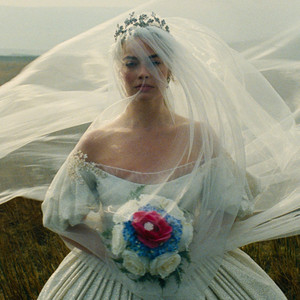
Her love of like diaphanous materials, her love of strange rooms unexpected, not really period materials in Kathy's clothes.
Yeah.
It's sort of period stuff, but then you see her in cellophane.
They've talked about drawing from different influences.
I think the grandiosity of her vision is always something I really appreciate.
And I like going in and just kind of seeing what she does with a story that in this case...
You go in and it's sort of like, well, at one point it seems kind of romantic.
And then it starts to be like, oh, these people are horrible.
And, you know, I enjoyed that evolution.
So I had a lot of fun with this.
I enjoyed it.
Hey, Sarah, where'd you come down?
Yeah, I think romance perhaps is conceived by the Marquis de Sade.
Absolutely.
I agree with Linda on Emerald Fennell's aesthetic habits, which also tend to draw me in.
There's plenty to focus on and it's very weird, particularly with the skin wallpaper with the freckle.
And the other thing that I appreciate about Emerald and her just her habit of just going big, regardless of whether or not I think the writing sort of stands up to the grandiosity of the imagery and the cinematography.
Is her fascination with dirt and filth and grossness the things that are taboo like her willingness to put things on screen that make your jaw drop.
And then, at the same time, I think, the older that you get, the more you appreciate how strange human beings can be.
Mm-hmm.
I appreciate her willingness to run toward that, rather than stuffing it away somewhere in honor of propriety.
Okay, cool.
All right.
So we got really liked.
We got appreciate.
Barry, do we have a spectrum?
We have a spectrum.
Tell me, what do you think?
We have a spectrum.
I find myself in the odd position of agreeing mostly with what everybody has said here, but it did not work for me, emphatically.
I love the idea of freezing this moment in time, this horny, billowing moment of puberty essentially,
I like that.
And I also love the imagery.
But for me it was a series of images that were connected by some speeches that I recognized from a book, and very little else.
So for me, I really do need the characters.
I like Wuthering Heights.
I'm not a Wuthering Heights obsessive.
I'm mentally healthy.
There are a lot of retellings of this, modern retellings of Wuthering Heights.
And those tend to work for me a little bit better, because you can kind of support the oddness of the story in a way that Emily Bronte does sort of in terms of the framing of the story.
But one of my favorites is by Alice Hoffman.
She wrote a book called Here on Earth.
And she said something about Wuthering Heights that really stuck with me, which is that you know you love Heathcliff at, you know, 16.
You are kind of horrified by Heathcliff at 30.
And then you get to 50 and you're like, well, people are weird.
You know what I mean?
You sort of understand his humanity.
That's...
That's Soraya's point, yeah.
You know, exactly.
You're like, okay, I can see how this could be a human, right?
The problem is it only worked for me at that first level.
You know what I mean?
It only gave me that and didn't pull out enough for me to see his humanity, which I think is important and the reason the book has lasted for so long.
Okay, interesting.
Interesting.
Well, look, this thing is fervid.
It's feverish.
It's febrile, which is a word I don't get to use much, but it just means fever.
So why didn't I just say feverish?
Feral.
Feral, yes.
Feral is a good one.
It's swoony.
It's breathless.
These are not adjectives that show up in my wheelhouse a lot.
I'm letting this movie wash over me and I'm thinking look, if you don't got those adjectives, do you even got Wuthering Heights?
I mean, I don't think you do.
It does what it says on the label.
Them heights, they got to be Wuthering Heights.
And Fennell is making choices here, which is exactly what you want in anything that's been adapted this many times.
You want big choices.
It starts with the public hanging that drives the crowd into sexual ecstasy.
So she's linking sex and death from the jump.
It's not subtle, but I went back to considering the source.
And for a long time, I was wondering exactly what those quotation marks in the title were doing.
But then I realized, no, everything in this film is just that bit ridiculous.
The two main sets, Wuthering Heights and Thrush Cross Grange, which is the neighboring manor.
You know they're art directed to the gods.
The costumes go hard.
When Catherine goes to visit her father at one point, who's played by the great British actor Martin Clunes, by the way, with exactly the kind of mustard you want from him.
He's great.
She's wearing this gown that is ostensibly silver satin, but it looks like tinfoil.
It looks ridiculous.
The movie does that thing in period drama.
Where sometimes if they don't get it right, the costumes just look like costumes.
They don't look like clothes worn by actual people.
But then that's kind of the point.
I mean, it's absolutely on purpose.
It's exactly it.
The Grange feels like a dollhouse because that's what it is.
Right.
And so that fit for me.
That worked for me.
I confess I wanted this to be like a notch more bonkers, a bit more arch, a bit more comic.
I'm a middle-aged gay man.
I'm going to use the word camp.
I kind of felt it edging there in the scenes in Thrush Cross Grange especially, which is kind of low-key Tim Burton in its silliness.
But it didn't go full Crimson Peak.
It didn't go full Bram Stoper's Dracula.
I felt it wanted to.
The scene where she crosses the moor to go back to Wuthering Heights and there's an empty doorway in the fog.
But then the fog blows away and the doorway isn't empty anymore.
I'm like, that's cinema, baby.
Mm-hmm.
All those scenes with a thunderstorm raging outside, I was like go off, Pathetic Fallacy, do your work.
I wanted more of that.
I was happy for what I got, though.
I was happy for what I got.
It was so funny to me because there's a moment where you see Kathy kind of walking into the foggy misty moors and it's not just foggy misty, it's like she instantly vanishes.
Yeah, you can't see two feet in front of your face and it's just everything is kind of overclocked.
Yeah, exactly what i find interesting about emerald finnell is that very often i find people i'm not talking about this conversation, i'm talking about in the discourse, as we've already mentioned I find people trying to figure out a way to read kind of a lot of social commentary into what she does.
And I think that maybe is because she started out with Promising Young Woman, which is a really like angry meaty piece.
But when you get to Salt Burn, and I think when you get to this piece, you more realize that she's a stylist much more than she is a social commentator.
Yes.
What I would compare her to actually is Quentin Tarantino.
I think when you see the kind of the stylishness, kind of pushing everything else and even to the degree that he likes to play with kind of extant aesthetics and mess around with them, the way that she does in this film with how the costumes have some period elements and then some things that are drawn from like 1940s and 50s melodrama,
Yeah.
And I think when you see her kind of mixing and matching sort of from these other elements, I think she's a stylist.
And when I read her that way, I don't necessarily think that she goes into this thinking.
Here's what I think Wuthering Heights is about.
Here's what I want it to be about.
Here's what I want it to be saying.
She's thinking.
I want to put you in the body of a young person who is experiencing this story for the first time.
And whatever it takes for me to take that book reading experience and make it something that you feel in your body.
That's what she wants done.
And that's what I think this movie is supposed to do.
And it's obviously not going to do that successfully for everyone.
But for me, I think that's what I liked about it.
Yes.
I think Emerald creates vibe cinema.
True.
Do we know how old Emerald is?
40, I think.
A millennial.
Okay yeah, that makes perfect sense, because I was like if you were a person who watched Maul Flanders on PBS and yet also maybe had crushes on, like Jonathan, Taylor Thomas and Andrew Keegan.
This movie will make sense to your 13-year-old self completely.
That is what it speaks to.
When you put it like that, I'm like, oh, this feels like Flowers in the Attic.
You know what I mean?
It feels like a kind of a taboo.
Again, it did not work for me.
But when I look at it as a style rather than an idea...
I can appreciate it further.
I think the thing that sort of disappoints me is that I was not like a particular fan of Salt Burn.
I liked looking at it.
But I kind of wanted to know her ideas is the thing.
Like I actually wanted something beyond, you know, the hormones.
And so partly it's because I think there are interesting things to say still within the style that she's making.
I think this movie doesn't actually have a lot of rage whatsoever.
We don't actually get that sense of, like, hatred that's actually horny.
There are some things about it that I really would have liked to see her take a hold of.
I think there's so many interesting ways to remake this.
And, you know, one of the interesting ways would have been to have cast an actor of color instead of Elordi.
I understand we are looking at a particular kind of pulp paperback.
And, you know, that's OK.
But I think for me I'm just it became boring about three quarters of the way through because I thought oh, there's not going to be another idea other than this, you know.
Yeah.
And in the production notes there's a bit about how Emerald Fennell wrote this version with Elordi in mind, because you look like the Heathcliff on the cover of the version that she read as a teenager.
Go ahead, Linda.
I think Barry is so right that you can certainly do the kind of provocative aesthetic work that I'm talking about.
And also sort of things that stimulate the intellect, so to speak, right?
You're Ryan Coogler's and those kind of folks.
Like if you look at Sinners.
It has a really similar intensity of aesthetic and intensity of visceral response.
And it also has a lot of… Guillermo del Toro.
This reminded me in many ways of Frankenstein.
Absolutely.
Del Toro, too.
Although I do think that like there are some similarities in the fact that people sometimes come away from Del Toro also saying like I don't necessarily know what this is about, but it like looks great.
Right.
I like a scarlet veil.
And I think, like I guess, one of the reasons why I instinctively like defend Del Toro her, or want to defend, I guess, more my enjoyment of her work is that it is so common to see everything is meant to be provocative, right.
It's provoking something.
You're provoking some kind of a reaction.
Nobody makes art not wanting to provoke anything.
I like the fact that she is really provoking the gut.
I think that's why you get her.
She's provoking the body.
Lower than the gut in some cases.
Absolutely.
Absolutely.
That's why I was just going to say that's why you get her interest in lust.
And one of the things that we talked about with Salt Burn is it's about that fine line between lust and desire and revulsion.
I think that's one of her animating things she's interested in.
And that's why in this movie you get, I would say, fewer bodily fluids than Salt Burn.
She's eased up on that a little bit.
I actually think this movie is arguably restrained for her.
It's very tame in a way.
For her it is, but you get like Kathy sticking her finger into an aspic, which is so squishy.
And you get this fascination with raw eggs and people putting their hands into raw eggs.
And it's all to me about provoking the body.
It's like body horror.
Yeah.
Your yuck response or your lust response.
And I like the fact that she's like proudly a provocateur of the body rather than necessarily the intellect.
I think that's cool.
I think that's cool.
Well, we talked a little bit about some of the changes she made.
Let's go through some of them.
There's a reason I never liked this movie more than when Isabella is on screen.
She's wonderful.
Isabella is the ward of the man Kathy marries.
She's played by Alison Oliver from task.
I didn't realize that, but that's Alison Oliver.
Oh, and from one of the Sally Rooney adaptations.
Yeah.
Oh, you're right.
That character Isabella, is vibrating at precisely the frequency I wanted this whole movie to be vibrating at, which is embracing the ridiculousness.
I also love the adaptation choice of making her a real character, someone who's a bit more controlled than she is in the book.
I mean, you've got to understand that in the book, Heathcliff does not negotiate consent.
When you say Soraya, that it felt tame, I think that actually was a little bit of my problem with it.
Uh-huh.
Because by not actually going all the way in terms of the BDSM of it all, in terms of letting Heathcliff's not just his freak flag but also his you know just awful personality too.
It was as though, by making Isabella kind of into his particular form of abuse and making it, you know, sort of a consensual thing, you've backed away from the point which is that Heathcliff is frigging terrible.
He is a stalker and a horrifying man.
And so you actually backed away from something that is a less tame idea.
And even putting in the consent, you know, even though it's a control, but also it's a little bit of a wink to a millennial Gen X audience that does want to also seek consent but not seek consent.
And so there's a pulling back from the actual edge, which she doesn't do visually, but she does do, I think, in terms of the ideas.
And that was the movie I wanted to see, I think.
I do agree with you there, Barry.
Absolutely.
You do realize There are no other ideas.
And yet... There's just more dresses.
That scene, I wrote down that line.
I think this speaks to why directors flock to Jacob Elordi, whether it be in Euphoria or Frankenstein or Wuthering Heights.
To be able to pull that off, you know, where he's saying, I don't love you.
I will never love you.
I will treat you abominably.
Do you want me to stop?
They are also pulling back from a key Heathcliff character trait, which is his revenge.
By combining Catherine's brother in the book with her father.
It also means Heathcliff's revenge storyline gets emotionally blunted, because the brother in the book is a real antagonist.
And by combining him with the father, I think you lose some of that juice.
You lose some of that, yeah, get him.
Yeah.
Another change, pumping up the character of Catherine's lady-made companion, whatever, Nellie.
You do that because you hire Hong Chao.
But with adaptation you want to ensure that you're changing something for a real plot reason, not just to do it.
And here I think Nellie's presence alters a very pivotal eavesdropping scene which I never liked, but it's a very pivotal eavesdropping scene midway through the movie slash book in a way that gives that an extra layer.
And I think it makes that scene make more sense.
And also Nellie's presence also later in the book slash movie.
Like here, it alters Kathy's ultimate fate.
I think that change makes sense to me.
Make it about something.
Make it about something.
Make it speak to something.
Make it alter something in the plot.
Mm-hmm.
I think the other thing is that I found myself thinking about is Margot and her attraction to roles where you see women confined and sort of squeezed into this sort of mean girl role, in part because they are infantilized in such a way and expected to be dolls, right.
Whether you go back to Barbie or this, you see the ways that those restrictions squeeze people into being utterly terrible, right.
She's petty, she's mean, she's cruel.
And all of those things.
If we're going to try to squeeze out an idea here are dynamics that shape women's behavior when they are dropped into societies where they have few choices and are expected to be decoration, more or less.
For me, she wasn't mean enough for the choices that she was given, A. And then B, this is where you could do something really interesting with Heathcliff, who, as a member of a different class, In the book, he is clearly othered in any number of ways.
And there has been lots of speculation.
Is he Spanish?
Is he Black?
Is this an escaped relationship, enslaved boy.
Also, it takes away his motivations too by not giving him those boundaries.
You know what i mean.
Like you know, all he has is a sort of is a sketch of this abusive childhood, instead of a series of motivators that you're talking about.
No, that's true, because you're like do they love each other?
Do these people even really know what love is like?
Is this love or is this just a trauma bond?
I think this is just a trauma bond.
That's what my husband said, too Sure.
Okay.
All right.
Last question.
Did you guys ever wonder, watching this movie, if Robbie and Elordi actually had chemistry or if they were just wet?
I liked both of these performances.
I have seen both of these people do very interesting things with a variety of roles.
Obviously, we've seen him be a monster and her be a doll and whatever.
In a way, this is a meeting of a monster and a doll in certain ways.
I did think they had chemistry.
I did think the sexy stuff was pretty sexy.
I did think that it was excessive that he's probably wet in about two-thirds of the movie.
And that did strike me as like perhaps the overdoing it that I expect and relish in her films.
Yeah.
No, I thought they had good chemistry.
I could totally see someone making a TikTok edit and just calling it pneumonia core.
Well, tell us what you think about Wuthering Heights.
Find us on Facebook.
Find us on Letterboxd.
Let us in at your window.
We're so cold.
We'll have a link in our episode description.
Up next, what's making us happy this week?
This message comes from NPR sponsor FX's Love Story John F Kennedy Jr and Carolyn Bassett.
The new limited series from executive producer Ryan Murphy.
It explores the complex courtship of the iconic couple, considered to be American royalty, whose love story captured the attention of the nation.
Their fairytale romance would unfold in front of the public eye and become a national obsession.
FX's love story, John F. Kennedy Jr. and Carolyn Bessette.
Watch now on FX, Hulu, and Hulu on Disney Plus for bundle subscribers.
It is hard to get a house.
Getting that down payment together?
Brutal.
You shipped off to Djibouti to afford a down payment for a house?
Yes, sir.
100%.
On Planet Money, the high price of housing, what the Trump administration is trying to do about it, and will it work?
Listen on the NPR app or wherever you get your podcasts.
Do you ever feel like no matter how many hours of sleep you got, you're still fatigued?
We have to be able to differentiate sleep from the different ways that we can rest.
On the Life Kit podcast, the seven types of rest and why each one is important to living a full, healthy life.
Listen to the Life Kit podcast in the NPR app or wherever you get your podcasts.
What allows Olympic figure skaters to land a jump on ice that most of us couldn't land on solid ground?
And how do snowboarders defy gravity?
Maybe even better than Cynthia Erivo.
Come learn the science that allows Olympic athletes to push the boundaries of what the human body is capable of with shortwave.
Listen in the NPR app or wherever you get your podcasts.
Now it is time for our favorite segment of this week.
And every week, what's making us happy this week?
Barry, what is making you happy this week?
So I am a lover of cozy television, obviously.
This is the time of year for a PBS cozy moment.
And All Creatures Great and Small is back.
And if you are a person who has not come upon this lovely drama series which is just about a country vet and there's a kind of But also for comfort TV.
Sometimes you don't get like too much reality.
There's enough dirt.
There's enough good Yorkshire dirt in there.
Not the Emerald Fidel kind, the actual kind.
It's more like manure, if you will.
This is kind of the thing that like my husband loves it.
My 11-year-old loves it.
It really does run the gamut.
And so if you are feeling in need of comfort, I cannot tell you how much that is making me happy.
And I think it might make you as well.
Mm-hmm.
Yes, Barry, that is a safe bet, I think, among the PCHH leadership.
Thank you so much, Barry.
That is All Creatures Great and Small on PBS.
Soraya, what is making you happy this week?
You know what's making me happy?
Well, it's sort of an extended happiness.
I am still sort of vibrating from just the utter joy and audacity of Bad Bunny's Super Bowl performance.
Here we go.
And that kind of led me down a rabbit hole of Latin music through salsa and cumbia and bachata.
And eventually I got back to Tejano.
And so then I just went on an extended run of Selena's discography.
And that has just put such a tremendous smile on my face.
That's wonderful.
Okay.
So that's the music of Selena.
Thank you so much, Soraya.
Linda, what is making you happy this week?
All right.
So we talked about a kind of a bonkers movie.
I want to talk about a bonkers book that I have been reading that.
I'm about halfway through reading, but I want to recommend it anyway.
It's called For Human Use, and it is by a woman named Sarah G. Pierce.
The setup is somebody invents a dating app that matches you with a dead body.
Okay.
Really, even though they set it up as a dating app, it's really just buy a dead body and keep it like a pet.
And it is a satire of how broken people are in terms of human connection.
As this app starts to become popular and more and more people have these dead bodies, you have a cycle of media responses.
You have a cycle of political responses.
Should a hotel be allowed to bar you from bringing your dead body to the hotel, or is that discriminatory?
There is a whole community of young men who feel like they are being super, super feminist by bringing dead women into their lives referred to, by the way, as women who are dead, because that is more polite than dead women.
They bring these dead women into their lives, because it's not fair to ask living women to be as subservient to you essentially, as they want women to be.
This is a book for a really, really impressively strange mind, and i mean that as the most complimentary possible thing i could say about it.
Again, it's called for human use by sarah g pierce.
I cannot stop reading it and i cannot read too much of it at the same time.
Yeah Well, that's a great rec.
Thank you so much, Linda.
That feels like the dating service that Heathcliff really wanted.
You know what I mean?
That's right.
Yeah.
I mean, kind of.
Haunt me, Catherine.
All right.
Thank you very much, Linda.
What is making me happy?
Book is coming out next Tuesday, February 17th.
It is called A Place, Both Wonderful and Strange, the Extraordinary Untold History. of Twin Peaks.
It's by film and TV critic Scott Meslow.
Now I consider myself a Twin Peaks uber nerd and I looked at that word untold in the subhead and I thought oh, bring it, buddy.
And it gets broadened.
If you belong to that subset of folks who read a lot about Twin Peaks, you'll get more interviews with all the people you would expect the writers executives, and actors and directors.
But Meslow does get something new out of each of them.
What I love most about this book, I now realize, is what it isn't.
It isn't an oral history.
Sometimes they're great, right?
But sometimes you want a ringmaster, somebody to hold folks' feet to the fire.
He brings the context of a good shoe leather reporter.
If two people's memories conflict, he calls it out.
He digs into it.
That's what you want.
But he also brings the analysis of a critic, which is hugely useful for a show like Twin Peaks.
Anyone with a passing interest in the show and its legacy, because let's remember that Peaks walked so that Lost and Westworld and Severance could run.
We'll be interested in this book.
It's called A Place Both Wonderful and Strange by Scott Meslow, and that is what's making me happy this week.
And if you want links for what we recommended, plus some more recommendations, sign up for our newsletter at nprorg slash popculturenewsletter.
That brings us to the end of our show.
Soraya, Nadia McDonald, Barry Hardiman, Linda Holmes, thank you so much for being here.
Thanks.
Oh, thank you.
It's a pleasure as always.
This episode was produced by Liz Metzger, Carly Rubin and Mike Katzeff and edited by our showrunner, Jessica Reedy, and a locum in provides our theme music.
Thank you for listening to Pop Culture Happy Hour from NPR.
I'm Glenn Weldon, and we'll see you all next week.
On the ThruLine podcast from NPR, the former slaveholder who took on the KKK and won.
He became more and more and more militant as time went on.
Listen to ThruLine in the NPR app or wherever you get your podcasts.
On.
Wait, Wait.
Don't Tell Me, it's not so much we get to talk to celebrities, it's that we get to talk to celebrities about other celebrities, like we did with actor Nathan Lane.
I remember having to tell George C Scott that I was leaving the show to do this musical and he said to me you're leaving me to do a fing magic show.
Listen to Wait, Wait in the NPR app or wherever you get your podcasts.
Venezuela, Iran, Greenland.
World events move quickly.
Make sense of them with State of the World from NPR.
We bring you on the ground reporting from around the globe in just a few minutes every weekday.
Listen to State of the World on the NPR app or wherever you get your podcasts.