This is the BBC.
Chinese characters.
Historian Rana Mitter tells the story of China in 20 Remarkable Lives.
The Female Emperor.
Nothing like a bit of soap opera skullduggery to really get things going.
Yeah.
Episode 74 no kidding of a Chinese drama series telling the history of Wu Zetian, Emperor of China, between 690 and 705 AD.
She was the only woman in 2000 years of imperial history ever to sit on China's throne as ruler in her own right.
Hers is not just the tale of one woman's rise to the top of her own society.
It touches so many themes that are central to understanding the long sweep of Chinese history.
Wu Zetian is our first Chinese character.
Over the course of this series, we'll hear the stories of women and men who shaped the most populous country on earth.
Scenes that range from a far-off time, parallel to the ancient Greek philosophers, to the rise of China in the past three decades as the world's second biggest economy.
Not all of our characters are famous or elite power holders.
We'll hear about the poor, sometimes nameless men and women who shaped China too, and we won't always go in chronological order.
I want to mix up viewpoints and ideas across time that tell us what has held China together over the centuries continuity as well as change, often violent and disruptive change.
So that's why we're starting off bang in the middle of the Tang Dynasty, which lasted from 618 to 906.
China's high medieval period and a time when its capital at Chang'an, the modern city of Xi'an in west-central China, was at the heart of a powerful and sophisticated Asian crossroads from Arabia and Central Asia in the west to Japan and Korea in the east.
Even today, the Tang Dynasty is known as one of the empire's most cosmopolitan eras.
So where better to start our tour of its past?
And we begin with someone who embodies a whole variety of themes that say something important about Chinese history.
Wu Zetian is immensely famous in China even today. but in the West, she's hardly known.
And that's a shame, because she was quite a character.
Well, they don't make prime-time soap operas like this about just anyone.
And even Queen Victoria didn't get one made in 74 parts.
Wu Zetian's story tells us about how people rose to power in China.
It also tells us about the values and the ideas that shaped them as they did so.
And it opens a window into a picture of a country not, as it's sometimes caricatured, a closed inward-looking, cut-off society, but rather as a society open to ideas from outside as well as its own traditions.
So who was Wu Zetian?
She was beautiful.
We can be pretty certain of this.
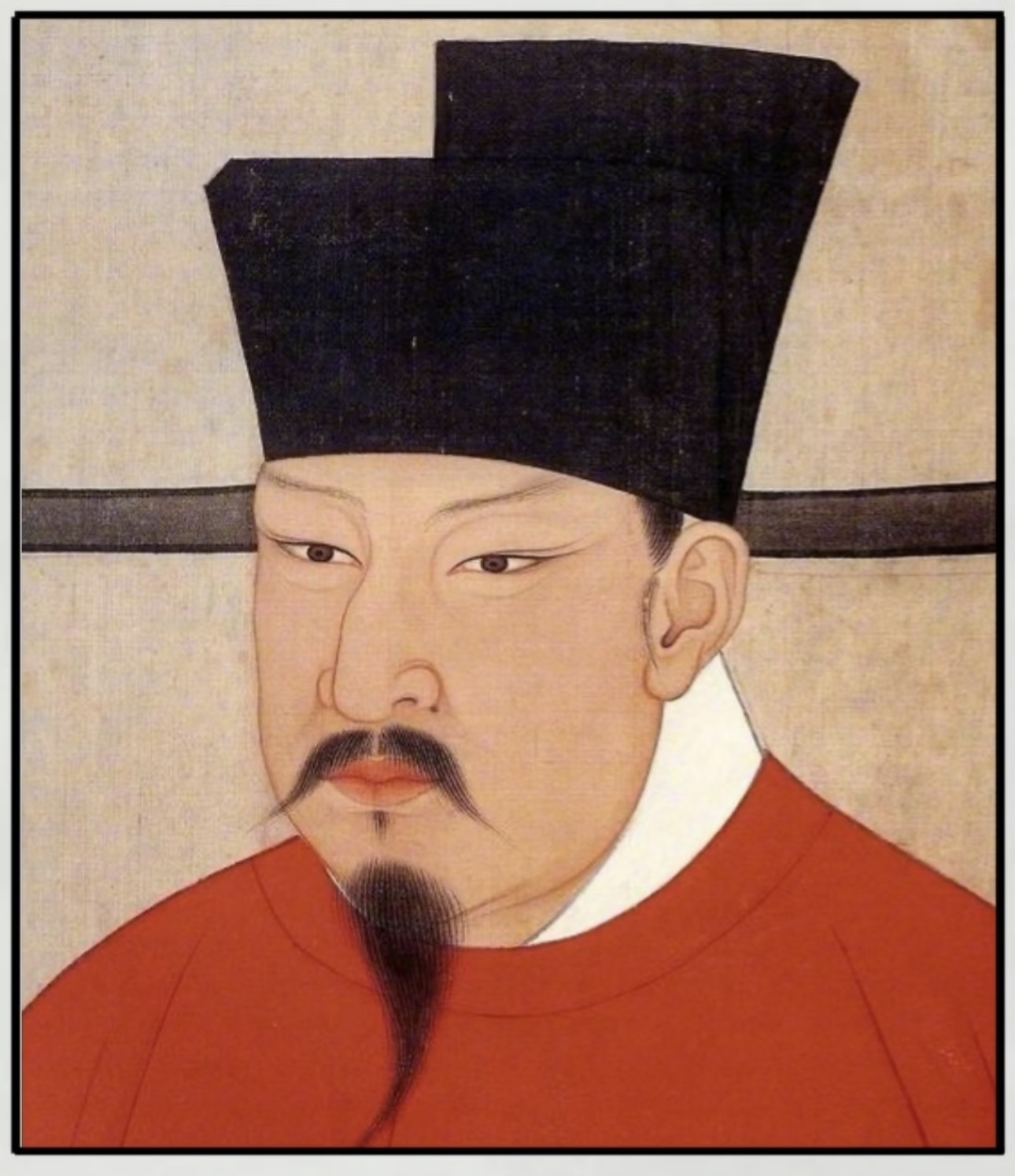
Now this might sound like a bold historical claim, particularly when there's no contemporary portrait of her whatsoever.
But she was taken on as a young woman who would live and serve in the royal household.
And you didn't get to do that unless you were considered attractive.
For an elite woman in medieval China, rising through service at court as an attendant, a concubine or a wife was one of the more potentially plausible ways to access power, even if it was by proxy.
But beauty wasn't enough.
You had to be strategic and ruthless.
The traditional ethic, shaped by the thinking of the philosopher Confucius, whose story we'll hear later in the series, abhorred the idea of women having genuine power.
So for any woman to gain power at court was not just a hard job of work.
It was going against nothing less than the entire natural order of the universe.
Some Challenge It turned out to be a challenge that Wu Zetian was eminently capable of meeting.
She didn't start right at the bottom.
She was the daughter of a duke.
But when she was sent into the imperial household as part of the group of palace concubines in the year 636, she had to cope with the fact that many other senior ladies-in-waiting were closer to the emperor than she was.
Her role was not at first much better than that of a classy serving woman, and her chances of rising in the imperial household were pretty minimal.
She managed to get close to the emperor, Taizong, by taking on the duty of changing his bedsheets.
When he died, she was sent to a Buddhist nunnery.
That was the custom with the concubines of a deceased monarch.
Somehow, she escaped, and not only returned to court, but also got rid of the new empress.
You may be wondering how she managed this.
Well, this was one of the most horrific stories told about her.
She killed her own newborn child the emperor's child too, of course and then framed the empress for the murder.
She was then exiled along with another senior concubine.
Wu Zetian took up her position next to the new emperor Gaozong, but not before she'd ordered the limbs of her rivals to be cut off and then left them to drown in a vat of wine.
By the 660s.
Wu Zetian's influence at court was indisputable, as she wielded power from very close to the throne.
When Gaozong died in 683, she ruled through her sons, and then, in 690, she took the ultimate step and made herself the emperor an unprecedented act for a woman, and one never repeated in the millennium and a half that the imperial system lasted.
This didn't go down well with observers at the time.
The heart of a serpent and the nature of a wolf.
Her hit list was pretty impressive, if true.
Her sister brothers, the emperor and her mother were all supposed to have been her victims, and this shaped views of her as a murderous megalomaniac.
Why did she get such a terrible reputation?
Being a woman was part of it, a large part of it.
It was unusual in Western Europe to be a ruling queen in your own right.
But it did happen, Mary and Elizabeth being English examples.
In China, it really didn't.
As I mentioned in the philosophy of Confucius, the thinker who did more than any other to shape China's cultural DNA, having a woman in power was one of the most unnatural circumstances that could possibly be imagined.
I'm not questioning that Wu Zetian killed off worryingly large numbers of her fellow courtiers.
She almost certainly did.
Nor would I deny that she was something of a tyrant.
The point is that these attributes were also true of huge numbers of male emperors who had come before her and would come afterward.
Yet her contemporaries and the men who wrote the histories later had to portray her as a ghastly anomaly.
But if we step away from her reputation and instead look at what she achieved, the story changes.
A map of the Tang Empire under Wu Zetian covers a very impressive stretch of real estate from Central Asia in the west to the borders of the Himalayas, to the fertile fields of central and eastern China.
Historians argue that her rule helped to stabilise the Tang, giving it a lease of life when it was under threat from ethnic groups from the north and west.
And this story of foreign invasion is one that we'll hear over and over again.
They also agree that it was a time when the empire was well run and its people well fed and relatively content.
So Wu Zetian tells us a story that's unique the only woman to take the throne but also one that was found frequently at the height of China's greatest dynasties the Tang, the Song, the Ming and the Qing.
When these rulers were at their most successful, they had to find ways to manage and use the rivalries at court, which were always part of the intrigue that underpinned the imperial system, just as it was in European monarchies of the time.
But those successful rulers also managed to control a large and widespread bureaucracy that was governing not a small kingdom but a vast empire of perhaps 50 million people that covered everything from lush riverine land to mountainous wastelands.
They also instituted social and economic changes that aimed at keeping China prosperous, fertile and under the government's control.
Some succeeded better than others.
Wu Zetian did pretty well.
Her status as a unique female emperor shouldn't distract from her status as a very competent emperor full stop.
But there were things she did that do seem like a woman poking her finger into the eye of the Confucian patriarchy whose ideas underpin Chinese thinking.
And she did that by drawing on a faith that came from somewhere much farther away.
There are plenty of signs of India here at the Jing'an Temple in central Shanghai.
There's a golden elephant up on the roof eaves.
There are the lions of Ashoka over there.
And of course the Sanskrit texts that underpin Buddhism, which is central to this temple.
And of course Buddhism itself was one of the things that fascinated the Empress Wu Zetian in the Tang Dynasty.
And in some ways her fascination with Buddhism, which her critics complained she favoured over the other religious traditions of China, said something quite central about that period of Chinese history.
It was a time when people looked to Central Asia, to India, to Tibet, to other parts of the whole Eurasian region, to influence Chinese culture.
And Chinese culture loved it.
It absorbed these ideas.
It brought them into something that was a combination of these different influences, and yet more than the whole.
It was one of the reasons that Chang'an, the Tang Dynasty's capital at the time, was one of the greatest cities in the world, and why Buddhism thrived at this time.
Perhaps it's not all that surprising that Wu Zetian promoted Buddhism above the indigenous Chinese religions.
After all, Buddhism gave more space to women than Confucian thinking.
And its popularity in China is also a sign of how much the country has always been willing to absorb and adapt to ideas from outside that it finds useful and attractive.
Wu Zetian died in 705.
What's left behind is a blank stone monument for her tomb.
All other emperors had masons carve a record of their lives into the stone, but not a word was written on her memorial.
That blank assessment was the final insult from the Confucian hierarchy to the anomalous emperor.
The site is located in the Qianling Mausoleum, about 50 miles northwest of Xi'an, deep inside a mountain.
Wu Zetian is our first Chinese character.
In some ways, as China's only woman emperor, she was entirely exceptional.
In another.
She is part of some important stories the gaining and using of power, the nurturing of a cosmopolitan culture and the use of faith to shape personal identity as well as society.
In the next episode we'll jump forward a millennium and a half to a story of China in a conflict for its very life and soul, and meet two more characters who we could call the Asian Power Couple.