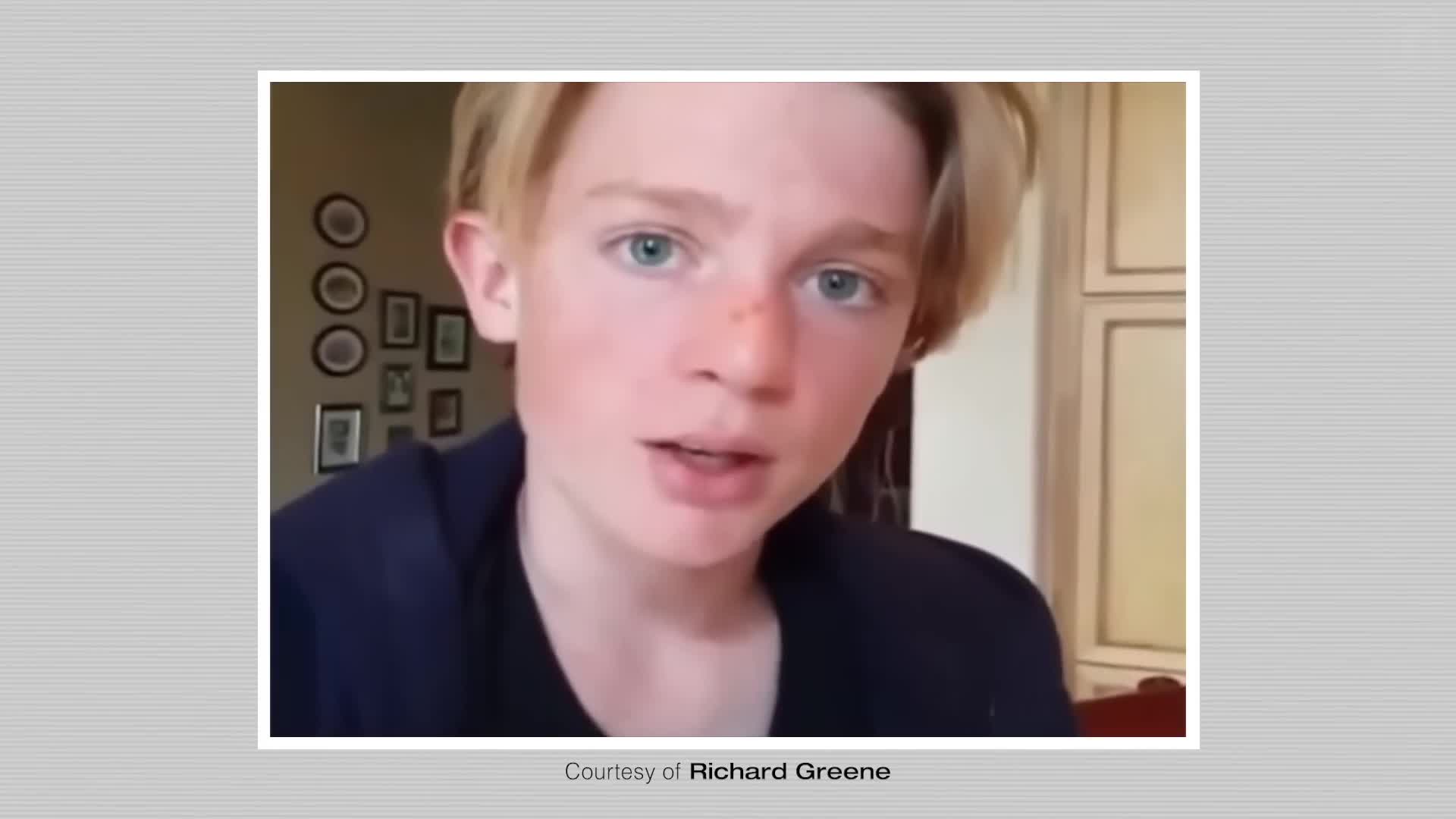
The particle accelerator altered the weight of one electron and therefore destroyed our universe and shifted us into the universe that's directly next to it.
There's a fluctuation in our reality of actually things that are real, that are real to us but are different in other realities.
There's a consistent fluctuation and I think this fluctuation is known as Mandela Effect.
This was happening in 2016.
Shortly after this video went viral, the genius kid disappeared.
No updates, no interviews, nothing.
For years, the internet searched for answers.
What happened to Max Lohan, the kid who said CERN broke reality?
What you're about to hear next will change how you see everything.
Just keep in mind, in 2008, CERN launched the Large Hadron Collider.
And in 2009, people started noticing something strange, memories that didn't match reality.
What happened was we made this universe sort of out of balance.
Because of the collider, the super collider?
Yeah, we altered the weight of a single electron which, I believe shifted us into a parallel universe.
This is our original timeline, right?
But as soon as this starts, we are infinitely catapulted into an infinite number of parallel universes.
In 2008, scientists at CERN launched the Large Hadron Collider, the most powerful particle accelerator ever built.
It smashes atoms together at almost the speed of light, searching for the fundamental code of the universe.
Some physicists even warned it could open microscopic black holes or distort spacetime itself.
And then, barely a year later, something even stranger happened.
Thousands of people began remembering Nelson Mandela dying in prison in the 1980s, but he actually died in 2013.
Entire groups shared the same false memory.
Soon after, a large segment of the population started noticing the same thing.
Logos. movie lines, and even historical events remembered differently than they actually were.
Guys, every time I work on a video like this, I get chills.
The next part might break your sense of reality.
But before we get there, let me tell you something that might change your future.
We all know that AI is reshaping the job market rapidly.
Nearly half of workers worldwide fear unemployment due to AI and technology.
Customer service, marketing, software, finance, no industry is untouched.
But the real issue is that people are still living in a bubble.
They still think they won't get affected until it hits them like a truck.
But I want you to make a smart choice this Black Friday.
While most people are spending on things that lose value, the smart ones are investing in learning what's shaping the future.
Which is why I have teamed up with Outskill to bring you a two-day live AI mastermind training, which has so far been attended by 10 million plus people globally.
They're hosting a two day live AI mastermind workshop this Saturday and Sunday from 10 AM to 7 PM Eastern time.
Now, usually this is a paid training or 395, but out skill is running their big black Friday sale and offering all of my viewers a free seat in the training.
I highly recommend you attend this workshop, because not only do you get AI certified, but we'll also learn how to build AI powered workflows, use AI tools and eventually launch businesses generating close to 5000 in weekly revenue.
It is rated 49 out of 5 on Trustpilot and you get trained by expert mentors from companies like Microsoft OpenAI Nvidia, Google and more.
People who have built and shaped the current AI landscape.
In just 16 hours, you will learn 10 plus AI-powered tools.
Master AI in Excel sheets and presentations, start building your own AI agents and workflows, and even join a community of AI builders inside their seamless learning dashboard to meet like-minded people and collaborate with them lifelong.
But wait, there's more.
If you attend both days, you'll unlock bonuses worth 5000, including a prompt bible, a roadmap to monetize AI and your own personalized AI toolkit.
So if you're already planning your exciting weekend, trust me, nothing's more exciting than planning your future.
Save your free spot now via the link in the description before the seats vanish, and join their WhatsApp community so that you never miss a beat.
Now, back to the video.
So the original universe is Mirror Mirror on the Wall.
Mirror Mirror on the Wall.
Transferred to universe is Magic Mirror on the Wall.
Magic Mirror on the Wall.
Who is the fairest one of all?
So we are now not in the same universe that we were in when Mirror Mirror on the Wall was a part of a film.
Well, that's what I'm theorizing, yeah.
So we're in a different universe.
Exactly.
Infinite number of zeros, 1% difference.
Right.
And that 1% difference is large on our scale.
After this video, Max appeared again, this time giving a presentation where he talked about a device he had built.
Everything is just a frequency of energy.
All of the energy in the universe is already here.
It just needs to be transferred into a form in which you can use it.
I had finished creating a device that takes wasted electromagnetic energy from all around us and converts it into electrical
Voila, free energy.
Well, this is a sensitive topic.
Free energy.
I don't know if Max's device actually worked or not, but I do know one thing.
After years of research for this channel, I've come across countless stories of people who claim to invent similar zero-point or free energy devices.
And almost every time, they were ridiculed, silenced, or simply disappeared from the public eye.
And honestly, it's not hard to see why.
Just think about it.
A working device like this could threaten entire industries overnight.
After all this came silence.
For the next three years, Max went completely quiet.
So did his family.
Nothing was posted on social media until April 22nd 2020, when a message suddenly appeared on Max's Facebook page.
I like to build things.
I want to change the world and make it a better place.
I also hope to inspire.
I searched all over the internet and Max is alive.
Thank God.
But even so, that long silence is hard to ignore.
Maybe he said something that wasn't supposed to be public.
Let's take a closer look at what he actually said in that video, because it's surprisingly interesting.
Technically, there's a universe in which god can exist right so like.
As your book suggests, god is everything because of e equals mc squared.
Literally, god is within and can be everything.
What Max was describing here sounds complex, but in simple terms, he believed reality is not fixed.
Instead, new versions of the universe are created every second, branching out from every possible event or decision.
It's similar to what David Deutsch, a leading quantum physicist from Oxford, has argued for decades.
That quantum mechanics naturally leads to the idea of parallel universes, all existing side by side.
In one universe, you're watching this video.
In another, Maybe you click something else."
Max takes that same idea and pushes it even further, suggesting that these universes are not just possible, but constantly being born as time flows forward.
In his view, each vibration, each particle movement, spins off an entirely new timeline.
As every electron spins, we are infinitely catapulted into an infinite number of parallel universes.
And somewhere infinity down the line, here's our universe, right?
And then we're constantly shifting into alternate universes as we speak.
In other words, reality isn't a single movie playing from start to finish.
It's millions of versions of the same movie, all happening at once.
This isn't far from ideas explored by Michael Talbott, author of the Holographic Universe, who suggested that our reality could be a projection where every piece contains the whole and infinite variations can exist simultaneously.
Max also touches on the paradox of infinity, saying that even infinity can have levels.
That's actually a real concept in mathematics, known as Aleph Null, used by Georg Cantor to describe different sizes of infinity.
It might sound abstract, but what Max was trying to express is that our universe might be infinite, yet still exist inside a larger, infinite structure.
Imagine it like this, right?
There's one line, and then a fractured A fraction closer and a fraction smaller is the next line.
And then a fraction closer and a fraction smaller is the next line.
So on and so on and so on.
Until eventually we get this sort of thing.
It's a little bit like this.
Now that's infinity in a confined space because there's nothing here or here.
Because this is still there.
But what happens when you add a line here?
Now that is actually still infinity, because it's still in the same place, but it's not in a confined space.
You may say.
He was only 13, yet somehow describing the same mathematical paradoxes physicists and philosophers have debated for over a century.
And considering that there is an infinite number of vibrations and therefore an infinite number of realities within our dimensional space or, I guess, altered dimensional space, considering that they're either higher or lower still in the same confined space, there is an infinite number of parallel realities within an infinite number of parallel dimensions that actually can create a powerful or a less powerful form of God.
E equals MC squared, and we know it.
He describes a structure where many universes exist side by side, all slightly different from ours.
Each small event creates another version of reality.
This idea matches the many worlds interpretation first proposed by physicist Hugh Everett in the 1950s.
According to this theory, the universe doesn't collapse into one outcome.
It splits into all of them.
What we call reality is just the version we happen to observe.
You see, we were moving relative to our universe and then our universe destroyed.
So now the universe moved.
Well, started to move, or I guess our parallel universes, our multiverse, started to move parallel to us because we were out of alignment and just destroyed everything.
So technically, I mean, the universe didn't change, we did.
He talks about infinite versions of the universe, some nearly identical, others completely different.
This view also appears in the work of Itzhak Bentov and Michael Talbott, who both suggested that everything in existence is connected through vibration and energy.
If reality is built from frequencies, then consciousness could be part of the same system, not separate from it.
What we perceive as one universe might just be one frequency among infinite others.
Here he links infinite universes to quantum uncertainty.
The principle that measurement changes what's being observed.
In quantum physics, particles exist in multiple states until an observation fixes one of them.
On a larger scale, that could mean reality itself forms as it's observed.
The concept is difficult, but the logic is simple.
If every possible outcome happens somewhere, then small differences between realities are not mistakes.
They're how existence naturally works.
This leads us to Itzhak Bentov, a researcher who tried to connect consciousness and physics.
We don't see light which is beyond uv and beyond infrared.
We hear only a limited scale of vibrations.
All our senses are limited.
So with these limited senses we naturally are seeing through a very narrow kind of tube or very narrow slit in the total reality there is.
Bentov explained that as the human nervous system evolves, that narrow slit of perception slowly opens, revealing more of the total reality that already exists around us.
But some people experience that opening suddenly i suggest that you find them in mental hospitals, in nut houses And the reason for that is that these people, they live in a different reality, in a reality which is very changed, so naturally they can't function very well.
So the only safe place, the only good place for them would be the mental hospital.
He said that some of the individuals we call mentally ill might simply perceive more of reality than the rest of us.
Their senses have expanded faster than their minds can integrate.
When that happens, society calls it schizophrenia.
Bentov called it a premature step in evolution.
We can take an example.
Say a family sitting at dinner table.
Say there's a kid maybe 15 years old, 16 years old.
He looks up and suddenly he says to his mother hey mom look, there's our dead.
Grandmother is standing in the corner.
Mother looks around and says, no.
And she says, well, kiddo, there's something wrong with you.
You need help.
You're crazy.
So you're crazy.
So she takes him off to the friendly neighborhood psychiatrist.
Psychiatrist says, oh, young fella, you're in trouble.
And then he writes out A little prescription for a little Thorazine or electroshock or whatever, and pretty soon, in a matter of two weeks, the kid is back in shape, very normal.
And what you would say is that there's a good chance that that kid is seen.
Very good chance that the kid has a spontaneous opening of his senses.
So that the evolution has been rushed up or hurried up?
Yes.
For him, these spontaneous openings were not delusions.
They were glimpses into layers of existence beyond ordinary human awareness.
And strangely, this connects to another thinker who explored similar ideas, not through science, but through imagination.
In 1977, writer Philip K. Dick stood before an audience in Metz, France, and made a claim that sounded unbelievable.
That our reality had been rewritten.
A change had been made, but not in our present, had been made in our past.
A variable was changed reprogrammed, as it were, and that, because of this, an alternative world branched off, became actualized instead of the prior one.
He described a kind of sideways shift in time, a lateral change where the past itself is altered and people continue living in the new version without realizing it.
We are living in a computer programmed reality and the only clue we have to it is when some variable is changed and some alteration in our reality occurs.
At the time, no one knew what he meant.
But today, his words sound like an early description of what people call the Mandela Effect.
Let me present you with a metaphor.
Let us say that there exists this very rich patron of the arts.
Every day.
On the wall of his living room, above his fireplace, his servants hang a new picture.
Each day, a different masterpiece.
Day after day, month after month.
Each day, the used one is removed and replaced by a different and new one.
I shall call this process change along the linear axis.
But now let us suppose the servants temporarily running out of new replacement pictures.
What shall they do in the meantime?
They can't just leave the present one hanging.
Their employer has decreed the perpetual replacement, That is to say changing the pictures, is to take place.
So they neither allow the current one to remain, nor do they replace it with a new one.
Instead, they do a very clever thing.
When their employer is not looking, the servants cunningly alter the picture already on the wall.
They paint out a tree here.
They paint in a little girl there.
They add this.
They obliterate that.
They make the same painting different and in a sense new but, as I'm sure you can see, not new in the sense of replacing it.
The employer enters his living room after dinner, sees himself facing the fireplace and contemplates what should be, according to his expectations, the new picture.
What does he see?
It certainly isn't what he saw previously.
But also, it isn't somehow.
I seem to remember a tree though, and there is no tree.
It's strange how this always seems to happen.
Someone talks about parallel realities.
About time being rewritten.
About the universe not being what it seems.
And then suddenly, they vanish.
Some die young.
Some disappear completely.
Others just fade from the internet as if they never existed.
Maybe it's coincidence.
Maybe it's something else, but it makes you wonder, what if they were right all along?
What if reality really does shift?
And the only reason we don't notice is because we're already living in the new version.