It's about reuniting with family, friends, but also sampling as much of China as possible.
These favourable policies coupled with the social media amplification.
Global government is trying to support for the people to consume so they can have a better and more affordable choices in the different products, like electronics.
Definitely long-term structure shift.
I think they've whetted the appetite for international tourists who now want to go and sample the real thing.
It's a permanent wave.
I don't think it's anything temporary.
We are still having a lot of potential areas to create. on hot issues in a more casual way.
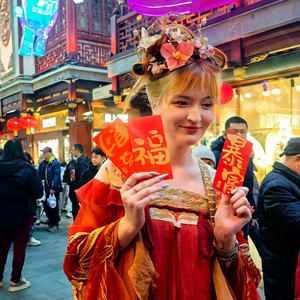
This spring festival, China isn't just welcoming the year of the horse, it's welcoming the world.
Welcome to the chat lounge.
I'm Tiyun.
Joining me to discuss the inbound tourism frenzy during China's Lunar New Year holiday.
Helen Hanhua, co-founder and Secretary General Beijing Club for International Dialogue.
Dr Joe Mi, Senior Research Fellow of the Chinese Academy of International Trade and Economic Cooperation, and Mike Bastin, China Observer and a Senior Lecturer at the University of Southampton, England.
A warm welcome to you all.
As we speak, we're just days away from the Spring Festival on Tuesday, which marks the beginning of the Year of the Horse.
So let me begin with Mike.
Do you know anyone who's heading to China for the spring festival this year?
Many, many people, many friends, many family.
In fact, my wife is going very soon.
So I do know a lot of people yeah, from different countries as well who are going, and quite a few going for the first time.
Very excited about this.
Yes.
And they're going for various reasons.
Obviously, we're going to discuss those.
Visa-free policies have helped a lot.
But I think the one thing I'll probably highlight more and more is the increased fascination with China Chinese history, Chinese culture, Chinese heritage, ancient China.
And they see increasingly Chinese New Year as a very, very important symbol of this.
So I think it's the Chinese heritage that is really driving this surge.
So yes, I know many, many people who are very excited about And some are there now and going very soon
Good to know.
And to Helen here in Beijing, have you been seeing more foreign faces around recently?
Oh, yes.
Not only recently.
I think the year of 2025 can be regarded as a milestone of having welcoming foreign visitors to Beijing, visit China again, especially after the pandemic.
The pandemic-related restrictions are completely eased as well as, at the same time, the Chinese government has loosened up the travel policies and has already inducted this unilateral visa-free policies to many countries.
So far, we have about 48 countries.
People from these 48 countries can come to China for visa-free.
And it's also on the agenda of almost every foreign leaders visit to discuss with the relevant government agencies in China about the visa-free arrangements.
So definitely when I was in Shanghai two months ago.
One month ago.
I see a lot of people from Korea.
They just spend a weekend in Shanghai, enjoy some cuisine, enjoy some local historic relics, as well as enjoy the modernization of Shanghai shopping as well.
And in Beijing, of course, there are so many historic relics and news explorations are waiting to be explored by the foreign visitors as well.
Indeed, last year, we've seen a rapid increase in the number of foreign visitors here in China.
And Dr. Zhou, what's your observation?
I understand you're going out of Beijing now.
Yes, I'm now in the United Kingdom, and I think it's really our time.
It's really a good opportunity for us to spend some of our later time in the Spring Festival and also trying to have some cultural exchange and interactions with our friends in other countries.
I hope that we can do more to improve the mutual understanding about each other, about the cultures, about what they are really interested in and what we can do to improve.
You know what we are going to be able to deal with uncertainty.
I think that you know.
I talked with some guys from UK several months ago about the possible cooperation between these two countries and one of my suggestions is about the trading services.
So in this regard, I think that we are already in the position to try to support more things like in the market electoral system of WTO in the MC, the Metro Conference of 14 this year.
It's a really important one.
So for both sides of China and the UK, we can do more.
But I don't think it's only limited in these two countries.
We can still do more to have a better and more open in the policies, in the different kinds of measurements.
I hope that we can try to give the people more confidence if we are able to meet with each other in a much easier way.
Indeed, we can enhance people-to-people exchanges.
Back to China.
Data from travel booking platforms show flight bookings by non-Chinese passport holders have surged by more than 400 in the two weeks leading up to the spring festival holiday.
So what is your interpretation of the figure?
Helen?
Sure.
Everything, you know, the figures are very promising.
I think this surge in numbers is a very promising sign for the travel industry or enhancing the bilateral relationship between two countries, especially the two peoples people-to-people exchange, as Dr Zhou just mentioned.
And it also shows that international tourists are increasingly confident and willing to travel to China.
So this is a very good sign.
It also points to a growing optimism regarding China's recovery.
It's reemerging as a key global travel destination.
This is very important to China, too, to China's economy as well.
And even given the turbulent world change and many countries, especially some major powers, are raising the slogans as de-globalization, I think China is doing the contrary, trying to make itself the country more accessible, more welcoming and, in the next move of globalization, especially China, the re-globalization in the culture and the tourism aspect.
Right.
We'll dive deeper into those aspects later on.
Can I just add to that?
Sure.
I think your question was about some sort of post-pandemic rebound or surge.
I don't think it is.
I think it's more than that.
I think travel numbers 2024, I think, surpassed pre-pandemic levels.
I think again it, building on Helen's comments it's very, very optimistic and positive for China and for the world really, where we see this exchange of cultures more and more.
I think it's a permanent wave.
I don't think it's anything temporary.
I think what we're also seeing is increasing numbers from different parts of the world interested in China's regional culture as well.
So they're going beyond the first tier cities and looking for the West Lake in Hongzhou, pandas in Chengdu, beautiful coastal areas like Qingdao, the eastern coast as well, and going inland to Lanzhou as well.
So I think It's far more than just a first-tier city shopping experience.
It's a real cultural experience that's going deep into ancient China's, as we know, rich regional culture.
So very, very promising.
Great.
We'll explore further on what's been attracting those visitors later on.
But back to some figures.
Bookings by Russian tourists rose over time.
470%, while arrivals from Argentina increased ninefold.
Travel demand from several European countries, including the Netherlands, Spain and the United Kingdom, also grew by over 200.
So maybe, Mike, how surprising do these figures look to you?
If we look at it separately, the surge from Argentina.
So this 900 increase is incredible and perhaps a very big but very pleasant surprise.
So that's probably the greatest surprise, but again, very, very pleasant.
And I think that's got a lot to do with direct flights, a lot to do with exchange between the two countries and developing ties, economic ties, but also direct flights affordability obviously, visa-free stays.
I think payment convenience is now very, very important now.
So I see recently, in the last year or two, a lot of local apps now linked directly to international credit cards and debit cards.
I think that's probably had something to say with the surge from Argentina.
From Russia, direct flights, again, more Russian flights directly into more Chinese cities.
And I also see that resorts are have trained staff to speak some of their language.
So they speak some Russian, they speak European languages as well, probably Spanish.
That caters to the Argentinian. tourists as well.
So a combination of those factors.
But yes, an incredible surge which is very, very good for the Chinese economy and for the global economy.
Dr. Zhou, I'd like to know your interpretation.
Why has travel from Argentina surged so dramatically, especially given that its president initially took a relatively unfriendly stance toward China right?
Yeah, I agree with you that when we're talking about the relation between these two countries, there are so many problems we have to deal with.
But we are not just trying to identify every problem just by the government itself, because the market is really playing an important role.
As for Argentina, I think that in the previous several years we are seeing Argentina is facing with many problems the hyperinflation and also the unstable of the currency's values.
So they are trying to open or trying to have a bigger share of their market in China, like for its beef or some of the dairy products.
So the people come here to China, they are trying to find more opportunities.
Well, as another reason, I would say that the direct flight from China to Argentina is really opening new routes for the people to commute from these two countries, maybe through New Zealand.
I think it's really a very nice signal sent by these two governments that we can try to break the gaps.
And that is really important in such an uncertain world.
So for Argentine people, I think that they are really friendly.
They want to establish a better relation with us.
So, no matter what the government wants to say or what the leaders want to say, I don't think that it's really a problem of the cooperation between the markets and the businesses, the private sectors especially.
And I think this kind of incoming people are really good for both sides.
And in a certain degree they will also bring some of their products to China and what they really want to have from China.
I think it's good news.
The Chat Lounge.
The Chat Lounge unpacks views and opinions on hot issues in a more casual way.
And Helen, you mentioned you observed a lot of Korean tourists in Shanghai.
So, from your perspective, visitors you know, actually speaking like some less common languages, like those from Russia, already mentioned, and from Spain Italy, South Korea.
They're also arriving in much larger cities and making you know early bookings very essential.
And in Shanghai, a veteran inbound tour guide called Tan Ke was quoted as saying during peak holiday periods, daily fees for those foreign language guides can reach some 2500 yuan.
That's about 360 U.S. dollars.
And many tourists need to reserve services a month or more in advance.
So from your perspective, why are travelers from those countries showing up in such a large number?
And have you observed any unexpected growth from non-traditional source countries?
Well, Argentina is definitely a very good example.
Indeed.
And there are travelers from Netherlands, from Spain, from UK, even from other Central Asia countries.
I think the surge in this we call the non-traditional markets or non-traditional countries highlights the shift in the global tourism patterns.
As travelers move, do increasingly seek diverse international experiences post-pandemic and they can learn China's policies, unilateral visa-free policies, as well as China's culture and tourism and tourist experiences from many social media platforms.
So China has been doing these favorable policies for several years now, Right after pandemic.
I would say not only the unilateral visa-free policies, but also visa on arrival and transit visa, as we discussed just now, simplified the digital payment, as Mike just said, and also the international flights availability.
So these favorable policies, coupled with the social media amplification and the visual culture that the KOLs Boring influencers,
They are actively framing the China's Spring Festival, China's travel experiences, as very interesting, very foreign exotic, but also immersive cultural experiences as well.
I think they help a lot.
You know, through TikTok, through Instagram, Xiao Hong Shu YouTube, every social media platform, you can see this.
China presented to the foreign visitors.
And these netizens, not only from China but from foreign countries.
They help together to actively share the interactions with the audiences.
This, I think, significantly enhances the desire, demand from not only from the non-traditional countries, but also from our neighboring countries, including Korea.
Helen, that's an excellent point.
I would just amplify that the social media presence and TikTok and Instagram and spreading the cultural significance of Chinese New Year, Chinese heritage, absolutely very, very pivotal in this surge in tourism.
And from your personal experience, how accessible and welcoming is China for foreign travelers today?
Can you maybe do some comparison with your past experience and the recent experience, maybe certainly in the last few years?
As we see more direct flights, we see the payment service is much smoother now.
So you can use your international credit and debit cards much more easily.
They're linked to local apps.
And the service infrastructure has improved, not just in the first tier cities.
And if you compare it to my experiences which go back, show my age now go back over 30 years, when I first I can remember first flying into Beijing before the new airport was open.
So obviously a very, very different China.
But yeah, all countries go through this.
So tremendous modernization.
So many international airports now.
Obviously Southwest China, South China, East China, not just the first tier cities.
So I think China is really open for tourism now. across mainland more and more.
And again, that's what's really, I think, driving this.
It's this real fascination in rich Chinese regional culture and history, as well as the obvious Beijing, obviously Forbidden City, the Great Wall.
But, like I say, going to Harbin for the ice festival, going to places like Chengdu for pandas and spicy food and Three Kingdoms.
So the modernization is there now and international tourists are taking advantage of this.
And I don't think it will be a temporary wave.
I think there's some permanence here.
And the procedures foreign travelers have to go through have been streamlined, right?
Absolutely.
I'm going to remember when I used to get tourist visas going back.
30 plus years for China.
It wasn't just the cost of the visa.
It was the cost of the travel to get to, for example London, to get to the consulate and then to go back again to collect your visa, unless you wanted the express service that day, which was even more expensive.
So we've just worked out we're probably coming back in December for a visit.
Very excited about that.
And the visa-free policy that's just been implemented for the UK will save us probably five, six hundred pounds, which is quite a significant amount.
And see, it's much, much easier and cheaper.
And I'm also wondering to what extent you know the Spring Festival has evolved from a primarily Chinese celebration into a globally recognisable cultural symbol.
You know, especially as more countries incorporate Chinese New Year celebrations into festivals, their official calendars?
Perhaps local celebrations abroad.
Just you know, don't give them the full picture of what Chinese New Year really means.
Maybe they've realized that watching parades abroad isn't the same as experiencing the festival at its source.
And they decided you know, fly to China to experience, you know, the authentic, you know celebrations, right.
I think so.
I think, the local celebrations which are more now in more cities, particularly across the UK.
So cities near me such as Southampton, obviously London, you'll see a lot of festivals parades, you know very fanciful colours.
I think they've whetted the appetite for international tourists who now want to go and sample the real thing.
Yeah, so very good point.
Ben, what could be more compelling to foreign visitors?
You know the festive spectacle or maybe the deeper values behind the holidays, such as family reunion and ritual.
Mike?
I think a combination of all of those things.
I mean, it's a record nine-day holiday.
Let's make that point.
So I think that's playing a part in this.
So it's quite, direct flights are good, but it's still quite a long flight.
So if you go, you want to go for a fair amount of time.
So the nine-day holiday period.
So I think it's.
It's about reuniting with family friends, but also sampling as much of China as possible.
I think that's what we'll see more and more.
So people will probably be flying indirectly to the major hubs, the major cities such as Shanghai Beijing, and taking in the obvious sites and historic sites there.
But they'll also have local flights, I'm sure, to regional provincial capitals to take in the local culture there.
So it's a combination of those things.
Also the food and the regional food.
So international tourists are obviously familiar with Chinese food, but are more familiar with regional varieties in food and drink as well across China, which is again very important, fascinating.
Again coming back to Helen's excellent point about social media, that has spread that very, very successfully through TikTok and Instagram.
People are much more knowledgeable now about, for example, the food in Dongbei, the food in Sichuan and Guangzhou and how this differs.
And then they really want to sample that.
So A combination of those things, but really looking across regional China and regional cultures, I think is most important now.
And do you think it gains the backdrop of an increasingly complex geopolitical environment?
Does this surge in inbound travel may carry some symbolic contrast?
Yeah, I think so.
If I interpret that question...
In the right way.
I think it's a rock of stability.
We are in uncertain times.
There are geopolitical tensions.
We can't deny that.
There's economic uncertainty.
And I think ancient China.
China with its ancient, rich cultural heritage and history, I think symbolizes a very important stability, you know sort of psychological safe area that people really are clinging to and also fascinated by.
So I think it's deeper, yes.
I do think that.
And I think that's why we're seeing this surge in increased interest in other areas in Chinese traditional culture, traditional elements.
In my area, in modern fashion, we're seeing traditional Chinese elements appear more and more.
I think it's that they're clinging to the stability and comfort they find in nostalgia and the past.
Helen, I'm not sure if you've Notice any you know there may be.
Some visitors are arriving with the intention of relearning or reassessing China for themselves.
Interesting question.
I would like to add that to what just Mike made, fascinating points regarding China.
You know they want to explore different dimensions of China and explore further about in-depth about China's different aspects culture, different aspects and as well as other different aspects.
So, if I may add, you know, the most recently UK Prime Minister visited China Beijing, and he and his team tried Yunnan cuisine restaurants in Beijing.
And while the owner of the restaurant prepared a knife and forks, but all the members they were trying using chopsticks.
I know they are very familiar with Chinatown food in London in particular, but it is still very fascinating.
And this makes a big boom in the Chinese social media platforms about what they were eating.
What does the menu look like?
What is the drink list?
So this is like an interaction of culture, mutual understanding, not only for foreign visitors to understand China better and or to learn or relearning the chinese culture, but also for chinese to learn from their experiences as well.
So if there is a surge in the inbound travel to china, I'm so happy that it happens during the Chinese Spring Festival, because Chinese Spring Festival carries such a symbolic meaning of Chinese rich culture and China's economic situation, China's experiences, also the safety and the sustainability of its development.
So the Spring Festival carries all these different factors for foreign visitors to learn more about this, to enrich their personal experiences.
This has been The Chat Lounge.
Check out three must-dos in China when we come back.
Stay with us.
With a history of 5000 years, it's no surprise that China has created a fabulous treasury of folk tales.
Once a year, on the seventh day of the seventh month, all the magpies fly up to heaven and form a bridge.
So many amazing worlds to discover.
I want a new palace, said King Mu of Zhou one day.
Chinese folk tales retold for audiences today.
He asked.
And with little hesitation, she said, Yes!
Five thousand years of amazing Chinese folk tales.
My father must not go to war.
Someone must take his place.
You'll find Chinese Folk Tales Season 3 wherever you discover your favorite podcasts.
Welcome back to the chat lounge.
We continue our chat on the world coming to China for Spring Festival.
Then let's move on to the impact of this trend.
So, Dr Zhou, how does the Spring Festival inbound tourism differ from traditional domestic travel in terms of its impact on cities and local economies?
Yes.
I don't think that I have the statistics about the distribution of the people, but I think that the purposes would be different, because you know the people, when they come here in the Spring Festival, they can enjoy not only the food, they also are going to enjoy more, I would say, the events, the festival events organized by the local governments in China.
So in Beijing, they can experience the Miao Hui.
It's a very important and gathering of people and they can have more kind of activities in this regard.
Well, in other cities in China, the Spring Festival is a place, it's a period of time, continuously with the interactions of the different people and also the groups, And I believe that it's really a very special experiment if they come here.
Well, another one, I think that is also about some of these policies in the spring festivals.
We know that in this time some local government is trying to do some kind of support for the people to consume so they can have a better and more affordable choices in the different products, like where now seeing some people is going to buy the electronics products and some computers so they can enjoy this time.
Well, another one is that in the Spring Festival it is the most important window for the different films to be casted.
That is a very happy time for China, so the people will try to show their latest films.
Like.
We heard that the first day of a spring festival in the lunar calendar there will be a new movie about the car racer.
I think it's really a comic movie and people will enjoy this kind of atmosphere in this time.
So they come here in these days.
Maybe it is a little bit more crowded compared with the normal time, but they can trying to have a very special and very happy time here in China.
Hopefully.
And to Mike, you mentioned a lot like Chengdu, Shanghai, those traditional tourist cities.
Which other cities or regions are best positioned to sustain long-term benefits from this trend?
Well, certainly southwest China and Chengdu springs to mind, a lot of history there.
Obviously the Three Kingdoms, that an increasing number of international tourists have read the English version so that they wanted to go there to find out more about the three brothers and Zhuge Liang, and Chinese history and pandas.
Lanzhou and northwest China.
I think very much a hub there and different culture, ethnic minorities, Yunnan in particular.
I think fascinates international tourists.
I think it's something about 40% are ethnic minorities.
They're very colorful, very interesting, a diversity of food and local culture.
So those spring to mind.
Obviously on the East Coast.
I mentioned Qingdao, a lot of history there and Shandong province generally.
So you'll probably find more international tourists flocking to Chufu, obviously the birthplace of Confucius, which is something I had to do when I first went to China.
It was the first thing I did.
I got a flight to Jinan and then hired a driver to take me to Chufu.
I had to go there.
So I think it opens up also and probably many, many more areas.
The international tourists are now really open to exploring this 5000 year history, this diversity across regional China, as well as a strong national identity.
So those areas, those cities obviously Harbin with the ice festival.
That's very much a global festival now as well.
Yeah, and probably more than I've mentioned.
So this is really just, I think, the beginning of international tourism across China.
You obviously have abundant knowledge about this country, but for those who are traveling for the first time, which cities or which scenic spot would you recommend?
The very first time, I always say to people, go to Beijing.
Obviously, Shanghai has attractions.
Thanks.
Most definitely.
But Beijing, I think, is the real cultural center, given that you have the Great Wall on your doorstep.
You have the Forbidden City, the Temple of Heaven, Summer Palace.
So very first trip, perhaps for maybe a week or so, will be Beijing and look around Beijing.
Obviously, the Hutongs, the alleyways, the Houhai.
Yeah, fascinating.
As Dr. Joe said, the Miaohui, the temple fairs, an incredible aspect of local culture as well.
So Beijing will be my recommendation for a very first trip.
And then I would expand to obviously Xi'an and then the terracotta warriors will be top of the list.
And then beyond that, yeah.
Okay.
So Beijing.
Right.
I didn't live in Beijing.
Beijing is a special place in my heart.
I've been here seven years.
Mike just mentioned the Lanzhou.
So a notable point of this wave of experiential travel is expanding rapidly from major hubs to lesser known, yet culturally rich hidden gem cities like Lanzhou in the Northwest and Hohot in China.
Northern China.
So Helen, what does this shift tell us?
Well, shame on me as a Chinese.
Have you been to the cities?
Yes, I have not yet been to Lanzhou yet.
But of course, the Lanzhou noodle is everywhere.
So of course, I have a taste of Lanzhou, if that can be regarded as a taste of Lanzhou.
So I think this shift, as I just mentioned, that this is not only a first-time travel experience, but the exploration of cities like Lanzhou, like Chengdu, like other cities.
I feel a little bit pity that Mike did not mention Hangzhou as my hometown.
Sorry, Ellen, the West Lake.
That was one of my greatest experiences in China.
I should correct that.
Wesley.
Surrounding mountains.
Yeah.
Absolutely.
Yeah, we can understand that because there are too many things to see.
Yeah, there are too many cities in China and then also too many rural areas, mountainous areas in Hunan or Hubei and some interesting cities in the Bay Area, not only Shenzhen, but the surrounding cities.
I think it indicates an ever-enriched China, not only by its attractions, not only its history, its rich culture, but also its development, its modernization and its combination of how, on one hand, maintain the natural landscape, the scenic places but, on the other hand, how the Chinese people have lived, has made their great efforts to build a new China, a very modernized China at the same time.
So it's a combination of culture and modernization.
So I think Lanzhou is a city like that and some southwest cities like, for example, Chengdu.
Chengdu is not only famous for its historic relics it's the gorgeous from over 1000 years ago but also its hub as a technological hub connecting to the barren road countries, especially Central Asia countries.
Urumqi is another place.
I would like to say but Xinjiang people always correct me that Urumqi is the least place that they recommend if we ever visit Xinjiang.
So I think there are so many places indicating that China has a lot of dimensions for foreign travelers.
And these every dimension worth deep exploration, even as Chinese.
I've been to Chengdu a lot of times, but I always can find some new thing for my next travel.
So I think that is the attraction for foreign visitors to make their one-time, once-in-a-lifetime visit to China a to a long-term, to a you can repeat again and again to visit China.
And Dr. Zhou, what's your interpretation here?
Does that mean that actually, on the other hand, those places like Lanzhou, which used to be regarded as less developed, now they are more travel-friendly in terms of their infrastructure or any other aspects?
Well, yeah, I have been to Lanzhou for several times.
I think that I enjoyed the beautiful sceneries, like the Yellow River.
And, you know, there has an iron bridge over there.
It is one of the, actually the center of China.
I mean, demographically.
So the development has started early quake because the connections between Gansu and Qinghai, these two provinces, are really providing many new opportunities.
And I mean China is trying to have a more balanced development.
So from the east to the west, from the But south to the north, we are trying to make it a better, more unified market in China.
And, in this regard, many people are just coming from the East part of the West, not just for the tourism, but also walk there and enjoy the very beautiful sceneries.
And I think they really are bringing more companies from the East to the West, like the textiles, some of its other electronics.
People are getting more kind of experiences there.
So when I was there, I also went to the provincial museum and I found that there are so many people's living activities, even many, many years ago.
So they really are kind of a curator for the people to move, to travel from the different parts in the world.
I think this modernization procedure is not just a unique one in China.
All the different provinces and cities are trying to explore their own identical ways of doing things a better modernization.
Modernization doesn't mean just to eliminate certain kind of industries or sectors out from the development.
They are trying to input or inject more abilities like the technology or the human resources in the development from the traditional one into a new one.
So the modernization is really giving people more ideas and space to discover kind of thing they can do and trying to also embrace the development of the technology.
Artificial intelligence is one example.
So i think that if you go around in china like i have been to all the provinces in china, so i i found that every places are really want to not stand still.
They want to do more to make the better use of what they are able to have and try to strengthen their abilities.
So I think that is really what we can expect in the future.
We can expect much more diversification of the development in the structure, in the areas and also in the abilities.
The Chat Lounge.
The Chat Lounge unpacks views and opinions on hot issues in a more casual way.
You've talked a lot about the positive side and if China wants this passion or foreign passion for China travel to continue, what does the country still need to catch up or improve?
This question goes to you, Dr. Zhou, first.
Yeah, I would say yeah, that is, you know, so many different expectations from the people who haven't been to China.
Right.
So I think one of these one is the hospitality, you know, and beautiful sceneries.
So can we try to have a better and more flexible of the logistics requirement for the people?
If they are coming here, can we have more air routes to connect in different cities?
And we know that China is trying to build very good aerial networks.
Can we try to make it more flexible?
Also introduce some snow speeds, trains, routes.
And can we do more to improve, the better.
I mean kind of very good practices about the use of the technology abroad, like the credit cards, like some of the e-payment also, are better interconnections in different areas.
I would say that every people have its very unique expectation about the experience of the economic year.
To China,
So can we just try to keep these two balanced?
First is you know what they really have or get used to in their own country, like the habits of the food, like the habit of shopping or even the hotels.
And the second one is what's the special thing that they can find some surprise in China.
I mean, these two balance are really important.
All right.
So Mike, what do you expect as a foreign tourist?
Well, I think, building on what Dr Zhou just said, some very, very good points going forward, such is the rich diversity and the extensive nature of China and Chinese history.
I think service infrastructure is probably an issue in the sort of far reaches of China, say northwest China.
Xinjiang has so much to offer, Kashgar, for example.
And I think service infrastructure in terms of transportation and And the Leicester Centre and hotel stays is something where there will be more improvement, I think very, very quickly.
Because I think this tourist trend will grow and tourists will be ever more fascinated with more and more sort of outreaches of China and want to visit these places and find out more about them and experience that.
So I think that's really something that needs to develop very quickly.
But I think it will.
And that's really, as I see, the way forward.
And I'm very, very interested in Hami in Xinjiang and the local embroidery there.
It's fascinating.
And I think that's the sort of thing that international tourists will start to look at more and more.
So service infrastructure in more regional parts of China, I think, is the key development focus now.
I think both Jomi and Mike made very good comments and their own observations.
If I may add, I think one thing is that Actually, Mike mentioned about the service infrastructure.
So we have wonderful infrastructure in terms of the physical facilities, but we need to do some more in the service infrastructure, especially in the second tier cities and those less visited regions.
Because these smaller cities still face challenges related to their own accessibilities, transportation and accommodation options to the foreign visitors in particular, which leads to another point, which is the language accessibility for those foreign visitors.
You know many of the staff in the tourism industry.
They are very proficient in Mandarin and they have their own know intern industry tests.
But the language capability is certainly a must need, or they need to upgrade their language capabilities to meet with the so many more international tourists because they need to have normal communication.
Even though we now have the ai, we have different apps.
I think people-to-people exchange is more important.
So if those staff, the industry players, they have better language capabilities, I think these kind of services will be improved much.
And last but not least, in my own opinion, I think, because we have our new 15th five-year plan, we are achieving and we want to reach a balance in terms of development and sustainability.
So I think the surge of international visitors, especially in those less visited places, may place some pressure on local infrastructure.
I'm thinking because of the overcrowding or some environmental issues which could dilute the quality of their own travel experiences.
So I think maybe the local relevant agencies need to take these into consideration as well.
Indeed.
And lastly, the implications and some outlook.
Helen, do you see this spring festival inbound travel boom as a one-off surge or the beginning of a long-term structural shift?
Definitely long-term structural shift, in my opinion.
I think several factors suggest that coming to China for the Spring Festival could become a very popular, even mainstream, international travel option over the next five years or even longer term.
This is the typical.
We call it the down season for many Western countries or many countries in the world, right after Christmas, after New Year.
But then China has this spring festival experience, cultural immersion.
So that might present some alternative options for international travelers when they look for some destinations travel destinations in the beginning of a new year, but right after the surge of the new year per se, not only the very beginning of the new year, but at the end of January, beginning of February.
So this might place a very interesting alternative for international travelers.
And also the global reach of the Chinese media, social media in particular, the entertainment product.
Like we have Disneyland, we have Universal Studios in the cities, we have our own theme parks, we have our natural landscapes and the scenery places.
And also we have so many traditional holidays for Chinese Spring Festival in particular.
We have the eve of the Spring Festival to welcome.
We even have the Spring Gala.
And on the 15th day, we have the Latin Festival.
So that presents a variety of choices.
You can come to China for the Eve of Spring Festival or you can come at a later stage to enjoy the Latin Festival where visually, it's very culturally visual and rich.
They have the Latins, they have the fireworks to some extent, the red envelopes. the temple fairs.
There are so many choices.
So I believe that, starting from the Spring Festival, it can present a very long, longer-term structure shift for China to become a long-term destination for travelers worldwide.
You've already provided a very detailed guide for foreign tourists what they can do during the Spring Festival holiday.
Right, yes.
And then, Dr. Zhou, are you as positive as Helen is?
Yeah, I think that we are still having a lot of potential areas to create, like in the recent months we are putting more efforts on the integration of the goods and the services so in the coming years maybe the service consumption will be a one of another priorities and potential errors so the people are able to enjoy the culture and the interactions between the different cultures And I would say that is a very challenging work for us to also to try to modernize our economy while at the same time to maintain some of the traditional ways of treating with others, to staying, have the relations with other peoples in a very unique way.
So like, you know, if you go to Lugu Lake in Yunnan, they are very special.
The Maturin society is still there.
So I think that that is the reason why, you know, many people are attracted by that.
There are so many things we have to try to dig out or try to preserve, not just for the foreigners but for our children in the future.
We have to try to make some of the relations stay stable in the coming years and try to make the culture more diversified.
Then would you please provide some three must-dos for them, especially for first-time visitors to China.
I don't think that the Tories will have the same kind of expectation.
But I would say there may be.
First they should try to look at the Chinese people, the ordinary people, the kindness of the people, the common families, some very common people who are working in the bring festivals, like the deliveries or other people who are really working very hard to make the functional society in such a large population country.
And second, I would say they can come here to enjoy some of the complex and also even sometimes there are some quite opposites from the historic to the Like.
You know, Suzhou is a very good example.
They have very special gardens while at the same time have very modernized industrial parks.
I think that is really very interesting for them to enjoy the different experiences.
And the third one, That is the innovation passion, innovative abilities of enterprises and markets.
I think that is one of the hard-to-experience like very quickly updated.
Take knowledge about the consumption, e-commerce or even robotics.
I would think that it's really interesting for many people to look at the volatilities of the Chinese society.
They might give us three must-dos for first-time visitors to China.
In my opinion, I would say, if they have the time and they can do, it would be to visit the town in Shandong Province Chufu, which is Confucius' hometown, and look around that, because you really get a feel for ancient China.
Obviously there are other influential people across Chinese history many others, but certainly Confucius is one of those.
So I would go off the beaten track and get to Chufu in Shandong Province.
Most definitely coming back to Helen, Hongzhou and the West Lake.
I'm sorry, I forgot about that.
That was one of the most beautiful experiences, those pagodas, those temples.
And then I think possibly Chengdu and the Panda Sanctuary.
That's an amazing concentration of pandas that, again, is very symbolic of China.
So probably those three, but that's three out of 300. very difficult to prioritize.
What about you know tools they probably must have with them for first-time visitors, like maybe knife and the fork?
Dr. Jeung mentioned this, it's an interesting phenomenon in this country when you go to Chinese restaurants, how many British people now quite comfortably use chopsticks. that's a real change you'll see a family of british people families of four or five more all just comfortably using chopsticks so i think that's a change so and i think western tourists really want to do that as well they want to try chopsticks even if they haven't tried them before so i would say you know don't if they offer you a fork or a spoon say no and have a go at the chopsticks.
You can pick it up quickly.
Also, a must-see, particularly in Beijing, will be the Mia Hui, the temple fair.
It's the Chinese New Year time as well.
So there's a couple of things.
Sure.
And last but not least, Ellen, your tips here, please.
You know, we have this cliche, if I may say, when in Rome, do as Romans do.
So maybe this applies to some traditional travelers.
When in China, do as Chinese do.
So to taste some authentic Chinese cuisine is a first priority, in my opinion.
But I also agree with Dr. Zhou and Mike regarding some different places.
For Zhou, it is Suzhou.
Suzhou has both the traditional flavor as well as the modernization, because Suzhou even has a very modern, very advanced industrial park.
And around this park, There are so many interesting places to visit, to explore.
But also for people who love Chinese culture.
I think Chufu is definitely a must-go place, even though it is probably a third-tier city in China.
And for me, I would like to say, if we carry this spirit of when China do as Chinese do, if you are an art lover in Beijing, not only go to Great War of China, the forbidden city in Beijing, the Beijing local cuisine.
But in this Spring Festival, in particular the Chinese museums and some art galleries.
They are having a very good international collaboration with some of the leading museums in the world.
So if you can explore some of these collaborations between China and the most famous galleries and museums in the world,
But enjoy these exhibitions and enjoy these historic and top-of-the-tier mass pieces in Beijing.
I think this could present a very different flavor to these foreign visitors as well.
Well said.
And on that note, we conclude this session.
Many thanks to Helen Hahn, co-founder and secretary general of the Beijing Club for International Dialogue, Dr Zhou Mi, senior research fellow Chinese Academy of International Trade and Economic Cooperation, and Mike Bastin, China observer and senior lecturer at the University of Southampton, for Time and Insights.
Drop us a line anytime at radio at cgtn.com and tell us what you think.
I'm Tian.
Join us for more chat at the chat lounge next week.
And also have a happy year of the horse.
As you sip your morning coffee, we transport you from the sea of tulips in the countryside to the exciting moments of table tennis worlds.
As you commute in the hustle and bustle of rush hour traffic, we guide you to navigate from intricacies of global markets, tech revolutions, to the El Nino-triggered fires. says over 90 active fires.
As you gather around a community event, we provide you the vibrant sounds on different topics, such as how AI empowers education.
What does Lung, or the Chinese dragon, mean to the Chinese people?
Why live stream shopping is gaining popularity in Brazil.
Entrepreneurs are seeking to establish a strong presence in the Brazilian market, to connect people through sharing insights, interviews and opinions that help us to see the world.
Together with CGTN Radio, hear the difference.
You can download the CGTN app to get more valued information.