I don't think we're playing enough and we're not rotting enough.
Something to take the edge off.
Close my laptop.
Peel off my blue light glasses.
Have you heard of the healthy mind platter?
You need to watch TV to have a healthy mind.
No wonder we're all mentally ill.
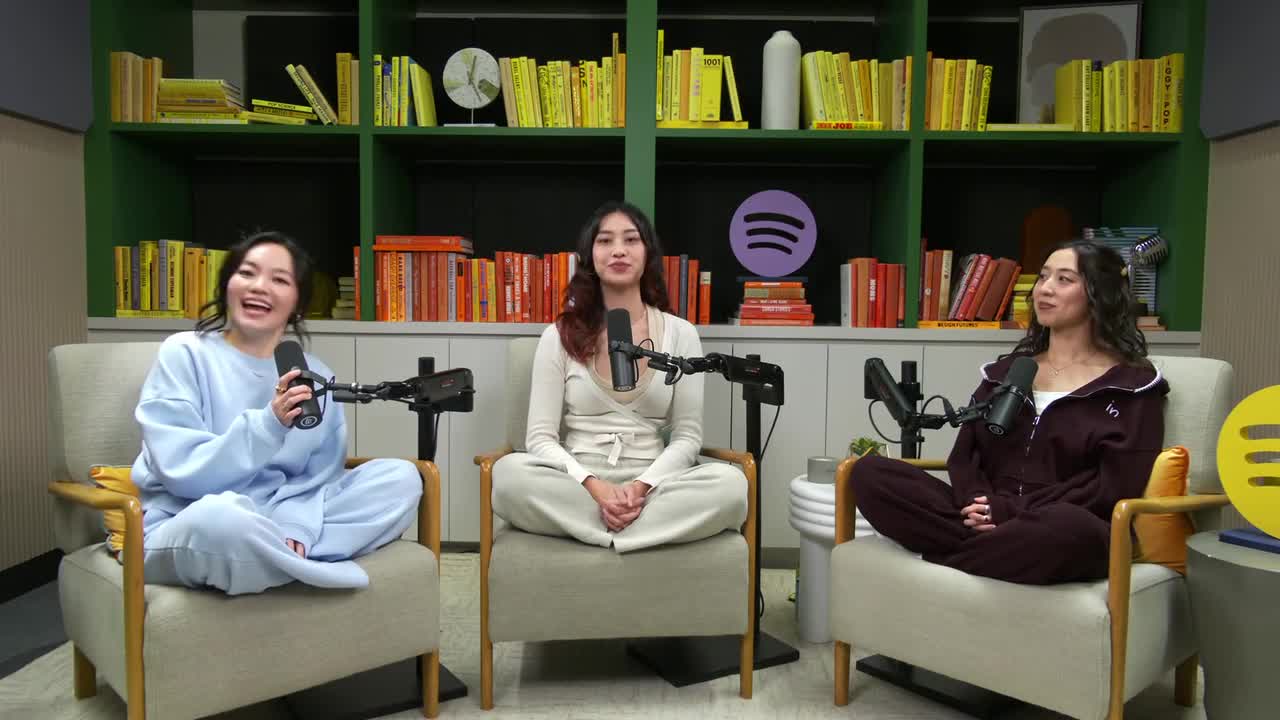
Hello and welcome back to a new episode of Hot Pursuit, a podcast about creating conversations where nothing is off limits.
This podcast is produced by Asian Boss Girl.
I'm Em, and I believe that home is where the pants aren't.
I'm Jen, and reality TV is essential to life.
And I'm Madeline, and I religiously believe in at-home loungewear.
We got cute loungewear on today, everybody.
Everyone has their loungewear sets on.
Yeah, so today we wanted to talk about the topic of a work wind down.
You get through your day.
It's been a long work day, and how do you start to decompress from such a stressful activity that takes up most of your life?
When does it start?
What do you do and how do you productively rest?
Is it even necessary?
We're going to be talking about these things today and we're going to start off with a rapid fire.
List of activities.
Love that.
All right.
I love our rapid fires.
Okay.
You're done with a long day of work.
Is this a part of your wind down?
A workout?
No.
Yes.
Sometimes.
On a good day.
Okay, that was not a yes or no.
I just wanted to let it hang and see if you changed your mind.
I'm a yes.
I love working out.
Okay.
Cooking versus grabbing dinner.
Oh, this is like a meh, meh.
Meh, meh, meh.
Oh, okay.
Dinner.
Grab dinner.
Obviously you have to eat.
Yeah.
Unless you're like fasting.
Some people do that.
I think I need a wind up to cook.
Yeah.
Cooking feels like more work.
Same with workouts.
Workouts feel like work as well.
Another chore.
So like, yes, but it is not part of the wind down.
No.
That's after you wind down.
That's after you, the wind down is after you cook.
The wind down is after you work before you cook.
Oh, interesting.
Oh, so you have like a sandwich wind down.
Like wine down is like for me, reset before you, before you, before you begin home work.
Yes.
Home work.
Home space work.
Being at home is not very restful.
Oh, no.
Not all the time.
Why not?
I just see any activity as work if it's not like intentional rest or laying down.
I do love being horizontal.
Yeah.
What intentional rest.
Okay.
Reality TV.
Yes.
She loves reality TV.
I never watched it until I met Jen and now I am quickly getting sucked into the world.
It's so dangerous.
No.
No for me.
Oh.
Boo.
That's after dinner.
You have like AD and PD.
BD and AD.
So wind down is like a short period of time for you before the rest of your evening begins.
Oh.
Because then you have to work and then, after all that's done, that's when you can really wind down for the evening.
No more obligation.
And then you can indulge in reality TV.
But then like doesn't logging off from work or being done with work partially, give you a little bit of a relief mentally.
Even if you're doing some other rote task, like with your hands or with your body, that's still not a wind down for you.
No, I got to be still.
It's all stressful.
We need to find what wind down is soon.
All right.
Moving along.
Moving on to our rapid fire.
We can just call it fire round.
Okay.
Socializing.
Yes.
It depends.
Some people I need to wind up for as well.
And then some people they are a wind down.
So it depends.
For me, if I go into the office, I cannot be socializing afterwards because I'm exhausted.
But if it's a work from home day, then I can hang out with people afterwards.
A little bit of the introversion.
I think introversion and extroversion have a lot to do with it.
Who do you think is the extrovert here?
Okay.
Drinking, like having a drink or something to take the edge off, you know?
That's a wind down, wind down.
Oh, so yes.
It's a wind all the way down.
Yeah.
That's a weekend wind down.
Yes.
Okay.
A nap?
Yes.
Oh, yeah.
She's pouring out.
No.
Because then I can't fall asleep later.
No.
I like naps before 4 p.m.
Before 4 p.m.?
But you're working.
Yeah.
So that I just don't take naps.
Yeah.
It's like, it's like past a certain time.
You won't take a nap.
Yeah.
Yeah.
I'm like that too.
Yeah.
Like if the sun, if it's already dark, it is not nap time.
Oh no.
Yeah.
No, no.
That's criminal.
No, no, no.
Maybe when I was like 16.
Yeah.
What about you?
Maybe when you were two.
I don't really take naps.
I should.
I think you should.
You're also a negative napper.
Yeah, yeah.
I actually think they would be really great, but I usually just don't put myself to bed.
During the day or at night.
Yeah.
Her sleep debt is like how many?
It's like six hours.
Six hours now.
Yeah.
She needs to catch up on.
Being horizontal.
Yes.
Yes.
Yes.
Yes.
Absolutely.
Need a lay.
Good job, guys.
Yeah.
That was quick.
Good job.
Okay.
Have an existential crisis.
That's not restful.
That's work.
These are the times though, that I think about like what I'm going to do when the world is ending.
I think of a conversation I had with one of my friends where I asked her about like do you ever think about your parents with like the state of the world?
Is that restful for you?
Well, it just happens to be when these thoughts have room to bubble.
So it's not restful, but it's inevitable?
Maybe.
I'm thinking of them as I'm horizontal and I'm texting my friend.
So she was telling me about how she probably wants to move to another country.
And then she's like, what about you?
And then I proceeded to tell her that I think about how I would find food if we were in war.
So I don't know.
We go to the 7-Eleven.
We've had this conversation before.
Yeah.
If the world was ending.
Where would you go?
We looked at a mountain like a literal set of probably 200 bottles of Mountain Dew piled up on each other.
And we stood there for probably seven minutes one day, being like How long do you think this could last for?
How would we ration this?
Mountain Dew.
That's all you had to survive on in the apocalypse.
Yeah.
If you went to 7-Eleven, you locked yourself in.
You're like, this is mine.
How would you ration?
This is my base.
Yeah.
Like, would you go to Costco?
I feel everyone would go to Costco.
So all the 7-Elevens are now free and open for us to.
You know, they do sell those kits at the wholesale clubs like Sam's and Costco right now.
That are like The bunker kits.
Yeah, the dry food.
And sometimes they're on sale.
I'm like do I need to get one of these?
My roommate got one last year when the la fires were happening.
No way, because we had to evacuate.
So she was like let's get a go bag.
Was it like beef jerky and dried fruit yeah, water.
A blanket, one of those foil blankets, see like isn't this more restful than like thinking about work?
I guess so.
See?
It's like spec, okay.
At least it's like a imaginative exercise.
It is, it is.
It's also kind of stressful.
Yeah, usually after work, I'm having the existential crisis.
Cause I'm like, I'm so tired.
Why was, what was that all for?
Why am I doing this?
Do you prefer this hypothetical existential crisis or your manager breathing down your back?
Yeah, I prefer a crisis.
Unfortunately, both are happening in a day.
True.
True.
What would you prefer?
Okay, next.
A snack.
Yes, absolutely must reset with a snack.
What do you go for?
Literally anything that's like dry and openable.
Dry.
Like Chex Mix, if I could just like grab something out of the pantry, something quick.
I love fruit.
Yeah.
Oh, that's so healthy.
Fruit hour.
Oh, yeah.
And then I complement them with chips, so it cancels out.
A balanced diet.
It's a balanced snack.
See, with fruit, I feel that's work.
What?
Because you have to prepare the fruit.
Get the cutting board.
You have to wash the fruit.
Get the knife.
Cut, cut, cut, cut, cut, cut, cut.
You might have to peel it, and then you have to wash the knife and the cutting board.
It's true.
Which makes you open and then throw it away.
Then you feel kind of gross afterwards.
If you do it enough, you don't feel gross.
All right, moving along.
Rant.
Huh?
Rant?
Rant to your friends.
Isn't that socializing?
Is that different?
I think it's different.
Socializing I envision like going out for a drink, or like going out to dinner or playing I don't know bowling, or I don't know what people do.
Just like a recap, a debrief of your day.
Or you could be like ranting about, I don't know, family drama.
Yeah.
Dating.
I could do that any hour of the day though.
Are you a ranter?
Yeah.
Yeah.
It's like therapeutic for me to rant and to be ranted too, because I feel they are reaching catharsis and therefore I'm also like I love this for you.
Get it off your chest.
It's a space to be angry.
Yeah.
That's a whole topic.
Let's talk about anger one day.
We all have it.
Quite visible.
Spend time in your hobbies.
Yes.
Yes.
Yeah.
You can turn your mind off.
Well, sometimes you have to turn your mind on.
In a different way.
Yeah, in a different way.
It ignites a different part of your brain.
Which is the same way as an existential crisis.
I guess so.
Your hobby is existential.
Her hobby is thinking about if the world is going to end.
The essence of the activity.
It's like imaginative play for you.
Versus?
She's playing pretend in my head.
Pretend.
But it's war.
But like productive pretend.
Yeah.
Yeah.
That's her daydreaming.
A day nightmare.
Moving on.
Shopping.
Online shopping?
Either or.
Online or in person.
Although they are different.
Let's do one for each.
Okay.
Online shopping.
Yes.
It's fun.
I say yes.
I get overwhelmed by online shopping.
Okay.
So in person shopping.
Yes.
No.
Yes.
Oh.
I'm just like, I've been out all day.
I want to go home.
I want to stay home.
But actually, no, I work from home.
So if you work from home, then yes.
Because then that's like a shift in environment.
Yeah, I do wonder if people's wind downs are the opposite of where they have to be.
So if they're out, maybe they feel they need to be home.
Or a lot of their wind downs are home versus it might be flipped.
I find that, because I work from home too, going out is really I'm like.
We're going out, you're just like ah, the world exists beyond yeah, the walls.
Yeah, i remember in my early 20s i used to go to the office and then i would go to a workout and then i would go to a social dinner afterwards.
I don't know how i did it.
That sounds like early 20s.
Yeah, i think about my life too.
I'm like What was I doing?
I don't know how, but I could never anymore.
One activity per day.
Okay, we're almost through.
Shopping feeds my extrovert.
Oh.
Going outside.
So it is restful.
I don't like the people, but I like touching the things and seeing what's new or what's exciting.
But being in my own world, nobody bothered me while I'm there.
So you prefer going to a store that's empty?
Yeah.
Oh.
I feel like I've been looking at a screen all day working this corporate job.
So like scrolling online again, I'm just like, I feel like a job.
More screen, more blue light.
A lateral shift.
Does the real world exist?
I need to touch it.
Okay.
Almost done.
A good old scroll.
I'm beginning to realize that, as restful as you think a scroll could be, you're still giving your brain so much input.
So it's really just exhausting your brain.
Do you ever feel like you're in that doom scroll loop and you're like I need to get out, but I can't help but like scroll to the next one?
It just feels like you're stuck.
So I don't feel like, I don't feel like it's actually restful.
But when you're doing it, you feel like it is because you're laying down.
The only thing you're moving is your thumb.
In like the context of socializing.
It's a nice break for me to like not have to produce output, to like interact with people.
But when I'm trying to wind down for actual sleep, it actually wakes me up.
Yeah.
So important.
Yeah, because it's just constant, like, me, me, me, me, me, me, me for your mind.
And you can just feel like I can feel myself wake up a little bit, which is not what you're trying to do when you're trying to wind down.
I just noticed your earrings are teddy bears.
They're so cute.
Thanks.
Where do you get them?
I got these in.
Oh, they're so fun.
That's a whole teddy bear.
India or Thailand?
Yeah, it's not even just the head.
It's like the whole body.
It's the whole body.
With a bow on it.
So cute.
It looks like my childhood bear.
Thanks.
Okay.
Scroll, J?
I'm not really a scroller.
I find that like a five minute scroll is really nice.
Sometimes.
That's incredible.
That's like five videos.
Yeah.
And then I get kind of bored.
So then I'm like, wow.
Quick break.
Yeah.
She can not be hijacked.
The last.
Run errands and or do chores.
That's work.
This is a mixed bag for me.
Because some chores I enjoy.
You can just do something with your hands and then think about other things.
But some chores I'm not about.
So it depends on the chore.
I like doing chores because it feels like it frees up my mental space to wind up.
So maybe the chores is preparation for a more sumptuous wind down.
So it's a pre wind down.
It freezes us.
That was us over complicating things.
It not only frees you of the task, but it frees you of the mental load of keeping track of that task.
So I'll know that I'm going to get to watch an episode and I feel like I can really enjoy it more when I don't have something hanging over my head.
Without the looming laundry or dishes or whatever.
Just like throwing something in.
Mm-hmm.
The dishwasher throwing something in the washer.
Mm-hmm.
I see.
Yeah.
Okay.
A passive chore.
A passive chore.
We love a passive chore.
A mindless chore.
Yes.
Yeah.
I like vacuuming.
It's just one swift motion, and then you hear the crusties go up the tube, and you're like, ah.
It's like ASMR.
And then it's clean.
I love dumping the bits in the trash can.
You just like open the basket and you see it fall out.
And you're like, that was all sitting in my old space.
With like a spiral of hair.
Yeah.
And you're like, no longer.
Yeah.
I'm clean now.
Now that we have gone through our not so rapid rapid fire responses for wind down activities, when exactly do you start winding down?
Is it the commute home, if you go into the office, or if you work from home?
Is it the moment you log off?
When does it really start for you?
When I hit the bed, that's when it begins.
So do you hit the bed immediately?
No.
If I'm coming home from outside, I'll quickly change.
I'll quickly hydrate.
I'll make sure like everything's kind of, all my ducks are in a row first.
And then I, and then I, Hit the bed.
You switch from outside to inside mode.
Yes.
Yes.
Wash the hands, turn into clothes.
Yeah.
You shed outside and then you put on inside and then you get inside.
My mom.
She says she never goes into her bed for naps after work because she feels like she needs that separation.
But for me, I'm like, just get me in bed.
I want to be in bed.
And I can stay there for like two hours if I let myself.
Yeah.
I'm like your mom, I think.
I try to leave bed for sleep, unless it's like a really rough day.
Yeah, you're not really in bed.
Well, you will stay in bed for as long as you want until you decide your day starts.
And then once you get out, then you'll never get back in perfectly made, but she will.
She will stay in bed till like 12 sometimes.
Yeah, I love rolling around on a weekday.
Once I'm up, I'm up yeah yeah, and then if I lay, then I'll lay on the couch, so I do do all of that, but then I just separate.
Yeah, or I think that's good.
I always know you have a chaotic day.
When I am in your room and the bed is not made and it's 2 pm, I'm like oh, It's a stressful day for her today.
She's really busy.
It's usually the first thing that I do.
Yes.
Very diligent about that.
So my wine dine starts when I close my laptop and I peel off my blue-white glasses, fold them up, set them aside and get up from the desk.
So immediately.
Yes.
Yes.
Because it feels like the physical act of leaving all of the things behind.
And then it's like I find that for most of the workday I feel like I'm in another world and headspace that is so cerebral.
And when I close everything, it feels like I'm reentering the physical.
Wow.
It's like a realm, realm switching.
I don't know if that makes sense, but like, yeah, like Phil of the future.
Did you ever watch Phil of the future?
Uh, I don't think so.
He'll like put these glasses on and then he'll go somewhere else.
And when he wants to come back to the real world, he'll take it off.
Yeah.
So you take them off, and then it's back to reality.
Oh, there goes gravity.
Sorry.
You're like, ah, my world.
So after that, usually I need to make dinner.
And so cutting a carrot, I'm like, this is the real world.
From cerebral to physical.
Yeah.
Hand to knife, knife to carrot.
All your senses are ignited.
Yeah.
Because we're so not in our bodies during the workday.
Yeah.
For corporate people.
For corporate workers, yeah.
Just so much screen time, so much virtual people.
If you're not in the office too, I guess work from home people.
So doing something physical with my hands feels satisfying.
I see.
So you opt for physical activity.
You opt for being horizontal in bed.
Yes, because my workday is I'm in front of the camera.
I'm like screaming at it all day.
I have to do like 50 takes.
So it is very physical.
And then I'm also like on my phone editing like this all day.
So if I could just Recline and outstretch and be still.
Expand your body a little bit because you're contracting all day.
Exactly.
Starfish.
Strike a victory pose, starfish, bask in the sun a bit.
That's my returning to the world.
What about you Mads?
When does wind down start?
Well, so when I would go into the office, I think I would.
Oddly, I have a love hate relationship with the commute because I've used to have to drive.
But then when I lived in SF, I would take the bus.
And so I loved the bus because I didn't have to do anything, but I also got to walk like half the way and then i can like listen to music or talk to people on the phone, so like just mindlessness, but like, i think, some type of physical activity.
I also go for walks every day, and sometimes it doesn't coincide with like actual wind down because i have to chase the sun right now and But just being physical and like breathing air, like seeing the sun, exposing your eyes to like natural sunlight, I feel like does a lot and takes you out of whatever you may be in.
So to answer your question, or just answer my question, Um, I don't know.
I'm not really good at it.
I don't.
I don't really have an exact time because I'll like start with the walk, but then I come back and I work for maybe 30 minutes an hour, two to three hours.
I might be cooking intermittently because I want to eat at a normal time.
Um, I don't know.
There's like so much home work that having a wind down sometimes feels like an optional thing.
And I feel like it's really easy to neglect winding down because you're like well, if like, like you said, you're like if I want to get that last hour of sunlight, then I have to go immediately.
And then by that time, now it's already six.
Now I have to start making dinner.
So there's like really no easy transition.
How long should a wind down be?
How long are your wind downs?
Is it important to have a set time?
Is it important just to like do one thing?
What do we think?
I find that if I properly wind down, it takes me like two to three hours.
But like, the number of times I actually do that in a month is probably like two or three yeah, because like, by the time you get everything done, it's like 11 or 12 and then you begin to wind down it's just not, it's not the vibe, but You just kind of have to do that.
And so I will try to do something that helps me relax and fall asleep.
But then I find, even if you get in bed, my mind is racing or my body is not calm or it's difficult for me to actually fall asleep.
Even if I've followed all the rules get away from blue light or, like you know, be in warm, soft lighting in a dark room and like read a book or something it's still sometimes not that helpful.
So i don't know really.
Yeah, sometimes sleep hygiene is not great.
I also have a theory that like, sleep quality is correlated with your cycle.
I'm currently kind of looking at it, but I don't really know.
Have you noticed a difference?
I've noticed that I don't know where in the cycle, but somewhere around right before the period, there's usually a night of insomnia.
Yeah, and then, yeah and then.
Um, if i have something like really early in the morning the next day, then i sleep a shot, whether it's like an early flight or early podcast recording.
Yeah, Extra early meeting.
Early meeting with Asia.
Yeah.
I used to not wind down at all in my 20s, especially in my early 20s.
I felt like I was wasting time with a wind down and I felt like I had so many other things to do and so many things on the to-do list, so much life admin-ing, so many errands to run that I would just barrel straight from closing the laptop.
Blue light glasses like what do I need to do next?
And that was not good because you like basically collapsed at the end of the day.
So my relationship to wind downs now are kind of like, a dessert or a treat.
I'll be like, 30 minutes, let's watch an episode, like FaceTime someone.
And then usually there's a second part of the evening where there's a chunk of something to do or like a hobby to do, or something where you're engaging your mind again.
So releasing the pressure valve for 30 minutes feels so good now.
For me it was less around like designing the activity of the windup, but more the mental permission given to myself to have a wind down and not feel guilty about it afterwards and not feel bad about it.
Oh, so yours is tied to guilt.
Yeah.
Guilt and productivity.
Yeah.
It's like, oh well, you just wasted an hour when you could have been doing X, Y and Z other things.
So, yeah, it was a mental shift more than like a tactical, like logistical activity shift for me.
And I imagine in your 20s your mental and physical stamina were so much higher and it gave way to the satisfaction of being efficient and accomplishing so much in a day.
After I close the lid, after I take my glasses off, then I can go bam, bam, bam, bam, bam.
I have optimized my life."
And I know that probably felt really good for you.
Yeah.
And then it's like and then you deserve the rest, versus giving yourself the rest now so that you can be more ready to embrace everything else that you want to do and need to do.
That's more mentally engaging.
I think that the idea of active rest is something that people often talk about, or the TED Talks are all about.
But I think that's kind of a toxic description of it, because I think rest in and of itself, even if it's unproductive, brain rot, rest is necessary.
But if we brand certain things as active rest versus non-active rest, I feel like it actually puts things into categories that isn't necessary.
It's like, is a cookie like a healthy dessert or not?
It doesn't matter.
Just have the cookie.
Know when to like stop and like get yourself to the next thing and have the discipline for that.
But the idea of active rest, I kind of just hate.
I can attest to you in your early twenties, like literally not stopping until you are dropping.
Like I would ask our other friends, does she ever sleep?
Because I remember it would be a work night and like y'all would be hanging out until like 4am and then wake up at 6am to go to work because you had to commute.
And I was like, I'm sorry.
I got to tap out at 11.
Like, I don't know what you guys are doing.
But I mean, that's also because you were having fun.
But still, it's interesting that it was tied to guilt the whole time, like underlying.
Because you felt like you had to earn the rest.
And then if you earn the rest, then you don't feel the guilt.
So now, like when you allow yourself to do it, is the guilt voice still loud?
Sometimes.
What does it say?
It's like you could have been doing blah, blah, blah, blah, blah, blah, blah, blah.
It's like the looming cloud of all the things.
And again, you should have been like expense reporting your finances.
You should have been researching that thing that you need to buy a car.
You need to research the car.
That's been on your list for the last two, three weeks and you haven't done it yet.
And because you're not doing it, then what are you telling yourself?
What's the further thought behind it?
It's usually like you wasted your time.
More than it is like, yeah.
It's usually, oh, you wasted your time.
You should have been.
You should.
The should.
Don't should yourself.
The should is so loud.
Yeah.
You don't should yourself.
Yeah.
It's like you should have been, and so you didn't meet the thing that you wanted to do.
I don't know.
So you're not operating.
Up to par.
At your fullest potential.
At your fullest potential.
Yeah, yeah, yeah.
Yeah.
Ooh, that is heavy.
Mm-hmm.
Just for a lay.
Because I'm doing more.
Yeah.
Yeah.
The self-talk is so accusatory.
Mm-hmm.
Yeah.
Flipping.
So it's like the concept of earning your rest or working from a place of rest that I think was beginning to flip for me in my twenties.
Rest should not be earned.
What does it mean to- As babies, we rested all day What happened to that?
And we were fed.
So you went from earning rest via work to now resting so that you can work from a place of rest.
So where did that shift come from and what does that feel like?
The shift happened because I burnt myself out so hard.
Fried, crispy, charred.
I think in like my mid to late 20s.
And I think also in my early 20s, the idea of being able to chase after dreams and accomplish things were very exciting.
And then, as I worked so hard on those, I felt some of those weren't worth the cost of My body, my health, my sleep, my mental sanity, the capacity I have to be available for my family and friends.
It just wasn't worth it as much.
But it's like I couldn't have discovered that unless I arrived at the destination.
I thought I wanted to get to and realized like it's not that pretty here.
The landscape is not as beautiful as I thought it was going to be.
So I think about this in the context of like very, in a corporate sense, like you're striving towards, like that promo, you get it.
And it's kind of a lot of it's like more empty than it seems to be sold to me when I was in my early twenties.
So it sounds like you, you realize that the self-sacrifice might have not been so worth it.
Mhm yeah, and i think in general in america, like we really value diligence, hard work, pulling yourself up by your bootstraps, like you get what you earn, and so the idea of input and output.
If i'm not pouring in this much and disciplined enough in this way, then like what will be my output?
But it's kind of like why is the output even worth it?
I don't know if this is making any sense.
Yeah no, it's kind of like viewed as a virtue to be hardworking and exhaust yourself.
Yeah.
That's an American virtue for sure.
Yeah.
Yeah.
Yeah.
It is celebrated.
Because we don't see the financial benefits of rest more than the financial benefits of like putting in more work, doing more things.
There's no like very clear result that you get from rest.
Yeah, right away.
Like like, the benefits of rest kind of happen over a long period of time.
You have to be consistent, but if you just like work for an extra one two, three hours, you see the results and you get feedback pretty immediately.
So i think, like with like our fast-paced environment, our fast-paced culture, we just don't value or see the really good benefits of getting consistent rest over a long period of time and how that could affect your quality of work in the long run.
Yeah, because it's not fiscally tangible, the benefits.
Exactly.
Even though your health and well-being is... No, we don't care about health.
What's that?
Yeah.
It's like sacrifice at all costs.
Because capitalism.
Yeah, exactly.
And now wellness is a thing, but it had to be marketed to us as productivity.
The active rest.
Yes, active rest.
Rest is being branded and sold to us.
Yeah, and then we're questioning every day, like, why do I feel so tired?
Why is my mind so scrambled?
Why am I depressed?
And it's just because you're not sleeping before 11 p.m.
Yeah.
You're not taking a nap.
You're not turning your mind off.
Yeah, yeah.
You're just constantly fatiguing it.
You know what I've been thinking about?
What?
The Big Arch.
It's the most McDonald's McDonald's burger yet.
It's beefy, saucy, cheesy.
And did we mention it's big?
It starts with two quarter pound patties, three slices of cheese tangy, creamy big arch sauce, lettuce pickles, crispy and slivered onions, all on a poppy and sesame seed bun.
Oh, no.
Now you're making us all hungry.
Order the new Big Arch, the most McDonald's McDonald's burger yet.
Now available at select locations and on McDelivery.
At participating McDonald's for a limited time.
For you, Em.
How has your work wind-downs changed from your early 20s, when you're a fresh baby spring chicken out of college, to today?
Um, I was working corporate in my twenties.
So, and it was pre COVID.
So office five days a week, which I don't really know how we did that.
I just can't imagine a life anymore where you go into an office five days a week.
Um, I think like companies right now, maybe six years after COVID are finally doing that.
And I'm like, how are, how are we doing that?
How is that humanly possible?
Um, but I found it a more tangible transition because you go from the office into your car, drive the 20 minutes home, change and then like, have a snack.
I would always like to debrief with my family about my day.
Like we would all gather around like our kitchen island, we'll bring out a few snacks and we'll just stand around like, tell me about your day, how was work?
Like, who are you dealing with today?
So it was kind of like a rant sesh, a debrief, a reset.
You get the socialization out of the way.
So it was a very easy and stark transition for me.
Um, i don't know, i felt like it was much easier to initiate the wind down.
Whereas right now I work from home.
Some days I just don't leave my apartment.
And I saw this TikTok the other day about how, if you don't leave your home tasks, start to feel bigger, because suddenly your whole world is this.
It's just like your home.
And so like everything feels so big.
And so when you get to go outside and you get to experience the world there's other people, there's other lives happening around you then it kind of puts your life back into perspective.
Like, oh, things aren't that bad.
I'm not falling apart.
Well, when you're working from home only, you start missing all of this input.
So your brain doesn't even realize that it's getting lax in these areas, because you don't have to be constantly navigating or socializing with people and thinking about what the next step is, because you are in the comfort of your home.
Yeah.
You're always comfortable.
Yeah.
And so that comfort becomes your default.
Yeah.
Yeah.
And so I remember when COVID happened and I had to work from home.
After I closed the lid, took my glasses off.
I literally I got out of my chair and I was like, suddenly I'm home.
I'm like, what's next?
There was no very clear transition, and I really didn't know what to do with myself.
And so, even sitting down on the couch to watch TV, I was like oh, I went from these two small screens to this bigger screen, five feet away.
How is this any different?
And I remember it did a lot to my mental negatively.
And then I had to talk to my therapist about it because I was like I don't know, I just get done with this long workday and then I feel guilty for sitting down to watch TV because it doesn't feel like a very clear transition and it didn't feel good or productive or healthy.
So now I don't I don't wind down.
I don't have time to wind down right now.
Like the past two days, I've been I texted Maddie.
I've been working like I wake up at eight and I work till like 7 30 pm, sometimes later, then i eat and then i'll have a podcast meeting for a few hours, then go home sleep, and yesterday i worked till probably 7 30.
I had a 10 minute transition before someone came over to help me unpack because i'm moving, And then I didn't fall asleep till like 1 am.
So I don't wind down and I feel like even 10 to 15 minutes of intentional something would be healthy for me.
But I just feel like I don't have time.
I think there's something about the nature of self-employment too.
That is in.
It's a different beast.
Yeah, like you can't really turn that off, the way you can turn corporate off, because it is your literal life being and so you have to kind of always be working to be able to like, stay alive and make money and put food on the table.
Versus corporate you can Yeah.
And then be done.
So I'm sure that contributes to it too.
Yeah.
Like I answered to myself.
It feels like if I don't work, then I won't make money.
And if I cannot make it to the next month, then it's my fault, because I could have been doing something else.
Versus like, yeah, it is a different piece.
So it's like the should that Jen was thinking of, but like actualized.
Yeah.
Current M meet twenties J. It would have a lot to talk about.
Cause it has real life implications.
Like if I don't work, I don't get paid.
I don't get deals.
Yeah.
I don't eat.
Yeah.
Yeah.
I've had to ask my parents for help a few times already.
Yeah.
And so it's just like, you have to.
It's like, it feels like, or the illusion is that and some of this is probably true too just we always take it too far with not being able to wind down, which is it feels like there's a direct relationship between how much you put in and how much you will get out.
So in our minds we're like okay well, put more apples in, you're gonna get more apple juice at the end.
Exactly.
But then there is no like.
It's like drawing the boundary or the line of like.
I think there's enough apples in there now and I'm satisfied.
But knowing when to call that is really hard.
So we all probably vacillate like there's more engagement and like investment that can be put in for some people that maybe tend to be a little bit more stagnant or fall into that like the lull of maybe boredom or whatever.
It is motivation, finding motivation.
Or some of us need to calm the fuck down.
And know when it's enough.
But I'm sure in self-employment too, it feels like the output is directly impacted by how much you're putting in.
So if you're not putting in enough, you're like the anxiety or the unknown of well, I have enough for next month's rent is like all consuming fuels the should to be the loudest it could possibly be in your head.
It's so much anxiety.
It's really heavy.
And like I feel like platitudes, like you miss a hundred percent of the shots you don't take, kind of overtake my mind.
And so I'm like, I should be shooting basketballs every single hour of every single day.
But then I don't realize, like if I don't rest I'm going to injure myself and then I won't make any of the shots that I don't take.
And I find like inspiration and motivation are gained in those rest periods where you're doing nothing and you're letting your mind wander.
You're talking with a friend.
I think it's hard too because, as Asian American women who have grown up with immigrant parents, we've only seen our parents grind.
There is no end to the grind, and it's what we admire so much about them, and it's a universal Asian American experience.
But at the same time, you see the toll that's taken on our parents', generations' bodies, and mental tolls, even though you know you should do better quote unquote in terms of taking care of yourself, you don't actually know how to do that because all we have seen and known and has been glorified as right.
When you layer on the American capitalism and work ethic whatever, what is it?
Work ethic virtue whatever um, how do you reconcile like, the opposing forces?
You have to force it, yeah.
So how do we do that?
Yeah, i think i think, growing up, we see how much our parents and grandparents have grinded, have ground And they've built a beautiful life for themselves.
They all came with, they all say they had like $8 in their pocket, $30 in their pocket.
They made their way in America.
So they're very grateful for everything that they were afforded here.
And so I think in our heads, we're like, wow, they did all that with this much.
So if we keep that same grind, with this extra platform that we were given when we were born, we could do so much more.
And if we're not doing that, then we're wasting their efforts.
And I think that's like a mindset that a lot of Asian American people in our generation have, because we're like we need to continue that legacy of of hard work, to honor their hard work, to honor their sacrifice, their sacrifice to get us here, and if we take a break it's, it's kind of like a slap in the face because they never took a break.
Why should we take a break if we're afforded like, this opportunity?
Um, so That's definitely something I have felt.
And I remember asking my therapist, I was like, I don't feel like I can watch TV.
I feel every time I watch TV, I am committing a cardinal sin.
Like literally it felt that guilty.
I felt that guilty.
And she was like, have you heard of the healthy mind platter?
And I was like, no, what's that?
And she was like in order to have a healthy mind, and she pulled up this pie chart of all the ways in which you should spend your time during the day.
She's like, you need to hit at least one of these every single day.
And so in the healthy mind platter, there's a wedge for focused work.
And we spend most of our time in the focused work area when we're working.
But she said she pointed out this like other section, and it's like I think it said like here.
Let me read it
Let me read it out loud.
So a healthy mind platter outlines seven daily essential mental activities for optimal brain function and mental health.
So if you eat these seven daily foods for your mind, it'll be better for your mental health in the long run.
So number one is focus time, which is engaging in deep, goal-oriented tasks to build neural connections.
We love that.
Asian Americans love deep focused work.
What is an example of that?
Just like work, work?
Work, work.
Tasks.
Practicing piano, practicing an instrument like full mind, engagement and golf, just something to either like produce a deliverable or a master or something.
Yes yes, we love that.
Okay, then there's playtime, allowing spontaneity, creativity and fun to foster new brain pathways.
So for me, playtime can be like going on a walk and pointing out flowers that I like, or taking pictures of flowers that I like, or singing a song or dancing, or just being silly.
And that is essential to a healthy mind.
Okay, the next one is connecting time.
So socializing, debriefing, connecting with someone on a deeper level.
Gossiping.
Gossiping.
Ranting.
It could be healthy.
Interacting.
It's healthy.
It's healthy, everyone.
Interacting with other people or nature to activate relational circuitry.
Oh, my God.
Big words.
Big words.
Big words.
What does that mean?
Big words, big fun.
Physical time.
Moving the body aerobically to strengthen brain health.
So it's not just...
Everything is connected, mind, body, soul, spirit, emotions.
So it's moving your body for physical and mental health.
I think for me, I don't really realize how mentally healthy exercise can be.
Yeah.
And until I did like a Pilates class and then I was like lifting heavy and then I felt like emotionally I could cry.
I was like, ooh, it touched something that I know I feel like I've been holding back for a while.
And by lifting this weight I feel like I've accessed that place where I can finally release very strange.
I remember also seeing in Lululemon on the wall, it said, sweat once a day.
That was their slogan at first, I think.
And for me, I was like, yeah, duh.
But then I realized, oh, I don't do that.
I don't sweat once a day, okay.
The next one is time in, so reflecting internally on sensations, thoughts and feelings, to practice mindfulness.
So so, pretending you're in a zombie apocalypse, pretending you're at war, which costco do you go to?
Is that reflection, speculating?
Reflecting internal?
You are reflecting internally.
You're like, what would i do?
Oh okay yeah, Which I also don't think.
I feel like people get into these like spirals of like oh, I did such a bad job communicating with that person today in the office.
I was so stupid in this or that.
And I don't, I don't think that's correct timing.
I feel like.
Healthy timing is reflecting like, oh, how am I feeling today?
How am I feeling right now?
Is there something that I need?
Reflectiveness is different from talking down on yourself.
Exactly.
Yes.
Yes.
And bullying yourself for messing up.
Yeah.
Different.
It's different.
Timing versus spiraling.
Yes.
Yes.
Yes.
Spending time with yourself.
These are good tips.
What's next downtime?
Okay, this is it.
This is it?
Downtime relaxing, without a specific goal to allow the brain to recharge?
So this is when this is brain rot, and this was so relieving for me to hear for my therapist to be like you need to watch tv.
It's not, you can watch TV.
She's like, you need to watch TV in order to have a healthy mind.
You need to allow your brain to do nothing to allow, because your brain's like this.
Your brain is clenched.
It feels like that.
It feels like it's clenched.
Like a rubber band.
All day for eight hours.
And in order to just like sit down on the couch, when you sit down and and like watch Love Island, you feel your brain go .
You feel it release.
Yeah, and that is healthy for your mind, boys and girls.
The other day we turned on Singles Inferno and Em was like, my therapist said, we need this, guys.
This is healthy.
It's true.
It's true.
It's true.
You get to observe life.
You get to observe someone else's life, make commentary on it, have no personal repercussions.
And it's great.
It's an exercise in itself.
And then last but not least, sleep time.
What's crazy is it feels like the majority of the seven activities are what should be in a wind down.
So the reflective, the physical activity, the sleep, the active not activity.
Like the only one that was actually work was like maybe social and engaged, right?
Two out of the seven?
And so, if you think about if you want a healthy mind and we, most of us, only have one or two of those states on a daily basis, no wonder we're all mentally ill.
Yes.
I don't think we're playing enough and we're not rotting enough.
Yeah.
I was thinking about how.
Because the state of modern society is so frenetic that it makes for the natural times where we would do some of these things.
We've efficientized ourselves as a society so much that the process of folding laundry or doing tasks that would have been more repetitive, that your mind could be imaginative, or you could be chatting with a friend while you're like washing the produce, i don't know.
We just like almost all the shortcuts that we've like taken for ourselves to give us more time have made us more exhausted instead of.
I just think about like um centuries ago, human civilizations living together probably naturally had more balance of these.
Granted, there's a lot more like physical labor and other stressors that they face, but our society is so um efficient that we like cut away all the times where we almost had to do these because of the way that our yeah days were designed.
It really manifests in like socializing, especially the older you go and people have either kids or they live different places.
Like you have to plan a social activity and it has to be like a month out yeah, and and like in order to even check the social box.
It has to be like placed perfectly into your schedule for both sides.
And then like the chances of it happening are already like so low.
And so if you don't live with anyone or like, if you're single and in your like twenties or thirties, you don't have that communal aspect that, like you would have had in a society that was a little more.
It's also our culture.
It's not conducive to communal activities.
Like we don't have a village because we have our, we live in human filing cabinets.
We don't have so like, like you said, when we have to schedule something like a play date with someone, I feel like in other cultures, It's just kind of like it is what it is.
That's just how it is.
You just like walk across the street or your kids just all play together in the courtyard.
You don't have to plan that.
Yeah.
Something that I love that Jay said in a previous episode was how our society right now does is not really conducive to intergenerational relationships and so like if you're young and single or just usually socialize mostly within your age group and that's actually robbing you of so much like wisdom and interaction and like life from people of all stages and like part of, I'm sure, the healthy, like social platter is to have not just your age group but like to have really old people and really young people as well.
Okay.
Um, do you want to read the categories again?
And then maybe we can go around and say which one's been the hardest to do something in that bucket.
Certainly I shall read it.
Okay.
Our healthy mind platter consists of focus time, play time, connecting time, physical time, time in downtime and sleep time.
Mads, which one has been the hardest?
The first, the one that's lacking that you're like, oh, I can't wait to figure out.
Yeah, what sparked something?
You're like, ooh.
You're like, ooh, that one.
I don't do that one.
That's a knot.
I need a massage.
The most exciting and I think dense one for me is probably sleep because actually, She loves sleep.
Sometimes I'll have a sleepover with her.
We'll wake up and she's like, I cannot wait to sleep tonight.
I'm like, we just woke up.
What are you talking about?
I love sleep.
And actually like at the beginning of me and Jay's friendship.
I hated on her for this, but she was like Mads.
I read this really interesting book called Why We Sleep and I rolled my eyes at her.
And then you read it and it was so entertaining.
And it changed my life.
Yeah.
And now we have Oura rings.
And the reason I choose that category is because I am trying to center all of my wind down decisions around preparing myself for sleep, because I think sleep is really what keeps you alive.
Good quality sleep and optimizing the conditions for having good sleep. is so important.
So I'm not very good at it, but I think the difference between me now and before is that I am consciously paying attention to, like all the things I can do to Increase the chances of good sleep.
Of good sleep, yeah.
Because it's already hard for you to fall asleep as is.
Yeah, you work really hard.
She's like, I don't have matcha past 2 PM.
Yeah, I don't drink tea.
I'm so sensitive to caffeine.
You spent time in to know what you need for that one.
Oh, platters are overlapping.
She's mixing foods now.
The peas are touching the mashed potatoes.
Yeah, I know it's good.
Yeah, so just prioritizing that, but I'm curious to hear what your categories are.
The one that stood out to me the most is downtime.
Because, wait, read the description again.
There's something around doing something without needing a goal.
Yes.
Relaxing without a specific goal to allow the brain to recharge.
So your goal is to not have a goal, Jennifer.
Yeah.
That's the one that speaks to me the most.
I find a lot of my time is spent doing things like hobbies and things that I love, but they often have a goal.
So the idea of doing something with no goal, like watching Singles, Inferno or Love Island, feels so indulgent for me.
It's so outside of your nature.
It's so fun.
The goal is just to relax and watch chaos happen in front of you and then yap about it with your friends.
That's my favorite.
And it's nice to know that science supports this.
Studies have shown.
Studies have shown you need to watch reality TV for a healthy mind.
For me it's a combination of downtime and time in, because I think when I'm alone with my thoughts they can be very scary.
They can also be very mean.
And so I tend to either drown it out with music or a podcast.
Like I fill my mind with other people's thoughts so I don't have to confront my own thoughts.
And I feel like I'm kind of scared of my own inner world.
And so if I don't spend that time in, it's still in there, But I just ignore that it even exists and I don't think that's healthy.
And so being brave enough to sit in the discomfort, wade through it and then discover the person underneath, all of that, I feel would be very good for my mind in the long run.
I'm so mean to myself all the time.
Yeah, you are.
Yeah.
And I have theories of where it comes from.
But I think, even sitting in those thoughts and taking the time to dismantle each thought, like if I'm sitting around or I'm watching TV, and the thought comes in like you're so lazy, you're not doing anything.
If you don't work right now, you are going to be homeless.
And it'll be all your fault.
And to even just sit in that and talk back to myself and say, You know, I really need this time and I don't think it's that dramatic.
I think that's not true.
And I trust myself to get myself there when it is time.
I think, yeah, so more time in.
And then I've taken up the practice of meditating recently with the Headspace app.
This is not sponsored.
I would love to be sponsored by Headspace, but yeah, they do like.
It's like a 10 minute, five to 10 minute wind down or five to 10 minute meditation.
So it's digestible chunks and you just get to sit and breathe.
And I think I personally don't do that enough, so.
By the way, the Headspace wind downs are excellent.
They're awesome.
Oh, my goodness.
There's these things called sleep casts at nighttime.
And so they have the 45 minute ones, which are just very boring stories told in a monotone with like ambient sounds, crickets and stuff.
But I love listening to the kids ones because they're like we're going to, we're going to get in a hot air balloon and go to fairyland.
And it helps.
It's kind of like getting snowball rolling for a dream.
And so it informs your dream and then you can fall asleep.
I've made both of them listen to it.
They're great.
They're like, let's blow up the hot air balloon.
There was a period in our life where me and Em would just hold hands and look at each other and say let's do a wind down.
I would walk in from brushing my teeth and I just hear, they're just like corpse mode on the bed.
And I just hear like, and now we're floating and floating into the purple skies.
Wave to the sweet flowers blooming down below.
You hear like giggling and then it's silent.
You're like, what happened?
And that's. they're in fairy land.
It works, it works.
It's really nice.
That hits play time, that hits sleep time, that hits downtime, time in.
Yeah, you could do combo activities.
It hits like all the mind platter things.
Yeah, I highly recommend you look it up.
And then just tell yourself that it is efficient because it's hitting three of the seven.
How could you say no to that?
Yeah.
Okay.
Let's wrap with what's one thing that you would highly recommend to everybody in your life as a great wind down experiment to try.
Something that is a non-negotiable that I have found pretty easy to incorporate is just making sure you take like one or two walks a day.
Even if it's only 10 minutes, go outside or get a walking pad.
Just walk for at least 10 minutes twice a day.
I walk for like an hour, but it really helps.
My therapist said that.
She's like.
You need to get at least 10 minutes of sunshine in your eyes without sunglasses every day.
And that makes a world of a difference, even if it's just 10 minutes a day.
So walks, she's very diligent about her walks.
I think that she lets herself out like a puppy.
But it's like to herself, she's like, I got walkies.
Yeah.
I can feel myself start to go insane if I don't do it.
That's good.
Yeah.
That's good.
You've trained yourself in a good way.
And now I bring you.
Yeah.
I find that resetting with two glasses of water helps a lot.
Yes.
Because when you're going throughout your day, you're not cognizant of drinking water.
And it's always the boring things that matter the most.
So it's diet, hydration, sleep, exercise.
And so I feel like getting too cups of water down the pipe, and then a snack really helps me reset.
I would say, one that I didn't intentionally implement as a wind-up but has been so wonderful, is just like FaceTiming my parents or FaceTiming a friend, even if it's like 10 minutes or five minutes.
Sometimes like throughout the day, I'll just be like, hey, do you have...
You wanna yap for like three minutes and then you just laugh and giggle and then go back to your day.
But I think it like gets me outside of myself.
Like whatever feels so anxiety inducing or stressful at work, like it all just kind of dissipates.
And you're like, this is not that important.
I think so much of.
I was thinking about how so much of wind down maybe is just like widening the perspective.
So going outside seeing other people on your commute home touching grass, it just gets you outside of yourself.
I feel like it brings you back to yourself.
Oh.
Because when you're at work, you have this mask on and you're performing.
Or when you're doing a task, you're doing something that's not yourself.
But when you come back to yourself, you talk to your family, you talk to your friends.
They bring you back, they remind you of who you are.
Not just a cog.
Yeah.
So you actually it's kind of like in the morning you put yourself out into the world and in your wind down you get to gather yourself back in, and then you get to be like oh, this is me.
This is me again.
So that was our episode about work wind down.
Work wind down.
We would love to hear what you guys do.
If you agree with the Healthy Mind Platter, what is your favorite pillar in that platter?
Please share with us, drop a comment.
Thank you always for listening.
We love to hear your thoughts.
Please let us know in the comments what you would want to hear more of.
You can follow us on socials at the Hot Pursuit Pod, and then we're on YouTube Spotify, Apple Podcasts.
We love hearing from you guys and seeing comments.
It makes us feel really connected and engaged with you.
Connection.
Hit subscribe.
Hit follow.
Hopper suit.