I'm Ayesha Roscoe and you're listening to The Sunday Story, where we go beyond the news of the day to bring you one big story.
President Trump has a vision for the American workforce.
Forget expensive college educations.
His eye is on the skilled trades.
This is an Instagram video posted by the Labor Department.
For years, we lost sight of the value of our trades.
Now, under President Trump, we are refocusing on these critical careers.
The new era of American dominance will be forged not by woke universities but by the grit of our skilled workers.
And the video ends with the slogan, make America skilled again.
Who gets to be part of that renaissance?
Since the 1980s, women have made small but meaningful gains in the construction trades.
Now there are concerns that President Trump's campaign to end diversity, equity and inclusion will stall that progress, setting women and the construction industry back.
Today on the Sunday Story, the Trump administration says the skilled trades are the future.
But how do women fit into that vision?
It makes you proud.
I can point to all the buildings I work to and every carpenter does that.
I built that building.
Stay with us.
This message comes from Allianz Travel Insurance.
If you're starting the year in Honolulu, ending it in Austin and taking a sojourn to Sweden somewhere in between.
It's important to protect yourself and your packed agenda.
The more adventures you have on your plate, the more chances there are for travel mishaps to leave a sour taste in your mouth.
And all trips.
Annual travel insurance plan can help protect you and your peace of mind on every trip you take this year.
This message comes from Middy Health.
CEO Joanna Strober shares why they started a virtual care platform for women in perimenopause and menopause.
Our goal at Middy is to make sure that all women have access to really expert care, starting around 35 and 40, making sure that they get access to all the things that can help them thrive as they're growing older.
MidiHealth, committed to helping women in midlife with perimenopause and menopause care.
Accessible via telehealth visits at joinmidi.com.
This is Ayesha Roscoe here with the Sunday Story.
Joining me is NPR labor and workplace correspondent Andrea Hsu.
She's been reporting on what President Trump's crackdown on DEI could mean for women in the construction trades.
Andrea, how did this story get on your radar?
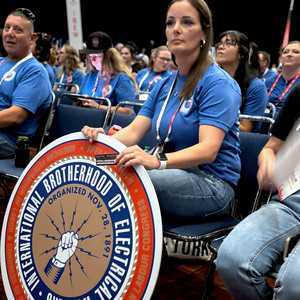
Well, for a few years I'd been hearing about this annual gathering of tradeswomen from all over the US and Canada, that it's huge and growing every year.
So last fall, I decided to go.
It was in Chicago at McCormick Place, which is this huge convention complex on the lake.
And the marquee event is a mile-long parade through the streets of Chicago.
Aisha, picture around 5,000 female construction workers.
You know, they're in colorful union t-shirts.
They're marching, they're chanting, they're ringing cowbells.
You had electricians, sheet metal workers, plumbers, pipefitters, roofers.
You know, this conference is all about building the tradeswomen movement, giving women opportunities to connect and share ideas for how to make the jobs better for women.
They also showcase the enthusiasm and support that's out there for getting women into these high-paying jobs.
Okay, so there are thousands at this conference, but how many women like, actually work in construction?
Yeah, women make up a tiny share of the workforce less than 5 nationwide.
If you're counting those who work with tools, you know, on construction sites.
And a lot of the women told me they're often the only woman on a job site.
And so getting to spend a couple days with thousands of other tradeswomen.
You can just imagine the energy.
Yeah, I mean, I'm sure it's just, like you know, exciting to be with other women doing the same thing when you know everywhere else you're kind of like you know, a unicorn, right.
The only one.
Yeah, you're the only one.
Did you get a chance to talk to some of these women about how they got into the trades?
Yeah actually, before the conference kicked off, I spent a morning at the Plumbers Union Training Center in Chicago.
It's local 130.
And I got to sit down with a bunch of female apprentices.
So, Ayesha, becoming a licensed plumber, it's a five-year process.
You have to have a high school diploma and pass an aptitude test and a physical agility test just to be accepted.
And then from there, it's on-the-job training.
So you go to work, like, right away?
Yeah.
Yeah, the model is earn as you learn.
There is some classroom instruction, but most of your time is working with mentors on job sites.
And the women apprentices I met shared stories of this journey, including early mistakes they'd made, like breaking a toilet.
Here's Alyssa Radojcic, who's now in her third year.
I went to go put the new toilet on, and I was like, it's always that last one.
And it was like, oh.
And one of the women chiming in there is Kaylee Jensen.
She's also a third year.
And she got into plumbing in kind of a roundabout way.
Before I got into the trades, I worked in the film industry and I was a freelance video editor.
Okay, that's a big shift.
Talk about two totally different industries.
Oh, yeah.
She had actually gone to college and graduated with a degree in cinema.
And she had been doing freelance video editing, making Instagram ads for beauty brands.
But after a while, she got bored of doing the same thing over and over again.
And she also started worrying about the future.
In 2020 with the explosion of TikTok.
I just very much saw AI coming down the pipeline taking my job.
There were things with filters and quick editing that was my job.
Well, yeah, we know that AI is threatening a lot of jobs right now.
So it seems like, you know, she's probably right to be concerned.
Yeah, you know, she started looking around and she realized that, although she had these digital skills, she didn't understand how some very basic things that are fundamental to our lives work, like sinks and toilets.
And I think that's a huge gap in our generation in general.
Since like the 80s, there's a big push to go to college and the trades are looked down upon.
And I come from a pretty blue collar family.
So I thought if like a bunch of men can do it, I could figure it out.
But Aisha, she had no idea how to get started.
So she turned to Google and she found this great opportunity.
It was a 12-week introduction to the construction trades specifically for women.
And it was free.
I mean, that's always going to sound good if it's free.
Who was offering this opportunity and really why?
Well, it's offered through a nonprofit called Chicago Women in Trades.
For more than 40 years, this group's mission has been to promote equity by helping women get into high-paying construction jobs, which is a mission that the federal government has backed for decades.
That training program that Kaylee Jensen was in was funded by federal dollars.
And then here's the equity piece of it.
So many occupations that are dominated by women and women of color they don't pay well like elder care and child care and food service retail.
But a licensed union plumber in Chicago makes more than $60 an hour coming out of an apprenticeship.
And that's a wage that could support a family, right?
Yeah, I mean, that's good money.
But even with that being the case, not a lot of women are pursuing these.
You know more lucrative blue collar jobs.
Not a whole lot, in part due to traditional beliefs.
You know about men and women's roles in society.
Kaylee Jensen told me.
You know, becoming a plumber is not something that occurs to a lot of women, even though, on paper at least, you don't need specialized skills to qualify for a union apprenticeship.
You don't have to have ever swung a hammer, picked up any kind of power tool.
But as a woman you're kind of at a disadvantage socially, just having that.
You know, not growing up in your grandpa's workshop.
So that's where Chicago Women in Trades comes in.
In their training programs they introduce the women to a bunch of tools, teach them how to read a blueprint.
They put them through a lot of physical conditioning to ensure that they can pass that agility test.
Aisha for plumbers.
You might have to lift a cast iron pipe weighing 76 pounds above your head.
That kind of thing.
Now this program also connects them with building contractors and unions to give them a feel for the work.
You get to go to the carpenters' union.
You get to go to the laborers' union.
You get to go to the plumbers' union.
That's where we all came here, and they kind of pitch to you.
So from what it sounds like, plumbing won her over?
Yeah, she says it just kind of clicked with her.
For me, plumbing just seemed like the most fundamental to society.
It literally is what took us out of the dark ages.
It takes diseased water away and brings fresh water in.
Society needs people like us to function.
And I think over time that kind of like stigma of its work for stupid people is going away, because it's quite complicated what we do.
There's physics involved.
We talk about the math.
It's physical and mental work.
And Ayesha, this is the argument the Trump administration has been making too.
This work is valuable and it's in demand.
The White House gave us a statement saying in 2024 there was a shortage of 447000 construction workers in the US.
But here's the thing.
The Trump administration is threatening that very organization, Chicago Women in Trades, that helped Kayleigh Jensen discover plumbing and get her where she is today.
The organization is fighting the administration in court essentially for its very existence.
And when you say that the Trump administration is threatening Chicago women in trades, I would assume you're referring to DEI, because that is not popular with the White House.
And it sounds like DEI is the whole point of Chicago women in trades.
Yeah, exactly.
You know, a year ago, President Trump signed two executive orders attacking diversity, equity and inclusion.
He said, under the guise of DEI, institutions everywhere were using what he called dangerous, demeaning and immoral race and sex-based preferences.
So he canceled funding for DEI-related initiatives.
He wants companies and groups that get money from the government to certify that they're not promoting DEI.
And, like you said, that's a real problem for Chicago Women in Trades, when DEI is pretty much their mission.
And beyond this, Trump has also ended longstanding federal policies aimed at preventing discrimination and opening doors for women in construction.
So there's a lot of uncertainty right now for the movement.
So, I mean, how did this affect the mood at the conference you were at?
Well, actually, the organizers seemed very intent on keeping politics out of the conference.
But on the sidelines I did hear a lot of concern, mostly from older women who have fought for decades to get women to where they are today in this industry.
Because as slow as progress has been, things are better now than they have ever been.
You know, tradeswomen tell me women now have their own bathrooms on many job sites.
There are processes for reporting harassment.
And Aisha, most of the building trades unions now offer maternity leave.
At this conference, I heard about the first union to offer maternity leave.
Vicky O'Leary told me the story.
She's a veteran ironworker and director of diversity for the Ironworkers International Union.
We were at this conference in 2016, and we have a caucus.
And one of the women got up and told her horrendous story of working in the rod patch one day too long.
And she had a miscarriage.
And she tells me the iron workers president at the time, Eric Dean, was in the room and he heard the story.
As we're walking out, Mr. Dean says, God, I feel like such a dope.
We've got to figure this out.
He goes, you've got to figure this out.
Figure out how we can do this.
So Vicky O'Leary wrote a policy that gives ironworkers up to six months of leave at partial pay prior to giving birth and six to eight weeks after birth.
And she says it was approved and implemented within a year.
And since then, she says it's helped enormously with retention.
Eighty-five percent of the women in her union who take maternity leave come back to work afterwards.
We've had over 200 women use the policy, you know, so we've grown 200 babies, not really.
You know, our family's gotten bigger.
And a lot of the other building trades unions followed suit and now offer maternity leave, too.
So it sounds like these unions do support bringing in more women.
Yeah, in part because, as we've talked about, the demand for the work is there.
And if you're looking for workers, you can't just ignore half the population, right?
And then Ayesha.
Something else that's happening is that people are recognizing that some women do excel at these jobs.
You know, Trump's attack on DEI is based on this idea that people who are not qualified for jobs are nevertheless getting them based on their sex or race.
He has stressed that people should only be hired based on merit.
Well, half a dozen people, including Vicky O'Leary, told me they think women are better at one task in particular welding.
You know, you see women on a plane or whatever, crocheting and stuff.
That's not me.
But that's kind of what, to me, what welding is like.
Because it takes concentration and steadiness.
And I heard this kind of thing from men, too.
The president of the painters union, Jimmy Williams, told me there are employers who routinely request women for jobs now, especially in commercial paint and wall covering, drywall finishing.
Those employers legitimately, have been focused on trying to increase the number of women because they see that there is an added value here.
And some of this work has very little to do with physical size or strength.
You go to like a state capital and they have all of that.
You know, it's artist-type work, right?
Gold leafing.
It's a very skilled trade.
And Aisha, the Painters Union has a goal of reaching 20 percent women by 2029.
And Jimmy Williams said he doesn't see a problem reaching that goal.
After the break, how the Trump administration pictures the skilled workforce of the future.
Good, hard, tough, mean construction workers that I love.
This message comes from Capital One with the Capital One Saver Card.
Earn unlimited 3% cash back on dining and entertainment.
Capital One.
What's in your wallet?
Terms apply.
Details at CapitalOnecom and save up to 500 on select Tempur-Pedic adjustable mattress sets, with next day delivery.
Restrictions apply.
Next day delivery available on select mattresses and subject to location.
See store for details.
This message comes from Schwab.
At Schwab, how you invest is your choice, not theirs.
Plus, get advice and more comprehensive wealth solutions to help meet your unique needs.
With award-winning service, low costs and transparent advice, you can manage your wealth your way at Schwab.
Visit Schwab.com to learn more.
I'm Ayesha Roscoe with the Sunday Story and I'm back with NPR.
Labor and workplace correspondent Andrea Hsu.
Andrea, you mentioned that President Trump has ended some longstanding policies that helped women kind of forge a path in the skilled trades.
What are some of those policies?
Yeah, so one is an executive order that was signed back in 1965 by Lyndon B. Johnson.
Trump rescinded that last year.
It required federal contractors to do a yearly analysis of who they were hiring, how that compared to the available workforce around them, and if they found disparities, they had to come up with a plan to do something about that.
There's also a similar rule that applies to apprenticeship programs that the Trump administration is now trying to rescind.
And there was also this requirement that on construction projects, federal contractors had to set a goal of having women perform 69 of the work.
It wasn't a quota, but it was a goal.
So companies had to make a good faith effort to get to 6.9%.
And that's no longer being enforced.
What counted as a good faith effort?
Was it just recruiting women?
Yeah, recruiting them, interviewing them, working with organizations like Chicago Women in Trades that help women compete for these jobs.
And what veteran tradeswomen have told me is that these requirements, they weren't some kind of panacea.
You know, they never actually leveled the playing field for women in construction.
And that 6.9 percent goal was rarely, if ever, met.
But it was something.
And now under Trump, it's gone.
But, I mean, employers still can't discriminate against women, right?
Like that is against the law.
Yes, absolutely.
Title VII of the Civil Rights Act of 1964 prohibits discrimination in employment and that still stands.
Anyone can still file an individual discrimination complaint, although under Trump, proving discrimination could be getting harder.
But federal contractors.
They no longer have to take those extra steps to identify and address systemic issues.
They don't have to prove that they're making a good faith effort to recruit women.
And not only that, but Trump has now told contractors, you must not engage in, quote, illegal DEI.
But the administration has not defined what constitutes illegal DEI.
And so the folks at Chicago Women in Trades fear that contractors won't want to partner with them, with an organization whose mission is helping women and women of color.
You know, their executive director, Jane Valinga, told me it's very hard to imagine what the future is going to look like.
But she is certain about one thing.
Let's just take a listen.
You cannot look at the workforce of the construction trades and say, oh, they've taken DEI too far.
You know, you look at the workforce of the construction trades and you see we have a long way to go.
Has the Trump administration addressed any of these concerns about women losing opportunities in this critical industry, the skilled trades industry?
Well, I did ask the White House a bunch of questions about it and spokesman Kush Desai brought me back.
He responded with this.
I'm going to read it here.
Okay.
And then he goes on.
Instead of DEI boondoggles that accomplish nothing, the Trump administration is laying the groundwork for Americans of all backgrounds to help build our next golden age.
That's the end of the quote.
OK, well, that doesn't say anything specifically about women.
Right.
And also, Ayesha, the administration put out a report titled America's Talent Strategy.
This is their plan for getting people to work and into good jobs.
And there's nothing specific about women in that document either.
Now, the report does talk about disengaged and disconnected workers.
And we know that the share of American men in the labor force has been dropping for decades and that it's a concern that labor economists have been worrying about for some time.
So some see Trump's focus on the skilled trades as an attempt to reverse that trend and to re-engage men.
But you know.
As for women, the only public comments I could find that Trump has made you know about women and the skilled trades came in response to questions he got about the Obama Presidential Library, which is under construction in Chicago.
You know, he's been asked about that project a couple of times.
OK, well, I would assume that, you know, he's not a fan, right?
Yeah, he called it a disaster.
Here he was talking about it last October.
This stuff?
And he wanted only women in DEI to build it.
That's what they got.
And what he's referring to there is that the Obama Foundation pledged that half of the construction subcontracts would go to minority-owned and operated firms.
Now, the project is not stuck.
It is scheduled to open this June.
And the Obama Foundation says those diversity goals did not cause the delay.
But Trump has repeatedly suggested otherwise.
He wanted to be very politically correct and he didn't use good hard tough, mean construction workers that I love.
Okay well, I mean referring to them.
That way.
It seems like he has a very particular ideal about construction workers and what this workforce is.
And there are other indications of who the administration has in mind for this skilled trades renaissance.
I'm going to take you to the Labor Department's Instagram feed.
I mean, there's a mix of stuff on here, but a lot of these images kind of take you back in time.
Yeah.
I mean, I'm looking, they look like kind of well, 1950s in that, you know kind of a Blonde hair, you know blue-eyed maybe.
I'm thinking Richie Cunningham.
I'm thinking Happy Days.
I'm thinking, you know, I'm seeing... I see a lot of white people.
But yeah, it's a very particular... perspective, you know?
Yeah.
These images kind of evoke the post-war American dream.
You see these, you know, posts that say things like, recapture the dream.
And, you know, you see these suburban homes with, like, a blue 1950s cruiser in the driveway.
And then, if you scroll down, you see that there are these sort of mid-century style posters with slogans like Make America Skilled Again, Build America's Future Blue Collar Boom.
And, like you said, each features a worker who's you know, mostly white men, on these backdrops of construction cranes.
Yeah.
I mean, it's definitely a nostalgia and like a hearkening back to a time in the past, but also a very particular view of that time.
Yeah.
And remember Aisha.
Back in the 50s, it wasn't illegal to keep someone out of a job based on their sex or race.
You know, this is the era that the Labor Department has chosen to embrace, at least on social media.
Yeah.
You mentioned some of the older female construction workers that you met.
They're some of the ones that are most worried about the future.
What did they say?
Well, some of them are feeling pretty discouraged right now.
I'm thinking about a woman that I met, Keena McAfee.
She got her start as a carpenter in the mid-80s, she says, thanks to a discrimination case brought by women against a trade school in Chicago.
Apprentices at that school accused the school of not recruiting women, not giving them the same opportunities as men and creating a hostile environment.
And Keena McAfee, who's a Black woman, got a spot there as this case was playing out.
So that was my entry into the trades, and it has changed my life.
She did a four-year apprenticeship in carpentry.
She got her license and she went to work on big commercial projects.
I did ceilings, I did hardware and doors, installed doors and things like that, framed up walls.
And you know, after a few years working in the field, she took a job as an instructor for the Carpenters Union, teaching apprentices, which she did for about 30 years until she retired last summer with a full pension.
It makes you proud because those buildings are always there.
Yeah, I can point to all the buildings I work to and every carpenter does that.
I built that building.
Well, that sounds like a very rewarding career.
Yeah, I mean, it's a career she feels really good about.
But when I met her, she was really disheartened about the direction things were going.
Last spring, her union, the United Brotherhood of Carpenters, announced it was disbanding this program that the union had supported for decades.
It's called Sisters in the Brotherhood.
So it was like an affinity group for women carpenters?
Yeah, spaces for women to get to know each other and share ideas and commiserate and advocate for things like women's bathrooms.
So what happened was last May the union president sent out a memo saying current policies targeting identity-based initiatives put the program at legal risk.
And Keena McAfee was just heartbroken over this.
It's very ironic that you can have a brotherhood of carpenters which references brothers, but you can't have because of DEI.
You can't have sisters in the brotherhood.
It's just unbelievably ironic.
Well, what did the union have to say about this?
Well, I reached out to the Carpenters multiple times and got no response on this topic.
The union did announce it was creating a member engagement program that's open to all members.
But McAfee isn't at all convinced that this is going to replace what has been lost.
And she says it's a real setback.
I don't understand it.
And it really, it will impact our ability to get women into the trades in the future.
But she is trying to do what she can.
And in her retirement, she has gone to work with Chicago Women in Trades.
She is now one of the instructors in that training program that Kaylee Jensen went through.
Remember, she was the plumber who used to be a video editor.
So despite the program's uncertain future, it's something that Keena McAfee wants to be a part of.
Women are committed.
We're committed.
We see what's out there and we see the difference between being on a job where you're the only woman and being on a job where there are other women there.
It's such an amazing difference.
Aisha Keena McAfee started her career in the trades thanks to a legal battle that forced a trade school to admit more women.
And now, 40 years later, at the end of her career, she's working for an organization that's fighting a legal battle to keep pathways open for women.
So what's that saying?
You know, what's old is new.
Yeah, you know, some things. but then they changed back again.
I don't think that's a saying, but, you know, that's the thing.
Thank you so much for bringing us this story.
Well, thanks for having me, Aisha.
That was Andrea Hsu, NPR's labor and workplace correspondent.
This episode of The Sunday Story was produced by Raina Cohen and edited by Jenny Schmidt.
It was fact-checked by Ida Porosad.
The engineer for this episode was Jimmy Keeley.
The rest of The Sunday Story team includes Justine Yan.
Andrew Mambo, and Liana Simstrom.
Irene Noguchi is our executive producer.
I'm Aisha Roscoe.
Up First is back tomorrow with all the news you need to start your week.
Until then, have a great rest of your weekend.
This message comes from BetterHelp.
February is full of relationship talk, making it feel like everyone has it all together in their love lives, but most people are still figuring it out.
Therapy can take that pressure off.
Visit betterhelp.com slash NPR for 10% off.
This message comes from NPR sponsor NetSuite.
Every business is asking the same question.
How did they make AI work for them?
With NetSuite by Oracle, you can put AI to work today.
NetSuite is the number one AI cloud ERP, trusted by over 43,000 businesses.
It's the unified suite that brings your financials, inventory, commerce, HR, and CRM together.
If your revenues are at least in the seven figures.
Get the free business guide Demystifying AI at netsuitecom.
This message comes from Bombas.
You need better socks and slippers and underwear because you should love what you wear every day.
One purchased equals one donated.
Go to bombas.com slash NPR and use code NPR for 20% off.