This is a Squiz Kids podcast.
Your fresh take on what's happening in the world around you.
It started with just 16 countries and a handful of events.
It involves ice, snow and people willingly hurtling downhill.
And it proves you do not need to live in a cold country to compete at the highest levels.
This is your Squiz Kids shortcut to the Winter Olympics.
The podcast where we dive into the who, what, where, when, why and how of the big news stories.
I'm Christy Kijerina.
And I'm Bryce Corbett.
Bryce, I know I'm going to regret asking, but why are you lying face down on the studio floor on a skateboard?
Huh?
Well, isn't that obvious, Christy?
I'm training for Skeleton.
Did you know that athletes hit over 140 kilometres an hour?
I mean, that's 87 miles an hour.
But Bryce, you're not moving.
Yes, Christy, but this is just phase one of my training.
All right.
Well, I'm both impressed and deeply concerned.
As well you should be.
Today we're going to take you through where the Winter Olympics began and where they're being held now.
What makes the sports so extreme and why this year's Games are such a big deal.
So grab your beanie, zip up your jacket, and let's hit the ice.
And listen carefully, there's a squiz at the end.
Where?
To understand where the Winter Olympics are happening today, we need to head back more than 100 years.
To a mountain town in France called Chamonix in 1924.
Yeah, that's right, Christy.
And back then, it wasn't even officially called the Winter Olympics.
It was known as International Winter Sports Week.
Almost a little bit like a trial run.
Yeah, exactly.
Only 16 countries took part with a small number of events.
Mostly skiing and skating.
And it was very Europe focused.
If you had snow and mountains in your country, you were in.
If you didn't, tough luck.
For years, the Winter Olympics stayed much smaller than the Summer Games.
In fact, they were held in the same year, which meant one massive Olympic year every four years.
Yeah, and world events shaped them too.
World War II meant that there were no Winter Olympics for 12 years.
Wow.
Germany and Japan weren't even invited to the first Games after World War II, which shows how closely the Olympics can be tied to global politics.
That's right.
But once the Games returned, they just kept growing.
More countries, more athletes.
And eventually, much bigger venues, which brings us to today and Milano Cortina 2026.
And these are some of the most unusual Winter Games ever because, instead of one main host city, This year the events are spread across the largest geographic area in Winter Olympic history.
That's right, Bryce.
The Games are being held in Italy and there are two main centres.
The city of Milan will host many of the ice sports, like ice hockey and figure skating, inside big city stadiums.
And Cortina d'Ampezzo up in the Dolomite Mountains will host the snow and sliding sports.
So things like alpine skiing, bobsleigh and curling on real mountain terrain.
The two locations are five hours apart.
So from one small mountain town in France to an entire country linking cities and mountains together, the wear of the Winter Olympics has really changed a lot.
Sure has.
But the sports themselves have changed even more.
So tell us, Christy, what do the Winter Olympics actually involve?
And how come athletes end up racing downhill head first on ice faster than I can drive on the motorway.
What?
Bryce, at their heart, the Winter Olympics are all about sports played on ice and snow.
Things like skiing, skating, ice hockey and curling.
But they're not exactly gentle sports anymore, are they, Christy?
Not even close.
In the early days, most events were about skill and endurance just staying upright on skis or skates in freezing conditions.
And then someone somewhere thought, hmm, what if we made it much faster and much scarier?
It's a bit like that.
Over time, the Winter Olympics started adding sports that pushed speed, risk and gravity to their very limit.
And that brings us neatly to one of the most dramatic sounding sports of all and one of my favourites.
It's called skeleton.
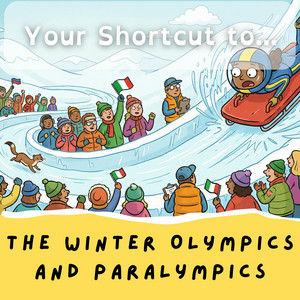
Now skeleton involves athletes lying face down, head first, on a tiny sled, racing down an icy track with no steering wheel, no brakes and speeds, if you can believe it, of over 140 kilometres an hour.
Oh, terrifying.
This sled actually looks a bit like a human rib cage, which is where the skeleton bit comes in.
It's also a sport Australians have done surprisingly well in.
Australia's Winter Olympic success really kicked off in the early 2000s.
That's right, Christy.
That's when Alisa Camplin won Australia's first ever Winter Olympic gold medal in freestyle skiing at the Salt Lake City 2002 Winter Games.
And you might have heard of this one Bryce, because not long after Stephen Bradbury pulled off one of the most famous wins in olympic history, you might remember he stayed upright when everyone else fell over in the 1000 meter short track speed skating final to come from behind and take gold, who could forget?
He gave australia a brand new phrase, and that is doing a bradbury, meaning you hang in there, you never quit and you take your chance when it comes.
And Bryce, as the Games kept evolving, another influence stepped in the Winter X Games.
That's where action sports like snowboarding, halfpipe, slope style and big air really took off.
Yeah, and today's Winter Olympics look a lot more extreme than they did a few decades ago, as the X Games acted as a testing ground for new Olympic sports.
And this year, there's a brand new sport making its Olympic debut.
Ski Mountaineering or Ski Mode.
This one's a little bit different.
Athletes ski or hike up mountains before racing back down again.
Sounds exhausting.
And they have to attach special skins to the bottom of their skis so that they don't slide backwards during the climb.
And get this, Australia has two athletes competing in Ski Mode.
We sure do.
Philip Bellingham and Lara Hamilton.
Which is pretty impressive for a country better known for its beaches than its blizzards.
It really is.
So, from careful skiing and skating to headfirst ice racing, gravity-defying jumps and climbing mountains on skis, the what and how of Winter Olympics have really changed dramatically.
And that makes me wonder, Christy, just how big are these games now?
And why should we all be watching?
Why?
Why should we be paying attention to this year's Winter Olympics?
Bryce, there are so many reasons.
I just don't know where to start.
How about the Winter Olympics now features more than 3,500 athletes from over 90 countries.
Wow.
And they're competing for nearly 200 medals.
Gosh, that is a lot.
And it's pretty wild when you remember that it started with only 16 countries in one single little French mountain town.
Exactly.
And the scale is a big reason why these games matter, even for countries without much snow like Australia.
Yeah, like Australia, indeed.
In fact, Australia is sending 53 athletes to the 2026 Winter Olympics.
Wow.
That is our second largest Winter Olympic team ever.
And more than 60% of them, Kristy, are women, which is a pretty big deal.
It is.
And Australians will be competing on every single day of the games.
Wow.
So who should we be watching?
Well, for Australia, keep an eye on Jakara Anthony, who's the defending Olympic champion in moguls.
So moguls are skiing down a steep, bumpy slope at speed, with sharp turns and two big jumps where the athletes perform tricks.
Wow.
All of this while being judged on their speed, control and style.
Yeah, that's pretty incredible.
And we should also be looking out for snowboarder Scotty James, who's already won Olympic silver and bronze and this year will be chasing gold.
And then there's Bree Walker, a bobsled pilot.
Now she'll be steering a sled down an icy track at terrifying speeds, with gravity doing most of that work.
And, of course globally, there are the powerhouse winter nations like Norway Canada, Germany and the United States, countries that have deep snow, steep mountains and decades of winter sport history, which makes every single medal a serious contest.
Oh, I can't wait.
Me neither.
And the games don't stop when the Olympics finish.
The Winter Paralympic Games follow in March and will mark 50 years since the very first Winter Paralympics.
I cannot wait for those to start.
Now Australia will compete in four Paralympic sports for the first time, with 15 Aussie athletes representing Australia.
It's a big step for inclusion and visibility in winter sport.
And it all starts for us on February 6th.
That's Friday afternoon in Italy, but early Saturday morning here in Australia.
And there won't be just one Olympic cauldron this year either.
Nope, that's right.
There'll be two cauldrons with the Olympic flame burning away in them, reflecting the way these games link cities and mountains together.
And that all feels pretty fitting for an Olympics spread across an entire country.
The perfect way to kick off a Games that's bigger, bolder, more action-packed than ever.
Time for the quiz.
This is the part of the podcast where you get to test how well you've been listening.
Question number one.
True or false?
The Winter Olympics used to be held in the same year as the Summer Olympics.
MUSIC
Did you say true?
You would be correct.
Question number two.
Which Australian athlete famously won gold after staying upright while the others all crashed around them.
Was it... That's right.
It was C, Stephen Bradbury.
What a hero.
Question number three.
Name one of the two main places hosting the 2026 Winter Olympics in Italy.
Bit of a tough one, wasn't it?
Congratulations if you said Milan or Cortina d'Ampezzo.
That's all we have time for today.
Adults, if you want to learn more about the Winter Olympics.
Claire and Andrew over at The Squizz have done their own shortcut on what to watch out for these games.
You can just scroll back a bit in their feed and take a listen.
For now though, thanks for joining us as we explored the who what where when, why and how of the Winter Olympics.
Now get out there and have a most excellent day.
Get on your skis.
Over and out.