
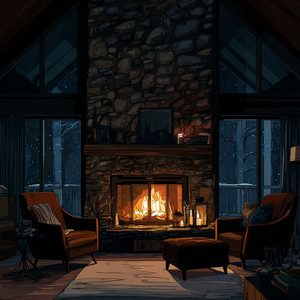
[An Analysis of Ambient Soundscapes: The Mechanics of 'Winter Night by The Fireplace']-[Winter Night by the Fireplace | Soft Crackles and Snowstorm]
📋 Summary
The Anatomy of Auditory Relaxation
The podcast episode titled "Winter Night by The Fireplace, Soft Crackles and Snowstorm" serves as a quintessential example of functional ambient audio designed to facilitate relaxation and deep sleep. By examining the structural components of this soundscape, we can understand how specific auditory stimuli are curated to induce a state of tranquility.
The Role of 'Soft Crackles' in Sensory Regulation
A primary element identified in the audio is the presence of "soft crackles." In the context of sound therapy, these intermittent, low-frequency bursts are essential for breaking the monotony of silence without causing startling arousal. The use of the term "soft" is deliberate; it implies a gentle acoustic profile that mimics the natural decay of burning wood. These crackles act as a rhythmic anchor, providing a predictable auditory environment that helps the listener's nervous system shift from a state of hyper-vigilance to one of parasympathetic dominance.
Environmental Immersion: The 'Snowstorm' Dynamic
The integration of a "snowstorm" sound serves as a sophisticated form of white noise. Unlike sharp or sudden sounds, the "snowstorm" provides a consistent, broad-spectrum frequency mask. This is critical for sleep hygiene, as it effectively obscures intrusive environmental noises that might otherwise disrupt a sleep cycle. By creating an immersive "Winter Night" atmosphere, the podcast leverages the psychological association between cold, harsh exterior elements and the safety and warmth of an interior hearth. This juxtaposition creates a cognitive "cocoon" effect, encouraging the listener to disengage from external stressors.
The Function of 'Deep Sleep Sounds' as a Therapeutic Tool
As the host notes, this is part of the "Deep Sleep Sounds podcast," a medium specifically engineered for nocturnal use. The brevity of the introduction—"Welcome to the Deep Sleep Sounds podcast"—is a strategic choice. By minimizing vocal intervention, the creators ensure that the listener is not jarred by human speech, which is naturally processed by the brain as a high-priority signal. The transition directly into the soundscape, marked by the phrase "Let's go," signals the immediate commencement of the therapeutic experience. The repetition of "Thanks for watching" and "Thank you" serves to establish a brief, polite social contract before receding entirely into the ambient background.
Conclusion: The Synthesis of Elements
The success of this audio piece lies in its minimalism. By combining the intimate, localized sound of a "fireplace" with the expansive, protective barrier of a "snowstorm," the podcast constructs a holistic soundscape. This blend of sounds is not merely background noise; it is a carefully calibrated instrument designed to regulate the listener’s internal state, proving that even simple acoustic textures can have a profound impact on sleep onset and quality.
Deep Learning with ListenLeap


