

[A Reflective Analysis of the 'Winter Evening Train Ride' Ambient Soundscape]-[Winter Evening Train Ride | Steady Motion and Distant Wind]
📋 Summary
Introduction to the Auditory Experience
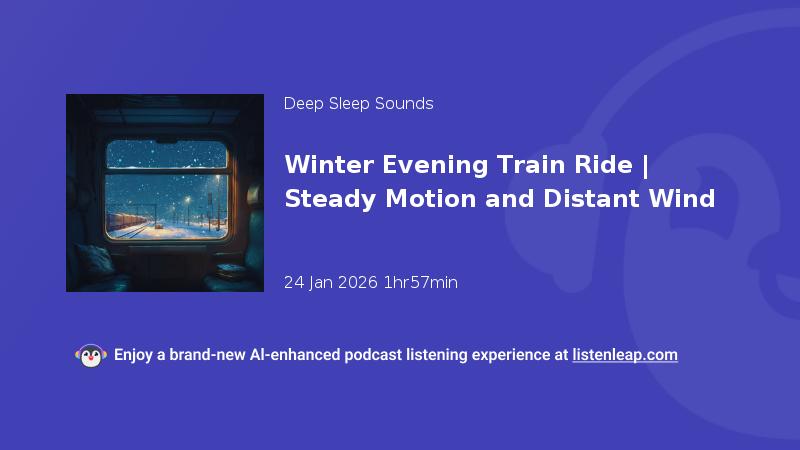
The podcast episode titled "Winter Evening Train Ride," hosted by Thomas, serves as a minimalist exploration of ambient sound design intended for deep sleep and relaxation. Unlike traditional podcasts that rely on narrative structure or intellectual discourse, this production focuses entirely on the sensory immersion of a locomotive journey. The core objective is to transport the listener into a state of tranquility through the simulation of travel, using what Thomas describes as "steady motion" and "distant wind" to anchor the auditory experience.
The Mechanics of Relaxation: Steady Motion
At the heart of this soundscape is the concept of "steady motion." In the context of sleep hygiene and stress reduction, rhythmic, consistent sounds are known to entrain the brain into a state of rest. Thomas utilizes the mechanical cadence of a train to create a predictable environment. The repetition of the train’s movement provides a sense of security and continuity, which is essential for listeners who struggle with the erratic nature of environmental noise in their daily lives. By prioritizing this "steady motion," the podcast effectively minimizes cognitive load, allowing the listener to disengage from the stressors of the day and transition into a restorative sleep cycle.
The Atmospheric Role of Distant Wind
Complementing the mechanical rhythm is the inclusion of "distant wind." This element serves as a crucial textural layer that softens the harshness of the train's mechanical sound. The wind acts as an atmospheric bridge, connecting the listener to the external world—specifically the "Winter Evening" setting mentioned in the title. This contrast between the interior, protected space of the train and the vast, cold exterior represented by the wind creates a cozy, cocoon-like feeling. It reinforces the psychological safety of the listener, grounding them in a space that feels both isolated from the world and gently connected to its natural rhythms.
Minimalism as a Therapeutic Tool
The production style of this episode is characterized by its extreme minimalism. The transcript reveals a heavy reliance on repetitive cues, such as the phrases "Thank you" and "Thanks for watching," which, while serving as a structural frame for the podcast, ultimately highlight the absence of intrusive human dialogue. By stripping away complex arguments or conversational filler, the podcast prioritizes the "sound" over the "message." This approach is highly effective for its intended audience, as it avoids triggering the listener's internal monologue, which is often the primary barrier to falling asleep. The simplicity of the soundscape acts as a blank canvas upon which the listener can project their own need for peace.
Conclusion
"Winter Evening Train Ride" is a masterclass in functional audio. By focusing on the interplay between "steady motion" and "distant wind," Thomas creates a sonic sanctuary that facilitates deep relaxation. The episode demonstrates that in the realm of sleep-focused media, the most effective content is often that which retreats from the complexities of language and embraces the soothing power of consistent, environmental sound. For those seeking an escape from the frantic pace of modern life, this episode offers a rhythmic, steady, and ultimately peaceful retreat into the stillness of a winter night.
Deep Learning with ListenLeap


