The 18th century artist William Blake was a true radical in the deepest sense of the word, and he raged against injustice of every kind.
Blake despised social division and the exploitation of workers.
He detested the strict rules laid out by the church and he loathed the scientists who believed that the world could be dissected, measured and explained.
Perhaps most dangerously of all, Blake hated the monarchy and embraced the American and French revolutions, whilst he was also a staunch abolitionist.
Blake belonged to the Romantic Age, but stands utterly alone in that age, both as an artist and as a poet.
He is someone who invented his very own form of graphic art, which organically fused beautiful images with powerful poetry, while he also forged his own distinctive philosophical worldview. and created an original cosmology of gods and spirits designed to express his ideas about love, freedom, nature, and the divine.
From childhood on, Blake had visions of angels, gods and demons that drove his work and spirits that guided his every move.
This leads to the question, first asked 200 years ago, that remains today.
Shall we call him artist, or genius, or mystic, or madman?
Probably he is all.
William Blake was born in Soho London, in 1757 into a working class family of religious dissenters with strong nonconformist beliefs.
The Bible however, was a major influence on his upbringing, thinking and eventually, his artistic creations.
At the age of eight.
He had his first vision when he saw a tree full of angels when he was walking on Peckham Rye in London.
His father threatened to thrash him for lying before his mother stepped in.
That visionary experience would be followed by many more throughout his life, and he would repeatedly draw on those visions to inform his artwork.
Even now, the intersection between Blake's mysticism and his madness is something that is debated.
As a child, he was imaginative, rebellious and headstrong.
He had a precocious talent for art, and so, instead of going to a regular school, Blake's parents sent him to Henry Parr's drawing school in central London at the age of 10.
Someone of his background was never expected to be an artist, and so, at 14, he began an apprenticeship as a printer, and after seven years of technical training he qualified as a professional engraver.
William Blake is unique in that he isn't just an artist.
He is also one of the greatest poets in the English language.
But his art and his poetry are in fact completely intertwined.
And for Blake, his words were images.
Most of his art appears as part of his self-published hand-coloured books which he wrote, printed and made by hand, creating every one individually, all of them different.
He only issued a small number of them over his career, and his work was barely known in his lifetime.
The 18th century had been dominated by the intellectual movement known as the Enlightenment, which believed in the power of reason and advocated for science, technology and logic.
Blake however, was part of the Romantic movement, a counter-movement which challenged Enlightenment thinking, preferring imagination, spirituality and mysticism.
The books Blake created were prophecies, poems, philosophical treatises and sometimes satires.
His work addresses contemporary subjects like social inequality and poverty, child exploitation, racial discrimination and religious hypocrisy.
The Ancient of Days was a cover or frontispiece to one of those books.
Europe a Prophecy one of the best examples of his unique style.
When he began to think about producing his poetry, Blake wanted to free himself from the need for patronage, printers or publishers. and so he decided that he would be the sole manufacturer of his artistic product in a bid to give himself true intellectual freedom.
It was a decision driven by ideological as well as aesthetic reasons.
With no one else to print or publish his work.
He didn't have to worry about censorship and could express his radical and to many unpalatable ideas on his own terms.
Blake's younger brother Robert died at the age of 25 in 1787 of tuberculosis.
At the moment of his death, Blake saw his spirit rise towards the ceiling, clapping its hands for joy.
Not long after, Robert appeared to him in a dream and gave to William the secret of illuminated printing.
This is a complex process of etching and printing using the relief technique.
But whereas other printers would print text and images for illustrated books separately on two different presses using different copper plates, Blake created the image and text on one plate and used one rolling press.
A total innovation, meaning the picture and poem are fully integrated as a single, complete art object.
Blake trained himself to draw and write backwards and would paint in mirror writing directly onto a copper plate using an acid-resistant varnish.
When the varnish dried, he would create a wax bath where he would pour the nitric acid, which would eat away all the areas he hadn't painted with the resistant varnish.
When the acid was washed off.
His lines painted in varnish would now be in relief and ready for inking.
Once printed, he then hand painted the finished prints in watercolour or ink.
Or his wife, who was his assistant, did.
Blake's wife Catherine, whose input was dismissed for so long, worked side by side with her husband on all his printed works and was central to his printing and colouring processes.
In his prints, longer letters from Blake's text joins up with tendrils or branches of trees, while other poems are woven amongst glorious colourful flowers or fiery flowing forms, or obscured by belching fumes from industrial fires.
Unsurprisingly then, the poetry of his books was the source of many of his most well-known visual images, including the Ancient of Days.
Blake's great image the Ancient of Days served as the frontispiece for the long poem Europe, which is one of Blake's prophetic books.
These were a series of longer poems in which Blake constructed his own cosmology of gods and goddesses and an epic mythological universe.
For Blake, it was necessary to create his own belief system, so as not to be enslaved by somebody else's.
Blake invented his own vast and complicated mythology that he used to illustrate his prophecies.
It was a fusion of ideas.
Inspired by John Milton's Paradise Lost, the visions of the mystic Immanuel Swedenborg and the German philosopher Jakob Bohm.
Mixing Christian philosophy and the grand poetry of the King James Bible with his own spiritual visions and revolutionary political ideas.
Among the various gods Blake created for his mythology was Urizen, the figure we see in the Ancient of Days.
Urizen is his best known and most frequently depicted mythological figure.
His name is a pun on your reason.
And he is Blake's version of the traditional Judeo-Christian patriarchal god, a bearded old man who is a rule-making creator who brings order to the world, but is also the god of restrictive reason and the origin of political repression.
The first book of Urizen was one of Blake's so-called Bibles of Hell and was published in 1794.
It is his version of the Genesis story.
It cannot be stressed enough just how subversive rewriting the Bible was in the 18th century.
He formed scales to weigh.
He formed massy weights.
He formed a brazen quadrant.
He formed golden compasses and began to explore the abyss.
And he planted a garden of fruits.
Blake also created a rebellious spirit called Orc, the spirit of revolt, who is an antidote to Urizen, a figure who strives to break down the rules and restrictions which Urizen introduced into the world.
It is Orc, who Blake has inspiring the American revolutionaries.
This pantheon of Blakean spiritual heroes populate his enormous and apocalyptic long poems and exist to expound in the grandest terms his philosophy and worldview.
This print was very important to Blake, who spent a huge amount of time working and reworking it, experimenting with colors and tones, different dilutions of ink and watercolor paints.
In fact, over 30 years after he created it, Blake was hand coloring a version of it in his sickbed in the last hours before he died in 1827.
The Ancient of Days was originally printed in 1794 and gets its name from the Book of Daniel.
It was an image inspired in part by a passage from the Bible.
When he prepared the heavens, I was there, and when he compassed the depths of the waters by certain law and compass,
It was also inspired by a vision Blake had of Urizen appearing to float above his staircase in his South London home.
The Ancient of Days can be seen as a direct attack on rationalism, rules and dogma, with Urizen depicted in the act of creation emerging from a formless void, leaning out of a golden orb and reaching out with his compass to measure the world.
It has a long tradition in visual representations of godlike figures as creators.
We know Blake had this image on display in his workshop and often featured compasses in his work.
Blake admired Michelangelo greatly and his debt to the Renaissance artist is apparent in this work and others.
The heroic musculature of the figures, the dramatic twisted postures, the figure of the creator bursting forth from a floating, nebulous form.
Even the graphic simplicity of the line and simplified backgrounds all point towards Michelangelo.
The body as metaphor is central to Blake's engraved and poetic images.
Like Michelangelo, he often used impossible and contorted positions to emphasize meaning and portrayed the body as simultaneously liberating and enslaving.
It is significant that in the Ancient of Days, Blake shows Urizen hunched forward.
This is part of a visual code running through Blake's entire body of work.
He presents figures in this posture again and again, from early works like Songs of Innocence and Experience to his later prophetic books.
It is his way of visually signifying themes of restriction and control, the constraints of rationality and the oppressive influence of society's rule makers.
Unlike these hunched figures, other gods or free-spirited children can be seen stood up or jumping, raising their arms free from the contracting forces of repression, fear and bitterness.
The giant compass appears to grow out of Urizen's fingers, as if he is losing his humanity, becoming a machine.
He holds the mathematical instrument at a 90 degree angle, pointing downwards towards the earth, symbolizing that he is the god who introduces order, reason and structure in Blake's mythological world and, with these things, introduces oppression, control and restriction.
He is so concerned with order and reason, so limited to the physical task of creating, that he has his back to and so cannot see the warmth and vitality of the universe behind him.
He is so focused on the darkness ahead and tilting so far forward that he almost looks as if he could fall into the void.
He who sees the infinite in all things sees God.
He who sees the ratio only sees himself only.
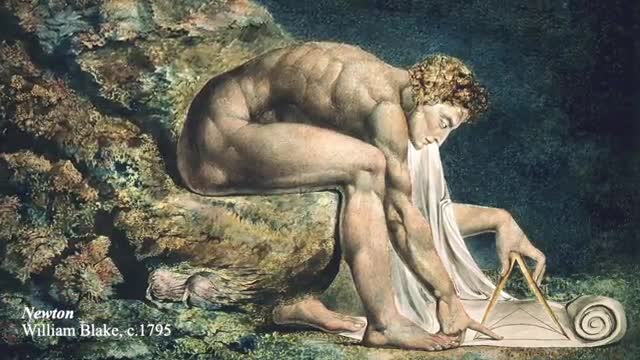
There is an obvious visual parallel between the Ancient of Days and Blake's earlier image Newton, with both holding compasses and both hunched over in that familiar restrictive pose towards the floor.
Blake shows the scientist sitting naked and muscular on a rocky outcrop, apparently at the bottom of the ocean.
The portrait bears little resemblance to the scientist, but that is likely intentional, as Blake didn't set out to create a true likeness, but rather to portray an idea of Newton and the science he represents.
The deep, consuming darkness surrounding Newton indicates his ignorance of the spiritual world and his distance from the light of truth.
The rock, which is covered in plants and other living organisms, represents the creative world.
The compass and the scroll represent tools used by scientific rationality to clip the wings of imagination.
Blake resented the cold detachment of rational thinking and preferred to think of reality not just as what you can see touch, hear or feel, but also as something you can imagine or believe.
He said Newton's reduction of life to an empty system of rules and facts is also what Urizen represents in the Ancient of Days.
He is a symbol of oppressive systems like the Ten Commandments or the cruel laws which target working-class people.
And he is also the scientist who tries to narrow our reality with his limited ideas of what you can believe.
The ideal of romantics like Blake was liberty from tyranny in all forms.
On the 12th of April, 1827, William Blake wrote to a friend.
I have been very near the gates of death and have returned very weak and an old man feeble tottering, but not in spirit and life, not in the real man, the imagination which liveth forever.
Four months later to the day, William Blake died, and his friend George Richmond gives a now famous account of Blake's passing as a moment of joy and celebration for the poet.
He died in a most glorious manner.
Just before he died, his countenance became fair, his eyes brightened and he burst out singing of the things he saw in heaven.
Although he ended his days in practical poverty.
This inspiring man died as passionately as he had lived.
But sadly he was not only largely unknown in his lifetime, he was also dismissed as a madman after his death.
And he may have remained unknown were it not for the Pre-Raphaelite Brotherhood who rediscovered him and promoted him to the public.
And the biography of Blake was published in 1863 to great acclaim.
Since then, he has become one of the most celebrated of all romantic poets, and not just as a poet, but as a unique mixed-media artist and trailblazer.
There are few artists who can exert such influence on their followers as Blake, perhaps because few artists had the passion and belief that Blake had.
One thought fills immensity.
In part two, we look at Blake's iconic poetry.
You can find it on my other channel, Great Books Explained.
The link is in the comments.