With news changing rapidly, listen to NPR News Now.
New episodes at the top of every hour on the NPR app or wherever you get your podcasts.
Heads up, before we start, this episode includes some vulgar language.
You're listening to Shortwave from NPR.
Hey short wavers.
Science correspondent Katie Riddle here in the host chair filling in for Emily and Gina.
I confess, like much of the internet, maybe even some of you, this week I fell in love with an adorable baby, monkey.
Footage of him is everywhere on the internet.
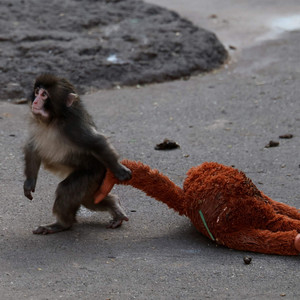
He's often seen wandering around, looking forlorn, hugging a big stuffed animal.
His name is Punch.
Punch lives in Ichikawa City Zoo outside of Tokyo, Japan.
After he was born, he was abandoned by his mom.
It's not clear why.
Now he's just seven months old.
So tiny, so cute, so vulnerable.
And I'm not the only one who feels this way.
As the internet learned more about him, people got invested.
Leave Punch alone.
I don't understand.
I don't know where Punch the monkey is, but I know where he's about to be.
If I find him, he's coming home with me.
Now, this message is for the other monkeys in the enclosure.
You all need to stand down.
Do you hear me?
Put me in that cage.
There's so many things going on in this world for me to add on another problem.
Let me just settle this right now.
Put me in that cage.
However, Shortwave is a science show and I'm a science journalist, so I figured, before we all board the punch train, we should talk to an actual monkey scientist, having worked with snow monkeys.
They're assholes.
I hope I can say that.
This is Lauren Robinson.
She's a visiting assistant professor of psychology at Mount Holyoke College in Massachusetts.
Lauren says that while we as humans might be worried about poor Punch getting bullied and neglected to some extent, this is normal for this species.
Snow monkeys, they have what's called a strict hierarchy.
So there is always someone at the top, but someone always ends up at the bottom of the hierarchy, right?
It's a global spectacle for us, but in Japanese snow monkey land, this is just another day.
If we get mad at snow monkeys for being aggressive to each other, we might as well be mad at the rain for being wet.
It's just who they are as a species.
Today on the show, we're getting into monkey business.
Is Baby Punch an anomaly in the monkey world?
Should we be defending him or leaving him alone?
And what's the difference between monkey and human social hierarchies anyway?
You're listening to Shortwave, the science podcast from NPR.
This message comes from Capital One, presenting sponsor of the 2026 Tiny Desk Contest.
NPR Music's annual Tiny Desk Contest called on musicians from all corners of the country to submit an original song performed behind a desk.
The lucky winner will play a Tiny Desk concert and headline a tour with NPR Music this summer.
While the judges are busy reviewing the entries, you can follow along and choose your favorites.
Explore a variety of original talent with videos performed everywhere, from bedrooms to staircases to rooftops.
See where this year's entries will take you at nprorg slash tiny desk contest.
And travel even further with the Capital One Venture X card offering premium benefits like a 300 annual Capital One travel credit.
Plus, earn unlimited double miles on every purchase.
What's in your wallet?
Terms apply.
See CapitalOne.com for details.
Okay, Lauren, so at the heart of this viral story about Punch is his mother's rejection.
And I guess I'm wondering, how common is this?
Like a mother macaque rejecting or abandoning its baby?
Yeah, well, it's a tough situation.
It does happen where infants get left by the mother for whatever reason.
We certainly hear about it in other facilities.
So research facilities, they will try to actually give the baby to a surrogate, which does happen and works sometimes.
So it's not uncommon, to the extent that we have methods that we can try if there's an appropriate female surrogate to take on the infant who's actually interested in doing so.
But that doesn't always happen.
So yes, it doesn't, it's not uncommon is the best way to put it.
And this obviously happened at a zoo in Japan.
What would happen if this occurred in the wild?
Um, it wouldn't be good for pun without anyone to support him.
I don't think there's really any question about what would happen in the wild.
I don't think he'd make it.
You know, and that's important to remember as well, that nature is not necessarily kind.
Nature is just what it does.
There's no need to judge it as like a negative or anything.
It's just how nature works right right um, and there you know out, in the wild, there aren't obviously zookeepers, as you're pointing out, to ease baby sadness.
Right.
At the zoo there are.
What do you make of this strategy to give him this adult-sized plush monkey?
Well, I suppose it does definitely bring back thoughts of Harry Harlow's work with the cloth mother.
So that's a classic study where they take baby away and they give him a cloth mother, and they tend to cling to it quite a lot.
As far as a method, I'm not sure I've seen it done before, but then again, these things don't go viral all the time.
And if he is getting comfort from it, then Sure, why not?
It's worth a try, I will say.
I think it very much brings back that work.
We know how important mom is, and it seems like he's getting an attachment from it.
Right.
And you're talking about Harry Harlow's experiments with Reese's macaques.
If I remember correctly, researchers gave the babies both a cloth mother and a wire mother.
Both mothers offered milk, but the babies still preferred the cloth mother.
So the thing that study was establishing was it's not just food that's developmentally critical.
It's also affection.
You're saying this feels similar.
Right.
Well, it only applies in the sense that there is a cloth mother that he is attached to.
So Harry Harlow did some of the early work as far as understanding the nature of love.
He was very charismatic as far as how he presented it.
A lot of us have conflicted feelings about him in psychology because obviously choosing to take an infant away from its mother to test how love works is not something that nowadays we would really want to see.
But at the same time, that's really core information, obviously, that helps us understand.
He definitely took things a bit too far, in my opinion, in some of the work he did over the years.
So really extreme isolation for monkeys, which is really bad for them.
But yeah, he's one of the original researchers into the importance of mother bonds in primates.
But what do we understand just generally?
What do we understand about how maternal guidance, or lack thereof, affects a baby monkey's development and well-being?
How might that be affecting Punch?
Well, as far as how it affects it.
There have been studies where they have put babies with other juveniles to be raised in juvenile social groups.
The truth is, in those situations, they're not as normal.
As we'd like.
You know, it's certainly not as ideal as having a mother because mom, you know, protects the baby.
She provides a lot of social relationship education.
You know teaching baby how to communicate rank as well as you know apologies.
Again, it's not an ideal situation.
So as far as how it's impacting Punch, I think we'll have to wait and see.
But I think the zoo's doing the best they can.
I don't know if there's a good alternative there.
Also at play are the social rules of the macaque trope.
Like his mother left him and now to reintegrate he has to find where he fits into the larger social hierarchy.
How does that figure into his struggle?
Yeah.
Well, as I said earlier, it's hard to know where he'll end up in the hierarchy.
And I don't know.
It's a tough one to predict.
If he learns quickly and he learns the ritualized aggression and how to apologize and get out of the way, I think he'll do all right.
And it seems like he is getting relationships with other monkeys.
So that's where you learn that information.
But if he doesn't learn it and he misreads information, that's a tougher life.
That's probably like getting that education as you go, in a more strict way, shall we say, when it comes to snow monkeys.
The dominant male will definitely let him know his place.
Wait okay, you mentioned earlier that snow monkey society is characterized by a pretty strict social hierarchy, and this is common among other kind of macaques.
Tell me more about that.
So basically, we have despotic monkeys like snow monkeys and rhesus macaques.
They're on the higher end for what we call a despotic group, meaning that they do have this more strict hierarchy with these very ritualized aggression behaviors.
The other end of that is more egalitarian.
So in those groups you're allowed to threaten the dominant male and you probably will get away with it.
He's a bit more tolerant.
As far as how we measure dominance, there are different behaviors that we look at.
So typically, we will look at what's called a supplant behavior.
So this is when one animal moves either near or physically contacts another.
And if that animal moves, that's considered to be a supplant.
So you've kind of forced that monkey to move physically.
We can also look at who wins in fights, things like that.
There are behaviors that we are really interested in.
So you know, those aggression displays, those chases, things like that who's getting chased, who leaves, who runs away, who avoids?
Those are the kind of things where, if we had to do it mathematically, we try to figure out who is at the top.
That's so interesting.
In recent days, we have seen Punch hanging around with other macaques.
When will we know when and if he's fully integrated?
What would the indicators of that be?
Well, I think it would be that he has grooming relationships that are pretty consistent.
Aggression in itself is not necessarily a sign he's not integrated.
So that's important to remember.
The hierarchy will reinforce itself eventually.
So if he acts up or if a dominant decides that he needs to let Punch know, that can happen.
It doesn't mean he's not integrated into the group.
I think it's easier to identify the signs that he's not where.
He'd be completely isolated and receive really high-intensity aggression, which I don't think is what's happening.
We're starting to see grooming relationships, so that's another really great sign that they're grooming him and spending time in proximity and near him.
So those are all good signs that he's being brought into the group.
But he's got quite a few years till he reaches adulthood anyway.
You know, he's just a juvenile.
He's just a baby right now.
So good news for Punch Vans at the moment?
It seems like he is adjusting?
I think so from what I've seen it.
You know, in some ways it feels like punch is just the latest animal that humans have latched onto.
We had Mu Dang, the young pygmy hippo.
People have been obsessed with orcas destroying yachts.
I know that you study animal psychology mostly.
Yes.
But I wonder why you think we as primates are projecting our feelings onto these other species.
Yeah, so that's something I think about a lot, right?
It's called anthropomorphism, so projecting human thoughts and feelings onto animals.
But I think it's probably because they are interesting, they are engaging in a way that very much speaks to us as people, and it's part of why I enjoy watching monkeys.
Totally.
But it sounds like what you're saying is we got to remember that our species are pretty different and we can imagine a lot of things about them that just aren't true.
Yeah well, I think it's an opportunity that I would hope for the public to kind of step back and say is there something I'm missing?
Do I not understand this species?
You know, we don't want to project our own human narratives onto animals.
I think they're just kind of doing what snow monkeys do.
Well, Lauren, thank you so much for coming on the show.
It's been great to chat with you.
Yeah, thank you for having me.
That was really fun.
This episode was produced by Hannah Chen.
It was edited by our showrunner, Rebecca Ramirez, and fact-checked by Tyler Jones.
Robert Rodriguez was the audio engineer.
I'm Katie Riddle.
Thanks for listening to Shortwave, the science podcast from NPR.
Greenland has said it is not for sale.
Denmark has said it can't even legally sell Greenland.
And whether Trump can or will or should try to control or purchase a territory that does not want to be sold is one question.
But on Planet Money, we are more interested in how we even got to this moment and how we might gracefully get out of it.
Listen to Planet Money on the NPR app or wherever you get your podcasts.
On the latest episode of Sources and Methods, NPR's national security podcast.
The US and Israel have attacked Iran.
President Trump is calling for regime change.
Telling Iranians quote when we are finished, take over your government.
We break down the most important questions about what happens next.
I'm Mary Louise Kelly.
Listen now to Sources and Methods on the NPR app or wherever you get your podcasts.